The Medallion Budget
 Action
Updated
Synopsis
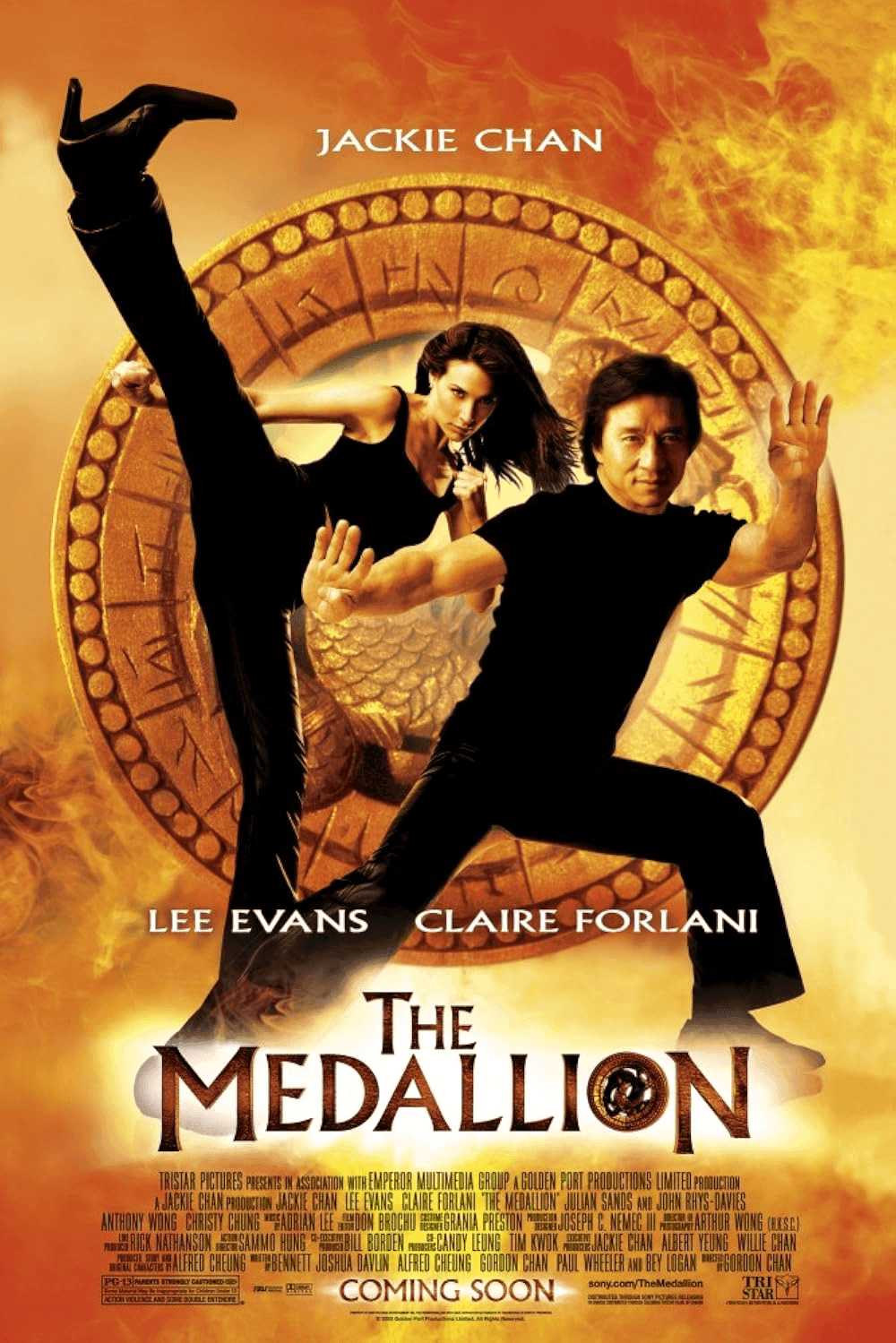
Hong Kong detective Eddie Yang teams with Interpol agent Arthur Watson to recover a mystical Chinese medallion that has been stolen by an evil arms dealer named Snakehead, only to discover that the medallion grants its owner supernatural strength and the ability to come back from the dead. Gordon Chan's 2003 martial-arts-fantasy stars Jackie Chan, Lee Evans, Claire Forlani, and Julian Sands.
What Is the Budget of The Medallion (2003)?
The Medallion (2003), directed by Gordon Chan from a screenplay by Bey Logan, Alfred Cheung, Paul Wheeler, and Bennett Joshua Davlin, was produced on a reported budget of $41,000,000. Screen Gems (a Sony Pictures Entertainment subsidiary) and TriStar Pictures co-financed and distributed the picture, with Hong Kong-based Golden Port Productions and Emperor Multimedia Group serving as primary production companies. The picture was developed as a U.S.-Hong Kong co-production targeting both the Jackie Chan international fan base and Western action-comedy audiences.
The $41,000,000 investment supported Jackie Chan in a leading role, a Bangkok-and-Hong Kong-based shoot, supernatural-fantasy visual effects work integrated with Chan's signature physical comedy and stunt choreography, and an international ensemble cast led by British comedian Lee Evans. The worldwide gross of approximately $34,400,000 did not cover the production spend before P&A, making The Medallion one of the clearest underperformers in Jackie Chan's early-2000s U.S.-co-production cycle alongside The Tuxedo (2002) and Around the World in 80 Days (2004).
Key Budget Allocation Categories
The Medallion's $41,000,000 budget was distributed across several major production areas:
- Jackie Chan Lead Jackie Chan, by 2002 commanding standard A-list rates for U.S. studio co-productions following the Rush Hour franchise and Shanghai Noon (2000), led the cast at his pre-Rush Hour 3 star fee. Chan additionally served as a producer, taking a significant additional combined producer-and-lead allocation.
- Supporting Cast British comedian Lee Evans played the Interpol agent Arthur Watson in his most prominent U.S.-distributed leading role following There's Something About Mary (1998). Claire Forlani played the female lead Nicole James, with Julian Sands as the antagonist Snakehead, Anthony Wong, Christy Chung, and various Hong Kong character actors filling out the supporting ensemble.
- Bangkok and Hong Kong Production Principal photography took place across Bangkok, Thailand and Hong Kong. Bangkok provided the bulk of the production base, with the Thai film service infrastructure (developed across multiple international productions) offering competitive below-the-line rates. Hong Kong location work supported the picture's authentic urban-action sequences.
- Stunts and Action Choreography Jackie Chan's signature physical comedy and stunt choreography required substantial action-unit production. Chan's longtime Stunt Team handled the choreography, with the budget supporting the elaborate practical stunts that defined Chan's 2000s U.S. co-productions.
- Visual Effects The supernatural-fantasy elements of the picture (medallion-empowered super-strength, resurrection sequences, mystical glow effects) required substantial visual effects work. VFX vendors handled the supernatural compositing alongside Chan's practical stunt photography, with the visual-effects integration representing a meaningful budget line item.
- Director and Producing Team Gordon Chan, the veteran Hong Kong director (Beast Cops, Fist of Legend), directed at a returning-director rate. Producers included Alfred Cheung, Jackie Chan, and various U.S. and Hong Kong producers reflecting the picture's co-production structure.
- Score Composer Adrian Lee delivered an orchestral score that blended Western action-comedy cues with Chinese instrumental elements. The music budget supported recording at international facilities.
How Does The Medallion's Budget Compare to Similar Films?
At $41,000,000, The Medallion sits in the mid-budget range for studio international-action-comedies. The comparison set illustrates how its commercial outcome compared with peer productions:
- The Tuxedo (2002): Budget $60,000,000 | Worldwide $104,400,000. Kevin Donovan's previous Jackie Chan-and-Jennifer Love Hewitt action-comedy cost roughly 50% more and earned roughly three times the worldwide gross of The Medallion, providing the closest Jackie Chan U.S.-co-production peer.
- Shanghai Noon (2000): Budget $55,000,000 | Worldwide $99,300,000. Tom Dey's Jackie Chan-and-Owen Wilson Western-action-comedy cost roughly 35% more and earned roughly three times the worldwide gross, providing the studio template for Chan's U.S.-co-production cycle.
- Shanghai Knights (2003): Budget $50,000,000 | Worldwide $88,300,000. David Dobkin's Shanghai Noon sequel released earlier in 2003 cost roughly 20% more and earned roughly 2.5 times the worldwide gross, demonstrating the gap between Chan's star vehicles paired with Western co-leads (Wilson) versus paired with international comedians (Evans).
- Rush Hour 2 (2001): Budget $90,000,000 | Worldwide $347,300,000. Brett Ratner's Jackie Chan-and-Chris Tucker buddy-cop sequel cost more than twice The Medallion and earned more than 10 times the worldwide gross, illustrating the franchise-vs-original divide in Chan's early-2000s U.S. work.
- Around the World in 80 Days (2004): Budget $110,000,000 | Worldwide $72,200,000. Frank Coraci's subsequent Jackie Chan-and-Steve Coogan Disney action-adventure cost more than twice The Medallion and earned roughly twice the worldwide gross, but Disney's budget put the picture into clear loss territory.
The Medallion Box Office Performance
The Medallion opened in North America on August 22, 2003 with $9,038,000 across the three-day weekend, finishing fifth behind Freddy vs. Jason, Open Range, S.W.A.T., and American Wedding. The opening was substantially below studio projections and reflected limited audience interest in the picture's specific supernatural-action-comedy register, with the Jackie Chan-and-Lee Evans pairing failing to resonate with U.S. audiences in the way the Chan-and-Wilson pairing had with Shanghai Noon.
Against a $41,000,000 production budget, the film needed approximately $95,000,000 worldwide to clear marketing and distribution. Here is the financial breakdown:
Box Office Breakdown
The Medallion

The Medallion returned roughly $0.40 in theatrical revenue for every $1 invested when measured against estimated production and marketing spend, putting it in the failed-release category by theatrical metrics. The domestic gross of $22,400,000 substantially outpaced the international take of $12,000,000, an unusually domestic-heavy split that reflected the picture's mixed U.S. theatrical reception and TriStar's relatively limited international theatrical investment beyond the major Asian markets.
Home video performance was modest. Sony issued the DVD and Blu-ray in March 2004, and the picture has since circulated as a Jackie Chan catalog title on various streaming platforms. The picture is primarily remembered as a representative entry in Chan's mid-2000s U.S.-co-production cycle, alongside The Tuxedo (2002), Around the World in 80 Days (2004), and the Rush Hour franchise. Chan's subsequent return to majority Hong Kong-financed productions (including Shinjuku Incident in 2009 and the CZ12 production company) was partly driven by the commercial difficulties of the early-2000s U.S. co-production model.
The Medallion Production History
The Medallion was developed by Alfred Cheung and Jackie Chan as a U.S.-Hong Kong co-production from a Bey Logan screenplay concept that fused Jackie Chan's signature action-comedy register with supernatural-fantasy elements. The supernatural-medallion premise was intended to differentiate the picture from Chan's more conventional U.S. work and to position the picture for the growing supernatural-action market following The Matrix (1999), Charmed (1998 onward), and the broader early-2000s supernatural-action cycle.
Gordon Chan attached to direct in 2001 on the strength of his previous Hong Kong work including Beast Cops (1998) and Fist of Legend (1994). Lee Evans attached as Chan's Western co-lead, with the casting positioning the picture for the British and Commonwealth markets in addition to the U.S. release. Claire Forlani and Julian Sands rounded out the international supporting cast.
Principal photography took place across Bangkok, Thailand and Hong Kong in 2002. Bangkok provided the bulk of the production base, with the Thai film service infrastructure offering competitive below-the-line rates. The Hong Kong location work supported the picture's authentic urban-action sequences. Jackie Chan's longtime Stunt Team handled the elaborate practical stunt choreography that defined the picture's action sequences.
Post-production stretched through 2002 and into 2003 as the visual-effects integration of the supernatural elements required substantial compositing work alongside Chan's practical stunt photography. Screen Gems and TriStar positioned the picture for the August 2003 corridor, a release window targeting late-summer family-action audiences. The marketing campaign emphasized Chan's physical comedy and the supernatural-medallion premise.
Awards and Recognition
The Medallion received no major awards recognition. The picture was not nominated at the Academy Awards, Golden Globes, BAFTAs, or any major guild ceremony. The picture received various genre-specific and action-comedy-specific nominations through ceremonies focused on martial-arts and Asian-cinema work, including limited Hong Kong Film Awards consideration through its co-production status.
The picture's most durable contribution to its talent's awards profile may be its positioning within Jackie Chan's early-2000s U.S.-co-production cycle, with The Medallion functioning as one of several intermediate entries between the Rush Hour franchise's major commercial successes and Chan's subsequent return to majority Hong Kong-financed productions including Shinjuku Incident (2009) and various CZ12-produced works.
Critical Reception
The Medallion received generally negative reviews. The film holds a 16% approval rating on Rotten Tomatoes based on 117 critic reviews, with a critical consensus that called the picture a thin and confused Jackie Chan vehicle whose mystical-medallion premise undermines the star's signature physical comedy with intrusive visual effects. On Metacritic, the film scored 39 out of 100, indicating generally unfavorable reviews. Audiences surveyed by CinemaScore gave the film a B-, modestly warmer than critics but below studio hopes.
Roger Ebert gave the film one-and-a-half stars out of four, writing that the supernatural elements "distract from the things Chan does best." Variety's Robert Koehler called the picture "a tired retread of the Jackie Chan template." The New York Times' Stephen Holden was more critical, calling the picture "a Frankenstein's monster of competing genre conventions." The Hollywood Reporter's Kirk Honeycutt praised Chan's commitment while criticizing the screenplay's narrative coasting.
The picture's reputation has stabilized as a representative low-point in Jackie Chan's early-2000s U.S.-co-production cycle. Online retrospective conversations frequently position The Medallion alongside The Tuxedo (2002) and Around the World in 80 Days (2004) as examples of the cycle's structural problems (Chan's signature physical comedy paired with supernatural or technological gimmicks that diluted the star's appeal). The picture has not received meaningful retrospective reassessment beyond its initial run.
Frequently Asked Questions
How much did The Medallion (2003) cost to make?
The reported production budget was $41,000,000. Screen Gems and TriStar Pictures co-financed and distributed the picture, with Hong Kong-based Golden Port Productions and Emperor Multimedia Group serving as primary production companies. The picture was a U.S.-Hong Kong co-production.
How much did The Medallion earn at the box office?
The film grossed $22,400,000 domestically and $12,000,000 internationally, for a worldwide total of $34,365,253. It opened to $9,038,000 in North America on the August 22, 2003 weekend, finishing fifth behind Freddy vs. Jason, Open Range, S.W.A.T., and American Wedding.
Was The Medallion a box office bomb?
Yes. Against a $41,000,000 budget and roughly $30,000,000 to $40,000,000 in marketing, the worldwide gross of approximately $34,400,000 resulted in a theatrical loss of approximately $40,000,000 to $50,000,000 before home video. The picture was one of the clearest underperformers in Jackie Chan's early-2000s U.S.-co-production cycle.
Who directed The Medallion?
Gordon Chan directed the film. Chan is a veteran Hong Kong director whose previous work includes Beast Cops (1998) and Fist of Legend (1994). The Medallion was his most prominent U.S.-distributed feature.
Where was The Medallion filmed?
Principal photography took place across Bangkok, Thailand and Hong Kong in 2002. Bangkok provided the bulk of the production base, with the Thai film service infrastructure offering competitive below-the-line rates. Hong Kong location work supported the picture's authentic urban-action sequences.
Who stars in The Medallion?
Jackie Chan stars as Hong Kong detective Eddie Yang. British comedian Lee Evans plays the Interpol agent Arthur Watson, Claire Forlani plays Nicole James, and Julian Sands plays the antagonist Snakehead. The supporting cast includes Anthony Wong, Christy Chung, and various Hong Kong character actors.
What is The Medallion about?
Hong Kong detective Eddie Yang teams with Interpol agent Arthur Watson to recover a mystical Chinese medallion that has been stolen by an evil arms dealer named Snakehead. The medallion grants its owner supernatural strength and the ability to come back from the dead, and Eddie's investigation accelerates into a supernatural-action confrontation.
Is The Medallion a Jackie Chan movie?
Yes. Jackie Chan stars in the leading role and also served as a producer through his various production-company arrangements. The picture is structured as a Jackie Chan action-comedy vehicle with supernatural-fantasy elements layered onto Chan's signature physical comedy and stunt choreography.
What did critics think of The Medallion?
The film received generally negative reviews. It holds a 16% approval rating on Rotten Tomatoes from 117 critics and a 39 out of 100 score on Metacritic. Audiences gave it a B- CinemaScore. Reviews criticized the picture's supernatural elements as distractions from Chan's signature physical comedy.
Where can I watch The Medallion today?
The picture circulates as a Jackie Chan catalog title on various streaming platforms and home-video formats. Sony issued the DVD and Blu-ray in March 2004 and the picture has remained continuously available through digital rental and SVOD services since.
Filmmakers
The Medallion

Build budgets like this one in Saturation
Start from an industry-standard feature film template, import the schedule and rates you already have, and let the cost report keep itself current as you spend. Real-time collaboration, no spreadsheets.