
The Marvels Budget
 Science FictionAdventureAction1h 45m
Updated
Synopsis
Decades after Carol Danvers destroyed the Supreme Intelligence and left the Kree homeworld of Hala in civil war, the new Kree leader Dar-Benn uses one of the two legendary Quantum Bands to tear open jump points across space. The disruption entangles the light-based powers of Carol, S.A.B.E.R. astronaut Monica Rambeau and Jersey City teenager Kamala Khan, who holds the other Band, so the three switch places whenever they use their powers at the same time. As Dar-Benn drains the air, water and sunlight of other worlds to restore Hala, the heroes must learn to fight as a team to stop her.
What Is the Budget of The Marvels?
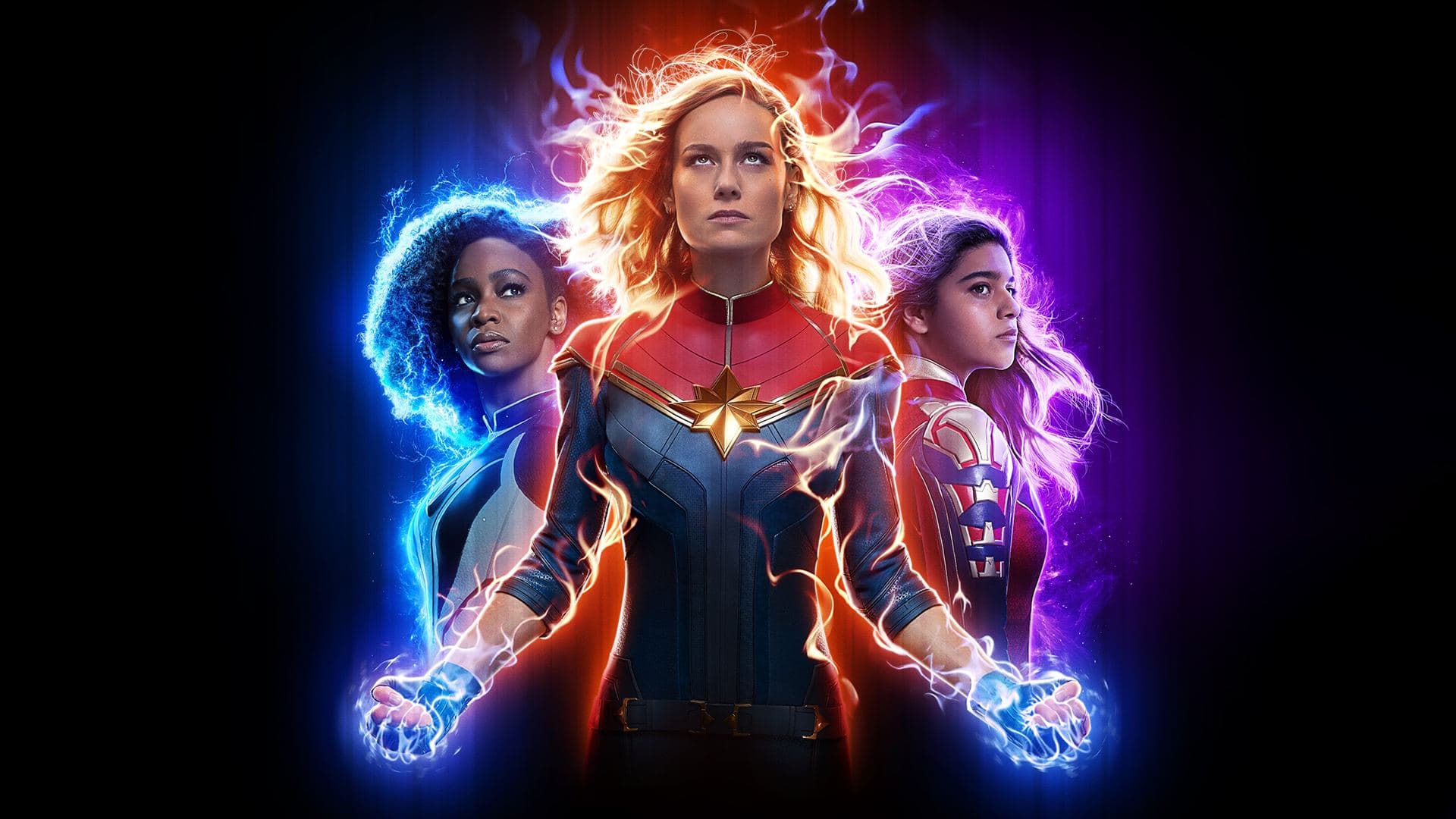
The Marvels (2023), directed by Nia DaCosta and released by Walt Disney Studios Motion Pictures, had a gross production budget of $374,000,000, which fell to a net cost of $307,300,000 after a reimbursement from the UK government. The 33rd film in the Marvel Cinematic Universe is a sequel to Captain Marvel (2019) that teams Carol Danvers (Brie Larson) with Monica Rambeau (Teyonah Parris) from WandaVision and Kamala Khan (Iman Vellani) from Ms. Marvel.
Disney does not publish the cost of individual films, so the figures come from the accounts of the UK production company Marvel used to make the movie, as reported by Forbes. Those filings show $374,000,000 (£307,800,000) spent by September 30, 2023, followed by a $66,700,000 (£54,900,000) reimbursement under the UK film tax relief, which brings Disney's net spend to $307,300,000. This page uses the gross figure as the production budget because it is the full cost of making the film; the net figure is what Disney ultimately paid once the incentive was paid out.
The $274,800,000 figure that circulated in 2023 came from an earlier filing that covered spending only up to September 30, 2022, before reshoots and post-production were finished. Forbes reported at the time that a $55,000,000 subsidy brought that interim figure to $219,800,000 net. The $270,000,000 production cost used by Deadline and The Numbers also predates the final filing.
Key Budget Allocation Categories
Disney has not released a line-item breakdown, so the categories below follow where the film's documented production choices concentrated its $374,000,000 spend:
- Visual Effects: Seven vendors delivered the effects: Industrial Light & Magic, Rise FX, Rising Sun Pictures, Sony Pictures Imageworks, Trixter, Wētā FX and Wylie Co., under visual effects supervisor Tara DeMarco. The central conceit, in which the three heroes swap places whenever they use their light-based powers at the same time, meant fight sequences had to be planned and composited across several locations at once.
- Stage Builds in England: Production designer Cara Brower's team built 54 sets at Pinewood Studios and Longcross Studios, covering five planets including the singing water world of Aladna, spaceships, the S.A.B.E.R. space station, Maria Rambeau's house and the Khan family home. That UK spending is also what qualified the production for its $66,700,000 reimbursement.
- Reshoots and Extended Post-Production: Reshoots were planned in London for August 2022. In April 2023, The Ringer's Joanna Robinson reported a "massive overhaul" of the film, and Variety later reported four weeks of additional shooting. The release moved four times, from July 2022 to November 2023, and the reported spend rose by $99,200,000 between the September 2022 and September 2023 filings.
- Cast and Above-the-Line Talent: Brie Larson returned as Carol Danvers, Teyonah Parris and Iman Vellani reprised their Disney+ roles, and Samuel L. Jackson returned as Nick Fury. Zawe Ashton played the Kree leader Dar-Benn and Park Seo-joon played Prince Yan of Aladna. Kevin Feige produced, and DaCosta wrote the screenplay with Megan McDonnell and Elissa Karasik.
- Location Shooting: A second unit began filming in Jersey City, New Jersey, in April 2021 to capture aerial footage, establishing shots and green screen plates. The production also filmed on the coast at Tropea, Italy, and in Los Angeles, and visual effects plates were shot in Battery Park in New York City.
How Does The Marvels' Budget Compare to Similar Films?
At $374,000,000, The Marvels cost more than twice as much as the film it followed and grossed less than a fifth as much. Set against other recent superhero releases, it is the clearest outlier in the group:
- Captain Marvel (2019): Budget $152,000,000 | Worldwide $1,131,416,446. The predecessor grossed about five and a half times as much on less than half the budget, so the franchise's worldwide gross fell by roughly 82% from one film to the next.
- Ant-Man and the Wasp: Quantumania (2023): Budget $200,000,000 | Worldwide $476,071,180. Released nine months earlier, Quantumania held the MCU record for the steepest second-weekend drop until The Marvels fell 78% in its own second weekend.
- Eternals (2021): Budget $200,000,000 | Worldwide $402,064,899. Eternals shared The Marvels' B CinemaScore, the lowest grade an MCU film had received at the time, yet still grossed nearly twice as much.
- Black Widow (2021): Budget $200,000,000 | Worldwide $379,751,131. Released in theaters and on Disney+ Premier Access on the same day, the female-led entry still grossed 84% more than The Marvels on a budget a little over half as large.
- The Flash (2023): Budget $200,000,000 | Worldwide $266,550,332. Warner Bros.' DC release ranked second on Deadline's list of 2023's biggest money losers with an estimated $155,000,000 loss, behind The Marvels at $237,000,000.
The Marvels Box Office Performance
The Marvels opened in the United States on November 10, 2023, and took in $46,110,859 from 4,030 theaters in its first weekend. That topped the box office and set a record opening for a film directed by a Black woman, but it was the lowest opening for any MCU film, taking that mark from The Incredible Hulk (2008). A 78% drop in the second weekend was the steepest in MCU history, and by early December Disney stopped reporting the film's weekend grosses.
Box Office Breakdown
The Marvels

The film earned $84,500,223 in the United States and Canada and $121,636,602 internationally, making it the lowest-grossing film in the MCU, though it passed A Wrinkle in Time (2018) to become the highest-grossing film directed by a Black woman. The P&A figure above is Deadline's marketing estimate. Deadline's full accounting, published in May 2024, counted about $218,000,000 in revenue from theaters, home entertainment and streaming against $455,000,000 in costs and put Disney's net loss at $237,000,000, the largest of any 2023 release. That estimate assumed a $270,000,000 production cost, below both the gross and net figures in the final filing.
The film reached digital storefronts on January 16, 2024, and Disney+ on February 7, 2024. Nielsen counted 559 million minutes of viewing for the week of February 5 to 11, the most of any film that week.
At -57%, "The Marvels" returned roughly $0.43 for every $1 invested.
The Marvels Production History
Kevin Feige confirmed plans for a Captain Marvel sequel at San Diego Comic-Con in July 2019, and development formally began in January 2020 when WandaVision staff writer Megan McDonnell entered negotiations to write the script. Disney dated the film for July 8, 2022, that April. Nia DaCosta, director of Candyman (2021), was hired in August 2020, the first Black woman Marvel Studios hired to direct one of its films; Deadline noted that it would likely be the biggest budget ever given to a film directed by a Black woman. Her original pitch included Adam Warlock and time travel, which Marvel had already assigned to Guardians of the Galaxy Vol. 3 (2023) and the Loki series.
Feige announced the sequel in December 2020 with Teyonah Parris and Iman Vellani joining Larson, and the title The Marvels was revealed in May 2021. Second-unit filming began on April 9, 2021, in Jersey City under the working title Goat Rodeo. Principal photography started on July 26, 2021, at Pinewood Studios in Buckinghamshire and Longcross Studios in Surrey, with Sean Bobbitt as cinematographer, and moved to Tropea in late August before further shooting in Los Angeles. Filming wrapped in May 2022.
The release date moved four times: from July 8, 2022, to November 11, 2022, then to February 17, 2023, then to July 28, 2023, when it swapped dates with Quantumania because that film was further along. Samuel L. Jackson said in June 2022 that he would return to London in August for reshoots. In February 2023, Disney moved the film to November 10, 2023, while it re-evaluated Marvel's output and costs, which gave the film more time in post-production. In April 2023, The Ringer's Joanna Robinson reported that the film was undergoing a "massive overhaul" with reshoots, which Variety later put at four weeks, and that June Marvel held an unusual public test screening in Texas.
Zeb Wells also worked on the script, though only DaCosta, McDonnell and Karasik were credited. Editors Catrin Hedström and Evan Schiff brought the film in at 105 minutes, the shortest running time of any MCU film to date. Laura Karpman, who had scored What If...? and Ms. Marvel, wrote a team theme, "Higher. Further. Faster. Together.", which premiered at the Last Night of the BBC Proms in September 2023. The SAG-AFTRA strike kept the cast from promoting the film until November 9, so the November 7 premiere in Las Vegas went ahead without them.
After release, Disney CEO Bob Iger pointed to the volume of Marvel content on Disney+ and said there had been less executive supervision on set because the film was shot during the COVID-19 pandemic, a remark several commentators criticized as unfairly blaming DaCosta. In July 2025, Feige said audiences had believed they needed to watch the Disney+ series to follow the film, and that Marvel should have made clear that they did not.
Awards and Recognition
The Marvels received no major film industry nominations, but it won two genre and craft honors. Iman Vellani won Best Actress in a Superhero Movie at the Critics' Choice Super Awards in April 2024, and Laura Karpman won Best Original Score for a Sci-Fi/Fantasy Film at the Hollywood Music in Media Awards in November 2023.
Vellani also drew most of the film's attention from critics' groups, with nominations from the Washington D.C. Area Film Critics Association for Best Youth Performance, the Las Vegas Film Critics Society for Best Youth in Film (Female), and the Indiana Film Journalists Association for Breakout of the Year. With audiences, the film was nominated for Action Movie of the Year at the People's Choice Awards and Favorite Movie at the Nickelodeon Kids' Choice Awards, and Brie Larson was nominated at both, for Action Movie Star of the Year and Favorite Movie Actress.
Critical Reception
Critics were split. The Marvels holds a 63% approval rating on Rotten Tomatoes from 377 reviews, with an average score of 5.9/10; the consensus calls it "funny, refreshingly brief, and elevated by the chemistry of its three leads" despite its "cluttered story and jumbled tonal shifts." Metacritic gives it 50 out of 100 from 57 critics, indicating mixed or average reviews. Opening-weekend audiences gave it a B on CinemaScore, tying Eternals and Quantumania for the lowest grade of any MCU film at the time, and a 73% positive score on PostTrak.
The lead trio drew the strongest notices. Peter Bradshaw of The Guardian called them "an entertaining intergalactic ensemble," Peter Travers of ABC News wrote that if there is such a thing as chemistry, Larson, Parris and Vellani have it, and IGN's Amelia Emberwing said Vellani "predictably steals the show." Lovia Gyarkye of The Hollywood Reporter praised DaCosta's "kinetic" direction, and Abby Olcese of Paste rated the film 8.5/10.
Detractors focused on the script and tone. Christy Lemire of RogerEbert.com gave it 1.5 stars and called it "the worst film yet in the Marvel Cinematic Universe," though she found its musical moments a delight, and NME's James Mottram gave it three stars, writing that it "never musters the same level of engagement" as DaCosta's Candyman. Novelist John Scalzi, writing for Uncanny Magazine, criticized the "homework" of Disney+ series and earlier films the story assumed, while Deadline's Anthony D'Alessandro rejected the superhero-fatigue explanation and blamed lackluster marketing and the overexposure of MCU content on Disney+.
Frequently Asked Questions
How much did it cost to make The Marvels?
Forbes, reviewing the accounts of the UK production company behind the film, reported that Disney had spent $374,000,000 on The Marvels by September 30, 2023. A $66,700,000 reimbursement from the UK government brought the net cost to $307,300,000. An earlier filing covering spending only through September 2022 showed $274,800,000, before reshoots and post-production were finished.
What is the difference between The Marvels' gross and net budget?
The gross budget of $374,000,000 is everything spent making the film. The net budget of $307,300,000 is what Disney paid after the UK government reimbursed $66,700,000 under its film tax relief, which the production qualified for by shooting at Pinewood and Longcross Studios in England. This page lists the gross figure as the production budget.
How much did The Marvels earn at the box office?
The Marvels grossed $84,500,223 in the United States and Canada and $121,636,602 internationally, for a worldwide total of $206,136,825. It opened to $46,110,859, the lowest opening weekend in MCU history, and dropped 78% in its second weekend.
Is The Marvels the biggest MCU box office bomb?
Yes. At $206,136,825 worldwide it is the lowest-grossing film in the MCU, and Deadline ranked it the biggest money loser of 2023 with an estimated net loss of $237,000,000. Deadline calculated that loss using a $270,000,000 production cost, below the $374,000,000 gross and $307,300,000 net figures in the final UK filing.
Who directed The Marvels?
Nia DaCosta directed The Marvels, and she was the first Black woman Marvel Studios hired to direct one of its films. She previously directed Little Woods (2018) and Candyman (2021), and she wrote the screenplay with Megan McDonnell and Elissa Karasik.
Why did The Marvels fail at the box office?
Commentators pointed to several causes. John Scalzi and others criticized the "homework" of Disney+ series the story assumed, and Kevin Feige said in July 2025 that audiences believed they needed to watch those series first. Deadline's Anthony D'Alessandro blamed lackluster marketing and the overexposure of MCU content on Disney+. The SAG-AFTRA strike also kept the cast from promoting the film until November 9, 2023, the day before its release.
How does The Marvels compare to Captain Marvel at the box office?
Captain Marvel (2019) earned $1,131,416,446 worldwide on a $152,000,000 budget, while The Marvels earned $206,136,825 on a $374,000,000 gross budget. The sequel cost about two and a half times as much and grossed about 82% less.
Where was The Marvels filmed?
Principal photography began on July 26, 2021, at Pinewood Studios in Buckinghamshire and Longcross Studios in Surrey, England, where the production built 54 sets. A second unit filmed in Jersey City, New Jersey, from April 2021, and the production also shot in Tropea, Italy, and Los Angeles. Filming wrapped in May 2022, with reshoots afterward.
How long is The Marvels?
The Marvels runs 105 minutes (1 hour and 45 minutes), the shortest running time of any MCU film to date. The Rotten Tomatoes critics consensus describes it as "refreshingly brief."
What did Disney and Marvel say about The Marvels' performance?
Disney CEO Bob Iger pointed to the volume of Marvel content on Disney+ and said there was less executive supervision on set because the film was shot during the COVID-19 pandemic, a remark several commentators said unfairly blamed director Nia DaCosta. In July 2025, Kevin Feige said Marvel should have made clear that audiences did not need to watch the Disney+ series to follow the film.
Filmmakers
The Marvels

Official Trailer
Build budgets like this one in Saturation
Start from an industry-standard feature film template, import the schedule and rates you already have, and let the cost report keep itself current as you spend. Real-time collaboration, no spreadsheets.