The Last Emperor Budget
 Drama
DramaUpdated
Synopsis
From his coronation at age three as the last emperor of China through his time in the Forbidden City, his exile, his collaboration with Japan as puppet emperor of Manchukuo, and his Communist re-education and rehabilitation as a gardener in Beijing, the film traces the life of Aisin-Gioro Pu Yi across the seismic upheavals of 20th-century China.
What Is the Budget of The Last Emperor (1987)?
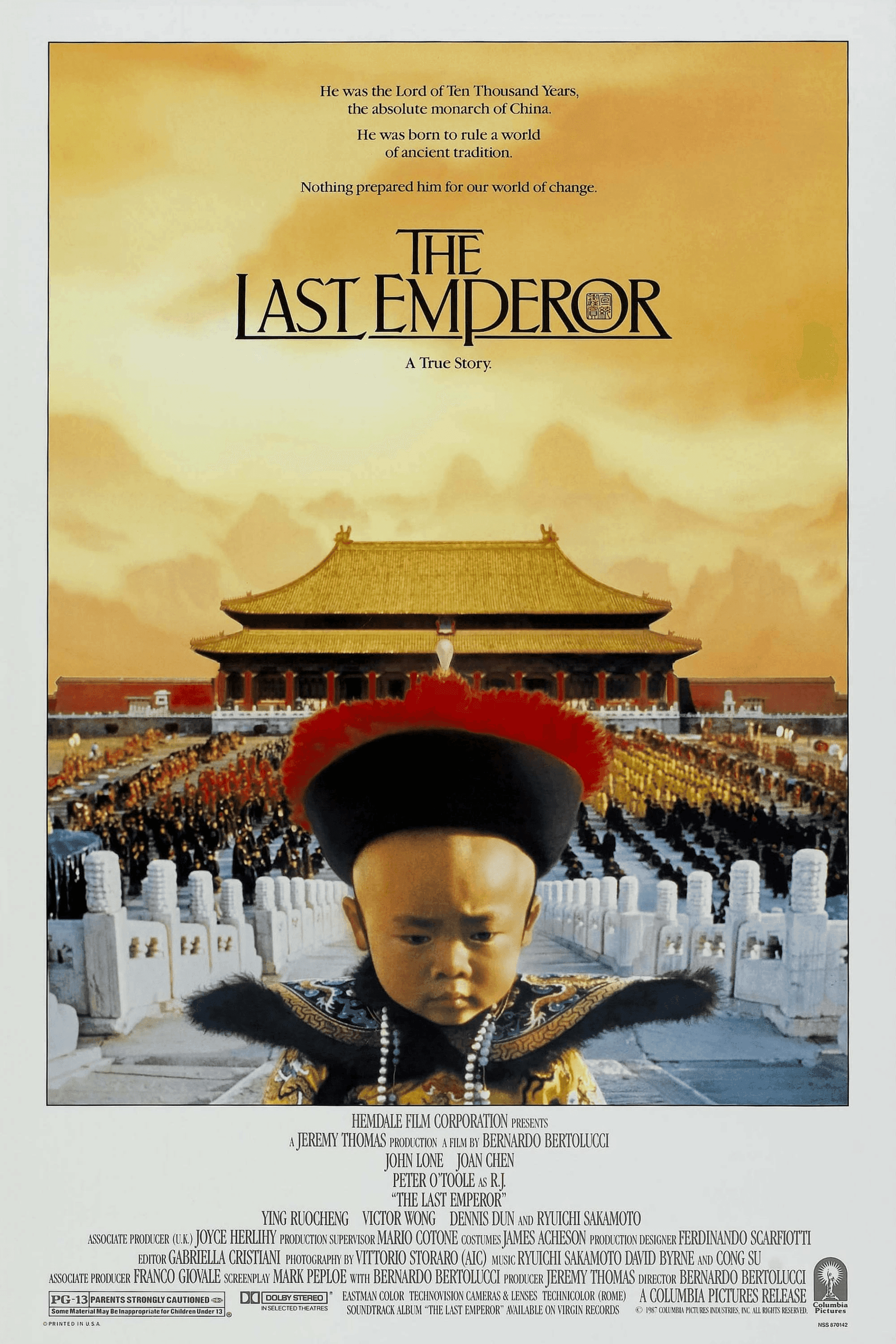
The Last Emperor (1987), directed by Bernardo Bertolucci and distributed by Columbia Pictures, was produced on a reported budget of $23,800,000. The biographical epic about Aisin-Gioro Pu Yi, the last emperor of China, was financed by an international consortium led by Hemdale Film, Yanco Films, Recorded Picture Company (Jeremy Thomas's production company), TAO Films, and Screenframe, with Columbia handling North American distribution and Italian and other European territory rights split regionally. The $23,800,000 commitment was substantial for an international art-house production but moderate by the standards of historical epics, reflecting the unprecedented Chinese government cooperation that allowed shooting inside the Forbidden City and a tight on-set production schedule that disciplined costs.
The financial structure was historically significant as the first Western feature granted permission to shoot inside the actual Forbidden City in Beijing. Producer Jeremy Thomas, who had built the Recorded Picture Company on previous Bertolucci collaborations, negotiated the access through extended diplomatic talks with the Chinese government from 1984 through 1986. The bulk of the budget went to the international ensemble cast including John Lone, Joan Chen, Peter O'Toole, Ying Ruocheng, and Victor Wong, the extensive on-location Chinese shooting across Beijing, Manchuria, and the Forbidden City, period costume work by James Acheson, and the Ryuichi Sakamoto, David Byrne, and Cong Su collaborative score.
Key Budget Allocation Categories
The $23,800,000 budget for The Last Emperor was distributed across several core production areas:
- Above-the-Line Talent: John Lone took the adult lead role of Pu Yi at a non-superstar international rate, with Joan Chen as Empress Wanrong, Peter O'Toole as the Scottish tutor Reginald Johnston, Ying Ruocheng as the prison governor, and Victor Wong, Dennis Dun, and Maggie Han in supporting roles. Bernardo Bertolucci, an Italian auteur with established international stature, commanded a director rate appropriate to his post-1900 prestige positioning.
- Forbidden City Location Shooting: The single most distinctive line item. The Chinese government granted unprecedented access to shoot inside the actual Forbidden City in Beijing, the first Western feature to receive such permission. The production paid substantial location and protocol fees, used Chinese coordinated crew and security, and operated within strict daily-access windows. Additional Chinese government cooperation extended to access to authentic 1930s Manchurian settings and Beijing prison-courtyard locations.
- International Production Footprint: Beyond the Forbidden City, principal photography moved across additional Chinese sites including the Imperial Palace in Changchun (the historical Manchukuo puppet-emperor palace) and Beijing prison settings, plus Italian post-production. The cross-border production added travel, freight, lodging, and translation costs.
- Costume and Production Design: Costume designer James Acheson dressed the ensemble across multiple historical periods from the 1908 imperial coronation through 1967 post-Cultural Revolution Beijing, requiring more than 9,000 individual costume pieces in the final inventory. Production designer Ferdinando Scarfiotti dressed the non-Forbidden-City settings to align with the imperial-grade authentic locations.
- Ryuichi Sakamoto, David Byrne, and Cong Su Score: The film's score was a collaboration between Japanese composer Ryuichi Sakamoto, Talking Heads frontman David Byrne, and Chinese composer Cong Su. Each contributed independent musical themes and sequences, with Sakamoto handling the imperial-grade orchestral material, Byrne the Manchukuo-era jazz textures, and Su the traditional Chinese instrumentation. The collaborative score required extended composition and recording sessions across three creative principals.
- Marketing and Theatrical Release: Columbia opened the film in limited release on November 18, 1987 in major U.S. markets and expanded gradually through the early-1988 Academy Awards campaign window. Marketing spend was modest by studio standards, in the $10,000,000 to $15,000,000 range domestically, with the Academy Awards sweep providing substantially more visibility than the marketing spend would otherwise have generated.
How Does The Last Emperor's Budget Compare to Similar Films?
At $23,800,000, The Last Emperor sits in the typical mid-range for late-1980s historical epics and international art-house productions. The comparison set illustrates how its commercial outcome compared with peers:
- Gandhi (1982): Budget $22,000,000 | Worldwide $77,818,000. Richard Attenborough's previous Indian historical epic cost essentially the same as The Last Emperor and grossed roughly twice worldwide, illustrating the upper ceiling of the international-historical-epic category in the same decade.
- The Mission (1986): Budget $24,800,000 | Worldwide $17,218,023. Roland Joffé's prior South American Jesuit-history epic cost essentially the same as The Last Emperor and grossed less than half worldwide, providing a direct apples-to-apples comparison that illustrates how unusually well The Last Emperor performed commercially.
- A Passage to India (1984): Budget $16,000,000 | Worldwide $27,187,653. David Lean's prior Indian-historical art-house epic cost less than The Last Emperor and grossed roughly two-thirds worldwide, showing the typical ceiling for the same category.
- Out of Africa (1985): Budget $31,000,000 | Worldwide $227,500,000. Sydney Pollack's Robert Redford and Meryl Streep African-historical romance cost slightly more than The Last Emperor and grossed roughly five times worldwide, showing what a star-led variant could deliver.
- Empire of the Sun (1987): Budget $35,000,000 | Worldwide $66,690,062. Steven Spielberg's contemporaneous Chinese-historical drama cost roughly 50% more than The Last Emperor and grossed roughly 50% more worldwide, providing a direct contemporary Chinese-historical comparison that illustrates how competitive Bertolucci's budget discipline was.
The Last Emperor Box Office Performance
The Last Emperor opened in limited release on November 18, 1987 in major U.S. markets, expanding gradually through the early-1988 Academy Awards campaign window. The film built strong word-of-mouth in art-house theaters through the late 1987 and early 1988 award-season window, with substantial week-over-week expansion across the country following the Academy Award nominations announcement in February 1988.
Against a $23,800,000 production budget, the film needed approximately $50,000,000 worldwide to reach profitability after marketing. Here is the financial breakdown:
Box Office Breakdown
The Last Emperor

The Last Emperor returned approximately $1.16 in domestic theatrical revenue for every $1 invested when measured against domestic-only investment, with substantial additional international theatrical revenue not consolidated in the publicly available Box Office Mojo data but widely reported in trade press at the time as exceeding the domestic total by a meaningful margin, particularly in Italian, French, Japanese, and Chinese territories.
The film's commercial success was substantially amplified by the unprecedented Academy Awards sweep at the 60th Academy Awards in April 1988, where The Last Emperor won all nine of the categories in which it had been nominated, including Best Picture, Best Director, and Best Adapted Screenplay. The post-Oscar theatrical re-expansion, combined with home video and pay-television licensing through the late 1980s and 1990s, ultimately delivered substantial multiples on the original investment.
The Last Emperor Production History
Development began in 1984 when producer Jeremy Thomas, who had built the Recorded Picture Company on previous Bertolucci collaborations including the Italian works of the 1970s, approached the Chinese government with a proposal to film Pu Yi's autobiography From Emperor to Citizen. Thomas anchored a multi-year diplomatic negotiation through 1984, 1985, and 1986 with the Chinese Ministry of Culture and the Forbidden City administration, ultimately securing unprecedented permission to shoot inside the actual Forbidden City, the first Western feature granted such access.
Bernardo Bertolucci and longtime collaborator Mark Peploe adapted the screenplay from Pu Yi's autobiography, with extensive research support from Chinese historical consultants. The script structured the narrative as a non-chronological dialogue between the post-Cultural Revolution prison-gardener Pu Yi and his interrogators, with flashbacks moving back through his life from the 1908 imperial coronation through his collaboration with Japan as Manchukuo puppet emperor and his post-1949 Communist re-education. Casting John Lone as the adult Pu Yi, Joan Chen as Empress Wanrong, and Peter O'Toole as the Scottish tutor Reginald Johnston anchored the international cast in early 1986.
Principal photography ran from August 1986 to January 1987 across multiple Chinese locations, with the Forbidden City sequences shot inside the actual palace complex in Beijing under strict daily-access windows. Additional photography took place at the Imperial Palace in Changchun (the historical Manchukuo puppet-emperor palace) and Beijing prison settings. The production used Chinese coordinated crew alongside the Italian and British creative team, with translation and protocol coordination handled by a substantial liaison apparatus. Costume designer James Acheson assembled more than 9,000 individual costume pieces.
Ryuichi Sakamoto, David Byrne, and Cong Su collaborated on the score in early 1987, with Sakamoto handling the imperial-grade orchestral material, Byrne the Manchukuo-era jazz textures, and Su the traditional Chinese instrumentation. The film was completed for a November 18, 1987 limited release. The 60th Academy Awards in April 1988 saw The Last Emperor sweep all nine of the categories in which it had been nominated, an outcome that substantially amplified the film's commercial reach and cemented Bertolucci's post-1900 international reputation.
Awards and Recognition
The Last Emperor swept all nine of the categories in which it was nominated at the 60th Academy Awards on April 11, 1988, an unprecedented achievement matched only by Gigi (1958, also nine for nine). The wins were Best Picture, Best Director (Bernardo Bertolucci), Best Adapted Screenplay (Mark Peploe and Bernardo Bertolucci), Best Cinematography (Vittorio Storaro), Best Film Editing (Gabriella Cristiani), Best Art Direction (Ferdinando Scarfiotti and Bruno Cesari), Best Costume Design (James Acheson), Best Original Score (Ryuichi Sakamoto, David Byrne, and Cong Su), and Best Sound (Bill Rowe and Ivan Sharrock).
At the 45th Golden Globe Awards in January 1988, the film won Best Motion Picture Drama, Best Director, and Best Original Score, with additional nominations for Best Screenplay and Best Cinematography. At the 41st British Academy Film Awards in 1988, the film won Best Film, Best Original Music, and additional category wins. The film also won the David di Donatello Awards in Italy for Best Film and Best Director, and the European Film Awards recognized the production. The Last Emperor remains one of the most decorated single-film international productions in the history of awards-season recognition.
Critical Reception
The Last Emperor received overwhelmingly positive reviews. The film holds a 91% approval rating on Rotten Tomatoes based on 90 critic reviews retrospectively logged, with a critical consensus that called it visually stunning and emotionally resonant, anchored by Bernardo Bertolucci's patient direction and Vittorio Storaro's extraordinary cinematography. On Metacritic, the film scored 76 out of 100, indicating generally favorable reviews. The contemporary 1987 and 1988 critical reception was nearly universally positive, with the major American, European, and Italian critics ranking the film among the year's best.
Critics broadly praised Bernardo Bertolucci's direction, Vittorio Storaro's Academy Award winning cinematography, James Acheson's costume design, Ferdinando Scarfiotti's production design, the collaborative Sakamoto, Byrne, and Cong Su score, and John Lone's lead performance. Roger Ebert in the Chicago Sun-Times gave the film four stars and wrote that "the film is a triumph of accuracy and feeling," ranking it on his year-end best-of-1987 list. Vincent Canby in The New York Times called it "the most extraordinary movie experience in years," and Pauline Kael in The New Yorker praised Storaro's cinematography as "the most beautiful work he has done since Apocalypse Now."
Italian and European critics were if anything more enthusiastic. Cahiers du Cinéma ranked the film at the top of its 1987 list. The overwhelmingly positive critical reception combined with the historic Academy Award sweep has positioned The Last Emperor as a landmark international co-production and one of the defining historical epics of the 1980s, frequently cited in discussions of Bertolucci's career, Vittorio Storaro's cinematography, and the broader history of Western productions filmed inside the People's Republic of China.
Frequently Asked Questions
How much did The Last Emperor (1987) cost to make?
The reported production budget was $23,800,000. The film was financed by an international consortium led by Hemdale Film, Yanco Films, Jeremy Thomas's Recorded Picture Company, TAO Films, and Screenframe, with Columbia Pictures handling North American distribution. The Chinese government granted unprecedented access to shoot inside the actual Forbidden City, the first Western feature to receive such permission.
How much did The Last Emperor earn at the box office?
The film grossed $43,984,230 domestically in the United States, with substantial additional international theatrical revenue particularly in Italian, French, Japanese, and Chinese territories that exceeded the domestic total by a meaningful margin. Box Office Mojo does not consolidate the international figure for releases of this era. The film opened in limited release on November 18, 1987, expanding broadly after the February 1988 Academy Award nominations.
Was The Last Emperor a box office success?
Yes. Against a $23,800,000 production budget and an estimated $10,000,000 to $15,000,000 in domestic marketing spend, the film returned approximately $1.16 in domestic gross alone for every $1 invested, with substantial additional international theatrical revenue, home video, and ongoing licensing multiplying the return over the following decade. The unprecedented Academy Award sweep substantially amplified the film's commercial reach.
Who directed The Last Emperor?
Bernardo Bertolucci directed the film, working from a screenplay he co-wrote with longtime collaborator Mark Peploe, adapted from Aisin-Gioro Pu Yi's autobiography From Emperor to Citizen. The film was Bertolucci's first English-language production since 1976's 1900 and represented the culmination of a multi-year diplomatic effort to film inside the People's Republic of China.
Where was The Last Emperor filmed?
Principal photography took place from August 1986 to January 1987 across multiple Chinese locations, with the Forbidden City sequences shot inside the actual palace complex in Beijing under strict daily-access windows. Additional photography took place at the Imperial Palace in Changchun (the historical Manchukuo puppet-emperor palace) and Beijing prison settings.
Was The Last Emperor filmed inside the Forbidden City?
Yes. The Last Emperor was the first Western feature granted permission to film inside the actual Forbidden City in Beijing. Producer Jeremy Thomas negotiated the access through extended diplomatic talks with the Chinese Ministry of Culture and the Forbidden City administration from 1984 through 1986. The production paid substantial location and protocol fees and operated within strict daily-access windows.
Who plays Pu Yi in The Last Emperor?
John Lone plays the adult Aisin-Gioro Pu Yi, the last emperor of China. The role is also played by child actors Richard Vuu (Pu Yi as a three-year-old), Tijger Tsou (Pu Yi at age 8), and Wu Tao (Pu Yi at age 15). The film traces Pu Yi's life from his 1908 imperial coronation through his post-1949 Communist re-education and rehabilitation as a gardener in Beijing.
How many Oscars did The Last Emperor win?
The Last Emperor won all nine of the categories in which it was nominated at the 60th Academy Awards on April 11, 1988, an achievement matched only by Gigi (1958). The wins were Best Picture, Best Director, Best Adapted Screenplay, Best Cinematography, Best Film Editing, Best Art Direction, Best Costume Design, Best Original Score, and Best Sound.
Who scored The Last Emperor?
The score was a collaboration between Japanese composer Ryuichi Sakamoto, Talking Heads frontman David Byrne, and Chinese composer Cong Su. Each contributed independent musical themes and sequences, with Sakamoto handling the imperial-grade orchestral material, Byrne the Manchukuo-era jazz textures, and Su the traditional Chinese instrumentation. The collaborative score won the Academy Award for Best Original Score.
What did critics think of The Last Emperor?
The film received overwhelmingly positive reviews, with a 91% approval rating on Rotten Tomatoes retrospectively and a 76 out of 100 score on Metacritic. Roger Ebert gave it four stars and ranked it on his year-end best-of-1987 list. Vincent Canby in The New York Times called it "the most extraordinary movie experience in years," and Pauline Kael praised Vittorio Storaro's cinematography as "the most beautiful work he has done since Apocalypse Now."
Filmmakers
The Last Emperor

Build budgets like this one in Saturation
Start from an industry-standard feature film template, import the schedule and rates you already have, and let the cost report keep itself current as you spend. Real-time collaboration, no spreadsheets.