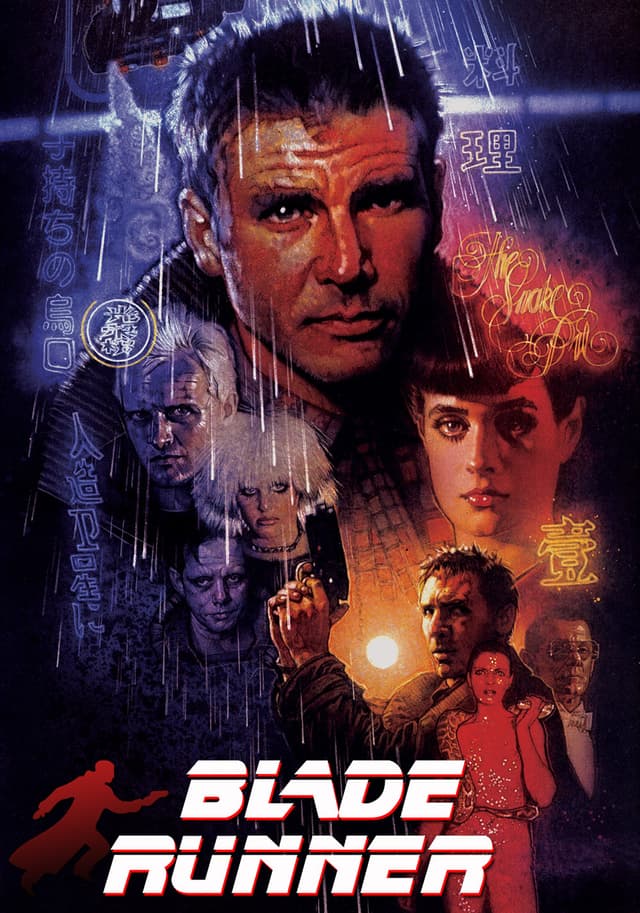
Blade Runner Budget
 Science FictionDramaThriller1h 58m
Updated
Synopsis
In the early twenty-first century, the Tyrell Corporation, during what was called the Nexus phase, developed robots, called "replicants", that were supposed to aid society, the replicants which looked and acted like humans. When the superhuman generation Nexus 6 replicants, used for dangerous off-Earth endeavors, began a mutiny on an off-Earth colony, replicants became illegal on Earth. Police units, called "blade runners", have the job of destroying - or in their parlance "retiring" - any replicant that makes its way back to or created on Earth, with anyone convicted of aiding or assisting a replicant being sentenced to death. It's now November, 2019 in Los Angeles, California. Rick Deckard, a former blade runner, is called out of retirement when four known replicants, most combat models, have made their way back to Earth, with their leader being Roy Batty. One, Leon Kowalski, tried to infiltrate his way into the Tyrell Corporation as an employee, but has since been able to escape. Beyond following Leon's trail in hopes of finding and retiring them all, Deckard believes part of what will help him is figuring out what the replicants wanted with the Tyrell Corporation in trying to infiltrate it. The answer may lie with Tyrell's fail-safe backup mechanism. Beyond tracking the four, Deckard faces a possible dilemma in encountering a fifth replicant: Rachael, who works as Tyrell's assistant. The issue is that Dr. Elden Tyrell is experimenting with her, to provide her with fake memories so as to be able to better control her. With those memories, Rachael has no idea that she is not human. The problem is not only Rachael's assistance to Deckard, but that he is beginning to develop feelings for her.
What is the budget of Blade Runner?
"Blade Runner," a science fiction released in 1982, was directed by Ridley Scott and stars Harrison Ford, Rutger Hauer. The production budget was $28,000,000, placing it in the mid-budget range for science fiction productions of the 1980s.
Key Budget Allocation Categories
While specific budget breakdowns are not publicly available, typical cost drivers for a science fiction production like this include:
- Visual Effects & CGI Pipeline: Sci-fi films are among the most VFX-intensive productions in Hollywood.
- Production Design & World-Building: Creating a believable sci-fi world required significant investment in set construction, prop fabrication, and conceptual design , from physical environments through LED volume stages and virtual production technology.
- Technology & Camera Systems: Cutting-edge camera rigs, motion capture stages, LED volume stages (virtual production), and proprietary rendering technology often push the technical budget far beyond conventional filming costs.
- Casting: Casting the film proved troublesome, particularly for the lead role of Deckard.
What were the major cost factors in Blade Runner?
Several factors contributed to the overall production costs of "Blade Runner."
- Visual Effects: Visual Effects & CGI Pipeline is one of the primary cost drivers in science fiction productions of this scale.
- Production Design: Production Design & World-Building is one of the primary cost drivers in science fiction productions of this scale.
- Technology: Technology & Camera Systems is one of the primary cost drivers in science fiction productions of this scale.
How Does Blade Runner's Budget Compare to Similar Films?
At $28,000,000, Blade Runner sits in the mid-budget range. Here is how it compares to productions with a similar budget:
- Agent Cody Banks (2003): Budget $28,000,000, Worldwide Gross $58,795,814
- Beverly Hills Cop II (1987): Budget $28,000,000, Worldwide Gross $299,965,036
- Shark Night 3D (2011): Budget $28,000,000, Worldwide Gross $10,126,458
- The Lovers on the Bridge (1991): Budget $28,000,000
- Pride & Prejudice (2005): Budget $28,000,000, Worldwide Gross $124,604,345
The median budget for wide-release science fiction films in the era ranges from $30 to 80M for mid-budget to $150M+ for tentpoles.
Blade Runner Box Office Performance
"Blade Runner" earned $32,914,489 domestically and $41,722,424 worldwide at the box office. Against a production budget of $28,000,000, the film showed modest profitability in theatrical release.
A film typically needs to earn approximately twice its production budget to cover marketing and distribution costs. For "Blade Runner," that break-even threshold was roughly $56,000,000. With worldwide earnings of $41,722,424, the film fell short of that threshold but recouped its production costs in theatrical release.
Box Office Breakdown
Blade Runner

At 49%, "Blade Runner" returned its production investment but margin was tight after marketing and distribution costs.
Blade Runner Production History
Casting the film proved troublesome, particularly for the lead role of Deckard. Screenwriter Hampton Fancher envisioned Robert Mitchum as Deckard and wrote the character's dialogue with Mitchum in mind. According to production documents, several actors were considered for the role, including Gene Hackman, Sean Connery, Jack Nicholson, Paul Newman, Clint Eastwood, Tommy Lee Jones, Arnold Schwarzenegger, Peter Falk, Nick Nolte, Al Pacino and Burt Reynolds.
The Blade Runner soundtrack by Vangelis is a dark melodic combination of classic composition and futuristic synthesizers which mirrors the film noir retro-future envisioned by Scott. Vangelis, fresh from his Academy Award-winning score for Chariots of Fire, composed and performed the music on his synthesizers. He also made use of various chimes and the vocals of collaborator Demis Roussos.
Awards and Recognition
Nominated for 2 Oscars. 13 wins & 22 nominations total
- BAFTA Award for Best Production Design: Lawrence G. Paull
- BAFTA Award for Best Cinematography: Jordan Cronenweth
- Los Angeles Film Critics Association Award for Best Cinematography: Jordan Cronenweth
- Hugo Award for Best Dramatic Presentation
Critical Reception
On Rotten Tomatoes, the film holds an 89% approval rating based on 132 reviews, with an average rating of 8.50/10. The website's critics consensus reads: "Misunderstood when it first hit theaters, the influence of Ridley Scott's mysterious, neo-noir Blade Runner has deepened with time. A visually remarkable, achingly human sci-fi masterpiece." Metacritic, which uses a weighted average, assigned the film a score of 84 out of 100 based on 15 critics, indicating "universal acclaim".
Frequently Asked Questions
How much did it cost to make Blade Runner (1982)?
The production budget was $28,000,000, covering principal photography, visual effects, cast and crew salaries, locations, sets, post-production, and music. Marketing and distribution (P&A) costs are estimated at an additional $14,000,000 - $22,400,000, bringing the total studio investment to approximately $42,000,000 - $50,400,000.
How much did Blade Runner (1982) earn at the box office?
Blade Runner grossed $32,914,489 domestic, $8,807,935 international, totaling $41,722,424 worldwide.
Was Blade Runner (1982) profitable?
The film did not break even theatrically, earning $41,722,424 against an estimated $70,000,000 needed. Ancillary revenue may have improved the picture.
What were the biggest costs in producing Blade Runner?
The primary cost drivers were above-the-line talent (Harrison Ford, Rutger Hauer, Sean Young); visual effects pipelines, virtual production technology, and speculative world-building; international production across United States of America, Hong Kong, United Kingdom.
How does Blade Runner's budget compare to similar science fiction films?
At $28,000,000, Blade Runner is classified as a low-budget production. The median budget for wide-release science fiction films in the era ranges from $30 - 80M for mid-budget to $150M+ for tentpoles. Comparable budgets: Agent Cody Banks (2003, $28,000,000); Beverly Hills Cop II (1987, $28,000,000); Shark Night 3D (2011, $28,000,000).
Did Blade Runner (1982) go over budget?
There are no widely reported accounts of significant budget overruns for this production. However, studios rarely disclose precise budget overrun figures publicly. The reported production budget reflects the final estimated cost.
What was the return on investment (ROI) for Blade Runner?
The theatrical ROI was 49.0%, calculated as ($41,722,424 − $28,000,000) ÷ $28,000,000 × 100. This measures gross revenue against production budget only - it does not account for P&A or exhibitor shares.
What awards did Blade Runner (1982) win?
Nominated for 2 Oscars. 13 wins & 22 nominations total.
Who directed Blade Runner and who were the key crew members?
Directed by Ridley Scott, written by Hampton Fancher, David Webb Peoples, shot by Jordan Cronenweth, with music by Vangelis, edited by Marsha Nakashima.
Where was Blade Runner filmed?
Blade Runner was filmed in United States of America, Hong Kong, United Kingdom.
Filmmakers
Blade Runner

Official Trailer
Build budgets like this one in Saturation
Start from an industry-standard feature film template, import the schedule and rates you already have, and let the cost report keep itself current as you spend. Real-time collaboration, no spreadsheets.