The Italian Job Budget
 Adventure
Updated
Synopsis
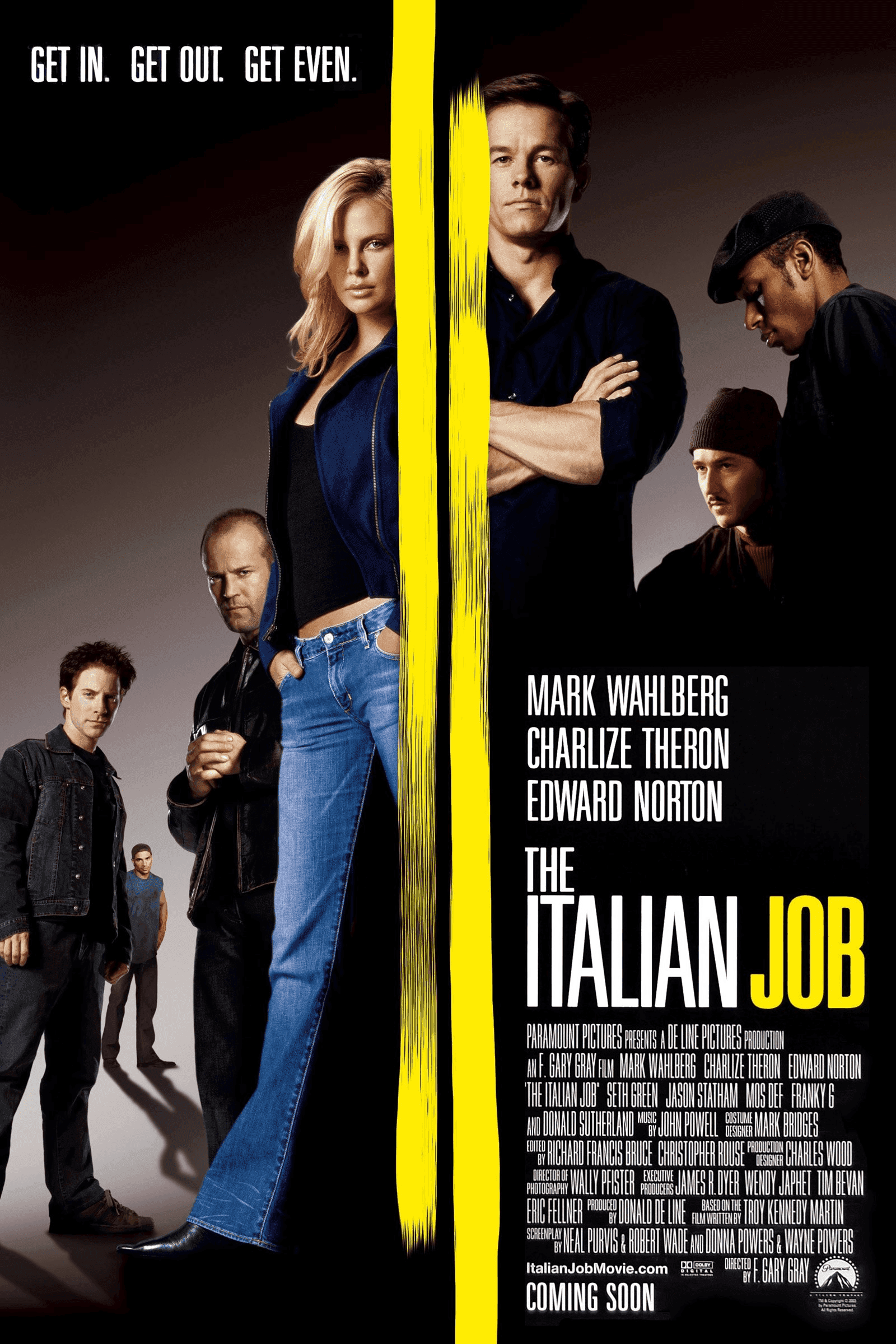
After a daring gold heist in Venice ends in betrayal and the death of their mentor, a team of expert thieves regroups in Los Angeles to plot a meticulous revenge. Their plan: steal back the gold from the traitor in a Mini Cooper-driven heist that hijacks the city's traffic-light grid.
What Is the Budget of The Italian Job (2003)?
The Italian Job (2003), directed by F. Gary Gray and distributed by Paramount Pictures, was produced on a budget of $60,000,000. Donald De Line produced through his De Line Pictures banner, with Paramount and MGM sharing rights as the 1969 Peter Collinson original's rights-holders. The film was conceived as a contemporary remake that retained the basic Mini Cooper heist hook while transposing the action from Turin to Venice and Los Angeles.
The budget reflected the cost of assembling a marquee ensemble (Mark Wahlberg, Charlize Theron, Edward Norton, Jason Statham, Mos Def, Seth Green, Donald Sutherland) and underwriting elaborate practical action sequences across multiple international locations. The math required the film to clear roughly $130,000,000 worldwide to break even after marketing, a target the film cleared comfortably en route to one of the more profitable Paramount releases of 2003.
Key Budget Allocation Categories
The Italian Job's $60,000,000 budget was distributed across several core production areas:
- Above-the-Line Talent: Mark Wahlberg led the ensemble for a mid-tier leading-man fee, with Edward Norton (in a contractual-obligation role he had publicly resented), Charlize Theron, Jason Statham, Seth Green, Mos Def, and Donald Sutherland filling out the cast. F. Gary Gray, coming off The Negotiator (1998) and Set It Off (1996), commanded a feature-director rate appropriate to a studio action vehicle.
- Mini Cooper Fleet and Stunt Work: The production used more than 30 BMW-built Mini Cooper vehicles for the climactic Los Angeles heist, including stunt doubles for the principal "red," "white," and "blue" cars. BMW provided picture-vehicle support as part of a coordinated product-placement integration. Stunt coordinator Alan Gibbs oversaw extensive city-driving choreography that required street closures across downtown Los Angeles and Hollywood.
- Venice and Italian Alps Photography: The film opened with an extended Venice heist sequence shot on the city's canals and at Lake Como locations standing in for the alpine getaway. The Italian shoot required complex logistics for waterborne camera vehicles, location permits in a protected historic city, and helicopter coverage of the lake region.
- Los Angeles Heist Sequence: The third-act Los Angeles sequence required extensive traffic-light system mockups, practical Metro train interior sets, sewer-tunnel coverage, and aerial cinematography. The sequence was shot across multiple weeks with full LAPD coordination and street closures.
- Visual Effects: While the film prioritized practical effects, it required substantial digital cleanup for traffic-light grid interactivity, set extensions for the Venice opening, and a moderate share of CGI augmentation in the Mini Cooper chase sequences. Vendor work was distributed across multiple post houses.
- Score and Music Licensing: Composer John Powell wrote the original score, anchored by an extended driving theme that became one of the year's most-recognizable cues. The soundtrack also featured prominent needle drops including The Who, the Wu-Tang Clan's Mos Def collaborators, and a cover of "On Days Like These" from the 1969 original.
How Does The Italian Job's Budget Compare to Similar Films?
At $60,000,000, The Italian Job sits in the typical range for early-2000s heist ensembles. The comparison set illustrates how the cycle's commercial outcomes scaled with cast and concept:
- Ocean's Eleven (2001): Budget $85,000,000 | Worldwide $450,717,150. Steven Soderbergh's heist ensemble cost $25M more than The Italian Job and earned more than 2.5 times its worldwide gross, the cycle's clear commercial leader.
- Ocean's Twelve (2004): Budget $110,000,000 | Worldwide $362,744,280. The sequel cost nearly twice The Italian Job and earned roughly twice its worldwide gross, suggesting comparable ROI across the two franchises despite different cast structures.
- The Italian Job (1969): Budget $3,000,000 | Worldwide gross unavailable in modern dollar comparison. The Peter Collinson-Michael Caine original is the franchise template; modern adjusted comparisons place it as a clear British box-office hit relative to its budget tier.
- The Score (2001): Budget $68,000,000 | Worldwide $113,571,094. Frank Oz's Robert De Niro-Edward Norton-Marlon Brando heist drama came in $8M above The Italian Job and earned $63M less worldwide.
- Inside Man (2006): Budget $45,000,000 | Worldwide $186,318,633. Spike Lee's Denzel Washington-Clive Owen bank-heist procedural cost less than The Italian Job and out-grossed it by $10M worldwide, the cycle's strongest ROI within the comparable range.
The Italian Job Box Office Performance
The Italian Job opened on May 30, 2003, debuting to $19,457,944 in its opening weekend across 2,927 theaters, finishing second on the chart behind Bruce Almighty's second weekend. The opening was solidly above Paramount's tracking projections and benefited from a Memorial Day-weekend release window with limited adult-action competition. The film posted strong second-week holds and remained in the top ten for six consecutive weekends.
Against a $60,000,000 production budget, The Italian Job needed roughly $130,000,000 in worldwide gross to reach profitability when accounting for marketing and distribution costs. Here is the financial breakdown:
Box Office Breakdown
The Italian Job

The Italian Job returned approximately $1.65 in theatrical revenue for every $1 invested when measured against total estimated production and marketing spend. The domestic share of the gross was $106,128,601 against an international share of $69,941,570, a 60/40 split heavily weighted toward North America but with respectable international performance for an English-language ensemble heist film.
The strong commercial result prompted Paramount and MGM to greenlight an Italian Job 2 with the same core cast, but the sequel collapsed in development across multiple writer-director combinations over the subsequent decade. The Brazilian Job, then The Black Mile, then various other working-title sequels were all eventually shelved, leaving the 2003 film as a standalone entry. The Mini Cooper integration was widely cited as a defining product-placement success and accelerated BMW's relaunch of the Mini brand in the United States market.
The Italian Job Production History
Development began at Paramount in the late 1990s, with the studio acquiring rights to remake the 1969 Peter Collinson film. Multiple writer-director combinations cycled through the project before Donald De Line came aboard as producer and F. Gary Gray attached as director in 2001. Donna Powers and Wayne Powers (the sisters who had written Deep Blue Sea) wrote the screenplay, which substantially reworked the original's structure while retaining the Mini Cooper grid-heist concept.
Casting was completed in 2002, with Mark Wahlberg signing on as Charlie Croker, the John Bridger character (originally Michael Caine's role in the 1969 film) going to Donald Sutherland, and Edward Norton joining as the villain Steve Frazelli to fulfill a contractual obligation to Paramount that he had publicly resisted. Charlize Theron, Jason Statham, Seth Green, and Mos Def filled out the ensemble.
Principal photography began in September 2002 in Italy, shooting the Venice opening sequence on the city's canals and at Lake Como locations. The Italian production block ran for approximately four weeks before the company relocated to Los Angeles for the bulk of the heist sequences. The Los Angeles shoot took advantage of California's established below-the-line crew infrastructure and the city's practical traffic-grid locations that doubled for the fictional control-system targets in the third act.
The Mini Cooper sequences required extensive coordination with BMW, the LAPD, and the Los Angeles Department of Transportation. Street closures across downtown, Hollywood, and the Los Angeles River storm channels facilitated the multi-week stunt-driving block. Post-production wrapped in early 2003, and Paramount positioned the film for a Memorial Day-weekend 2003 release window. The marketing campaign emphasized the Mini Cooper hook, the heist-ensemble cast, and the Venice opening.
Awards and Recognition
The Italian Job received limited industry awards recognition. It was not nominated at the Academy Awards, Golden Globes, BAFTAs, or SAG Awards.
The film received a Saturn Award nomination for Best Action, Adventure, or Thriller Film at the 30th Saturn Awards. It also earned multiple MTV Movie & TV Awards nominations including Best Movie and Best On-Screen Team for the ensemble cast. The BMW Mini Cooper integration was widely cited as a Clio Award-worthy product-placement success and remains a textbook reference in marketing and advertising coursework. F. Gary Gray's direction received retrospective recognition through the success of his subsequent work on Straight Outta Compton (2015) and The Fate of the Furious (2017).
Critical Reception
The Italian Job received generally favorable reviews. The film holds a 73% approval rating on Rotten Tomatoes based on 196 critic reviews, with a critical consensus that praised it as a fun, well-mounted heist film. On Metacritic, the film scored 68 out of 100, indicating generally favorable reviews. Audiences surveyed by CinemaScore gave the film an A-.
Critics broadly praised F. Gary Gray's direction, the ensemble cast's chemistry, the practical Mini Cooper stunt work, and John Powell's propulsive score. Roger Ebert awarded the film three stars, calling it "a clean, sharp, professional job that knows what it wants to be and gets there fast." Variety's Todd McCarthy wrote that "the Mini Cooper sequence alone justifies the price of admission and signals F. Gary Gray's arrival as a serious action director."
Comparative critical assessment against the 1969 Peter Collinson original generated divided trade-press debate. Some reviewers, particularly in British outlets, defended the original as the superior film, while American critics broadly accepted the 2003 remake on its own contemporary action-ensemble terms. Edward Norton later publicly criticized his own performance in the film as the result of his contractual-obligation casting, a candor that became part of the film's afterlife narrative. The strong critical reception, combined with the commercial success and the standalone status of the franchise, has cemented The Italian Job as one of the cleaner heist ensembles of the early 2000s.
Frequently Asked Questions
How much did it cost to make The Italian Job (2003)?
The production budget was $60,000,000. The film was produced by De Line Pictures and distributed by Paramount Pictures, with MGM sharing rights as the 1969 original's rights-holders.
How much did The Italian Job earn at the box office?
The film grossed $106,128,601 domestically and $69,941,570 internationally, for a worldwide total of $176,070,171. It opened to $19,457,944 across 2,927 theaters on May 30, 2003, finishing second on the chart behind Bruce Almighty.
Was The Italian Job profitable?
Yes. Against a $60M production budget and an estimated $40M to $50M in marketing spend, the film returned approximately $1.65 in worldwide gross for every $1 invested, generating roughly $66M to $76M in theatrical profit before home entertainment and television revenue.
Who directed The Italian Job (2003)?
F. Gary Gray directed the film. Gray had previously directed Set It Off (1996) and The Negotiator (1998), and he would later direct Straight Outta Compton (2015) and The Fate of the Furious (2017).
Where was The Italian Job filmed?
Principal photography began in September 2002 in Italy, shooting the Venice opening sequence on the city's canals and at Lake Como locations. The bulk of the heist sequences were then shot across Los Angeles, with street closures coordinated through the LAPD and Department of Transportation.
Is The Italian Job a remake?
Yes. It is a contemporary remake of the 1969 Peter Collinson film starring Michael Caine, retaining the Mini Cooper grid-heist concept while transposing the action from Turin to Venice and Los Angeles. Donna Powers and Wayne Powers wrote the screenplay based on Troy Kennedy Martin's 1969 script.
Who stars in The Italian Job?
Mark Wahlberg leads as Charlie Croker, with Charlize Theron, Edward Norton, Jason Statham, Mos Def, Seth Green, and Donald Sutherland filling out the heist ensemble. Edward Norton later publicly criticized his own performance, having taken the role to fulfill a contractual obligation to Paramount.
How does The Italian Job compare to Ocean's Eleven?
The Italian Job cost $60M and earned $176M worldwide. Ocean's Eleven (2001) cost $85M and earned $450.7M. Both anchored the early-2000s heist-ensemble cycle, with Ocean's the clear commercial leader and Italian Job the cleaner ROI play.
Was there a sequel to The Italian Job?
No theatrical sequel was produced, though Paramount and MGM greenlit Italian Job 2 (variously titled The Brazilian Job and The Black Mile) and pursued it for over a decade with multiple writer-director combinations. The sequel ultimately collapsed in development, leaving the 2003 film as a standalone entry.
What did critics think of The Italian Job?
The film holds a 73% approval rating on Rotten Tomatoes (196 reviews) and scored 68 out of 100 on Metacritic. Audiences gave it an A- CinemaScore. Roger Ebert awarded three stars, calling it "a clean, sharp, professional job," and Variety praised the Mini Cooper sequence as the film's defining set piece.
Filmmakers
The Italian Job

Build budgets like this one in Saturation
Start from an industry-standard feature film template, import the schedule and rates you already have, and let the cost report keep itself current as you spend. Real-time collaboration, no spreadsheets.