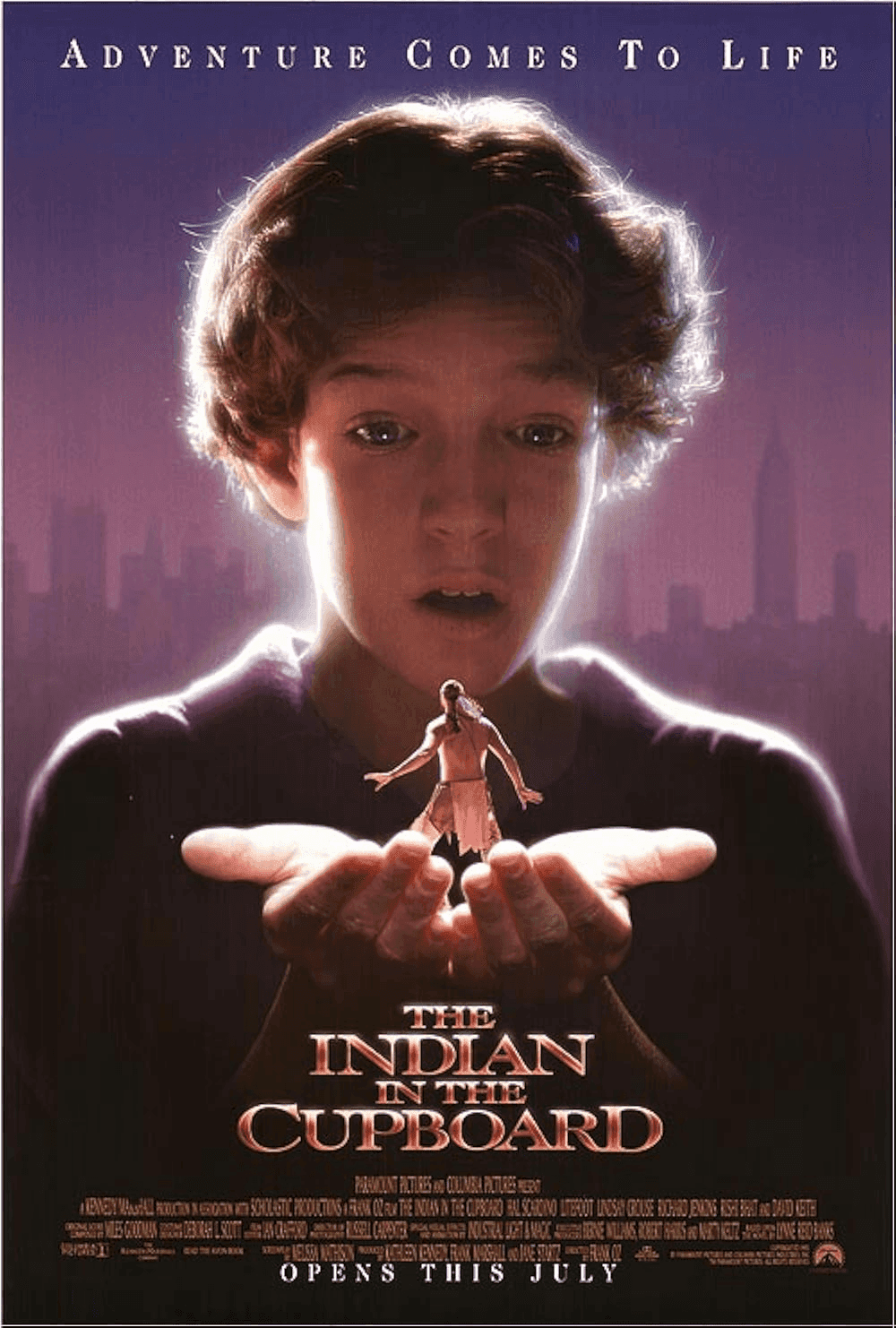
The Indian in the Cupboard Budget
 Adventure
Updated
Synopsis
On his ninth birthday, Omri Cooper receives a small plastic Iroquois warrior figurine and an old wooden cupboard with a mysterious key. When the cupboard transforms the figurine into a tiny, living 18th-century Iroquois named Little Bear, Omri must hide his secret from his family, navigate the moral weight of holding another human being in miniature, and prepare for the day when he must send Little Bear home.
What Is the Budget of The Indian in the Cupboard (1995)?
The Indian in the Cupboard (1995), directed by Frank Oz and distributed by Paramount Pictures and Columbia Pictures, was produced on a reported budget of $45,000,000. The family fantasy adaptation of Lynne Reid Banks's 1980 novel was financed through Paramount, Columbia, and Kennedy/Marshall Company, with Frank Marshall and Kathleen Kennedy producing alongside Jane Startz. Steven Spielberg served as executive producer.
The budget reflected the picture's heavy reliance on Industrial Light & Magic visual-effects integration to make the miniature Iroquois warrior Little Bear and the miniature cowboy Boone interact convincingly with the boy lead Omri. Above-the-line costs centered on the family-friendly ensemble (Lindsay Crouse, Richard Jenkins, Hal Scardino as Omri, Litefoot as Little Bear, and David Keith as Boone) at scaled rates appropriate to the family-feature template.
Key Budget Allocation Categories
The Indian in the Cupboard's $45,000,000 budget was distributed across several core production areas:
- Visual Effects and Compositing: Industrial Light & Magic delivered the picture's defining technical investment, with extensive compositing to integrate the miniature characters (Little Bear and Boone) with the full-scale lead Hal Scardino across the bulk of the film's runtime. The compositing-heavy effects work consumed a significant portion of the budget and required substantial principal-photography blue-screen work to support post-production integration.
- Cast Compensation: Hal Scardino starred as Omri, with Litefoot (a Cherokee rapper-actor in his first major film role) as the Iroquois warrior Little Bear and David Keith as the cowboy Boone. Lindsay Crouse and Richard Jenkins played Omri's parents, with Steve Coogan in a supporting role as a magician.
- Production Design: Production designer Leslie Dilley built oversized props and scaled environments to support the miniature-character compositing. Omri's bedroom and the surrounding domestic interiors required both standard-scale and over-scale set construction to accommodate the visual-effects shots from the miniature characters' point of view.
- Score and Music: Composer Randy Edelman scored the film with a sweeping family-fantasy orchestral approach blending Iroquois traditional elements with Hollywood orchestral grammar.
- New York Production Block: Principal photography took place primarily in New York City and surrounding boroughs in New York, with the family-apartment setting and adjacent locations supporting the contemporary narrative frame.
- Cultural Consultation and Research: The production engaged extensive consultation with Iroquois cultural advisers and 18th-century Indigenous-history scholars to support the Little Bear character's period and cultural authenticity, distinguishing the film from prior screen treatments of similar source material.
How Does The Indian in the Cupboard's Budget Compare to Similar Films?
At $45,000,000, The Indian in the Cupboard sits in the mid-range of mid-1990s family fantasy productions:
- Jumanji (1995): Budget $65,000,000 | Worldwide $262,800,000. Joe Johnston's contemporary family-fantasy adventure cost 1.4x The Indian in the Cupboard and grossed nearly 7.4x worldwide, the contemporary commercial peer that decisively outperformed Indian in the Cupboard the same year.
- Casper (1995): Budget $55,000,000 | Worldwide $287,928,194. Brad Silberling's contemporary effects-heavy family feature cost 22% more and grossed more than 8x worldwide.
- Honey, I Shrunk the Kids (1989): Budget $32,000,000 | Worldwide $222,724,172. Disney's earlier miniature-character family adventure cost 71% of Indian in the Cupboard and grossed 6.2x worldwide, the visual-effects template the Frank Oz feature explicitly built on.
- Hook (1991): Budget $70,000,000 | Worldwide $300,854,823. Steven Spielberg's earlier Kennedy/Marshall-produced family fantasy cost 1.6x and grossed 8.4x more, the broader Kennedy/Marshall family-feature ceiling.
- A Little Princess (1995): Budget $17,000,000 | Worldwide $10,015,449. Alfonso Cuaron's contemporary literary family adaptation cost 38% of Indian in the Cupboard and grossed only 28% worldwide, illustrating that the mid-budget literary-family-adaptation bracket carried significant commercial risk.
The Indian in the Cupboard Box Office Performance
The Indian in the Cupboard opened on July 14, 1995 to $5,609,521 across 1,851 theaters, finishing fourth on a weekend won by Apollo 13. The release positioned the film in the heart of the 1995 family-feature summer corridor against Pocahontas (then in extended release), Free Willy 2 (opened the following week), and Jumanji (which released later in the year and dominated the season).
Against a $45,000,000 production budget, the film needed approximately $100,000,000 worldwide to break even when accounting for marketing and distribution costs. Here is the financial breakdown:
Box Office Breakdown
The Indian in the Cupboard

The Indian in the Cupboard returned approximately $0.42 to $0.48 in theatrical revenue for every $1 invested when measured against total estimated production and marketing spend, a significant theatrical disappointment for Paramount, Columbia, and the Kennedy/Marshall Company. The picture's domestic-only release pattern (with limited international rollout) reflected the producers' assessment that the United States family-feature market was the primary commercial opportunity, an assessment that proved overly optimistic against the unusually competitive 1995 family-feature summer schedule.
Home entertainment, cable-television licensing, and continuous family-television programming have meaningfully recovered the production cost in long-tail revenue, with the picture becoming a perennial after-school and family-night staple through VHS, DVD, and streaming availability. The picture is widely cited within the Kennedy/Marshall Company catalogue as a critically respected but commercially underperforming entry in the family-fantasy slate.
The Indian in the Cupboard Production History
Development on a film adaptation of Lynne Reid Banks's 1980 novel began in the late 1980s at Paramount, with multiple producer teams optioning and developing screenplays through the early 1990s. The project consolidated when Kennedy/Marshall Company (Frank Marshall and Kathleen Kennedy's production banner) acquired the rights and brought in Steven Spielberg as executive producer through the Amblin Entertainment relationship. Melissa Mathison, who had previously written E.T. the Extra-Terrestrial for Spielberg, adapted the screenplay.
Frank Oz was attached to direct on the strength of his earlier visual-effects-intensive family work (Little Shop of Horrors, The Muppets Take Manhattan, What About Bob?) and his comfort working with miniature characters from his decades of Jim Henson Company puppetry. Industrial Light & Magic provided the visual-effects pipeline through the Lucasfilm relationship.
Casting Hal Scardino as Omri and Litefoot (Gary Davis) as Little Bear set the lead structure, with David Keith as the cowboy Boone, Lindsay Crouse and Richard Jenkins as Omri's parents, and Steve Coogan in a supporting role. The Litefoot casting reflected an explicit production commitment to authentic Indigenous representation in a role that prior Hollywood treatments would likely have miscast.
Principal photography ran from spring to summer 1994 in New York City and surrounding boroughs in New York. The compositing-heavy effects work required substantial blue-screen capture during principal photography to support the post-production miniature-character integration. Post-production through early 1995 at Industrial Light & Magic prepared the picture for the July 1995 release ahead of the back-to-school window.
Awards and Recognition
The Indian in the Cupboard received no major industry awards recognition on its initial release. The film was not nominated at the Academy Awards, Golden Globes, BAFTAs, or Saturn Awards. It received nominations at the Young Artist Awards and the YoungStar Awards for Hal Scardino's lead performance but did not win those categories.
Beyond its initial awards run, the picture has been retroactively recognized for its progressive Indigenous representation by Litefoot, who became the first Indigenous actor to play a major Indigenous role in a contemporary mainstream Hollywood family feature without resorting to caricature. The picture has appeared on various best-1990s-family-films retrospective lists and is regularly cited in coverage of the Kennedy/Marshall Company catalogue.
Critical Reception
The Indian in the Cupboard received generally positive reviews on its initial release. The film holds a 74% approval rating on Rotten Tomatoes based on 31 critic reviews, with a critical consensus that called it thoughtful, technically accomplished, and respectful of its Indigenous source material. On Metacritic, the film scored 56 out of 100, indicating mixed or average reviews. Audiences surveyed by CinemaScore did not officially rate the picture during its release window, though contemporary audience-tracking data suggested strong family-segment approval.
Critics praised the picture's emotional intelligence in handling a child's discovery of moral responsibility, the technical accomplishment of the Industrial Light & Magic compositing, and Litefoot's lead performance as Little Bear. Roger Ebert gave the film three-and-a-half stars out of four, writing that "this is a movie that knows its audience and respects it; the visual effects serve the story instead of overwhelming it." The Hollywood Reporter's Duane Byrge called it "a thoughtful family adventure that doesn't condescend to its viewers."
Some critics objected to the picture's sober tone and the perception that the miniature-character framing limited the film's adventure-set-piece appetite. Variety's Todd McCarthy wrote that the film "may strike some young viewers as paced more like contemplation than action." The picture's critical reception has appreciated over time, with retrospective coverage emphasizing its progressive Indigenous casting and its thoughtful treatment of historical responsibility ahead of comparable family features of its era.
Frequently Asked Questions
How much did it cost to make The Indian in the Cupboard (1995)?
The reported production budget was $45,000,000. Paramount Pictures and Columbia Pictures co-financed the film through Kennedy/Marshall Company (Frank Marshall and Kathleen Kennedy's production banner), with Steven Spielberg as executive producer through the Amblin Entertainment relationship.
How much did The Indian in the Cupboard earn at the box office?
The film grossed $35,656,131 in domestic United States theaters. The international release was limited, and the worldwide gross is essentially the same as the domestic figure. It opened to $5,609,521 across 1,851 theaters on July 14, 1995, finishing fourth on a weekend won by Apollo 13.
Was The Indian in the Cupboard profitable?
No, theatrically. Against a $45,000,000 production budget and an estimated $30,000,000 to $40,000,000 in marketing spend, the $35.7M worldwide gross returned approximately $0.42 to $0.48 in revenue for every $1 invested. Home entertainment and cable licensing have recovered the production cost in long-tail revenue.
Who directed The Indian in the Cupboard?
Frank Oz directed the film on the strength of his earlier visual-effects-intensive family work (Little Shop of Horrors, The Muppets Take Manhattan, What About Bob?) and his decades of Jim Henson Company puppetry work. The screenplay was adapted by Melissa Mathison (E.T. the Extra-Terrestrial) from Lynne Reid Banks's 1980 novel.
Who stars in The Indian in the Cupboard?
Hal Scardino stars as nine-year-old Omri Cooper, with Cherokee rapper-actor Litefoot in his first major film role as the Iroquois warrior Little Bear, David Keith as the cowboy Boone, Lindsay Crouse and Richard Jenkins as Omri's parents, and Steve Coogan in a supporting role as a magician.
Where was The Indian in the Cupboard filmed?
Principal photography took place primarily in New York City and surrounding boroughs in spring and summer 1994. The contemporary-family-apartment setting and adjacent New York locations supported the narrative frame. Industrial Light & Magic handled the post-production miniature-character compositing in San Rafael, California.
Is The Indian in the Cupboard based on a book?
Yes. The film is adapted from Lynne Reid Banks's 1980 novel of the same name, the first in a five-book series. Melissa Mathison (E.T. the Extra-Terrestrial) adapted the screenplay. The novel and its sequels have remained popular middle-grade reading staples for more than four decades.
How does The Indian in the Cupboard compare to other 1995 family films?
At $45,000,000 it cost less than Jumanji (1995, $65M, grossed $262.8M), Casper (1995, $55M, grossed $287.9M), and Hook (1991, $70M, grossed $300.9M). However, it grossed only a fraction of those competitors' worldwide returns, underperforming the broader 1995 family-feature commercial template.
What did critics think of The Indian in the Cupboard?
The film received generally positive reviews, with a 74% approval rating on Rotten Tomatoes (31 critics) and a 56 out of 100 on Metacritic. Roger Ebert gave the film three-and-a-half stars, writing that "this is a movie that knows its audience and respects it; the visual effects serve the story instead of overwhelming it." Critics praised the emotional intelligence and Litefoot's performance.
Why is Litefoot's casting historically significant?
Litefoot (Gary Davis), a Cherokee rapper-actor, was cast as Little Bear in what is widely cited as one of the first major Indigenous lead roles in a contemporary mainstream Hollywood family feature played by an actual Indigenous actor without resorting to caricature. The picture's commitment to authentic Indigenous representation distinguished it from prior screen treatments of similar source material.
Filmmakers
The Indian in the Cupboard

Build budgets like this one in Saturation
Start from an industry-standard feature film template, import the schedule and rates you already have, and let the cost report keep itself current as you spend. Real-time collaboration, no spreadsheets.