The Ice Storm Budget
 Drama
DramaUpdated
Synopsis
Over a wintry Thanksgiving weekend in 1973, two affluent Connecticut families come apart as parents drift into extramarital affairs and teenage children explore their own confusions of sex, drugs, and identity. A devastating ice storm rolls in, leaving the families to reckon with the consequences of their disconnection.
What Is the Budget of The Ice Storm (1997)?
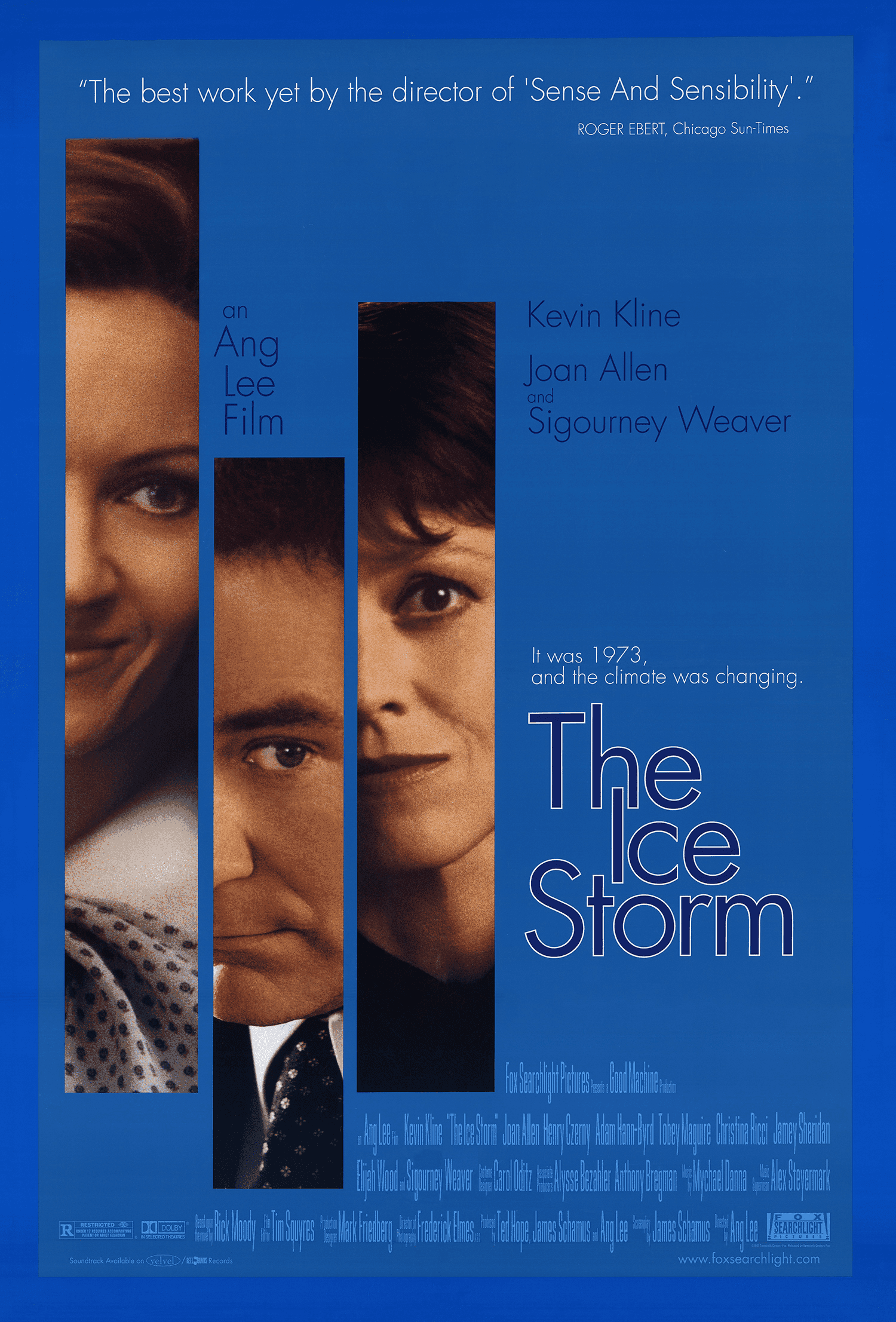
The Ice Storm (1997), directed by Ang Lee and distributed by Fox Searchlight Pictures, was produced on a reported budget of approximately $18,000,000. The film adapted Rick Moody's 1994 novel of the same name for the screen, with James Schamus delivering a screenplay that compressed the book's multi-perspective structure into a tight ensemble of two affluent New Canaan, Connecticut families navigating a Thanksgiving weekend in 1973. Good Machine, the production company Schamus co-founded with Ted Hope, anchored the financing alongside Fox Searchlight.
The budget reflected a deliberately contained late-1990s prestige drama scale. The bulk of the spend went to the ensemble cast (Kevin Kline, Sigourney Weaver, Joan Allen, Christina Ricci, Tobey Maguire, Elijah Wood, Adam Hann-Byrd), the meticulous 1973 period production design, and the location shoot in New Canaan, Connecticut and surrounding Westchester County. Fox Searchlight, then in its second year as a Twentieth Century Fox specialty label, acquired the film for theatrical release on the strength of a strong Cannes Film Festival premiere.
Key Budget Allocation Categories
The Ice Storm's reported $18,000,000 budget was distributed across the following core production areas:
- Above-the-Line Ensemble Cast: The film assembled an unusually deep ensemble of established and emerging actors: Kevin Kline and Sigourney Weaver as the principal married pair, Joan Allen as Kline's wife, and a young Christina Ricci, Tobey Maguire, Elijah Wood, and Adam Hann-Byrd as the teenage children. Most of the cast accepted scale or near-scale rates against backend participation in recognition of the prestige nature of the project, keeping the above-the-line cost well below comparable star packages.
- Period Production Design: Production designer Mark Friedberg recreated the 1973 affluent Connecticut suburban interior with meticulous attention to avocado-and-burnt-orange color palettes, modernist architecture, period rec rooms, and the bakelite-and-tweed material vocabulary of the early-1970s American upper-middle class. Costume designer Carol Oditz sourced period-accurate outfits across the entire ensemble.
- Connecticut and New York Location Shoot: Principal photography took place across New Canaan, Connecticut and various Westchester County and Long Island locations, supplemented by Manhattan exteriors for the New York-set sequences with Tobey Maguire's character. The cross-territory shoot required additional logistics for the multi-family ensemble.
- Cinematography: Ang Lee's longtime collaborator Frederick Elmes, the Lynch-trained DP of Blue Velvet and Wild at Heart, shot the film on 35mm with a deliberately desaturated palette that emphasized the eerie suburban remove of the period. The titular ice storm sequence required extensive practical ice-build and lighting work across multiple nights.
- Score and Music: Composer Mychael Danna delivered a sparse, melancholic score that drew on East Asian instrumentation including gamelan and shakuhachi, providing the film with a distinctive non-Western sonic palette that contrasted with the suburban Connecticut setting. Music licensing covered a substantial set of period-accurate needle drops including David Bowie, Frank Zappa, Traffic, and Harry Nilsson tracks.
- Editorial and Post: Editor Tim Squyres cut the film for a 113-minute runtime, with the structural challenge of weaving the two families' parallel narratives into the climactic ice-storm sequence. Post ran through the first quarter of 1997 ahead of the Cannes Film Festival premiere in May.
How Does The Ice Storm's Budget Compare to Similar Films?
At a reported $18,000,000, The Ice Storm sits in the mid-range of late-1990s prestige ensemble dramas. The comparison set illustrates how its commercial outcome compared with budgetary peers:
- Eat Drink Man Woman (1994): Budget $1,500,000 | Worldwide $7,294,403. Ang Lee's previous Taiwanese feature cost less than a tenth of The Ice Storm and earned nearly the same domestic gross, illustrating Lee's long-running budget consciousness across his early career.
- Sense and Sensibility (1995): Budget $16,000,000 | Worldwide $134,993,774. Ang Lee's previous English-language feature cost effectively the same as The Ice Storm and earned more than 16 times its worldwide gross, illustrating the gap between Austen period drama and contemporary American suburban drama in commercial terms.
- Happiness (1998): Budget $3,000,000 | Worldwide $2,807,390. Todd Solondz's ensemble drama released a year after The Ice Storm cost a sixth as much and earned a third of the worldwide gross, illustrating the floor of late-1990s suburban-dysfunction drama.
- American Beauty (1999): Budget $15,000,000 | Worldwide $356,296,601. Sam Mendes's suburban-dysfunction drama from two years later cost less than The Ice Storm and earned more than 40 times the worldwide, illustrating how the category found a mass audience by the end of the decade.
- Magnolia (1999): Budget $37,000,000 | Worldwide $48,451,803. Paul Thomas Anderson's ensemble drama cost more than double The Ice Storm and earned six times the worldwide, illustrating the upper ceiling of the late-1990s ensemble-drama format.
The Ice Storm Box Office Performance
The Ice Storm premiered in competition at the Cannes Film Festival in May 1997, where James Schamus won the Best Screenplay prize. Fox Searchlight released the film in limited theatrical release on September 26, 1997, opening in four theaters with a per-screen average of $49,877 and expanding modestly across the fall. The film closed its domestic run at $8,038,061 and did not pursue significant international theatrical distribution.
Against a reported production budget of $18,000,000, the film fell well short of break-even on theatrical alone. Here is the financial breakdown:
Box Office Breakdown
The Ice Storm (1997)

The Ice Storm returned approximately $0.27 to $0.31 in worldwide theatrical gross for every $1 invested in production and marketing, placing it among the clearer commercial underperformers of the 1997 fall specialty slate. Home video sales, critical-acclaim word of mouth, and the film's subsequent canonization as a Criterion Collection title have closed a meaningful portion of the theatrical loss over the decades, but the initial theatrical recoupment was minimal.
The film's commercial underperformance contrasts sharply with its critical and awards reception, illustrating the late-1990s difficulty of converting prestige adult ensemble drama into theatrical revenue. Despite the box office, the project established Ang Lee's versatility across continents and genres and contributed to his subsequent attachment to Crouching Tiger, Hidden Dragon (2000).
The Ice Storm Production History
Development began in 1995, when Good Machine's Ted Hope and James Schamus optioned Rick Moody's 1994 novel for the screen. Schamus, who had previously written The Wedding Banquet and Eat Drink Man Woman for Ang Lee, adapted the novel's multi-perspective narrative into a tighter ensemble structure while preserving the book's key thematic concerns of suburban anomie, generational disconnection, and the early-1970s collapse of post-war American certainty.
Ang Lee attached to direct in 1996 following the international success of Sense and Sensibility (1995). Casting Kevin Kline and Sigourney Weaver as the principal married pair anchored the ensemble, with Joan Allen joining as Kline's wife and Christina Ricci, Tobey Maguire, Elijah Wood, and Adam Hann-Byrd filling out the teenage roles. Ricci was twelve years old at the start of production but turned sixteen during filming.
Principal photography ran from autumn 1996 through early winter 1997 across New Canaan, Connecticut and surrounding Westchester County and Long Island locations, with additional Manhattan exteriors for the Tobey Maguire character's New York sequences. The titular ice storm sequence required extensive practical ice-build work across multiple cold-weather nights, with the production crew spraying water onto carefully positioned trees and branches to create the ice-accretion visual.
Post-production ran through the first quarter of 1997 ahead of the Cannes Film Festival premiere in May, where James Schamus won the Best Screenplay prize. Fox Searchlight released the film into limited theatrical distribution on September 26, 1997, with a slow rollout across the fall awards season aimed at building critical momentum into the year-end calendar.
Awards and Recognition
The Ice Storm received broad and substantial awards recognition despite its limited commercial footprint. James Schamus won the Best Screenplay prize at the 1997 Cannes Film Festival, the film's most prominent industry award. Sigourney Weaver received the BAFTA Award for Best Supporting Actress, and Joan Allen and Christina Ricci both earned BAFTA nominations in supporting categories.
Additional recognition included nominations at the Golden Globe Awards (Best Supporting Actress for Sigourney Weaver), the Independent Spirit Awards, the New York Film Critics Circle Awards (where Joan Allen won Best Supporting Actress), and the National Board of Review. The film did not receive any Academy Award nominations, a notable omission that has been widely discussed in retrospectives of the 1997 awards season.
Critical Reception
The Ice Storm received strong reviews. The film holds an 86 percent approval rating on Rotten Tomatoes based on 65 critic reviews, with a critical consensus that called it "an intelligent, accomplished study of family dynamics and dysfunction." On Metacritic, the film scored 76 out of 100, indicating generally favorable reviews. CinemaScore did not poll opening-weekend audiences because of the limited release pattern.
Roger Ebert gave the film three and a half out of four stars and called it "an extraordinarily perceptive film about a time when the American family began coming apart in ways it has never recovered from." Janet Maslin of The New York Times praised the "rare and serious accomplishment" of capturing the early 1970s without nostalgia or pastiche, and Variety's Todd McCarthy wrote that the film "shows Mr. Lee progressing as a director of formidable command and feeling."
The film has settled into the canon as one of Ang Lee's most highly regarded works and one of the defining prestige American ensemble dramas of the 1990s. It is widely cited as a precursor to subsequent suburban-dysfunction films including American Beauty (1999), Far from Heaven (2002), and Little Children (2006). The Criterion Collection released a deluxe restoration in 2008, cementing the film's long-term canonical status.
Frequently Asked Questions
How much did it cost to make The Ice Storm (1997)?
The reported production budget was approximately $18,000,000. Fox Searchlight Pictures distributed the film and co-produced with Good Machine, the production company co-founded by James Schamus and Ted Hope. Canal+ provided additional international financing.
How much did The Ice Storm earn at the box office?
The film grossed $8,038,061 domestically. Fox Searchlight did not pursue significant international theatrical distribution. The film opened in limited release on September 26, 1997, beginning at four theaters with a per-screen average of $49,877 before expanding modestly across the fall.
Was The Ice Storm profitable?
No, not theatrically. Against an $18,000,000 production budget and an estimated $8,000,000 to $12,000,000 in marketing spend, the film returned approximately $0.27 to $0.31 in worldwide gross for every $1 invested. Home video sales and decades of critical-acclaim word of mouth have closed a meaningful portion of the theatrical loss over time.
Who directed The Ice Storm?
Ang Lee directed the film, following Eat Drink Man Woman (1994) and Sense and Sensibility (1995). The Ice Storm marked Lee's third English-language feature in succession after Sense and Sensibility, and his work with longtime collaborator and screenwriter James Schamus, who had also written The Wedding Banquet and Eat Drink Man Woman.
Where was The Ice Storm filmed?
Principal photography took place from autumn 1996 through early winter 1997 across New Canaan, Connecticut and surrounding Westchester County and Long Island locations, with additional Manhattan exteriors. The titular ice storm sequence required extensive practical ice-build work across multiple cold-weather nights.
Who stars in The Ice Storm?
Kevin Kline and Sigourney Weaver play the principal married pair, with Joan Allen as Kline's wife. Christina Ricci, Tobey Maguire, Elijah Wood, and Adam Hann-Byrd play the teenage children of the two families. Katie Holmes and Henry Czerny round out the supporting cast. The film was Christina Ricci's breakout role as a teenage actress.
How does it compare to other Ang Lee films?
The Ice Storm cost $18,000,000 and grossed $8,038,061 domestically. Sense and Sensibility (1995) cost $16,000,000 and earned $134,993,774 worldwide. Crouching Tiger, Hidden Dragon (2000) cost $17,000,000 and earned $213,525,736 worldwide. The Ice Storm's commercial performance was Lee's weakest of his 1990s English-language run despite the strong critical reception.
What is the time period of The Ice Storm?
The film is set during a Thanksgiving weekend in November 1973, against the backdrop of the Watergate hearings and the late phase of the Vietnam War. Production design and costume work meticulously recreated the affluent Connecticut suburban material culture of the period, including avocado-and-burnt-orange color palettes, period rec rooms, and the bakelite-and-tweed material vocabulary of the early-1970s American upper-middle class.
What did critics think of The Ice Storm?
The film received strong reviews, with an 86 percent approval rating on Rotten Tomatoes (65 critics) and a 76 out of 100 score on Metacritic. Roger Ebert gave the film three and a half stars and called it "an extraordinarily perceptive film about a time when the American family began coming apart in ways it has never recovered from."
Did The Ice Storm win any awards?
Yes. James Schamus won the Best Screenplay prize at the 1997 Cannes Film Festival, and Sigourney Weaver won the BAFTA Award for Best Supporting Actress. Joan Allen and Christina Ricci both received BAFTA nominations, and Joan Allen won the New York Film Critics Circle Award for Best Supporting Actress. The film notably did not receive any Academy Award nominations.
Filmmakers
The Ice Storm (1997)

Build budgets like this one in Saturation
Start from an industry-standard feature film template, import the schedule and rates you already have, and let the cost report keep itself current as you spend. Real-time collaboration, no spreadsheets.