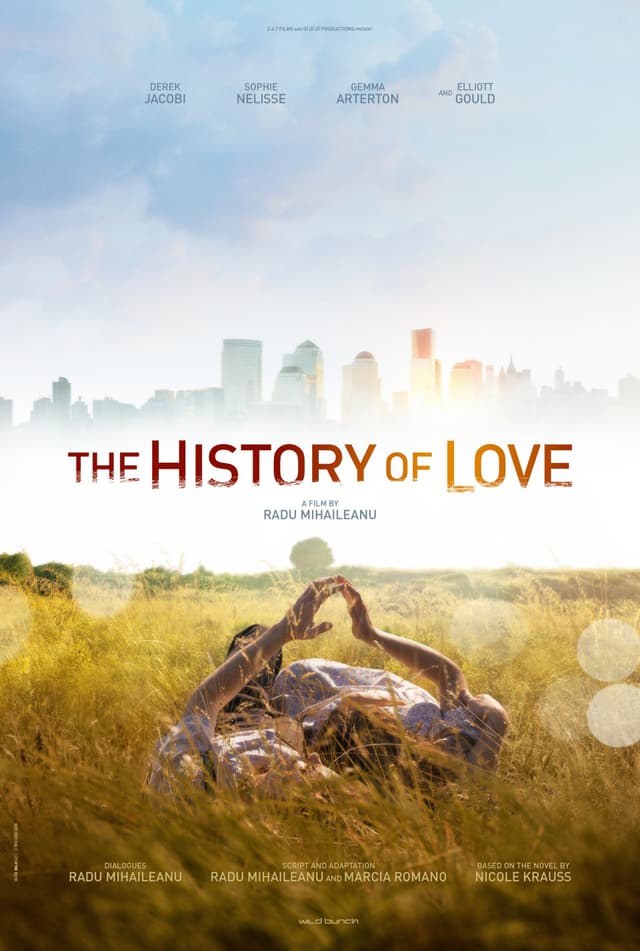
The History of Love Budget
Updated
Synopsis
In present-day Brooklyn, fourteen-year-old Alma searches for the truth behind a mysterious book that gave her her name. The story unfolds across decades and continents, connecting Alma's search to the life of Leo Gursky, a Polish-Jewish refugee who wrote the original manuscript as a love letter in pre-war Slonim and believed it lost forever.
What Is the Budget of The History of Love (2016)?
The History of Love (2016), directed by Romanian-French filmmaker Radu Mihăileanu and distributed internationally by Wild Bunch, was produced on a reported budget of $20,000,000. The international co-production was financed by Oï Oï Oï Productions, 2.4.7. Films, Wild Bunch, France 3 Cinéma, Caramel Films, Panache Productions, RTBF, and Libra Film, with additional support from Belgian, Romanian, and Canadian co-production partners.
The film adapted Nicole Krauss's acclaimed 2005 novel of the same name, which weaves a single love letter manuscript across multiple narratives spanning pre-war Slonim, post-war Chile, and contemporary Brooklyn. Mihăileanu, known for Train of Life (1998) and The Concert (2009), spent years securing the rights and developing the screenplay with Marcia Romano. The investment reflected the demands of a multi-decade, multi-continent production schedule.
Key Budget Allocation Categories
The $20,000,000 budget was distributed across these core production areas:
- Multi-Country Location Shoot: Principal photography took place across multiple countries including Romania, Canada, the United States, and Belgium, with each location standing in for different time periods in the narrative. The international logistics, transportation, and per-location crew costs anchored a significant share of the budget.
- Period Recreation: The film moves between contemporary Brooklyn, post-war South America, and pre-war Eastern European Jewish communities. Production designer Cristian Niculescu created period environments and costume designer Catherine Marchand built wardrobes spanning approximately seventy years.
- Ensemble Cast Compensation: Derek Jacobi (Leo Gursky as an old man), Sophie Nélisse (Alma), Gemma Arterton, Elliott Gould, and supporting players across multiple time periods filled out a deep international cast. Jacobi and Arterton commanded the largest individual fees.
- Cinematography and Lighting: DP Laurent Dailland (The Concert) shot the film with distinct visual languages for each time period and continent, requiring multiple lighting packages and camera setups across the international locations.
- Score and Music: French composer Armand Amar (a frequent Mihăileanu collaborator on Train of Life and The Concert) composed the score, blending classical European motifs with Jewish folk elements and contemporary New York textures.
- Editing and Post-Production: Ludo Troch edited the structurally complex narrative, weaving together the multiple time periods and points of view. The post-production phase extended over many months across European facilities.
How Does The History of Love's Budget Compare to Similar Films?
At $20,000,000, The History of Love sat in the standard range for international literary-adaptation co-productions:
- The Reader (2008): Budget $32,000,000 | Worldwide $108,900,000. Weinstein's German-American Holocaust-themed adaptation cost 60% more and earned roughly five times the History of Love worldwide gross, anchored by a Best Actress Oscar win for Kate Winslet.
- Sarah's Key (2010): Budget $11,000,000 | Worldwide $26,500,000. The French Holocaust-themed novel adaptation cost half as much and earned modestly more, offering the closest commercial twin to History of Love's positioning.
- The Concert (2009): Budget $19,000,000 | Worldwide $40,500,000. Mihăileanu's previous feature cost roughly the same and posted significantly stronger commercial returns, providing the financial template the producers hoped History of Love would match.
- Train of Life (1998): Budget $7,000,000 | Worldwide $13,900,000. Mihăileanu's breakthrough feature cost less than half and earned more at the box office on a percentage-of-budget basis, framing History of Love as the director's most expensive commercial underperformer.
The History of Love Box Office Performance
The History of Love received limited theatrical releases across Europe and select international territories beginning in October 2016. The film did not receive a wide North American theatrical release. The financial breakdown:
Box Office Breakdown
The History of Love (2016)

The History of Love returned a small fraction of its theatrical investment in initial release, with most reported revenue concentrated in France, Belgium, and Romania. The film was acquired by streaming platforms in subsequent years (including Amazon Prime Video in select territories), providing additional recoupment beyond theatrical. The combination of structurally complex source material, multi-territory release patterning, and lack of a major North American distribution partner constrained the film's commercial ceiling.
The History of Love Production History
Development on a film adaptation of Nicole Krauss's novel began shortly after its 2005 publication and Pulitzer Prize finalist status. Radu Mihăileanu, building on the success of The Concert (2009), spent several years securing rights and developing the screenplay with co-writer Marcia Romano. The producers assembled the multi-territory co-production financing through Wild Bunch and a coalition of French, Belgian, Romanian, and Canadian partners.
Principal photography began in 2014 and continued into 2015 across multiple international locations. The production used the Romania tax incentive for European-period sequences, with additional shooting in Brooklyn, New York for the contemporary Alma narrative and in Belgium for studio and interior work. The complex international schedule extended principal photography across multiple production blocks separated by weeks of preparation time.
The film premiered at the 2016 Rome Film Festival before opening theatrically across European territories beginning in October 2016. Subsequent international rollouts continued through 2017 and 2018, with streaming licensing extending the film's availability in markets where theatrical exhibition was minimal.
Awards and Recognition
The History of Love received limited but notable awards recognition. The film was nominated at the 2017 César Awards in France for Best Adaptation. Cinematographer Laurent Dailland received nominations from European craft guilds for the film's visual work spanning multiple time periods and locations. Composer Armand Amar received festival recognition for the original score.
Lead actress Sophie Nélisse, building on her work in The Book Thief (2013), received festival jury recognition at the Rome Film Festival for her central performance as Alma. The film's awards profile remained concentrated in European craft and festival circuits, with limited penetration into the major North American awards conversation.
Critical Reception
The History of Love received mixed reviews internationally. The film holds a 65% approval rating on Rotten Tomatoes based on a limited number of critic reviews from its international rollout. Critics broadly praised the ensemble performances, particularly Derek Jacobi as the elderly Leo Gursky, and the film's ambitious multi-decade structure, while several reviewers noted that the structurally complex source material had been simplified in ways that diluted some of the novel's emotional weight.
Variety's Jay Weissberg wrote that the film "captures the novel's essential melancholy while occasionally struggling with its formal complexity," and The Hollywood Reporter called it "a heartfelt but somewhat overstuffed adaptation of an exceptionally difficult source." European critics were generally warmer than North American reviewers, with Le Monde and Liberation both praising Mihăileanu's emotional commitment to the material and the strength of the Nélisse-Jacobi screen pairing. The film's reputation has been most durable in European literary-cinema circles, where it is regarded as a respectable if commercially modest entry in Mihăileanu's filmography.
Frequently Asked Questions
How much did it cost to make The History of Love (2016)?
The reported production budget was $20,000,000. The international co-production was financed by Oï Oï Oï Productions, 2.4.7. Films, Wild Bunch, France 3 Cinéma, Caramel Films, Panache Productions, RTBF, and Libra Film, with additional support from Belgian, Romanian, and Canadian co-production partners.
How much did The History of Love earn at the box office?
The film received limited theatrical releases across Europe and select international territories beginning in October 2016. International box office is reported under $2,000,000 across all released territories. The film did not receive a wide North American theatrical release.
Was The History of Love profitable?
No. The film returned a small fraction of its theatrical investment in initial release. The combination of structurally complex source material, multi-territory release patterning, and lack of a major North American distribution partner constrained the commercial ceiling. Streaming licensing in subsequent years provided additional recoupment beyond theatrical.
Who directed The History of Love (2016)?
Romanian-French filmmaker Radu Mihăileanu directed the film. Mihăileanu is also known for Train of Life (1998), Live and Become (2005), and The Concert (2009). He co-wrote the screenplay with Marcia Romano.
Is The History of Love based on a novel?
Yes. The film is based on Nicole Krauss's acclaimed 2005 novel of the same name, which was a Pulitzer Prize finalist and won France's Prix du Meilleur Livre Étranger. The novel weaves a single love letter manuscript across multiple narratives spanning pre-war Slonim, post-war Chile, and contemporary Brooklyn.
Where was The History of Love filmed?
Principal photography took place across multiple countries including Romania, Canada, the United States, and Belgium, with each location standing in for different time periods in the narrative. The production used Romania's incentives for European-period sequences, Brooklyn for the contemporary Alma narrative, and Belgium for studio and interior work.
Who is in the cast of The History of Love?
The ensemble includes Derek Jacobi as the elderly Leo Gursky, Sophie Nélisse as Alma, Gemma Arterton, Elliott Gould, Torri Higginson, Mark Rendall, Corneliu Ulici, and William Ainscough. Sophie Nélisse was previously known for The Book Thief (2013).
When was The History of Love released?
The film premiered at the 2016 Rome Film Festival before opening theatrically across European territories beginning in October 2016. Subsequent international rollouts continued through 2017 and 2018, with streaming licensing extending availability in markets where theatrical exhibition was minimal.
What did critics think of The History of Love?
The film received mixed reviews internationally, with a 65% approval rating on Rotten Tomatoes. Critics praised the ensemble performances, particularly Derek Jacobi as the elderly Leo Gursky, and the film's ambitious multi-decade structure. Some reviewers noted that the structurally complex source material had been simplified in ways that diluted some of the novel's emotional weight.
Did The History of Love win any awards?
The film received limited but notable awards recognition. It was nominated at the 2017 César Awards in France for Best Adaptation. The film's awards profile remained concentrated in European craft and festival circuits, with limited penetration into the major North American awards conversation.
Filmmakers
The History of Love (2016)

Build budgets like this one in Saturation
Start from an industry-standard feature film template, import the schedule and rates you already have, and let the cost report keep itself current as you spend. Real-time collaboration, no spreadsheets.