The Good German Budget
 Drama
DramaUpdated
Synopsis
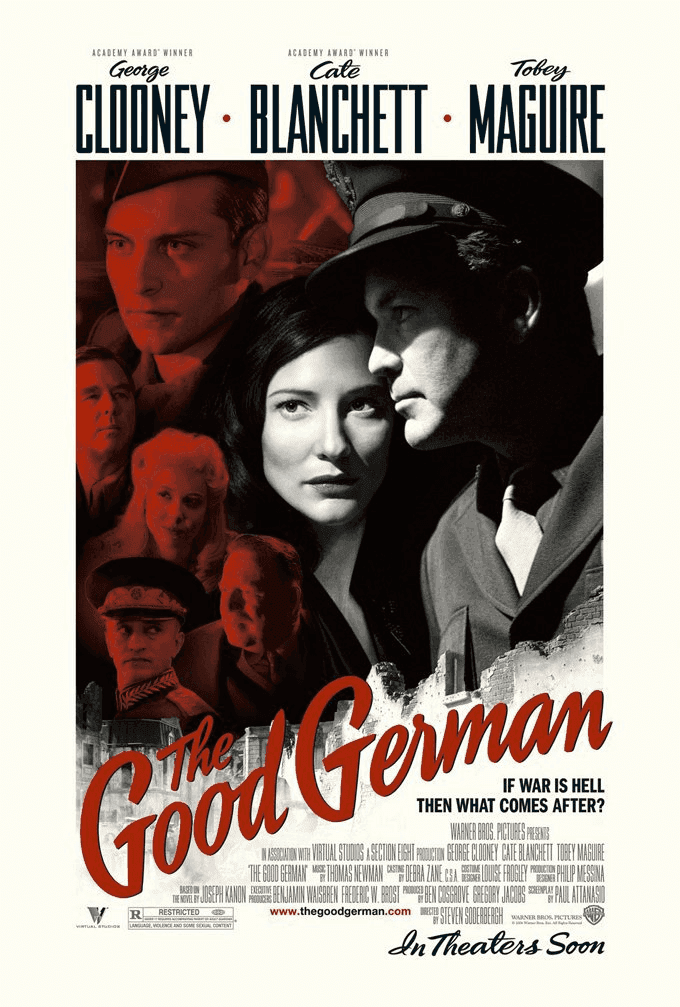
In the chaotic weeks following Germany's surrender, American war-correspondent Jake Geismer returns to a ruined Berlin to cover the Potsdam Conference and finds his former lover Lena Brandt working as a survival prostitute. When Jake's military driver Tully turns up dead, Jake is drawn into a search for Lena's missing husband, a scientist whose Nazi-era work both the Americans and the Soviets want to claim.
What Is the Budget of The Good German (2006)?
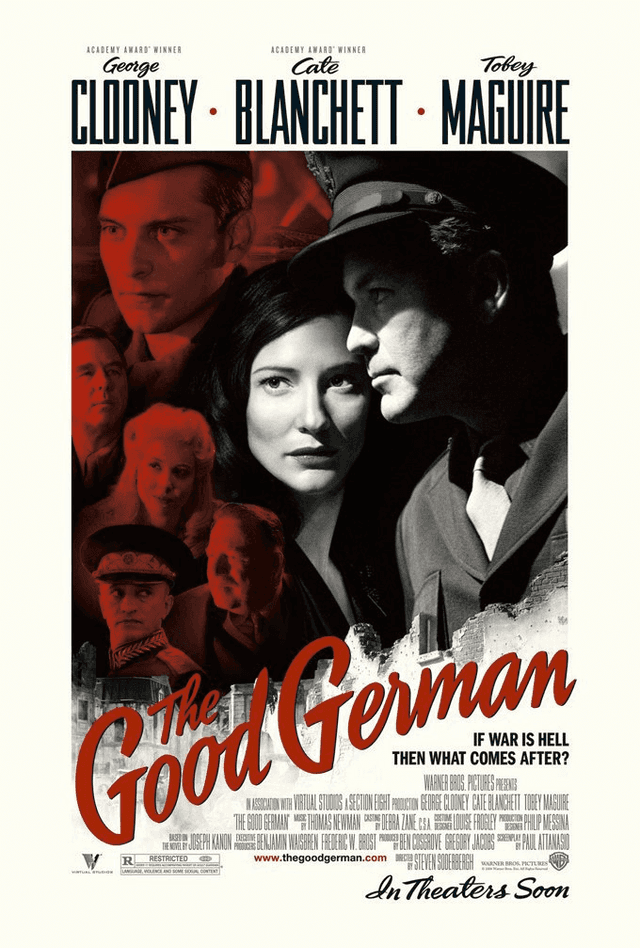
The Good German (2006), directed by Steven Soderbergh and distributed by Warner Bros. Pictures, was produced on a reported budget of $32,000,000. The film was a stylistic experiment: Soderbergh shot the picture using period-accurate 1940s production techniques, including incandescent lights, fixed-focal-length lenses, no boom microphones, fewer than 60 shots per day, and black-and-white film stock processed for a 1.37:1 Academy aspect ratio. The script by Paul Attanasio adapted Joseph Kanon's 2001 novel, transplanting the espionage thriller plot of the source into a deliberate pastiche of postwar films like The Third Man, Notorious, and Casablanca.
The investment reflected a contained-scale studio prestige play. Warner Bros. financed the production through Section Eight Productions, the Soderbergh-Clooney company that had also produced Ocean's Eleven and Good Night, and Good Luck. George Clooney took a reduced fee in line with his Section Eight practice, and Cate Blanchett, fresh off her Best Supporting Actress Oscar for The Aviator, attached to play Lena. Tobey Maguire, then in the middle of the Spider-Man trilogy, rounded out the principal trio.
Key Budget Allocation Categories
The Good German's $32,000,000 budget was distributed across these core production areas:
- Above-the-Line Talent: Steven Soderbergh took feature-director compensation appropriate to his Oscar-winning standing, plus producer participation through Section Eight. George Clooney, Cate Blanchett, and Tobey Maguire each took reduced fees substantially below their major-studio quotes in exchange for participation in a Soderbergh project. Writer Paul Attanasio (Quiz Show, Donnie Brasco) received feature scale.
- Period-Authentic Production Methodology: Soderbergh's choice to shoot using 1940s-era techniques (incandescent rather than HMI lighting, prime fixed lenses rather than zooms, no Steadicam, no boom microphones, dialogue captured by lavalier or on-camera dynamic mics in the period style) reduced equipment rental costs in some categories but slowed the shooting pace significantly. The compressed shot count per day meant longer total production days than a conventional 2006 shoot of equivalent length.
- Los Angeles and Berlin Locations: Principal photography took place primarily on stages at Warner Bros. in Burbank, California, with key second-unit work in Berlin for the establishing shots of the bombed-out city. The Burbank shoot used backlot ruins constructed specifically for the film, combined with archival World War II newsreel footage cut into the narrative for the period authenticity.
- Black-and-White Cinematography: Soderbergh shot the film himself under his pseudonym Peter Andrews on Kodak Double-X 5222 black-and-white film stock at a 1.37:1 Academy aspect ratio. The choice of film over digital (still the dominant capture medium in 2006 for prestige features) and the period aspect ratio carried higher stock and processing costs than a contemporary capture format.
- Production Design: Production designer Philip Messina (an Ocean's trilogy veteran) constructed the bombed Berlin sets at the Warner Bros. ranch, blending newly built rubble exteriors with archival match-cut footage of the actual postwar city. The set construction budget covered both the ruined Berlin streets and the interior reconstructions of period hotels, U.S. Army offices, and underground bars.
- Wardrobe: Costume designer Louise Frogley dressed the cast in period-accurate American military uniforms, civilian DP and refugee clothing, and the kind of late-1940s European tailoring that the genre referencs demanded. The wardrobe budget covered both new construction and authentic vintage acquisitions.
- Score: Composer Thomas Newman scored the film with a deliberate homage to Max Steiner and the Warner Bros. house orchestral style of the 1940s, recorded with a full orchestra at the Sony Pictures Scoring Stage. The music budget covered original composition, orchestra recording, and the period-authentic source cues used in the film's nightclub sequences.
How Does The Good German's Budget Compare to Similar Films?
At $32,000,000, The Good German sits in the mid-range of mid-2000s Soderbergh-directed star-led pictures. The comparison set shows how its commercial outcome diverged from its closest peers:
- Good Night, and Good Luck (2005): Budget $7,500,000 | Worldwide $54,600,000. Section Eight's previous black-and-white period drama, directed by Clooney, cost less than a quarter of The Good German and grossed nearly ten times as much while earning six Academy Award nominations including Best Picture.
- Solaris (2002): Budget $47,000,000 | Worldwide $30,000,000. Soderbergh's prior collaboration with Clooney for Twentieth Century Fox cost 47% more than The Good German and earned slightly less worldwide, providing the closest commercial peer for a Soderbergh-Clooney genre-experiment film.
- Ocean's Eleven (2001): Budget $85,000,000 | Worldwide $450,700,000. The Section Eight Soderbergh-Clooney heist that funded their experimental work cost nearly three times The Good German and grossed more than 75 times as much, providing the franchise economic foundation.
- The Black Dahlia (2006): Budget $50,000,000 | Worldwide $49,300,000. Brian De Palma's contemporaneous postwar Los Angeles noir cost 56% more than The Good German and grossed roughly 8 times as much, providing a direct genre peer that also underperformed expectations.
- Hollywoodland (2006): Budget $14,000,000 | Worldwide $16,800,000. Allen Coulter's George Reeves-Adrien Brody postwar Hollywood noir cost less than half The Good German and grossed nearly three times as much, illustrating the difficulty of monetizing prestige period noir in 2006.
The Good German Box Office Performance
The Good German opened in limited release on December 15, 2006 in five U.S. theaters as an Academy-qualifying release, grossing $40,665 over its opening weekend. The film expanded to a wide 564-theater release on January 12, 2007, grossing $1,300,000 over the expansion weekend. The domestic theatrical run ended at $1,300,000, and international receipts added $4,580,000, for a worldwide total of $5,880,000. Here is the financial breakdown:
Box Office Breakdown
The Good German

The Good German returned approximately $0.11 in worldwide theatrical gross for every $1 invested when measured against total estimated production and marketing spend, placing it among the clearest commercial disappointments in Soderbergh's major-studio career to that point. Domestic gross accounted for only 22% of the worldwide total, an unusually low split that reflected the limited art-house U.S. release and the marginally stronger European reception. Home-entertainment revenue on DVD and Blu-ray recovered a modest portion of the loss.
The commercial result contributed to the dissolution of Section Eight, which Soderbergh and Clooney had been planning to wind down. The company officially closed in 2006 after The Good German's release, with both partners moving to independent companies (Smokehouse Pictures for Clooney, eventually Extension 765 for Soderbergh).
The Good German Production History
Steven Soderbergh optioned Joseph Kanon's 2001 novel The Good German in 2003 and brought screenwriter Paul Attanasio (Donnie Brasco, Quiz Show) onto the project to adapt the source. The script went through several drafts as Soderbergh developed the period-authentic production methodology that would define the picture's approach. Warner Bros. greenlit the project through Section Eight in mid-2005, with George Clooney attached from the early development stage.
Principal photography ran from March to May 2006 on stages at Warner Bros. Studios in Burbank, California, with second-unit pickups in Berlin for the establishing exteriors of the bombed postwar city. The Burbank shoot used backlot ruins constructed specifically for the film, blended with archival World War II newsreel footage cut into the finished narrative. Soderbergh served as his own cinematographer under his Peter Andrews pseudonym.
The production methodology became one of the film's defining stories, both for the press cycle and for subsequent film-school analysis. Soderbergh prohibited boom microphones, Steadicam, modern lighting, and zoom lenses on set. Dialogue was captured using period-style on-camera microphones, with cast members required to project from the placement of the visible mics. The shooting pace fell to approximately 30 to 60 setups per day, slower than a typical 2006 feature but consistent with 1940s practice. Tobey Maguire shot his role during a Spider-Man 3 production hiatus.
Awards and Recognition
The Good German received one Academy Award nomination at the 79th ceremony in February 2007: Best Original Score for Thomas Newman, his ninth career nomination at that point. Newman lost to Gustavo Santaolalla for Babel. The film received no other nominations at the Academy Awards, BAFTAs, Golden Globes, or Screen Actors Guild Awards.
Within Soderbergh's filmography, The Good German is generally regarded as one of his most divisive experimental works alongside Bubble (2005) and the Ché diptych (2008), prized by admirers of his formal preoccupations but generally absent from the conversation about his commercial collaborations with Clooney and Roberts. The film closed Section Eight's decade-long run and signaled the end of the Soderbergh-Clooney studio-prestige collaboration phase.
Critical Reception
The Good German received mixed-to-negative reviews on release. The film holds a 32% approval rating on Rotten Tomatoes based on 167 critic reviews, with the consensus calling it "an impressive stylistic exercise that never finds emotional traction." On Metacritic, the film scored 50 out of 100, indicating mixed or average reviews. Audiences gave the film a C+ CinemaScore.
Roger Ebert gave the film two and a half out of four stars, writing that "Soderbergh proves he can make a 1947 movie, but not that he should have." Manohla Dargis in The New York Times called the film "a glossy, deliberate homage that mistakes nostalgia for narrative momentum." A.O. Scott described it as "an experiment that yields exactly the result you would expect: gorgeous and inert." Stephanie Zacharek at Salon offered one of the few unambiguously positive reviews, defending the film as "a serious attempt to think through what was lost when American cinema abandoned its 1940s grammar."
Negative reviews concentrated on the perceived disconnect between the period-authentic visual style and the contemporary frankness of the language and violence, particularly an early scene featuring graphic sexual content that critics argued no 1947 film would have included. Several reviewers noted that the formal exercise was more interesting as a film-school case study than as a dramatic experience. The film's reputation has improved modestly since release among admirers of Soderbergh's formal-experimentation phase, though it remains one of his lesser-discussed major releases.
Frequently Asked Questions
How much did it cost to make The Good German (2006)?
The reported production budget was $32,000,000. Warner Bros. Pictures financed the production through Section Eight Productions, the Soderbergh-Clooney company that had previously produced Ocean's Eleven and Good Night, and Good Luck, with Virtual Studios providing additional financing.
How much did The Good German earn at the box office?
The film grossed $1,300,000 domestically and $4,580,000 internationally, for a worldwide total of $5,880,000. It opened to $40,665 in five-theater limited release on December 15, 2006 and expanded to 564 theaters on January 12, 2007.
Was The Good German a box office bomb?
Yes. Against a $32,000,000 production budget and an estimated $20,000,000 to $25,000,000 in marketing spend, the film returned approximately $0.11 in worldwide gross for every $1 invested. The commercial failure contributed to the dissolution of Section Eight Productions, which closed in 2006 after the film's release.
Who directed The Good German?
Steven Soderbergh directed the film, working from a screenplay by Paul Attanasio adapting Joseph Kanon's 2001 novel. Soderbergh also served as his own cinematographer (credited as Peter Andrews) and editor (credited as Mary Ann Bernard), per his usual practice.
Why is The Good German shot in black and white?
Soderbergh deliberately constructed the film as a pastiche of 1940s noir cinema like The Third Man, Notorious, and Casablanca, using period-accurate production techniques including black-and-white film stock, the 1.37:1 Academy aspect ratio, incandescent lighting, fixed prime lenses, no boom microphones, and no Steadicam. The film was shot on Kodak Double-X 5222 stock.
Where was The Good German filmed?
Principal photography ran from March to May 2006 on stages at Warner Bros. Studios in Burbank, California, with second-unit pickups in Berlin for the establishing exteriors of the bombed postwar city. Production designer Philip Messina built rubble sets on the Warner Bros. ranch, blended with archival World War II newsreel footage.
Who stars in The Good German?
George Clooney stars as American war correspondent Jake Geismer, with Cate Blanchett as his former lover Lena Brandt and Tobey Maguire as military driver Patrick Tully. Supporting roles went to Beau Bridges, Tony Curran, Leland Orser, Jack Thompson, and Robin Weigert.
Is The Good German based on a book?
Yes. The film adapts Joseph Kanon's 2001 novel The Good German, an espionage thriller set in postwar Berlin. Screenwriter Paul Attanasio (Donnie Brasco, Quiz Show) restructured the novel's plot into the period-pastiche film Soderbergh ultimately directed.
What did critics think of The Good German?
The film received mixed-to-negative reviews, with a 32% Rotten Tomatoes approval (167 reviews), a 50 out of 100 Metacritic score, and a C+ CinemaScore from audiences. Critics broadly admired the stylistic ambition while objecting to the perceived disconnect between the period-authentic visual style and the contemporary frankness of the language.
Did The Good German win any awards?
The film received one Academy Award nomination: Best Original Score for Thomas Newman, his ninth career nomination at that point. Newman lost to Gustavo Santaolalla for Babel. The film received no other nominations at the Academy Awards, BAFTAs, Golden Globes, or Screen Actors Guild Awards.
Filmmakers
The Good German

Build budgets like this one in Saturation
Start from an industry-standard feature film template, import the schedule and rates you already have, and let the cost report keep itself current as you spend. Real-time collaboration, no spreadsheets.