The Glimmer Man Budget
 Action
Updated
Synopsis
Eccentric Los Angeles detective Jack Cole, a former covert operative haunted by his Special Forces past in Vietnam and Tibet, is partnered with by-the-book detective Jim Campbell to investigate a series of crucifixion murders. As the trail leads to Russian mobsters, military weapons, and a personal connection to Cole's shadowy past, the two detectives must work past their differences to stop a domestic conspiracy.
What Is the Budget of The Glimmer Man (1996)?
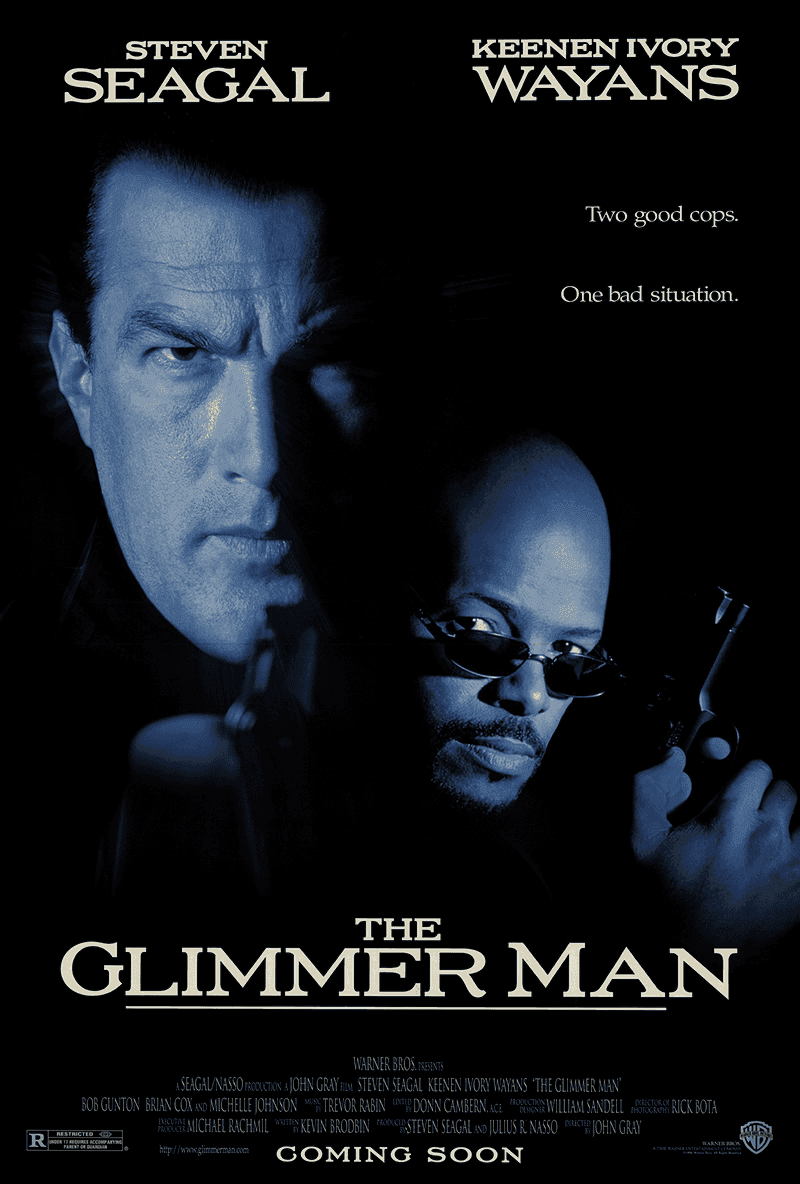
The Glimmer Man (1996), directed by John Gray and distributed by Warner Bros. Pictures, was produced on a reported budget of $20,000,000. The buddy-cop action thriller, pairing Steven Seagal and Keenen Ivory Wayans, was financed by Warner Bros. in partnership with producer Steven Seagal's production company Steamroller Productions. The $20,000,000 commitment was a modest mid-budget studio action production by 1996 standards, reflecting the established Seagal action template, the contained Los Angeles setting, and the limited stunt and effects requirements compared to a tentpole-tier action film.
The financial structure was built around Steven Seagal's mid-1990s action-star recognition and the Lethal Weapon-style buddy-cop format. Keenen Ivory Wayans, fresh off the In Living Color comedy series and Don't Be a Menace to South Central, joined as the comedic counterweight at a feature-launch rate. Director John Gray, primarily a television director, commanded a feature rate appropriate to his Brooklyn South work. The bulk of the budget went to the cast, Los Angeles location work, practical action sequences, and a Trevor Rabin score, with no major above-the-line star compensation outside Seagal.
Key Budget Allocation Categories
The $20,000,000 budget for The Glimmer Man was distributed across several core production areas:
- Above-the-Line Talent: Steven Seagal commanded his mid-1990s action-star rate, reportedly in the $7,000,000 to $10,000,000 range, plus a producer credit through Steamroller Productions. Keenen Ivory Wayans took a feature-launch rate, with Bob Gunton as the police lieutenant, Brian Cox as the Russian mob figure Frank Deverell, and supporting work from Stephen Tobolowsky and Michelle Johnson. Director John Gray commanded a television-to-feature rate.
- Los Angeles Location Work: The film shot extensively on location across Los Angeles, with crime-scene exteriors, police-station interiors, Russian-mob warehouse sequences, and a downtown rooftop chase. The location footprint was contained within Los Angeles County, allowing the production to draw on local crews and limit travel and freight costs.
- Practical Action Sequences: The film required substantial stunt and pyrotechnics coordination for the warehouse shootout, the rooftop chase, the climactic helicopter sequence, and a series of Seagal aikido fight choreographies. Stunt coordination was handled by Seagal's long-time team, with practical squib and explosive work on the warehouse and rooftop sequences.
- Trevor Rabin Score: Composer Trevor Rabin, then transitioning from a career as the lead guitarist of Yes into film composition with The Glimmer Man as one of his early scoring assignments before Con Air and Armageddon, delivered an electric-guitar-and-orchestra score that became one of his early signature feature credits.
- Production Design: Production designer Robb Wilson King dressed the Russian-mob warehouse, the police precinct interior, and the eccentric apartment of Seagal's Jack Cole character, which featured Tibetan Buddhist iconography and weapons-collection set dressing reflecting the character's Special Forces backstory.
- Marketing and Theatrical Release: Warner Bros. opened the film wide on October 4, 1996 on 2,012 screens, with an estimated prints and advertising spend in the $15,000,000 to $20,000,000 range to support the post-summer action-thriller window. The marketing campaign emphasized the Seagal-Wayans pairing and the buddy-cop format.
How Does The Glimmer Man's Budget Compare to Similar Films?
At $20,000,000, The Glimmer Man sits squarely in the mid-1990s range for mid-tier studio buddy-cop and Steven Seagal action vehicles. The comparison set illustrates how its commercial outcome compared with its peers:
- Under Siege 2: Dark Territory (1995): Budget $50,000,000 | Worldwide $104,300,000. Steven Seagal's previous Warner Bros. sequel cost two and a half times The Glimmer Man and grossed four times worldwide, illustrating how a higher-profile premise and tentpole positioning could outperform the buddy-cop format.
- Executive Decision (1996): Budget $55,000,000 | Worldwide $122,000,000. Seagal's contemporaneous Warner Bros. supporting role in the Kurt Russell hijack thriller cost nearly three times The Glimmer Man and grossed nearly five times worldwide, showing how Seagal worked better in support of an A-list lead than in a buddy pairing.
- Bulletproof (1996): Budget $25,000,000 | Worldwide $36,449,490. The contemporaneous Adam Sandler and Damon Wayans buddy-action film cost slightly more than The Glimmer Man and outgrossed it modestly, providing a near-direct apples-to-apples comparison.
- Fled (1996): Budget $25,000,000 | Worldwide $17,200,000. The contemporaneous Laurence Fishburne and Stephen Baldwin buddy-action film cost slightly more than The Glimmer Man and grossed substantially less, illustrating just how soft the buddy-action category was in 1996.
- Eraser (1996): Budget $100,000,000 | Worldwide $234,000,000. The Arnold Schwarzenegger contemporaneous Warner Bros. action film cost five times The Glimmer Man and grossed nine times worldwide, showing the gap between a Seagal-tier action vehicle and a Schwarzenegger-tier tentpole.
The Glimmer Man Box Office Performance
The Glimmer Man opened wide on October 4, 1996 on 2,012 screens, earning $9,237,028 in its opening weekend and finishing first at the domestic box office, narrowly beating That Thing You Do! and the second weekend of The First Wives Club. The opening was a respectable result for a Steven Seagal mid-budget action film in the post-summer window, although weekend-over-weekend declines were sharp, indicating limited audience word of mouth.
Against a $20,000,000 production budget, the film needed approximately $50,000,000 worldwide to reach profitability after marketing. Here is the financial breakdown:
Box Office Breakdown
The Glimmer Man

The Glimmer Man returned approximately $0.68 in worldwide theatrical revenue for every $1 invested when measured against total estimated production and marketing spend, marking it a theatrical loss for Warner Bros. The domestic share of $20,351,264 against an international share of approximately $5,300,000 was a 79/21 split heavily weighted toward North America, indicating that the Steven Seagal action audience did not travel as strongly to European and Asian markets as comparable Schwarzenegger or Stallone vehicles.
The film recouped substantially through home video and pay-television licensing through 1997 and 1998, becoming a steady catalog title for Warner Bros. The theatrical disappointment, however, marked the beginning of Steven Seagal's transition away from major studio theatrical leading-man roles toward the direct-to-video action category that would define the second half of his career through the late 1990s and 2000s.
The Glimmer Man Production History
Development began at Warner Bros. in 1995 immediately after Under Siege 2: Dark Territory delivered respectable returns. Screenwriter Kevin Brodbin delivered the original screenplay, which framed itself around the buddy-cop format with a Lethal Weapon-style mismatched-partner dynamic between a covert-operations-trained eccentric (Seagal) and a by-the-book detective (Wayans). Producer Julius R. Nasso of Steamroller Productions, Steven Seagal's long-time producing partner, anchored the project.
John Gray was attached to direct in early 1996, making The Glimmer Man one of his earliest feature credits after a substantial television-directing career. Casting Keenen Ivory Wayans as Jim Campbell in spring 1996 was a deliberate effort to widen the audience appeal beyond Seagal's core action constituency, with Wayans fresh off In Living Color and the parody feature Don't Be a Menace to South Central. Bob Gunton joined as the police lieutenant, with Brian Cox as the Russian mob figure Frank Deverell.
Principal photography ran from May to August 1996 across Los Angeles County, with the production using practical exteriors and a contained location footprint to manage the modest budget. The Russian-mob warehouse, the rooftop chase, and the climactic helicopter sequence were captured with practical stunts and pyrotechnics by Seagal's long-time stunt team. Trevor Rabin recorded the score in late summer 1996, with the film completed for an October 4, 1996 release.
Production was reportedly marked by tension between Steven Seagal and director John Gray over creative control and Seagal's preferred approach to his fight choreography, with subsequent press characterizing the working relationship as strained. The post-production process included revisions to several action sequences, although the final cut largely preserved the original screenplay structure. The film opened wide on October 4, 1996 and, while it topped the domestic box office in its first weekend, underperformed against earlier Seagal vehicles in worldwide gross.
Awards and Recognition
The Glimmer Man received no major awards nominations. The film failed to register at the Academy Awards, Golden Globes, BAFTA Awards, Saturn Awards for genre filmmaking, or any of the major industry honors. Steven Seagal's lead performance, while drawing the typical action-star coverage in trade press, did not generate either positive awards traction or significant Razzie attention that year.
Trevor Rabin's score earned no major industry recognition, although it became a stepping stone in his transition from rock guitar to feature scoring that would carry through Con Air, Armageddon, and the National Treasure films. The film has retained modest catalog visibility as a touchstone Steven Seagal mid-1990s buddy-cop entry, frequently cited in retrospectives of Seagal's pre-direct-to-video studio period and in discussions of the failed attempts to broaden his audience appeal beyond the core action constituency.
Critical Reception
The Glimmer Man received negative reviews. The film holds a 14% approval rating on Rotten Tomatoes based on 22 critic reviews retrospectively logged, with a critical consensus that called the screenplay incoherent and the Seagal-Wayans pairing chemistry-free. Contemporary 1996 reviews ranged from mildly dismissive to actively hostile. Audiences responded somewhat better than critics, with the film earning a B-minus CinemaScore exit response and a respectable opening weekend.
Critics broadly excoriated the convoluted screenplay, the strained chemistry between Steven Seagal and Keenen Ivory Wayans, the underused Brian Cox supporting performance, and the unfocused direction by John Gray. Roger Ebert in the Chicago Sun-Times gave the film one and a half stars and wrote that "the movie can't decide if it wants to be a thriller, a buddy comedy, or a martial-arts showcase, and it ends up being none of them very well." Variety's Todd McCarthy called it "an underbaked attempt to graft buddy-comedy beats onto a Steven Seagal vehicle that didn't want them."
Action and genre press were no more forgiving. Entertainment Weekly's Owen Gleiberman wrote that "the Russian mob plot would be incomprehensible even if you cared about the characters, which you don't." The negative critical reception combined with the soft commercial performance has positioned The Glimmer Man as a clear inflection point in Steven Seagal's career, the moment when his ability to deliver studio-tentpole-tier returns ended and the long descent into direct-to-video began.
Frequently Asked Questions
How much did The Glimmer Man (1996) cost to make?
The reported production budget was $20,000,000. Warner Bros. Pictures financed the film in partnership with Steven Seagal's production company Steamroller Productions, run by long-time Seagal producing partner Julius R. Nasso. Seagal commanded a star fee reportedly in the $7,000,000 to $10,000,000 range plus producer credit.
How much did The Glimmer Man earn at the box office?
The film grossed $20,351,264 domestically and approximately $5,300,000 internationally, for a worldwide total of $25,651,264. It opened to $9,237,028 in the United States on October 4, 1996, finishing first at the domestic box office in its opening weekend, narrowly beating That Thing You Do! and the second weekend of The First Wives Club.
Was The Glimmer Man a box office success?
No. Against a $20,000,000 production budget and an estimated $15,000,000 to $20,000,000 in marketing spend, the film returned approximately $0.68 in worldwide gross for every $1 invested. Warner Bros. absorbed an estimated theatrical loss of around $12,000,000. The theatrical disappointment marked the beginning of Steven Seagal's transition away from major studio leading-man roles toward direct-to-video.
Who directed The Glimmer Man?
John Gray directed the film. The Glimmer Man was among Gray's earliest feature credits after a substantial television-directing career. The screenplay was written by Kevin Brodbin. Production was reportedly marked by tension between Steven Seagal and Gray over creative control and Seagal's preferred approach to his fight choreography.
Where was The Glimmer Man filmed?
Principal photography took place from May to August 1996 across Los Angeles County, with the production using practical exteriors and a contained location footprint to manage the modest budget. Crime-scene exteriors, police-station interiors, Russian-mob warehouse sequences, and a downtown rooftop chase were all captured within Los Angeles County.
Who plays Jack Cole in The Glimmer Man?
Steven Seagal plays Jack Cole, the eccentric Los Angeles detective and former covert operative haunted by his Special Forces past in Vietnam and Tibet. The character's apartment is dressed with Tibetan Buddhist iconography and weapons-collection set decoration reflecting the backstory, an unusual character-detail choice for a 1996 buddy-cop action film.
Who plays Jim Campbell in The Glimmer Man?
Keenen Ivory Wayans plays Jim Campbell, the by-the-book detective partnered with Jack Cole. Wayans came to the project fresh off the In Living Color comedy series on Fox and the parody feature Don't Be a Menace to South Central, and was cast as a deliberate effort to widen the audience appeal beyond Steven Seagal's core action constituency.
Who scored The Glimmer Man?
Trevor Rabin, then transitioning from a career as the lead guitarist of Yes into film composition, scored the film with an electric-guitar-and-orchestra approach. The Glimmer Man was among Rabin's earliest feature scoring assignments and became a stepping stone in his transition to Con Air, Armageddon, and the National Treasure films.
What did critics think of The Glimmer Man?
The film received negative reviews, with a 14% approval rating on Rotten Tomatoes retrospectively and contemporary reviews ranging from mildly dismissive to actively hostile. Roger Ebert gave it one and a half stars, writing that the film couldn't decide if it wanted to be a thriller, a buddy comedy, or a martial-arts showcase. Audiences gave it a B-minus CinemaScore.
Did The Glimmer Man get a sequel?
No. The soft theatrical performance, combined with Steven Seagal's subsequent transition to direct-to-video, prevented any sequel development. Seagal would return to limited Warner Bros. theatrical work but the buddy-cop format with a comedic counterweight was not attempted again. The film stands as a single entry in Seagal's late-1990s studio filmography.
Filmmakers
The Glimmer Man

Build budgets like this one in Saturation
Start from an industry-standard feature film template, import the schedule and rates you already have, and let the cost report keep itself current as you spend. Real-time collaboration, no spreadsheets.