The Glass House Budget
 Thriller/Suspense
Updated
Synopsis
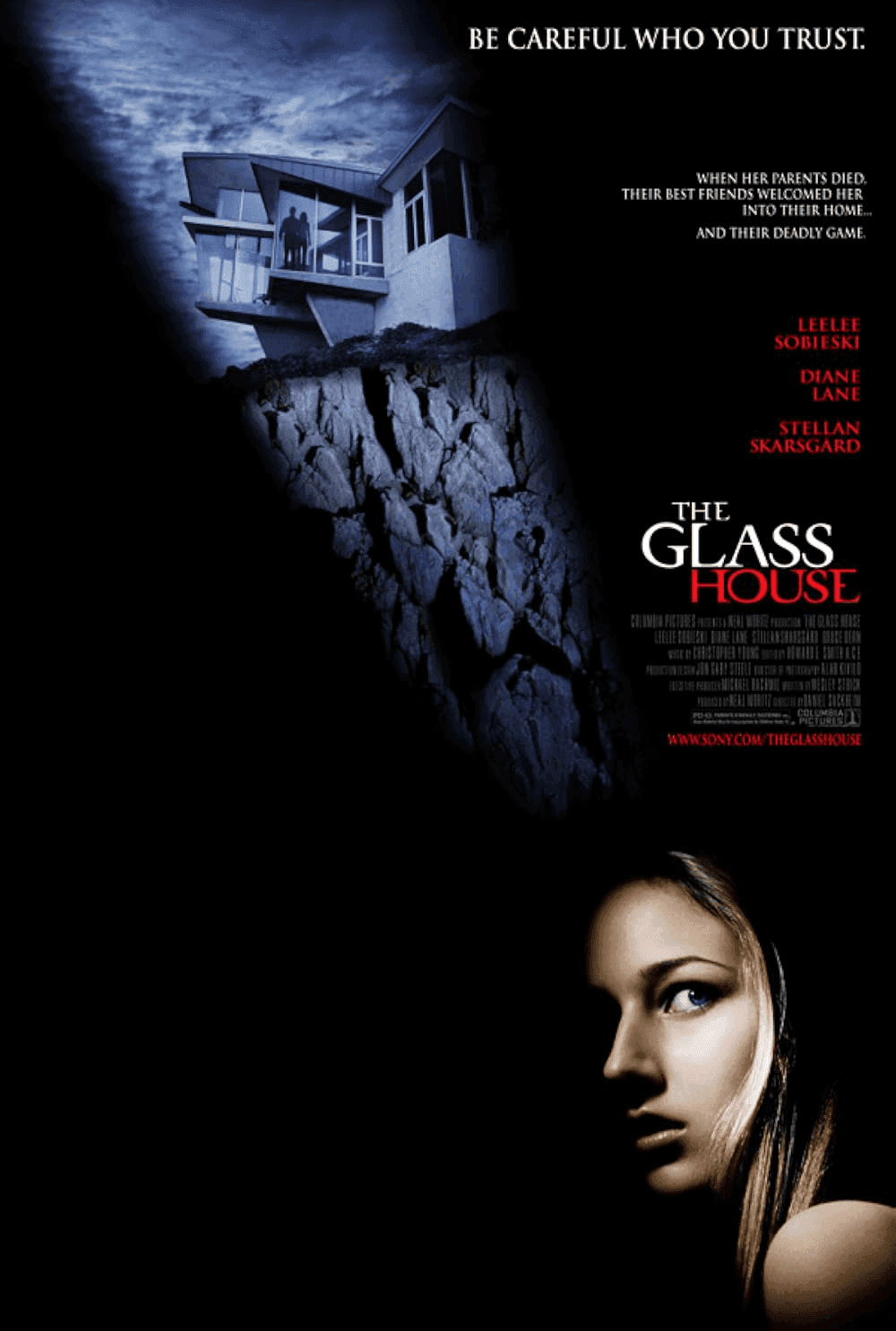
After her parents die in a car crash, teenager Ruby Baker and her young brother Rhett move in with their wealthy guardians in a Malibu glass-walled mansion. As Ruby uncovers unsettling truths about the Glasses' finances and their interest in the inheritance trust, she comes to suspect the accident was not what it seemed.
What Is the Budget of The Glass House (2001)?
The Glass House (2001), directed by Daniel Sackheim and distributed by Columbia Pictures, was produced on a reported budget of $22,000,000. The teen-led psychological thriller, written by Wesley Strick, was financed by Columbia in partnership with Original Film and Mediastream Film, with regional rights split internationally. The $22,000,000 commitment positioned the film as a mid-budget studio thriller targeting the teen and young-adult demographic, opening in September 2001 during the post-summer thriller window.
The financial structure was built around recent teen-thriller successes such as I Know What You Did Last Summer and Disturbing Behavior. Leelee Sobieski headlined as the teenage protagonist after breakout roles in Eyes Wide Shut and Joy Ride, with Diane Lane and Stellan Skarsgård as the menacing guardians and Bruce Dern in a smaller supporting role. The bulk of the budget went to the cast, location shooting in Malibu and Los Angeles, the construction of additional glass-house interior sets, and a Christopher Young thriller score.
Key Budget Allocation Categories
The $22,000,000 budget for The Glass House was distributed across several core production areas:
- Above-the-Line Talent: Leelee Sobieski led the cast as Ruby Baker, coming off significant young-adult visibility from Eyes Wide Shut, Here on Earth, and Joy Ride. Diane Lane and Stellan Skarsgård played the menacing guardians Erin and Terry Glass, both commanding established adult-drama rates. Bruce Dern played Ruby's family attorney Alvin Begleiter. Director Daniel Sackheim, primarily a television director and producer (The X-Files, NYPD Blue), commanded a feature-director rate appropriate to his first studio thriller.
- Malibu and Los Angeles Location Work: The film shot extensively at a modernist Malibu glass house and additional Los Angeles locations covering the high school, the legal offices, and the harbor sequences. Location fees for the modernist mansion, security, and the closed-set requirements of a teenage cast added meaningful production cost.
- Glass House Interior Sets: While exteriors and some interiors used the practical Malibu location, the production built additional glass-walled interior sets on soundstages at Culver Studios in Los Angeles to allow controlled lighting and camera movement for the climactic sequences. The transparent-set construction was a substantial below-the-line line item.
- Christopher Young Score: Composer Christopher Young, known for Hellraiser and The Gift, scored the film with a string-driven thriller approach. The score was recorded with a full orchestra and required substantial studio time for the climactic sequences.
- Visual Effects: While most of the film was practical, the climactic car-in-pool sequence and several reveal moments required digital compositing work. The visual-effects budget was modest compared to a creature feature or action film but still represented a meaningful line item.
- Marketing and Theatrical Release: Columbia opened the film wide on September 14, 2001 on 2,538 screens, with an estimated prints and advertising spend in the $20,000,000 to $25,000,000 range to support the post-summer thriller positioning. The marketing campaign was forced into adjustment after the September 11 attacks, which fell just three days before the film's release.
How Does The Glass House's Budget Compare to Similar Films?
At $22,000,000, The Glass House sits squarely in the mid-budget range for early-2000s teen-led thrillers. The comparison set illustrates how its commercial outcome compared with its peers:
- I Know What You Did Last Summer (1997): Budget $17,000,000 | Worldwide $125,586,134. Sony's late-1990s teen-thriller hit cost slightly less than The Glass House and grossed more than three times worldwide, demonstrating the upper ceiling for the category at the time.
- Disturbing Behavior (1998): Budget $15,000,000 | Worldwide $17,521,432. MGM's teen-led psychological thriller cost less than The Glass House and grossed less than half worldwide, illustrating the soft floor of the same demographic.
- Joy Ride (2001): Budget $23,000,000 | Worldwide $36,642,838. The contemporaneous Fox thriller with Leelee Sobieski's co-star Steve Zahn cost essentially the same and grossed approximately the same worldwide, providing a near-direct apples-to-apples comparison.
- The Sixth Sense (1999): Budget $40,000,000 | Worldwide $672,806,432. The M. Night Shyamalan supernatural thriller cost less than twice as much and grossed more than seventeen times worldwide, illustrating the gap between a category hit and a category-tier-2 entry.
- Final Destination (2000): Budget $23,000,000 | Worldwide $112,880,294. New Line's teen-led supernatural thriller cost essentially the same as The Glass House and grossed nearly three times worldwide, showing what a more high-concept hook could deliver in the same window.
The Glass House Box Office Performance
The Glass House opened wide on September 14, 2001 on 2,538 screens, earning $5,938,213 in its opening weekend and finishing third at the domestic box office behind The Others and Hardball. The opening weekend fell just three days after the September 11 terrorist attacks, with most studios delaying or pulling marketing campaigns and audience theatrical attendance dropping sharply across the country. Despite the disrupted release window, the film held reasonably through its run.
Against a $22,000,000 production budget, the film needed approximately $50,000,000 worldwide to reach profitability after marketing. Here is the financial breakdown:
Box Office Breakdown
The Glass House (2001)

The Glass House returned approximately $0.87 in worldwide theatrical revenue for every $1 invested when measured against total estimated production and marketing spend, falling just short of theatrical break-even but recouping the bulk of the investment. The domestic share of $23,355,786 against an international share of approximately $15,200,000 was a 61/39 split that suggested the teen-thriller premise traveled reasonably well to European markets.
The film recouped fully through home video and pay-television licensing through 2002 and 2003, and a direct-to-video sequel, The Glass House: The Good Mother, was produced and released in 2006, indicating Sony Pictures Home Entertainment's confidence in the property's catalog value despite the theatrical short-fall.
The Glass House Production History
Development began at Columbia in 1999 when Wesley Strick delivered the original screenplay, which framed itself around the modernist-mansion-as-prison conceit. Strick, known for thriller writing on Cape Fear and Final Analysis, had pitched the project as a teen-led entry in the gothic-orphan-thriller tradition stretching back to The Bad Seed and Stoker. Producer Neal Moritz of Original Film, fresh off I Know What You Did Last Summer and Cruel Intentions, optioned the screenplay.
Daniel Sackheim, a long-time television director and producer with significant X-Files and NYPD Blue credits, was attached to direct in late 2000, making The Glass House his feature debut. Casting Leelee Sobieski as Ruby Baker in early 2001 reflected Columbia's push to anchor the teen-thriller positioning with a recognizable young-adult lead. Diane Lane and Stellan Skarsgård joined as the menacing guardians, with Bruce Dern, Trevor Morgan, and Kathy Baker rounding out the supporting cast.
Principal photography ran from March to May 2001, primarily on location at a modernist Malibu glass house with additional Los Angeles work covering the high school, legal offices, and harbor sequences. The production built additional glass-walled interior sets on soundstages at Culver Studios to allow controlled lighting and camera movement for the climactic sequences. Christopher Young recorded the score in summer 2001, with the film completed for a September 14, 2001 release.
The film's opening weekend fell three days after the September 11 attacks. Columbia adjusted its marketing campaign on short notice, pulling television spots that featured imagery of car crashes and home-invasion threats. Despite the disrupted release window, the film opened to a respectable $5,938,213 and held reasonably through its theatrical run, with the eventual worldwide total recouping the bulk of the investment.
Awards and Recognition
The Glass House received no major awards nominations. The film failed to register at the Academy Awards, Golden Globes, BAFTA Awards, Saturn Awards for genre filmmaking, or Teen Choice Awards. Leelee Sobieski's lead performance, while broadly praised by genre critics, did not generate the same awards traction that her contemporary work on Joan of Arc (1999) had earned her at the Golden Globes and Emmys.
Christopher Young's thriller score earned no major industry recognition, although Young remained one of the more decorated working thriller composers of the era. The film has retained modest catalog visibility through home video and streaming and was sequelized in 2006 with The Glass House: The Good Mother, but it has not built the cult following of contemporaneous teen thrillers such as Final Destination or I Know What You Did Last Summer.
Critical Reception
The Glass House received mixed reviews. The film holds a 33% approval rating on Rotten Tomatoes based on 105 critic reviews, with a critical consensus that called Leelee Sobieski capable but the script formulaic and the suspense undercooked. On Metacritic, the film scored 47 out of 100, indicating mixed or average reviews. Audiences surveyed by CinemaScore gave the film a B, the typical floor for studio thrillers and a clear signal that the genre audience was reasonably satisfied.
Critics broadly praised Leelee Sobieski's lead performance, Stellan Skarsgård's menacing turn as the guardian Terry Glass, and the modernist Malibu glass-house production design, but objected to the predictable structure of Wesley Strick's screenplay, the broad characterization of Diane Lane's Erin Glass, and Daniel Sackheim's unfocused pacing of the central mystery. Roger Ebert in the Chicago Sun-Times gave the film 1.5 stars and wrote that "the screenplay is the thing thats broken; it just doesn't have the energy to support the visual concept." Variety's Robert Koehler called Sobieski "the only fully realized element in a film that mistakes its setting for its story."
Genre press were more forgiving. Fangoria praised Christopher Young's score and the climactic glass-set sequences, with the film finding a steady audience on cable through the 2000s. The mixed-to-negative critical reception combined with the modestly soft commercial performance has positioned The Glass House as a competent but unmemorable entry in the early-2000s teen-thriller cycle, overshadowed in retrospect by the bigger I Know What You Did Last Summer and Final Destination franchises.
Frequently Asked Questions
How much did The Glass House (2001) cost to make?
The reported production budget was $22,000,000. Columbia Pictures financed the film in partnership with Original Film, producer Neal Moritz's production company, and Mediastream Film, with the bulk of the budget going to the cast, the modernist Malibu location work, and additional glass-walled interior sets at Culver Studios.
How much did The Glass House earn at the box office?
The film grossed $23,355,786 domestically and approximately $15,200,000 internationally, for a worldwide total of $38,555,786. It opened to $5,938,213 in the United States on September 14, 2001, three days after the September 11 terrorist attacks, finishing third on its opening weekend behind The Others and Hardball.
Was The Glass House a box office success?
Not quite. Against a $22,000,000 production budget and an estimated $20,000,000 to $25,000,000 in marketing spend, the film returned approximately $0.87 in worldwide gross for every $1 invested, falling just short of theatrical break-even. Home video and pay-television licensing recouped the remainder, and a direct-to-video sequel followed in 2006.
Who directed The Glass House?
Daniel Sackheim directed the film. The Glass House was Sackheim's feature debut after a long career as a television director and producer with significant credits on The X-Files and NYPD Blue. The screenplay was written by Wesley Strick, known for thriller writing on Cape Fear and Final Analysis.
Where was The Glass House filmed?
Principal photography took place from March to May 2001, primarily on location at a modernist Malibu glass house with additional Los Angeles work covering the high school, legal offices, and harbor sequences. The production built additional glass-walled interior sets on soundstages at Culver Studios to allow controlled lighting for the climactic sequences.
Who plays Ruby Baker in The Glass House?
Leelee Sobieski plays Ruby Baker, the teenage protagonist. Sobieski came to the project after breakout roles in Eyes Wide Shut, Here on Earth, and Joy Ride, and brought significant young-adult recognition to the project. Trevor Morgan plays her younger brother Rhett.
Who plays the Glass guardians?
Diane Lane and Stellan Skarsgård play Erin and Terry Glass, the menacing guardians who take custody of Ruby and Rhett after the children's parents die. Bruce Dern appears in a smaller supporting role as Alvin Begleiter, the family attorney managing the children's inheritance trust.
Did the September 11 attacks affect The Glass House's release?
Yes. The film opened on September 14, 2001, three days after the attacks, and Columbia adjusted its marketing campaign on short notice, pulling television spots that featured imagery of car crashes and home-invasion threats. Theatrical attendance dropped sharply nationwide that weekend, though the film still managed a respectable third-place opening behind The Others and Hardball.
What did critics think of The Glass House?
The film received mixed reviews, with a 33% approval rating on Rotten Tomatoes and a 47 out of 100 score on Metacritic. Audiences gave it a B CinemaScore. Critics praised Leelee Sobieski's lead performance and Stellan Skarsgård's menacing turn but objected to Wesley Strick's predictable screenplay and Daniel Sackheim's unfocused pacing.
Did The Glass House get a sequel?
Yes. A direct-to-video sequel, The Glass House: The Good Mother, was produced and released in 2006 by Sony Pictures Home Entertainment. The sequel was a standalone story with no returning cast and made no theatrical play, reflecting Sony's catalog confidence in the property despite the original's soft theatrical performance.
Filmmakers
The Glass House (2001)

Build budgets like this one in Saturation
Start from an industry-standard feature film template, import the schedule and rates you already have, and let the cost report keep itself current as you spend. Real-time collaboration, no spreadsheets.