What Lies Beneath Budget
 Thriller/Suspense
Updated
Synopsis
A Vermont couple, Norman and Claire Spencer, settle into their lakeside home after Claire's daughter leaves for college. As Claire begins to experience inexplicable phenomena that suggest the house is haunted, she becomes convinced that the spirit of a missing young woman is reaching out to her, and her investigation gradually exposes a buried secret in Norman's past.
What Is the Budget of What Lies Beneath (2000)?
What Lies Beneath (2000), directed by Robert Zemeckis and distributed jointly by DreamWorks Pictures in North America and 20th Century Fox internationally, was produced on a reported budget of $100,000,000. The supernatural thriller starred Harrison Ford and Michelle Pfeiffer as a Vermont couple whose lakeside home becomes the site of a slow-burn haunting tied to a buried secret. Zemeckis shot the film during a planned production gap on Cast Away while Tom Hanks lost weight for that film's second half, an unusually opportunistic use of a studio production pause that allowed him to complete two studio features back to back.
The investment reflected the cost of attaching two of the most expensive movie stars working in 2000 to a single project, with Ford and Pfeiffer commanding combined above-the-line compensation reported in the $35,000,000 range. DreamWorks and Fox split the financing and distribution rights as a co-production, with DreamWorks retaining the higher-grossing domestic market and Fox taking international, a structure that hedged the unusually large star budget across two major studios rather than concentrating the risk on a single balance sheet.
Key Budget Allocation Categories
What Lies Beneath's reported $100,000,000 budget was distributed across several core production areas:
- Above-the-Line Talent: Harrison Ford and Michelle Pfeiffer, both A-list stars at the height of their commercial power, commanded the single largest portion of the budget, with combined fees reported around $35,000,000. Director Robert Zemeckis, fresh from the box office success of Contact (1997) and in the middle of producing Cast Away simultaneously, received a director and producer fee appropriate to a back-to-back Tom Hanks and Harrison Ford studio tentpole pairing.
- Lakeside Location Shoot: Principal photography took place around Lake Champlain in Vermont, with extensive practical-location work and the construction of the Spencer family lakeside home as a fully functional set. Lake exteriors, dock sequences, and storm-water effects required custom rigs, marine units, and a substantial second-unit budget to capture the New England water imagery that anchors the film's atmosphere.
- Visual Effects and Bathtub Sequence: The film's climactic underwater sequences, including the celebrated bathtub paralysis set piece, required Sony Pictures Imageworks and other vendors to deliver subtle but technically demanding water and apparition effects. The full-body paralysis effect, which Pfeiffer performed with her face partially submerged, required custom rigging, controlled water surfaces, and digital cleanup to maintain continuity across multiple takes.
- Score and Music: Composer Alan Silvestri, a long-standing Zemeckis collaborator dating back to the Back to the Future films, delivered an orchestral score that consciously evoked Bernard Herrmann's Hitchcock work, particularly Vertigo and Psycho. The score required a full orchestra and a multi-week recording schedule, with Silvestri's above-the-line composer fee reflecting his standing as one of the highest-paid film composers of the era.
- Production Design and the Spencer House: Production designer Rick Carter, another regular Zemeckis collaborator, built the Spencer family home both as practical Vermont exteriors and as Universal Studios stages in Los Angeles, with interior sets including the central bathroom, foyer, and lake-facing porch designed to be both photogenic and mechanically capable of accommodating the water sequences.
- Marketing the Twist: While not a direct production line item, the studio committed an unusually disciplined marketing campaign that aggressively obscured the film's third-act reveal. Trailer cut sequences, talk-show appearances, and the theatrical poster were all structured to misdirect audiences about the nature of the haunting, with Zemeckis personally signing off on key promotional materials to preserve the twist.
How Does What Lies Beneath's Budget Compare to Similar Films?
At a reported $100,000,000, What Lies Beneath was one of the most expensive supernatural thrillers ever produced at the time of its release. The comparison set below illustrates how its star-driven budget stacked up against contemporaneous genre peers:
- The Sixth Sense (1999): Budget $40,000,000 | Worldwide $672,806,432. M. Night Shyamalan's twist-driven Disney supernatural thriller cost less than half what What Lies Beneath spent and grossed more than double worldwide, a comparison that defined the surprise hit benchmark for the genre going into 2000.
- What Lies Beneath-adjacent Stir of Echoes (1999): Budget $12,000,000 | Worldwide $23,386,254. Artisan's Kevin Bacon supernatural thriller cost roughly one eighth of What Lies Beneath and earned a fraction of the worldwide total, demonstrating how dramatically star-driven Zemeckis-scale production scaled the genre upward.
- The Others (2001): Budget $17,000,000 | Worldwide $209,947,037. Alejandro Amenábar's Nicole Kidman ghost story cost less than one fifth of What Lies Beneath and earned roughly seventy percent of its worldwide gross, illustrating that the audience appetite for atmospheric haunted-house thrillers did not require A-list dual stars or Zemeckis-scale production design.
- Hollow Man (2000): Budget $95,000,000 | Worldwide $190,213,455. Paul Verhoeven's Kevin Bacon invisibility thriller, released the same summer, cost roughly the same as What Lies Beneath and earned about two thirds as much worldwide, providing the closest direct comp for a star-driven, effects-heavy adult thriller of summer 2000.
- Signs (2002): Budget $72,000,000 | Worldwide $408,247,917. Shyamalan's follow-up to The Sixth Sense, with Mel Gibson, cost approximately seventy percent of What Lies Beneath and out-grossed it worldwide, demonstrating the audience preference for grounded supernatural premises with a single megastar over the dual-A-list approach.
What Lies Beneath Box Office Performance
What Lies Beneath opened on July 21, 2000, finishing first at the domestic box office with $29,702,959 over its opening weekend, an exceptionally strong July opening for a non-action, non-sequel adult thriller. The film legged out unusually well, holding within thirty to forty percent declines for several weeks on positive word of mouth, eventually grossing $155,464,351 domestically. Here is the financial breakdown:
Box Office Breakdown
What Lies Beneath

What Lies Beneath returned approximately $1.82 to $1.95 in theatrical revenue for every $1 invested when measured against total estimated production and marketing spend, before accounting for DVD, VHS, pay television, and broadcast windows that would have pushed the lifetime return well past two-to-one. The domestic share of the gross was $155,464,351 against an international share of $135,500,000, a 53/47 split that demonstrated unusual genre balance for an English-language psychological thriller.
The result justified the dual-studio co-financing structure and represented a clear win for both DreamWorks and Fox. For Harrison Ford it was the second-largest grossing film of his post-Star Wars career at the time, and for Pfeiffer it ranked as her second-highest grossing live-action lead, behind only Batman Returns. The film's success also reinforced the commercial viability of adult-skewing summer counter-programming opposite the season's typical youth-oriented action and family releases.
What Lies Beneath Production History
Development began in 1998 when screenwriter Clark Gregg, then primarily known as a stage actor, sold his spec script to Robert Zemeckis's ImageMovers production company. Zemeckis read the script during pre-production on Cast Away and recognized that the Cast Away schedule built in a four-month production gap in mid-1999 to allow Tom Hanks to lose roughly fifty pounds for the second half of that film. Rather than let the pause run its course, Zemeckis used the window to shoot What Lies Beneath, an unprecedented use of a fellow production's downtime to mount a major studio feature.
Harrison Ford was attached first, with Pfeiffer joining in February 1999. Casting was completed quickly to align with the Cast Away pause schedule, and Zemeckis assembled a crew of his regular collaborators, including cinematographer Don Burgess, editor Arthur Schmidt, composer Alan Silvestri, and production designer Rick Carter, many of whom were also working on Cast Away in parallel pre-production and post-production capacities.
Principal photography ran from May to August 1999, with location work around Lake Champlain in Vermont and interior stages at Universal Studios in Los Angeles. The lakeside set was constructed on a working Vermont property, and the production worked closely with local film commissions to coordinate the marine units and water choreography required for the climactic sequences. Zemeckis returned to Cast Away principal photography in late 1999 immediately after What Lies Beneath wrapped.
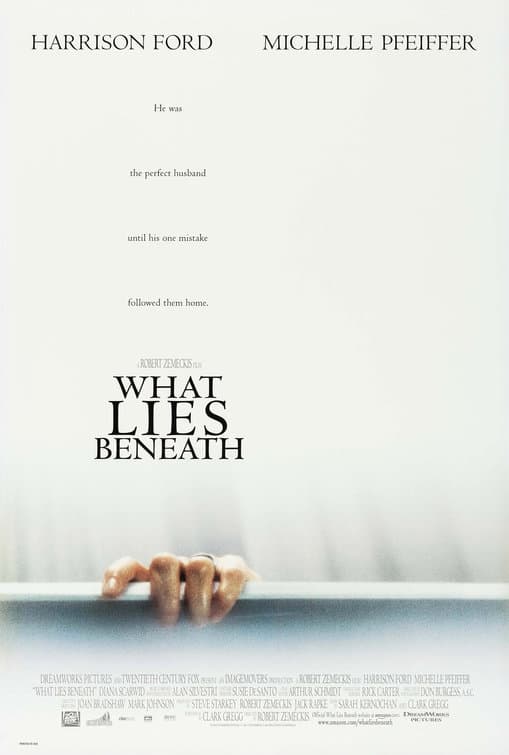
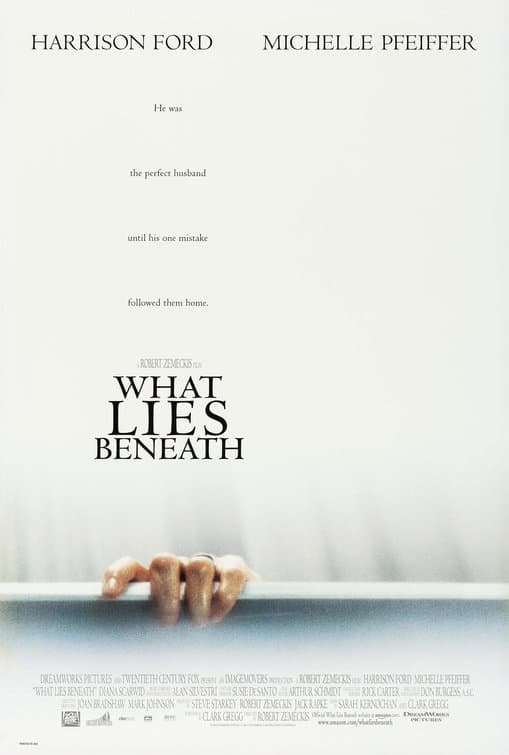
Sony Pictures Imageworks handled the bulk of the digital effects in post, with the bathtub paralysis sequence requiring extensive practical-effect rehearsal and digital cleanup. Marketing emphasized the Hitchcock-style suspense framework and consciously avoided revealing the supernatural mechanics, with the famous tagline "He was the perfect husband until his one mistake followed them home" structured to suggest a marital thriller rather than a ghost story.
Awards and Recognition
What Lies Beneath received limited but notable awards recognition. The film was nominated for the Saturn Award for Best Horror Film at the 27th Saturn Awards, and Michelle Pfeiffer received a Saturn Award nomination for Best Actress, recognizing her central performance as the haunted Claire Spencer. Composer Alan Silvestri received an ASCAP Award for the score and the film was also nominated for a Blockbuster Entertainment Award for Favorite Suspense Movie.
At the broader industry-prestige ceremonies the film was not in serious contention, but it did register in genre and craft circles. Cinematographer Don Burgess's lake imagery and Rick Carter's production design were widely praised in trade coverage of the year's genre fare, and Pfeiffer's performance was singled out in multiple year-end critic round-ups as among the strongest dramatic turns in a 2000 studio thriller, even where the film itself did not earn higher-tier nominations.
Critical Reception
What Lies Beneath received mixed reviews on release. The film holds a 47% approval rating on Rotten Tomatoes based on 147 critic reviews, with a critical consensus describing it as a slick, well-acted Hitchcock pastiche that telegraphs its twists. On Metacritic, the film scored 51 out of 100, indicating mixed or average reviews. Audiences surveyed by CinemaScore gave the film a B, a respectable but not exceptional grade for an adult-skewing thriller.
Critics broadly praised Michelle Pfeiffer's performance, the lakeside cinematography, and Alan Silvestri's Bernard Herrmann-influenced score, but objected to the deliberate pacing of the first act and the plot's reliance on Hitchcock signifiers. Roger Ebert gave the film three and a half stars out of four, writing that Zemeckis "has made a thriller that is almost lovingly old-fashioned" and praising the Hitchcockian construction, while The New York Times's A.O. Scott called it "a polished, expertly engineered piece of work" that ultimately could not transcend its inspirations.
Other reactions were more divided. Variety praised the production craft but flagged the third-act reveal as overly telegraphed, and The Hollywood Reporter called the film a "luxury-class entertainment that knows exactly which Hitchcock buttons to press." The strong opening weekend and durable legs through August indicated that mainstream audiences responded warmly to the pastiche framing even where critics found it derivative, and the film's reputation has been reassessed more positively in subsequent years as a high-craft studio thriller of its era.
Frequently Asked Questions
How much did it cost to make What Lies Beneath (2000)?
The reported production budget was $100,000,000, with the bulk of the above-the-line spend going to lead actors Harrison Ford and Michelle Pfeiffer, whose combined fees were reported in the $35,000,000 range. DreamWorks Pictures financed the film for North American distribution and 20th Century Fox financed and distributed internationally as a co-production.
How much did What Lies Beneath earn at the box office?
The film grossed $155,464,351 domestically and approximately $135,500,000 internationally, for a worldwide total of $291,420,351. It opened to $29,702,959 in the United States, winning the weekend of July 21, 2000, and held unusually well into August on positive word of mouth.
Was What Lies Beneath a box office success?
Yes. Against a $100,000,000 production budget and an estimated $50,000,000 to $60,000,000 in marketing spend, the film returned approximately $1.82 to $1.95 in worldwide theatrical revenue for every $1 invested. Home video, pay television, and broadcast windows pushed the lifetime return well past two-to-one, making the film a clear win for both DreamWorks and Fox.
Who directed What Lies Beneath?
Robert Zemeckis directed the film during a planned production pause on Cast Away, while Tom Hanks lost roughly fifty pounds for the second half of that film. The Cast Away schedule built in a four-month window in mid-1999, which Zemeckis used to mount the entire What Lies Beneath production back to back.
Where was What Lies Beneath filmed?
Principal photography ran from May to August 1999, with location work around Lake Champlain in Vermont and interior stages at Universal Studios in Los Angeles. The Spencer family lakeside home was constructed both as practical Vermont exteriors and as soundstage interiors designed to accommodate the climactic water sequences.
How does What Lies Beneath compare to other supernatural thrillers?
At $100,000,000 What Lies Beneath was one of the most expensive supernatural thrillers ever produced at the time of its release. It cost two and a half times what The Sixth Sense (1999) spent and almost six times what The Others (2001) cost, but it out-grossed every other star-driven adult genre release of summer 2000 and ranks among the highest-grossing supernatural thrillers of its era.
Who stars in What Lies Beneath?
Harrison Ford plays Norman Spencer and Michelle Pfeiffer plays Claire Spencer, with a supporting cast including Diana Scarwid, Joe Morton, James Remar, Miranda Otto, and Amber Valletta. It was one of only a handful of films to pair two A-list stars of their stature in a contained two-hander thriller at the time.
Did What Lies Beneath win any awards?
The film received Saturn Award nominations for Best Horror Film and Best Actress for Michelle Pfeiffer at the 27th Saturn Awards. Composer Alan Silvestri received an ASCAP Award, and the film was nominated for a Blockbuster Entertainment Award for Favorite Suspense Movie. It was not a factor at the major industry ceremonies such as the Oscars, Golden Globes, or BAFTAs.
What did critics think of What Lies Beneath?
The film received mixed reviews, with a 47% approval rating on Rotten Tomatoes (based on 147 critics) and a 51 out of 100 score on Metacritic. Audiences gave it a B CinemaScore. Roger Ebert was an outlier in the positive camp, awarding three and a half stars and praising the Hitchcock pastiche, while others objected that the third-act reveal was telegraphed and that the film leaned too heavily on Vertigo and Psycho signifiers.
Why does What Lies Beneath feel so much like a Hitchcock film?
Robert Zemeckis and composer Alan Silvestri designed the film as a deliberate Hitchcock pastiche, with the score consciously evoking Bernard Herrmann's Vertigo and Psycho work, the lake setting nodding to Strangers on a Train, and the bathtub paralysis sequence playing as an explicit Psycho callback. Critics noted the homage explicitly, and Zemeckis acknowledged the influence in production interviews at the time.
Filmmakers
What Lies Beneath

Build budgets like this one in Saturation
Start from an industry-standard feature film template, import the schedule and rates you already have, and let the cost report keep itself current as you spend. Real-time collaboration, no spreadsheets.