The Fall of the Roman Empire Budget
Updated
Synopsis
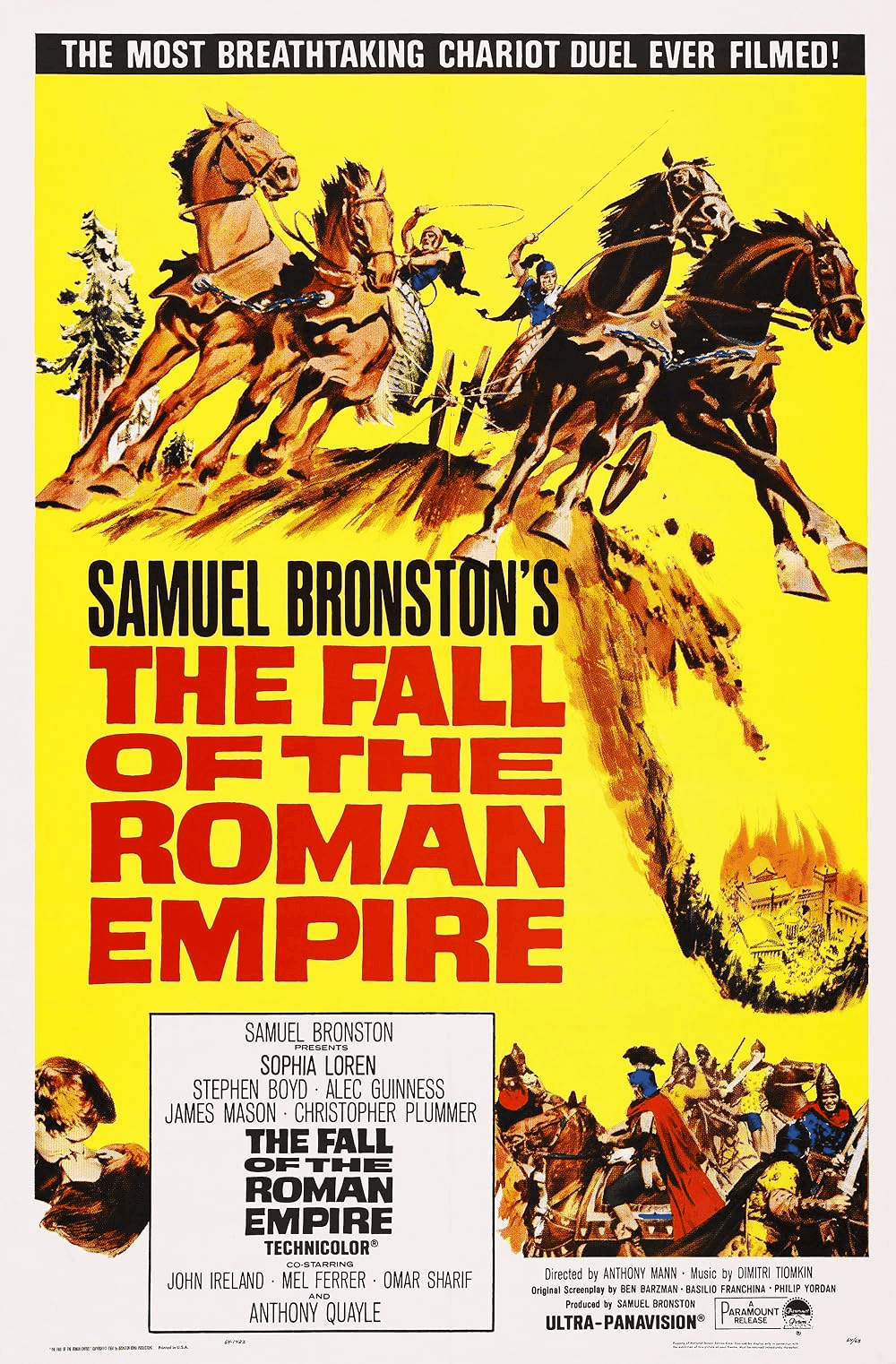
In the final years of the Roman Empire, the philosopher emperor Marcus Aurelius prepares to name a virtuous successor only to be poisoned by allies of his erratic son Commodus, plunging Rome into political and military crisis. Anthony Mann's sprawling Samuel Bronston-produced epic deploys a vast ensemble across the Empire's collapse.
What Is the Budget of The Fall of the Roman Empire (1964)?
The Fall of the Roman Empire was produced on a budget of approximately $20 million, an extraordinary sum for 1964 that ranked among the most expensive productions in cinema history at that point. Independent producer Samuel Bronston financed the project as the final and largest entry in his run of historical epics, with Paramount Pictures handling worldwide distribution.
Key Budget Allocation Categories
Massive Set Construction, the recreation of the Roman Forum was the largest outdoor set ever built at the time, covering approximately 55 acres and including over 600 individual statues and structures.
Above-the-Line Talent, Sophia Loren, Stephen Boyd, Alec Guinness, James Mason, Christopher Plummer, and Anthony Quayle headlined an ensemble that absorbed a significant share of the budget.
Extensive Extras and Battle Sequences, large-scale battle sequences and forum crowd scenes required thousands of Spanish military and civilian extras across multi-day shoots.
Spain Production Base, Samuel Bronston Productions operated a permanent studio complex outside Madrid with its own infrastructure, supporting a long shoot but at significant ongoing cost.
Costumes and Props, tens of thousands of period costumes, weapons, and props for legions, senators, slaves, and the imperial court added substantial below-the-line cost.
Music Score, Dimitri Tiomkin composed an epic orchestral score recorded with a full European symphony orchestra, complete with a substantial overture and intermission entr'acte.
How Does The Fall of the Roman Empire's Budget Compare to Similar Films?
Cleopatra (1963), Budget $31,115,000 | Worldwide $26,000,000. The prior year's notorious budget overrun and similarly disappointing Roman epic, illustrating broader collapse of the sword-and-sandal cycle.
Ben-Hur (1959), Budget $15,175,000 | Worldwide $74,700,000. The high-water mark of the Roman epic cycle, made for 24 percent less and grossing 11 times as much.
Spartacus (1960), Budget $12,000,000 | Worldwide $60,000,000. A successful Roman epic from earlier in the cycle made for 40 percent less and grossing nine times as much.
Gladiator (2000), Budget $103,000,000 | Worldwide $465,000,000. Ridley Scott's much later film covering substantially the same historical period and political transition with vastly stronger commercial results.
The Fall of the Roman Empire Box Office Performance
The Fall of the Roman Empire opened to weak results in major North American cities in late March 1964 and never recovered. Roadshow engagements in select markets posted respectable initial figures but national wide release was a sharp commercial disappointment.
Box Office Breakdown
The Fall of the Roman Empire

On theatrical revenue alone the film returned roughly $0.33 for every $1 invested at the production-budget level, one of the worst returns in the entire historical-epic cycle. The result was financially catastrophic for Samuel Bronston Productions.
Bronston Productions collapsed under the weight of the loss, effectively ending Samuel Bronston's career as an independent producer. The failure contributed to the broader Hollywood retreat from the sword-and-sandal epic that defined the late 1950s and early 1960s production landscape.
The Fall of the Roman Empire Production History
Samuel Bronston began developing The Fall of the Roman Empire in late 1961 following the commercial success of El Cid, intending it as the largest and most ambitious project of his historical-epic run. Bronston assembled a screenplay team led by Philip Yordan and engaged Anthony Mann, his El Cid director, to helm the production.
A vast set construction effort began at the Bronston studio complex outside Madrid in 1962, including the largest outdoor set ever built to that point, a near full-scale recreation of the Roman Forum covering approximately 55 acres. Production designer Veniero Colasanti and John Moore led the construction effort over more than a year.
Principal photography took place from January through August 1963, with thousands of Spanish military and civilian extras participating in large-scale battle and forum crowd sequences. The Spanish location offered tax advantages and lower labor costs, but the scale of construction and the extended shoot pushed the budget well past $20 million.
Post-production was rushed to meet a March 1964 release. Composer Dimitri Tiomkin delivered an epic score recorded with a full orchestra. Paramount handled distribution with a 70mm roadshow rollout in select markets followed by wide 35mm release, but commercial reception was immediately disastrous.
Awards and Recognition
The Fall of the Roman Empire received one Academy Award nomination, for Dimitri Tiomkin's Original Music Score, which it did not win. The film was effectively shut out of the technical categories despite its scale.
Tiomkin also received a Golden Globe nomination for Best Original Score. The Forum set construction received industry technical recognition at the time as a remarkable production design achievement, though no major awards followed.
Industry retrospectives have framed the film as the final major entry in the Roman epic cycle that began with Quo Vadis in 1951, and a key marker of the end of the sword-and-sandal era. The film is also frequently cited as a major inspiration for Ridley Scott's Gladiator three and a half decades later.
Critical Reception
Critical reception in 1964 was mixed to negative. Reviewers acknowledged the production scale and Tiomkin's score while criticizing the screenplay as ponderous and the three hour runtime as exhausting. Bosley Crowther at The New York Times praised the visual ambition while questioning whether the film "earns its monumental scale."
Variety found the film "magnificent in scope but tiring in execution," while Time magazine called it "the most spectacular Roman epic since Ben-Hur, and the least satisfying." Many contemporary critics drew unfavorable comparisons to Cleopatra the prior year.
Modern retrospective evaluations have softened considerably, with Rotten Tomatoes settling at 88 percent positive reviews on aggregated retrospective coverage. The film is now widely regarded as an underappreciated late entry in the Roman epic cycle and a clear influence on Ridley Scott's Gladiator.
Frequently Asked Questions
What is the budget of The Fall of the Roman Empire?
The film was produced on a budget of approximately $20 million, an enormous sum for 1964 equivalent to over $200 million in 2025 dollars, making it one of the most expensive films ever made at the time.
Who directed The Fall of the Roman Empire?
Anthony Mann directed the film, having previously helmed Samuel Bronston's El Cid in 1961.
When was The Fall of the Roman Empire released?
Paramount Pictures released the film in North America on March 26, 1964.
Where was The Fall of the Roman Empire filmed?
Principal photography took place at Bronston's studio complex outside Madrid, Spain, with extensive use of the largest set ever built at the time, a near full-scale recreation of the Roman Forum.
How much did the film earn?
The film earned approximately $4.75 million domestically and $1.92 million internationally for a worldwide total of about $6.67 million, far below its production cost.
Why did Fall of the Roman Empire fail?
A combination of bloated budget, three hour runtime, exhausted public appetite for sword-and-sandal epics following decades of Roman films, and unfavorable comparisons to Cleopatra the prior year all contributed to the commercial failure.
Did Fall of the Roman Empire bankrupt Samuel Bronston?
Yes. The film's catastrophic underperformance brought down Samuel Bronston Productions and effectively ended Bronston's career as an independent producer.
What is the largest set in the film?
The recreation of the Roman Forum was the largest outdoor set ever constructed at the time, covering approximately 55 acres and including over 600 statues. The set was used heavily throughout the film's third act.
How does the film compare to Gladiator?
Ridley Scott's 2000 film Gladiator drew significantly from the historical period and political dynamics depicted in Fall of the Roman Empire, with both films focusing on the transition from Marcus Aurelius to Commodus.
Was the film nominated for Oscars?
The film was nominated for one Academy Award, for Dimitri Tiomkin's Original Music Score, which it did not win.
Filmmakers
The Fall of the Roman Empire

Build budgets like this one in Saturation
Start from an industry-standard feature film template, import the schedule and rates you already have, and let the cost report keep itself current as you spend. Real-time collaboration, no spreadsheets.