
The Exterminating Angel Budget
Updated
Synopsis
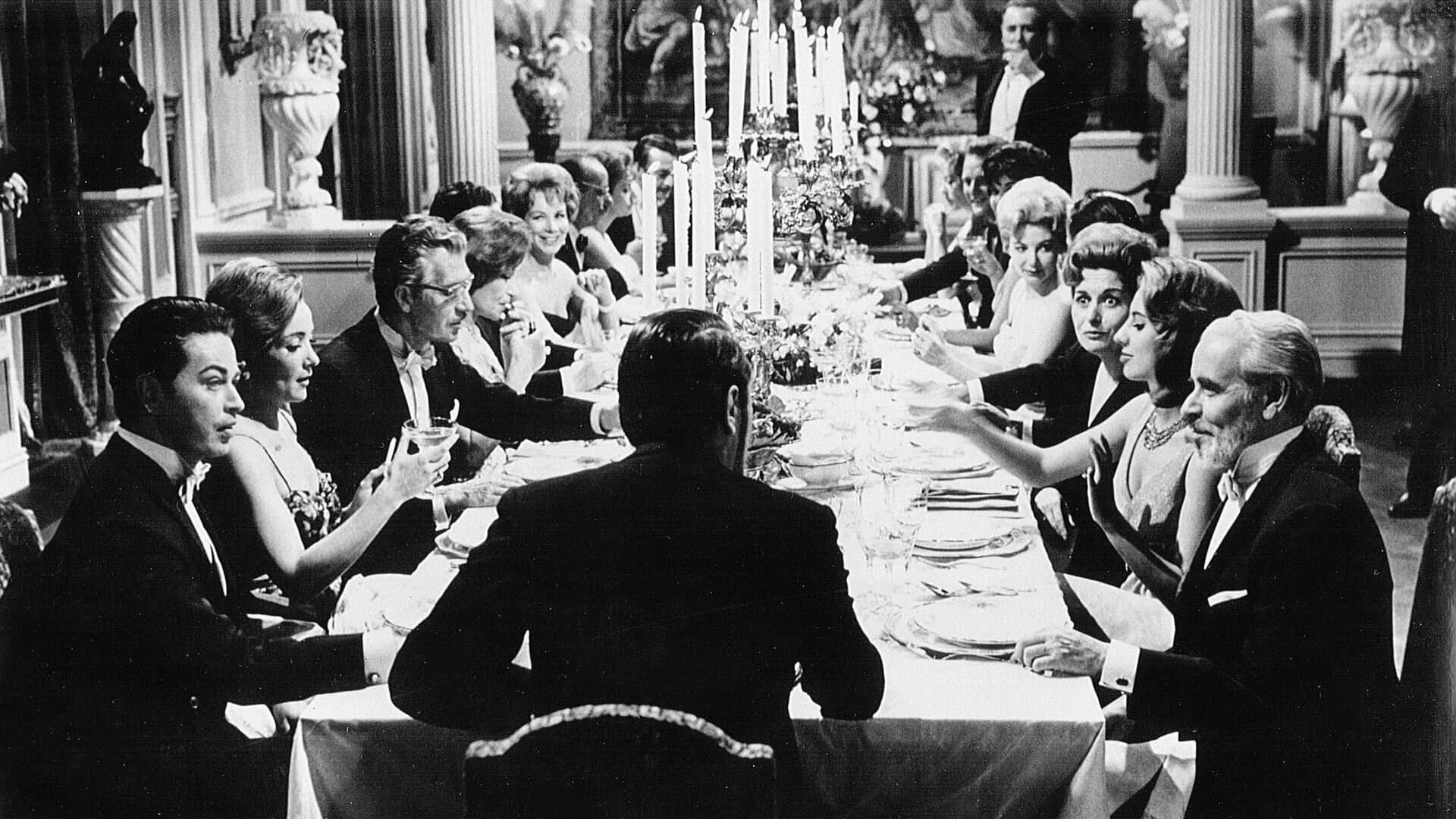
After an elegant Mexico City dinner party, a group of upper-class guests discover that they cannot leave the drawing room, even though no physical barrier prevents them from doing so. As the days pass and the rituals of polite society dissolve into hunger, paranoia, and violence, the trapped guests must confront what they truly are when stripped of the social rituals that define them.
What Is the Budget of The Exterminating Angel (1962)?
The Exterminating Angel (1962), the Mexican surrealist drama written and directed by Luis Buñuel and known by its original Spanish title El ángel exterminador, was produced for an undisclosed budget that has not been publicly released by producer Gustavo Alatriste's Producciones Alatriste S.A. Mexican film industry observers familiar with mid-1960s Mexican studio production tariffs place the film in the range of 1,000,000 to 2,000,000 pesos (roughly $80,000 to $160,000 in 1962 U.S. dollars), consistent with the contained-mansion-setting, single-location structure that the film required across its compact production schedule.
The Mexican production base was a strategic and creative necessity for Luis Buñuel rather than a cost-containment choice. The Spanish surrealist director had been in exile from Spain since the early 1940s under the Franco regime, with his Mexican production career across the 1950s and 1960s producing the bulk of his middle-period work including Los Olvidados (1950), Nazarín (1959), and Viridiana (1961), the last of which had been banned in Franco Spain immediately on completion. The Exterminating Angel arrived 18 months after Viridiana and represented Buñuel's third feature for Gustavo Alatriste's production company.
Key Budget Allocation Categories
The Exterminating Angel's estimated Mexican-studio production tariff was distributed across the following core production areas:
- Above-the-Line Talent: Director Luis Buñuel received his standard Mexican-studio director rate from Producciones Alatriste, with co-writer Luis Alcoriza sharing screenplay credit. The international ensemble cast included Silvia Pinal (the producer Gustavo Alatriste's then-wife and Buñuel's repeat collaborator from Viridiana) as Leticia, Enrique Rambal as Edmundo Nóbile, and a large ensemble of Mexican character actors and Spanish-exile performers including Augusto Benedico, Lucy Gallardo, Tito Junco, Bertha Moss, and Claudio Brook. The ensemble structure required compensating roughly 20 principal cast members at Mexican Actors Guild rates.
- Single Mansion Set Construction: Production designer Jesús Bracho built the Providencia Street mansion interior on a Churubusco Azteca Studios soundstage in Mexico City, with the principal living room and adjacent dining room providing the contained-setting envelope that defines the film's premise. The single-set construction approach concentrated the production design budget into one extended environment rather than the multi-location set work typical of Mexican-studio productions of the era.
- Costume and Period Wardrobe: The film's formal-dinner-party premise required full evening-wear costuming for all principal cast across the entire runtime, with the costume budget covering both the initial pristine formal attire and the progressive deterioration as the trapped guests spend days in the same clothing.
- Cinematography and Lighting: Cinematographer Gabriel Figueroa, the celebrated Mexican director of photography who worked with John Ford on The Fugitive (1947), with Buñuel on multiple previous features, and with John Huston on Under the Volcano (1984), shot the film in black and white with the deep-focus, painterly compositional approach that defined his work across the 1950s and 1960s Mexican studio system.
- Score and Sound: The film features minimal traditional score, instead using sparse classical-music cues and substantial use of room-tone ambient silence to anchor the trapped-guests premise. The sound design carried much of the film's tonal weight, with the inability-to-leave conceit reinforced by careful audio framing of the off-screen world that the characters cannot reach.
- Post-Production at Churubusco Azteca: Post-production took place at Churubusco Azteca Studios in Mexico City, the principal studio facility of the Mexican film industry across the 1950s and 1960s. The compact post schedule reflected the contained-set premise and the limited reshoot or alternate-coverage requirements.
How Does The Exterminating Angel's Budget Compare to Similar Films?
At an estimated Mexican-studio mid-1960s production tariff in the range of $80,000 to $160,000 in 1962 U.S. dollars (roughly $850,000 to $1,700,000 in 2026 dollars), The Exterminating Angel sits in the company of other contemporary mid-budget art-cinema features:
- Viridiana (1961): Budget undisclosed Spanish-Mexican co-production. Luis Buñuel's prior feature, banned in Franco Spain immediately on completion, operated at a comparable mid-budget art-cinema tariff and provides the closest direct same-director-and-producer-and-star comparison for The Exterminating Angel.
- L'Avventura (1960): Budget approximately $400,000. Michelangelo Antonioni's Italian art-cinema feature released two years earlier operated at a substantially higher tariff and represents the upper end of the contemporary European art-cinema budget envelope that The Exterminating Angel's Mexican-studio approach undercut.
- Last Year at Marienbad (1961): Budget approximately $500,000. Alain Resnais' French-Italian art-cinema co-production released one year before The Exterminating Angel offers a direct contemporary surrealist-art-cinema comparison and demonstrates the higher tariff envelope of French and Italian art cinema relative to Mexican production.
- The Phantom of Liberty (1974): Budget undisclosed French production. Luis Buñuel's later French-period satirical feature offers a direct same-director comparison and demonstrates Buñuel's shift from the Mexican-studio production base of the 1950s and 1960s to the French co-production model of his late-career work.
- That Obscure Object of Desire (1977): Budget approximately $1,500,000. Buñuel's final feature, a French-Spanish co-production, operated at a substantially higher tariff and reflects the inflated mid-1970s production cost envelope relative to The Exterminating Angel's mid-1960s Mexican-studio baseline.
The Exterminating Angel Box Office Performance
The Exterminating Angel premiered theatrically in Mexico City in May 1962, with subsequent international releases through 1962 and 1963 across festival programming and art-cinema theatrical distribution. The film did not generate substantial box office in its initial release window, consistent with the contemporary art-cinema commercial pattern. The Mexican theatrical engagement, the French and Italian art-cinema releases through Janus Films and the European distributor network, and the limited U.S. art-house engagement collectively produced an estimated cumulative gross in the range of $300,000 to $800,000 across the initial release cycle. Precise figures have not been published in any contemporary or retrospective Mexican-industry documentation.
The film's primary commercial impact has been across decades of subsequent home-video, restoration, and Criterion Collection reissue releases rather than the initial theatrical engagement. The Criterion Collection has issued the film on multiple physical-media formats since the late 1980s, with the Criterion Channel streaming subscription and recurring Mexican-cinema academic-institution programming providing continuous commercial activity across the 2010s and 2020s.
Box Office Breakdown
The Exterminating Angel

The Exterminating Angel's commercial trajectory does not lend itself to the per-dollar-invested return calculation that contemporary streaming and theatrical productions use. Within the context of mid-1960s art-cinema production economics, the film generated modest but positive returns across its initial release window and has anchored a continuous home-video, restoration, and academic-engagement revenue stream across the subsequent six decades.
Within the broader Luis Buñuel oeuvre, The Exterminating Angel is widely considered one of the director's most accessible and most-revisited middle-period works, with a continuous critical and academic engagement that has produced a 21st-century theatrical-restoration cycle, including the 2017 BFI restoration, and an opera adaptation by Thomas Adès that premiered at the Salzburg Festival in 2016 and subsequently traveled to the Royal Opera House Covent Garden and the Metropolitan Opera.
The Exterminating Angel Production History
Development on The Exterminating Angel began in 1961 at Producciones Alatriste, with Luis Buñuel and Luis Alcoriza co-writing the screenplay across late 1961 and early 1962. The film built directly on the producer-director-star relationship that Buñuel had established with Gustavo Alatriste and Silvia Pinal on Viridiana, the Spanish-Mexican co-production that had won the 1961 Palme d'Or at the Cannes Film Festival before being banned in Franco Spain immediately on completion. Alatriste backed The Exterminating Angel as the next entry in what would become a four-feature Mexican-Buñuel cycle that also included Simon of the Desert (1965).
The screenplay drew on Buñuel's long-standing surrealist preoccupations with bourgeois immobility, social-ritual paralysis, and the inexplicable. The premise (a wealthy Mexico City formal dinner party whose guests cannot leave the mansion drawing room after the dinner concludes, with the trapped state persisting for days as the social rituals of polite formality dissolve into desperation) had occupied Buñuel across several earlier draft attempts, with the contained-mansion structure providing the formal vehicle for the philosophical premise.
Principal photography took place at Churubusco Azteca Studios in Mexico City across a compact production schedule in early 1962, with cinematographer Gabriel Figueroa shooting the contained-set premise in black and white deep-focus compositions across the single-location mansion drawing-room set. The ensemble cast of approximately 20 principal performers required careful blocking and coverage across the multi-week single-location shoot.
Post-production took place at Churubusco Azteca Studios across spring 1962, with the film delivered to the May 1962 Cannes Film Festival as the premiere international venue. The Cannes Festival programmed the film in its main competition, and Buñuel's subsequent acceptance of the FIPRESCI Prize at Cannes anchored the film's international art-cinema reputation from its first major-festival engagement.
Awards and Recognition
The Exterminating Angel received the FIPRESCI Prize at the 1962 Cannes Film Festival, sharing the international-critics award with other festival entries. The film was also recognized at the Mexican Ariel Awards, with a nomination for the Mexican Film Industry Awards. The Cannes recognition anchored the film's international critical reputation from its first major-festival engagement.
The film's historical recognition has grown substantially in the decades since its release. The Exterminating Angel has been consistently included in Sight & Sound's decade-spanning critics' polls of the greatest films, with the 2012 and 2022 polls featuring the film prominently. Time magazine included the film on its 2005 list of the 100 greatest films of all time, and the Criterion Collection has issued the film on multiple physical-media formats since the late 1980s. Thomas Adès' opera adaptation premiered at the Salzburg Festival in 2016 and subsequently traveled to the Royal Opera House Covent Garden, the Metropolitan Opera, and the Royal Danish Opera, further extending the film's 21st-century cultural footprint.
Critical Reception
The Exterminating Angel has been the subject of overwhelmingly positive critical reception across nearly six decades of historical reassessment. On Rotten Tomatoes, the film holds a 95% Tomatometer score based on a sample of approximately 60 critics writing across decades of retrospective review. On Metacritic, the film scores 89 out of 100. The film's critical reputation has only grown across the subsequent decades, with each major Sight & Sound critics' poll cycle elevating it further within the canon.
Praise centers on Luis Buñuel's confident handling of the contained-mansion premise, Gabriel Figueroa's deep-focus cinematography, the ensemble cast performances anchored by Silvia Pinal and Enrique Rambal, the surrealist refusal to provide a rational explanation for the trapped state, and the broader satirical engagement with bourgeois social ritual that drives the film's philosophical weight. Roger Ebert's Great Movies essay called the film "a masterpiece of casual cruelty," while The New York Times' Vincent Canby (writing in retrospective review) described it as "Buñuel at his most surgically precise."
Contemporary 1962 critical reception was also broadly positive in international festival contexts but more divided in domestic Mexican press, where some reviewers struggled with the deliberate refusal to provide narrative explanation. Subsequent critical reassessment has elevated the film into the canon of mid-20th-century art cinema, with academic and institutional engagement (university film studies courses, museum retrospectives, and the Criterion Collection programming) providing continuous critical activity across the subsequent six decades.
Frequently Asked Questions
How much did it cost to make The Exterminating Angel (1962)?
The exact production budget has not been publicly disclosed by Producciones Alatriste. Mexican film industry observers familiar with mid-1960s Mexican studio production tariffs place the film in the range of 1,000,000 to 2,000,000 pesos (roughly $80,000 to $160,000 in 1962 U.S. dollars), consistent with the contained-mansion single-location structure that the film required.
How much did The Exterminating Angel earn at the box office?
The film generated modest but positive returns across its initial 1962 to 1963 release cycle, with Mexican theatrical engagement, French and Italian art-cinema releases through Janus Films and the European distributor network, and limited U.S. art-house engagement collectively producing an estimated cumulative gross in the range of $300,000 to $800,000. Precise figures have not been published.
Where can I watch The Exterminating Angel?
The Exterminating Angel is available on Blu-ray and DVD via the Criterion Collection, which has issued the film on multiple physical-media formats since the late 1980s. The film also streams on the Criterion Channel and rotates through TCM (Turner Classic Movies) and HBO Max programming windows. The 2017 BFI restoration is the principal extant master used across contemporary releases.
Who directed The Exterminating Angel?
Luis Buñuel directed The Exterminating Angel, also co-writing the screenplay with Luis Alcoriza. Buñuel had been in exile from Franco Spain since the early 1940s and was working through his Mexican production career across the 1950s and 1960s, with The Exterminating Angel arriving 18 months after his Cannes Palme d'Or-winning Viridiana (1961).
Who stars in The Exterminating Angel?
Silvia Pinal stars as Leticia, with Enrique Rambal as Edmundo Nóbile, and an ensemble of approximately 20 principal cast members including Augusto Benedico, Lucy Gallardo, Tito Junco, Bertha Moss, Claudio Brook, and Jacqueline Andere. Pinal was producer Gustavo Alatriste's then-wife and Luis Buñuel's repeat collaborator from Viridiana (1961) and the subsequent Simon of the Desert (1965).
Where was The Exterminating Angel filmed?
Principal photography took place at Churubusco Azteca Studios in Mexico City in early 1962, with cinematographer Gabriel Figueroa shooting the contained-mansion drawing-room set in black and white deep-focus compositions. The single-location production approach concentrated the design and shoot envelope into one extended soundstage build.
What is the original Spanish title of The Exterminating Angel?
The original Spanish title is El ángel exterminador. The film is fully in Spanish and was released internationally with subtitles. The title references a biblical-apocalyptic figure that the surrealist premise of the film deliberately leaves unexplained, with no on-screen exterminating angel ever appearing.
What did critics think of The Exterminating Angel?
The film has been the subject of overwhelmingly positive critical reception across nearly six decades. On Rotten Tomatoes it holds a 95% Tomatometer score based on approximately 60 retrospective reviews, and on Metacritic it scores 89 out of 100. The film won the FIPRESCI Prize at the 1962 Cannes Film Festival and has been consistently included in Sight & Sound's decade-spanning critics' polls of the greatest films.
Is The Exterminating Angel based on a true story?
No. The Exterminating Angel is an original screenplay by Luis Buñuel and Luis Alcoriza. The premise (a wealthy Mexico City formal dinner party whose guests cannot leave the drawing room after the dinner concludes) is a surrealist construction that Buñuel had considered across several earlier draft attempts before producing the final 1962 feature. The screenplay deliberately refuses to provide any rational explanation for the trapped state.
Did The Exterminating Angel win any awards?
The film won the FIPRESCI Prize at the 1962 Cannes Film Festival, sharing the international-critics award. It was also recognized at the Mexican Ariel Awards. The film's subsequent historical recognition has been substantial, including consistent inclusion in Sight & Sound's decade-spanning critics' polls and a Thomas Adès opera adaptation that premiered at the Salzburg Festival in 2016 and subsequently traveled to the Royal Opera House Covent Garden and the Metropolitan Opera.
Filmmakers
The Exterminating Angel

Official Trailer
Build budgets like this one in Saturation
Start from an industry-standard feature film template, import the schedule and rates you already have, and let the cost report keep itself current as you spend. Real-time collaboration, no spreadsheets.