The Beverly Hillbillies Budget
 Comedy
Updated
Synopsis
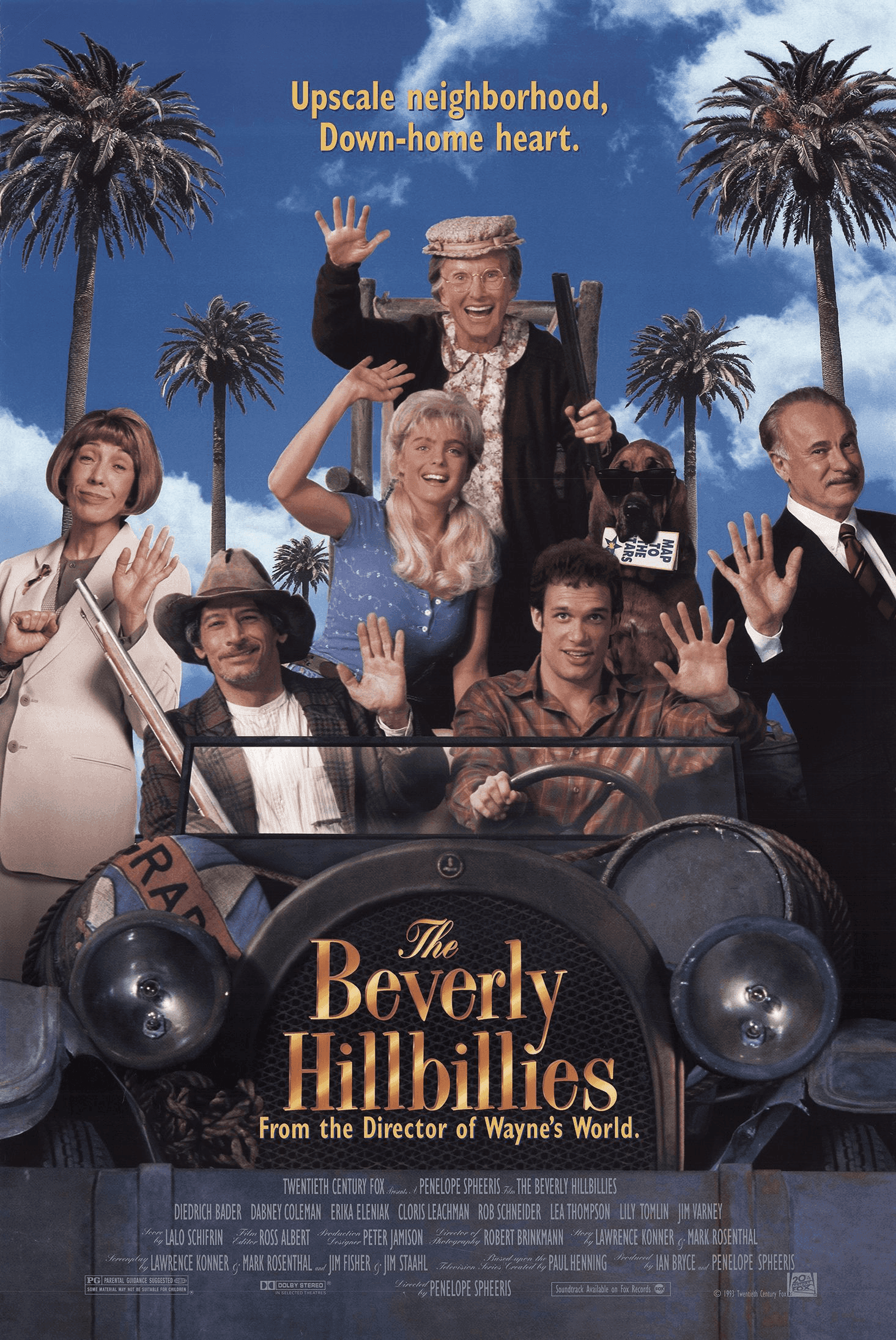
After Ozark mountaineer Jed Clampett strikes oil on his land and becomes an overnight billionaire, he moves his family to a Beverly Hills mansion, where banker Milburn Drysdale schemes to keep their fortune in his bank. A gold-digging tutor sets her sights on Jed while daughter Elly May, nephew Jethro, and Granny adjust to high society, leading to a fish-out-of-water comedy of culture clash.
What Is the Budget of The Beverly Hillbillies (1993)?
The Beverly Hillbillies (1993), directed by Penelope Spheeris and distributed by 20th Century Fox, was produced on a reported budget of $25,000,000. The film adapted the long-running CBS sitcom that aired from 1962 to 1971, repositioning the Clampett family for a 1990s theatrical audience with Jim Varney (Ernest P. Worrell) as Jed Clampett, Diedrich Bader as Jethro, Erika Eleniak as Elly May, and the venerable Cloris Leachman as Granny. Fox greenlit the project on the heels of Spheeris's breakout success with Wayne's World (1992), which had grossed more than $180,000,000 worldwide against a $20,000,000 budget.
The investment reflected a calculated mid-budget bet on nostalgia IP, a strategy Hollywood revisited frequently throughout the early 1990s with adaptations such as The Addams Family, The Flintstones, and Dennis the Menace. Fox kept costs disciplined by shooting on Los Angeles area locations, leaning on production design rather than visual effects, and casting recognizable but affordable lead performers rather than top-tier comedy stars.
Key Budget Allocation Categories
The Beverly Hillbillies' reported $25,000,000 budget was distributed across several core production areas:
- Above-the-Line Talent: Director Penelope Spheeris commanded a feature-director rate appropriate to her post-Wayne's World market value. Jim Varney, fresh off a successful run of Ernest theatrical comedies for Touchstone, headlined as Jed, with Cloris Leachman, Lily Tomlin (as banker Miss Hathaway), and Dabney Coleman (as Milburn Drysdale) filling out the ensemble. Each principal commanded compensation reflecting their established television and feature credits.
- Production Design and Locations: The film required two distinct visual worlds, the rural Ozarks homestead and the opulent Beverly Hills mansion. The production filmed mansion exteriors at the famed Kirkeby Estate (the original Beverly Hillbillies TV-series mansion) and built interior sets at Fox's Century City lot, with significant set dressing investment to achieve the over-the-top luxury aesthetic.
- Costume and Makeup: The Clampett family's wardrobe transition from rustic mountain garb to Beverly Hills excess required two complete costume sets per principal, with prosthetic appliances for Cloris Leachman's aging makeup as Granny and continuity work for Erika Eleniak's glamour transformations.
- Picking-up Footage and Stunts: Light physical comedy gags, including the truck loaded with the Clampetts' belongings and the mansion swimming pool sequences, required stunt coordination, a rigged Olds-mobile period vehicle, and water-tank work that added cost beyond what a pure dialogue comedy would require.
- Music and Theme: Composer Lalo Schifrin scored the picture, and the production secured rights to the iconic Paul Henning theme song "The Ballad of Jed Clampett" for orchestral re-recording, plus needle drops including Dolly Parton's contribution to the soundtrack.
- Marketing-Adjacent Production Costs: Fox commissioned extensive trailer-ready set pieces and tied promotional appearances to the film's September 1993 wrap, with cast availability days built into the back-end of production schedules to support the October press cycle.
How Does The Beverly Hillbillies's Budget Compare to Similar Films?
At a reported $25,000,000, The Beverly Hillbillies sat comfortably inside the early-1990s nostalgia-IP comedy bracket. The comparison set frames its commercial outcome:
- The Addams Family (1991): Budget $30,000,000 | Worldwide $191,500,000. Paramount's sitcom adaptation cost slightly more but earned more than three times what Beverly Hillbillies did, demonstrating that family-friendly nostalgia IP could break out when paired with a stronger genre hook.
- Wayne's World (1992): Budget $20,000,000 | Worldwide $183,097,323. Penelope Spheeris's previous film cost slightly less and outperformed by a factor of three, illustrating the difficulty of replicating her SNL-anchored breakout with a sitcom-to-screen translation.
- Dennis the Menace (1993): Budget $35,000,000 | Worldwide $117,200,000. Warner Bros.'s contemporaneous comic-strip-to-film adaptation cost 40% more and earned roughly double, showing that family-property branding had broader theatrical pull than 1960s sitcom nostalgia.
- The Flintstones (1994): Budget $46,000,000 | Worldwide $341,631,208. Universal's adaptation released the following year cost nearly twice as much, used heavy practical effects and animatronics, and earned six times Beverly Hillbillies's worldwide gross. The comparison highlights how production scale and animated-source recognition delivered a measurably bigger commercial outcome.
- Coneheads (1993): Budget $33,000,000 | Worldwide $21,274,717. Paramount's SNL-derived comedy released two months earlier cost 30% more and grossed less than half, a useful reminder that the nostalgia-comedy category had decisively split into winners and losers by the time Beverly Hillbillies entered the marketplace.
The Beverly Hillbillies Box Office Performance
The Beverly Hillbillies opened on October 15, 1993, finishing fourth at the domestic box office with $9,506,538 over its opening weekend. That figure trailed Demolition Man, Cool Runnings, and Fatal Instinct, and the film never reached the top of the chart in any subsequent week. Domestic legs were respectable for a family comedy, holding through Thanksgiving, but the picture's international rollout was muted, a recurring problem for distinctly American-vernacular comedies.
Against a reported production budget of $25,000,000, the film needed approximately $60,000,000 in worldwide gross to reach profitability when accounting for marketing and distribution costs. Here is the financial breakdown:
Box Office Breakdown
The Beverly Hillbillies

The Beverly Hillbillies returned approximately $1.28 in worldwide theatrical revenue for every $1 invested when measured against total estimated production and marketing spend. After theatre and distributor splits, the film's actual studio profit was modest and concentrated in domestic home video, where the title performed steadily into the late 1990s thanks to repeat family viewings and cable-broadcast tie-ins.
The mediocre theatrical result halted any sequel discussion. Fox redirected its family-comedy slate toward animation tie-ins and original concepts, and the studio's next sitcom adaptation, the unrelated Get Smart project, sat in development limbo for over a decade.
The Beverly Hillbillies Production History
Development of a Beverly Hillbillies feature dated to the late 1980s, but the project did not coalesce until producer Penelope Spheeris committed in 1992 on the strength of her Wayne's World deal at Fox. Spheeris, who had built a documentary and music-film resume (The Decline of Western Civilization series, Suburbia) before crossing into mainstream studio comedy, was attracted to the material's class-collision premise and the opportunity to honor the source while updating it for 1990s sensibilities.
Principal photography began in spring 1993 across the Los Angeles area, with mansion exteriors filmed at the original Kirkeby Estate at 750 Bel Air Road, Beverly Hills (the same property used in the 1962 TV series), and supplementary shooting at California soundstages and surrounding locations. The Ozarks opening sequences were filmed at Tennessee-substitute locations within driving range of Los Angeles to control costs and crew distance.
Casting was the production's defining creative challenge. Spheeris and Fox cycled through multiple Jed Clampett candidates before settling on Jim Varney, whose Ernest P. Worrell character had built a sturdy if critically dismissed theatrical box office through the late 1980s and early 1990s. Cloris Leachman, then 67, replaced an originally announced Granny choice and required extensive prosthetic aging to evoke the late Irene Ryan's 1960s incarnation. The film features a brief Buddy Ebsen cameo, with the original Jed Clampett appearing in character as Barnaby Jones, a knowing fan-service inclusion the screenplay accommodated.
The shoot wrapped in summer 1993 ahead of an October release. Spheeris later described the experience as creatively frustrating, citing studio notes that softened the screenplay's satirical edge in favor of broader family-comedy beats. The director moved on to Black Sheep (1996) and The Little Rascals (1994) before returning to the documentary work that anchored her later career.
Awards and Recognition
The Beverly Hillbillies received no major awards recognition. The film was not nominated at the Academy Awards, the Golden Globes, the Saturn Awards, or any of the principal critics' organizations.
At the 1994 Razzie Awards, Jim Varney was nominated for Worst Actor, losing to Burt Reynolds for Cop and a Half. Cloris Leachman was nominated for Worst Supporting Actress. The Razzie attention reflected the broader critical consensus that the production had failed to elevate its source material, though both performers continued working steadily afterward and Leachman went on to win an Emmy the following year for Promised Land.
Critical Reception
The Beverly Hillbillies received predominantly negative reviews. The film holds a 12% approval rating on Rotten Tomatoes based on 25 critic reviews, with the consensus calling it a flat translation that fails to capture either the warmth or the social satire of the original series. On Metacritic, the film scored 39 out of 100, indicating generally unfavorable reviews. Audiences surveyed by CinemaScore gave the film a B, below the A- threshold typical for family comedies that achieve broader theatrical legs.
Roger Ebert wrote in the Chicago Sun-Times that the film "plays like a sitcom that doesn't know it's already over," while Janet Maslin in The New York Times observed that the production's attempts to update the property merely highlighted how dated the underlying concept had become. Variety's Leonard Klady called Jim Varney "a likeable enough Jed" but found the screenplay's pacing "leaden in the third act."
Genre and family-press reaction was more forgiving. Entertainment Weekly graded the film a C, citing Cloris Leachman and Lily Tomlin's supporting performances as the principal pleasures, and The Hollywood Reporter noted that younger audiences unfamiliar with the original series found the slapstick perfectly serviceable. The film's reputation has remained that of an interesting commercial misfire from a director with a stronger sensibility than the project could accommodate.
Frequently Asked Questions
How much did it cost to make The Beverly Hillbillies (1993)?
The reported production budget was $25,000,000. 20th Century Fox produced the film as a follow-up to Penelope Spheeris's Wayne's World (1992), with Amblin Entertainment and Heyman/Hill Productions co-producing.
How much did The Beverly Hillbillies earn at the box office?
The film grossed $44,011,963 domestically and approximately $13,394,683 internationally, for a worldwide total of $57,406,646. It opened to $9,506,538 in the United States, finishing fourth on its October 15, 1993 opening weekend behind Demolition Man, Cool Runnings, and Fatal Instinct.
Was The Beverly Hillbillies (1993) a box office success?
The film was a marginal commercial performer. Against a $25,000,000 production budget and an estimated $15,000,000 to $20,000,000 in marketing spend, it returned approximately $1.28 in worldwide gross for every $1 invested, generating modest studio profit primarily through downstream home video rather than theatrical returns.
Who directed The Beverly Hillbillies (1993)?
Penelope Spheeris directed the film, working from a screenplay by Lawrence Konner, Mark Rosenthal, Jim Fisher, and Jim Staahl. Spheeris had directed Wayne's World (1992) for Paramount immediately prior and went on to direct The Little Rascals (1994) and Black Sheep (1996).
Where was The Beverly Hillbillies filmed?
Principal photography took place in spring 1993 across the Los Angeles area. Mansion exteriors used the original Kirkeby Estate at 750 Bel Air Road, Beverly Hills, the same property featured in the 1962 to 1971 CBS television series. Interior soundstage work was completed at Fox Studios in Century City.
Who played Jed Clampett in the 1993 film?
Jim Varney played Jed Clampett. Varney was best known at the time for the Ernest P. Worrell character that anchored a string of Touchstone Pictures comedies (Ernest Goes to Camp, Ernest Saves Christmas, Ernest Goes to Jail) throughout the late 1980s and early 1990s. Buddy Ebsen, the original Jed Clampett from the TV series, appears in the film in a brief cameo as Barnaby Jones.
Is the 1993 Beverly Hillbillies film connected to the TV series?
Yes. The film is a direct theatrical adaptation of the 1962 to 1971 CBS sitcom The Beverly Hillbillies created by Paul Henning. The production uses the same Clampett family characters, the iconic Paul Henning theme song "The Ballad of Jed Clampett," and exteriors of the original Kirkeby Estate mansion that anchored the TV series.
What did critics think of The Beverly Hillbillies (1993)?
The film received predominantly negative reviews, with a 12% approval rating on Rotten Tomatoes (based on 25 critics) and a 39 out of 100 score on Metacritic. Audiences gave it a B CinemaScore. Roger Ebert called it a flat translation of the source material, and Variety described the screenplay's pacing as "leaden in the third act."
Did The Beverly Hillbillies (1993) win any awards?
The film received no major industry awards. At the 1994 Razzie Awards, Jim Varney was nominated for Worst Actor (he lost to Burt Reynolds for Cop and a Half) and Cloris Leachman was nominated for Worst Supporting Actress.
Why does the 1993 Beverly Hillbillies have a small budget compared to similar adaptations?
Fox kept costs disciplined to a $25,000,000 mid-budget by shooting on Los Angeles area locations, avoiding visual effects, and casting recognizable but affordable lead performers rather than top-tier comedy stars. Comparable adaptations such as The Flintstones (1994) at $46,000,000 and Dennis the Menace (1993) at $35,000,000 spent significantly more on practical effects, animatronics, and bigger-name leads.
Filmmakers
The Beverly Hillbillies

Build budgets like this one in Saturation
Start from an industry-standard feature film template, import the schedule and rates you already have, and let the cost report keep itself current as you spend. Real-time collaboration, no spreadsheets.