The Best Little Whorehouse in Texas Budget
 Musical
Updated
Synopsis
Sheriff Ed Earl Dodd is romantically entangled with Miss Mona Stangley, the proprietor of the Chicken Ranch, a Texas brothel that has operated openly for more than a century. When crusading Houston television reporter Melvin P. Thorpe launches a high-profile campaign to shut the Ranch down, Ed Earl, Miss Mona, and the Texas governor must navigate the political storm that follows.
What Is the Budget of The Best Little Whorehouse in Texas (1982)?
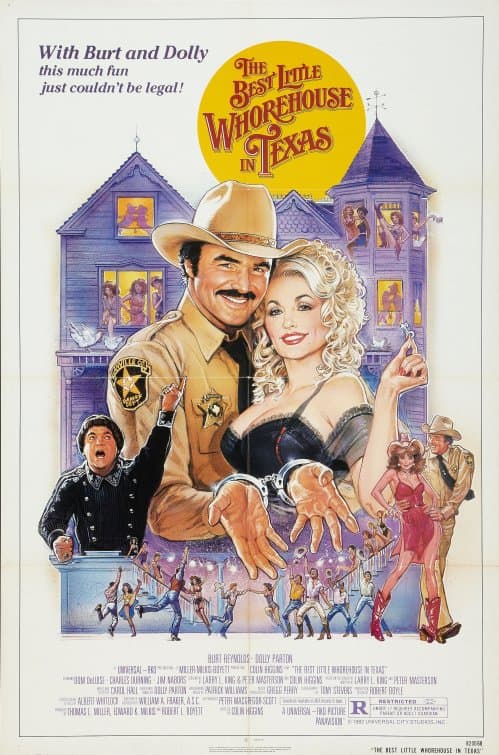
The Best Little Whorehouse in Texas (1982), Colin Higgins's film adaptation of the 1978 Broadway musical, was produced on a reported budget of $25,000,000. Universal Pictures and RKO Pictures co-financed and co-distributed the project, with Miller-Milkis-Boyett Productions (the Happy Days, Laverne and Shirley, and Mork and Mindy television production house) attached as the lead production company. The film paired Burt Reynolds at the height of his Smokey and the Bandit-era box-office pull with Dolly Parton in her second major film role following 9 to 5 (1980), positioning the project as a major-studio musical-comedy tentpole at a moment when the genre had been largely dormant.
The $25,000,000 figure was substantial for a 1982 musical comedy and reflected the production scale required for a full-scale studio musical, including the construction of the Chicken Ranch and adjacent small-town Texas exterior sets at Universal's ranch facility, period-1970s costume and production design across multiple Texas locations, the licensing of the Broadway musical score by Carol Hall and the addition of original songs by Dolly Parton, and a salary structure topped by Burt Reynolds, Dolly Parton, Dom DeLuise, and Charles Durning. The film also licensed the original musical based on the 1973 Playboy magazine article by Larry L. King about the actual Chicken Ranch in La Grange, Texas, which had been shut down in 1973 after a similar television-reporter campaign.
Key Budget Allocation Categories
The Best Little Whorehouse in Texas's $25,000,000 budget was distributed across several core production areas:
- Above-the-Line Talent: Burt Reynolds received an established top-of-market lead-actor fee, at the peak of his Smokey and the Bandit-era commercial pull. Dolly Parton was paid a substantial fee following her 9 to 5 breakthrough plus a soundtrack-album coordinated payment for original-song contributions. Dom DeLuise commanded an established featured-comedy rate for the Melvin P. Thorpe role. Charles Durning, in his Oscar-nominated supporting turn as the Governor, was paid at established character-actor rates. Director Colin Higgins, coming off Foul Play (1978) and 9 to 5 (1980), received an established directing fee.
- Universal Studios Ranch Construction: The Chicken Ranch exterior and interior sets, the small-town Texas main street, and the adjacent farms were constructed at Universal's ranch facility in Newhall, California. The set construction included a full-scale Chicken Ranch boarding house with multiple bedroom interiors, the Lasso the Moon dance-hall set, the Texas football-team locker-room sequence, and the multi-block Texas-town exterior.
- Music Production: The film licensed the original Broadway musical score by Carol Hall, including "20 Fans," "Hard Candy Christmas," "A Lil' Ole Bitty Pissant Country Place," and the title song. Dolly Parton wrote and performed two original songs for the film: "I Will Always Love You" (which Parton had originally recorded for her 1974 album and re-recorded for the soundtrack) and "Sneakin' Around." The Patrick Williams-conducted orchestrations and the on-set vocal recording added significant music-production costs.
- Cinematography and Lighting: Cinematographer William A. Fraker (Looking for Mr. Goodbar, 1941) shot the film on 35mm with a warm, sepia-toned Texas palette. The musical numbers required extensive crane and dolly work, particularly the "Lasso the Moon" dance sequence and the closing "Hard Candy Christmas" wrap-up.
- Production Design: Production designer Robert F. Boyle (The Birds, North by Northwest) populated the Texas-1973 setting with period-accurate signage, vehicles, costumes, and dressed interiors. The Chicken Ranch interior, in particular, required detailed late-1960s and early-1970s set decoration to convey the brothel's decades-long operation. Costume designer Theadora Van Runkle built the Dolly Parton outfits as a deliberate dazzling-Texas-madame visual signature.
- Choreography: Choreographer Tony Stevens supervised the multiple musical numbers, including the opening "20 Fans," the football-team locker-room "Aggie Song," and the closing "Hard Candy Christmas." Dance rehearsal time across pre-production and principal photography consumed a meaningful production-schedule line item.
- Marketing and Soundtrack Tie-In: The MCA Records soundtrack release, anchored by Dolly Parton's "I Will Always Love You" and the broader Broadway score, ran a parallel commercial campaign that supported the film marketing across radio, television, and music-retail venues.
How Does The Best Little Whorehouse in Texas's Budget Compare to Similar Films?
At $25,000,000, The Best Little Whorehouse in Texas sat in the upper-middle range of early-1980s major-studio musical and comedy budgets. The comparison set illustrates how its commercial outcome stacked up:
- Grease (1978): Budget $6,000,000 | Worldwide $396,271,103. Paramount's Randal Kleiser musical cost less than one quarter of Best Little Whorehouse and earned nearly six times the worldwide gross, the musical-comedy genre ceiling of the era.
- 9 to 5 (1980): Budget $10,000,000 | Worldwide $103,900,000. Twentieth Century Fox's previous Dolly Parton vehicle, also directed by Colin Higgins, cost less than half of Best Little Whorehouse and earned 49% more worldwide.
- Smokey and the Bandit (1977): Budget $4,300,000 | Worldwide $300,000,000. Universal's previous Burt Reynolds Texas-set comedy cost less than one fifth of Best Little Whorehouse and earned more than four times the worldwide gross.
- Annie (1982): Budget $35,000,000 | Worldwide $57,000,000. Columbia's contemporaneous John Huston Broadway adaptation cost 40% more than Best Little Whorehouse and earned 18% less worldwide, a closer-comparable musical of the same year that registered as a commercial disappointment.
- Steel Magnolias (1989): Budget $15,000,000 | Worldwide $95,897,000. TriStar's later Dolly Parton ensemble Southern comedy cost 40% less than Best Little Whorehouse and earned 38% more worldwide.
The Best Little Whorehouse in Texas Box Office Performance
The Best Little Whorehouse in Texas opened on July 23, 1982, in 1,303 theaters and earned $11,874,268 over its opening weekend, finishing second behind E.T. the Extra-Terrestrial (in its eighth week of release). The opening met Universal's box-office projections and confirmed the commercial pull of the Burt Reynolds-Dolly Parton pairing.
Against a $25,000,000 production budget, the film needed approximately $60,000,000 in worldwide gross to reach profitability after marketing and distribution costs. Here is the financial breakdown:
Box Office Breakdown
The Best Little Whorehouse in Texas (1982)

The Best Little Whorehouse in Texas returned approximately $1.50 in worldwide theatrical revenue for every $1 invested when measured against total estimated production and marketing spend, a modest theatrical profit. The domestic share of the gross was $69,701,637 (the international gross is not separately tracked in Box Office Mojo records for this title), reflecting a heavy weighting toward North American audiences. The film was Universal's sixth-highest-grossing release of 1982.
The MCA Records soundtrack album generated parallel music-retail revenue that significantly exceeded the album's production cost, and Dolly Parton's "I Will Always Love You" reached number one on the Billboard Hot Country Singles chart for the second time (the song had previously topped the chart in 1974). The song would later become a global phenomenon when Whitney Houston covered it for The Bodyguard (1992), making Parton tens of millions of dollars in publishing royalties across the subsequent decades. The film also generated meaningful home video revenue across the 1980s and 1990s.
The Best Little Whorehouse in Texas Production History
Development on The Best Little Whorehouse in Texas began at Universal Pictures in 1980 following the commercial success of the 1978 Broadway musical, which had been adapted by Larry L. King and Peter Masterson from King's 1974 Playboy magazine article about the actual Chicken Ranch in La Grange, Texas. Producer Thomas L. Miller of Miller-Milkis-Boyett Productions optioned the film rights and brought the project to Universal with Burt Reynolds attached after his Smokey and the Bandit and Cannonball Run commercial peak.
Casting Dolly Parton as Miss Mona Stangley in 1981, on the strength of her 9 to 5 breakthrough, completed the lead pairing. Parton agreed to contribute original songs to the soundtrack, including re-recording her 1974 country single "I Will Always Love You" for the film and writing the new song "Sneakin' Around." Colin Higgins, who had directed Parton in 9 to 5, was attached to direct after extended negotiations. Reynolds and Higgins had a contentious working relationship, with Higgins reportedly frustrated by Reynolds's on-set improvisations and the singer's reluctance to commit to the choreographed musical sequences.
Principal photography ran from October 1981 to February 1982 at Universal Studios in Hollywood, California, with extensive ranch-facility location work in Newhall and additional Texas location pickups in Pflugerville and Bastrop for exteriors. The Chicken Ranch exterior and interior sets, the small-town Texas main street, and the adjacent farms were constructed at Universal's ranch facility in Newhall. Reshoots in April and May 1982 added scenes for the romantic arc between Ed Earl and Miss Mona, with Higgins's tensions with Reynolds reaching a breaking point that contributed to Higgins not returning for a planned subsequent collaboration.
Post-production stretched across the spring and early summer of 1982, with editor David Bretherton (the lead editor on Cabaret) and a multi-editor cutting team handling the musical numbers. Composer Patrick Williams conducted the orchestrations of the Carol Hall Broadway score, with Dolly Parton recording her vocal contributions in Nashville sessions. The MCA Records soundtrack album was released in July 1982 ahead of the July 23, 1982 theatrical opening, with Parton's "I Will Always Love You" anchoring radio play.
Awards and Recognition
The Best Little Whorehouse in Texas received significant industry recognition. Charles Durning received an Academy Award nomination for Best Supporting Actor for his performance as the Texas Governor, his first of two Oscar nominations. Dolly Parton received Golden Globe Award nominations for Best Actress in a Motion Picture, Musical or Comedy and for Best Original Song for "I Will Always Love You" and "Sneakin' Around."
The film also received Golden Globe Award nominations for Best Motion Picture, Musical or Comedy, and for Best Actor in a Motion Picture, Musical or Comedy (Burt Reynolds). Choreographer Tony Stevens received a Saturn Award nomination for his work on the musical numbers. At the Razzie Awards, the film received nominations for Worst Actor (Burt Reynolds) and Worst Director (Colin Higgins), reflecting the polarized critical reception. The MCA Records soundtrack album received an American Music Award nomination for Favorite Country Soundtrack.
Critical Reception
The Best Little Whorehouse in Texas received mixed reviews. The film holds a 44% approval rating on Rotten Tomatoes based on 27 critic reviews, with a critical consensus that called it an uneven adaptation of the Broadway musical. On Metacritic, the film scored 45 out of 100, indicating mixed reviews. The film did not record a CinemaScore at release, as the polling at the time excluded many musicals from formal audience surveys.
Critics praised Charles Durning's Oscar-nominated turn as the Governor, Dolly Parton's singing and screen presence, and the production design by Robert F. Boyle. Roger Ebert gave the film three out of four stars and wrote that "the movie is at its best when it lets Parton sing or when Durning is doing his political-soft-shoe routine," while The New York Times' Vincent Canby wrote that the film "captures most of the stage show's rough good humor."
Detractors objected to Burt Reynolds's reluctance to fully commit to the musical-comedy register, an underdeveloped romantic arc between Ed Earl and Miss Mona, and a screenplay structure that critics felt sanded down the political satire of the original Broadway musical. Pauline Kael wrote that the film "lets Dolly Parton run rings around Burt Reynolds," and Variety's review flagged the tension between the property's Broadway origins and the Hollywood-rom-com adaptation. The film's critical reputation has stabilized as a competent but uneven musical adaptation, with the cultural footprint of Dolly Parton's "I Will Always Love You" extending the title's recognition far beyond its theatrical box-office tier.
Frequently Asked Questions
How much did it cost to make The Best Little Whorehouse in Texas (1982)?
The reported production budget was $25,000,000. Universal Pictures and RKO Pictures co-financed and co-distributed the project, with Miller-Milkis-Boyett Productions (the Happy Days, Laverne and Shirley, and Mork and Mindy television production house) attached as the lead production company.
How much did The Best Little Whorehouse in Texas earn at the box office?
The film grossed $69,701,637 worldwide (primarily from North American release). It opened to $11,874,268 over its July 23, 1982 weekend, finishing second behind E.T. the Extra-Terrestrial in its eighth week of release. The film was Universal's sixth-highest-grossing release of 1982.
Was The Best Little Whorehouse in Texas profitable?
Yes. Against an estimated $45,000,000 to $50,000,000 total investment (production plus marketing), the film returned approximately $1.50 in worldwide gross for every $1 invested, a modest theatrical profit. The MCA Records soundtrack album generated parallel music-retail revenue that significantly exceeded the album's production cost.
Who directed The Best Little Whorehouse in Texas?
Colin Higgins directed the film, his third feature after Foul Play (1978) and 9 to 5 (1980), both of which had also paired Higgins with notable comedic leads. Higgins and Burt Reynolds had a contentious on-set working relationship, with Higgins reportedly frustrated by Reynolds's on-set improvisations and reluctance to commit to the choreographed musical sequences.
Did Dolly Parton write "I Will Always Love You" for The Best Little Whorehouse in Texas?
Dolly Parton originally wrote and recorded "I Will Always Love You" in 1973 for her 1974 album "Jolene," when the song topped the Billboard Hot Country Singles chart for the first time. She re-recorded the song for the 1982 film soundtrack, returning it to the chart for a second number-one run. The song became a global phenomenon when Whitney Houston covered it for The Bodyguard (1992).
Where was The Best Little Whorehouse in Texas filmed?
Principal photography ran from October 1981 to February 1982 at Universal Studios in Hollywood, California, with extensive ranch-facility location work in Newhall and additional Texas location pickups in Pflugerville and Bastrop for exteriors. The Chicken Ranch exterior and interior sets, the small-town Texas main street, and the adjacent farms were constructed at Universal's ranch facility in Newhall.
Is The Best Little Whorehouse in Texas based on a true story?
Yes. The film is adapted from the 1978 Broadway musical, which was itself based on Larry L. King's 1974 Playboy magazine article about the actual Chicken Ranch in La Grange, Texas. The Chicken Ranch had operated for more than a century before being shut down in 1973 after a Houston television-reporter campaign led by Marvin Zindler, the real-life inspiration for the Dom DeLuise character Melvin P. Thorpe.
Did The Best Little Whorehouse in Texas win any awards?
Charles Durning received an Academy Award nomination for Best Supporting Actor for his performance as the Texas Governor. Dolly Parton received Golden Globe nominations for Best Actress (Musical or Comedy) and Best Original Song. The film also received Golden Globe nominations for Best Motion Picture (Musical or Comedy) and Best Actor (Musical or Comedy) for Burt Reynolds.
What did critics think of The Best Little Whorehouse in Texas?
The film received mixed reviews, with a 44% approval rating on Rotten Tomatoes (based on 27 critics) and a 45 out of 100 Metacritic score. Critics praised Charles Durning's Oscar-nominated turn as the Governor, Dolly Parton's singing and screen presence, and the production design. Detractors objected to Burt Reynolds's reluctance to fully commit to the musical-comedy register and an underdeveloped romantic arc.
How does The Best Little Whorehouse in Texas compare to other Dolly Parton films?
The Best Little Whorehouse in Texas cost $25M and earned $69M worldwide, less than 9 to 5 (1980, $10M / $104M) and Steel Magnolias (1989, $15M / $96M), the two flanking entries in Parton's early film career. The film is most often remembered for the "I Will Always Love You" soundtrack contribution rather than for its commercial performance.
Filmmakers
The Best Little Whorehouse in Texas (1982)

Build budgets like this one in Saturation
Start from an industry-standard feature film template, import the schedule and rates you already have, and let the cost report keep itself current as you spend. Real-time collaboration, no spreadsheets.