The Wiz Budget
 Musical
Updated
Synopsis
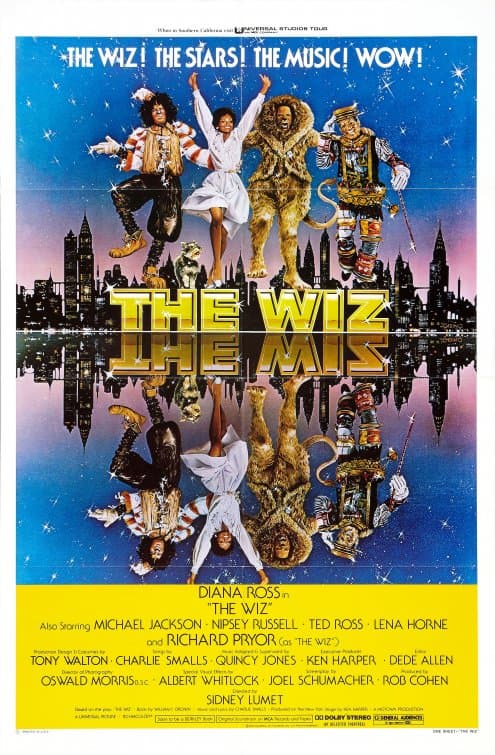
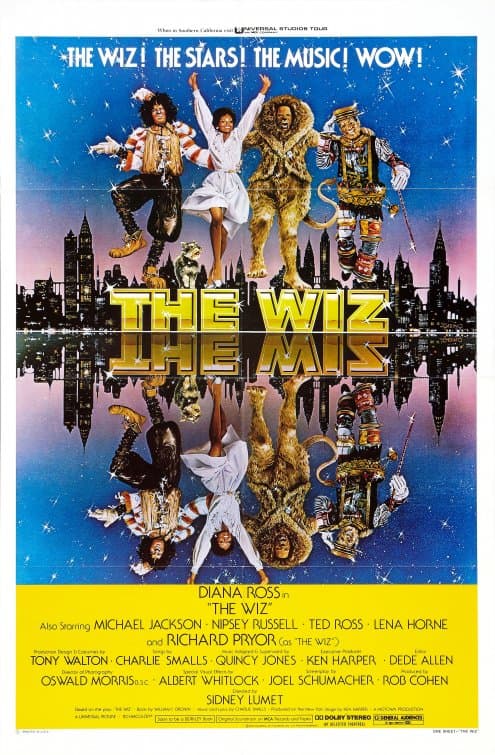
In this all-Black retelling of The Wizard of Oz, 24-year-old Harlem schoolteacher Dorothy is swept up by a snowstorm and deposited in the wonderland of Oz. Following a yellow brick road that winds through the New York City landscape, she joins a Scarecrow, a Tin Man, and a Cowardly Lion on a journey to meet the Wiz and find her way back home.
What Is the Budget of The Wiz (1978)?
The Wiz (1978), directed by Sidney Lumet and distributed by Universal Pictures with Motown Productions, was produced on a reported budget of $24,000,000. The film adapted the Tony-winning 1975 Broadway musical of the same title (book by William F. Brown, music and lyrics by Charlie Smalls), which had itself reimagined L. Frank Baum's The Wonderful Wizard of Oz with an all-Black cast and a contemporary R&B and disco score. Diana Ross headlined as Dorothy, with Michael Jackson as the Scarecrow in his first feature acting role.
The investment reflected what was at the time the most expensive film built around an all-Black cast in Hollywood history. Motown founder Berry Gordy partnered with Universal to finance and produce, with Rob Cohen of Motown Productions producing and Diana Ross attached as the principal star above contract. The budget accommodated extensive New York City location shooting, a 1,000-person ensemble disco-Munchkinland sequence, and elaborate practical effects work for the Wicked Witch melting and the Yellow Brick Road set pieces.
Key Budget Allocation Categories
The Wiz's reported $24,000,000 budget was distributed across several core production areas:
- Above-the-Line Talent: Director Sidney Lumet (Network, Dog Day Afternoon, Murder on the Orient Express) commanded a top-tier feature-director rate following his recent Oscar-circuit prestige run. Diana Ross, the Supremes lead-turned-Mahogany solo star, commanded a top-tier music-and-film quote, with Michael Jackson, Nipsey Russell, Ted Ross, Lena Horne, and Richard Pryor filling out the principal cast.
- New York Location Production: Principal photography took place across New York City's five boroughs, with the World Trade Center plaza standing in for the Emerald City, the Brooklyn Astoria Subway used for Munchkinland, Coney Island used for the Poppy Field sequence, and Shea Stadium used for the cathedral scene. Location permits, NYPD coordination, and street closures for major Manhattan sequences represented one of the production's largest line items.
- Production Design and Set Construction: Production designer Tony Walton (Mary Poppins, Murder on the Orient Express) and his department constructed elaborate Munchkinland, Emerald City, and Wicked Witch's castle sets at Astoria Studios in Queens. The Munchkinland set alone reportedly required four months of construction, with the Emerald City sequences built across multiple soundstages and the surrounding World Trade Center plaza.
- Costume Design: Costume designer Tony Walton (doubling on the picture) designed approximately 3,000 costumes for principal cast and the 1,000-plus extras featured in the Munchkinland, Emerald City, and Poppy Field sequences. The costume budget represented one of the largest in late-1970s Hollywood musical history.
- Music and Recording: Quincy Jones served as music supervisor and arranger, with Charlie Smalls's Broadway score augmented by new songs from Jones, Ashford and Simpson, and Luther Vandross. The score recording at Hit Factory Studios in New York represented a major line item, with Diana Ross, Michael Jackson, Nipsey Russell, and the ensemble all recording principal vocals.
- Visual Effects and Practical Magic: The film required extensive practical and optical effects for the Tornado sequence, the Wicked Witch's castle, the Yellow Brick Road floating-tile reveal, and the Poppy Field hallucination. Effects work, fronted by Albert Whitlock's matte paintings and supplemented by mechanical-effects rigging, represented a significant additional line item.
How Does The Wiz's Budget Compare to Similar Films?
At a reported $24,000,000, The Wiz sat at the high end of late-1970s movie musicals. The comparison set frames its commercial outcome:
- Grease (1978): Budget $6,000,000 | Worldwide $396,271,103. The Randal Kleiser musical released six months earlier cost one quarter and earned more than 18 times the worldwide total, the in-house Paramount comparison Universal could not avoid.
- Saturday Night Fever (1977): Budget $3,500,000 | Worldwide $237,113,184. The contemporaneous John Badham disco drama cost less than one sixth and earned 11 times the worldwide total, illustrating the dramatic disparity between a low-budget streetlife film and the elaborate studio-built spectacle of The Wiz.
- Hair (1979): Budget $11,000,000 | Worldwide $15,283,000. Milos Forman's contemporaneous counter-culture musical cost less than half and earned 75% of The Wiz, demonstrating the broader struggles of the late-1970s movie-musical category.
- Sgt. Pepper's Lonely Hearts Club Band (1978): Budget $18,000,000 | Worldwide $20,400,000. The Peter Frampton-Bee Gees Beatles tribute released two months before The Wiz cost 25% less, grossed similarly, and was widely cited as evidence that Hollywood musicals had decisively cooled.
- Hello, Dolly! (1969): Budget $25,000,000 | Worldwide $33,200,000. The Barbra Streisand Gene Kelly musical cost roughly the same and earned similarly, an earlier example of the same prestige-musical financial pattern that The Wiz replicated.
The Wiz Box Office Performance
The Wiz opened on October 24, 1978, in limited release, expanding wide on October 27, finishing third at the domestic box office over its expansion weekend behind Halloween and the second weekend of Animal House. The film opened to broadly negative reviews in major dailies and saw weak word-of-mouth from general audiences, with theatre operators reporting unusually high walk-out rates compared with other late-1978 releases.
Against a reported production budget of $24,000,000, the film needed approximately $55,000,000 in worldwide gross to reach profitability when accounting for marketing and distribution costs. Here is the financial breakdown:
Box Office Breakdown
The Wiz (1978)

The Wiz returned approximately $0.45 in worldwide theatrical revenue for every $1 invested when measured against total estimated production and marketing spend, placing it among the largest losses on Universal's 1978 slate. The picture's box office collapse, combined with the underperformance of the contemporaneous Sgt. Pepper's Lonely Hearts Club Band, is broadly credited with ending the late-1970s major-studio movie-musical cycle.
The financial result had significant downstream consequences. Universal subsequently reduced its musical commitments dramatically, Motown's film-production ambitions contracted (Berry Gordy did not produce another major theatrical project for years), and Sidney Lumet returned to grittier dramatic material with Just Tell Me What You Want (1980) and Prince of the City (1981). Quincy Jones and Michael Jackson, however, continued their collaboration directly from The Wiz into Jackson's Off the Wall (1979) album, the launchpad for Jackson's solo superstardom.
The Wiz Production History
Development on a Wiz feature began at Motown Productions in 1975 immediately after the Broadway musical opened, with Motown founder Berry Gordy negotiating screen rights from producer Ken Harper. Diana Ross attached as Dorothy in 1976 on the strength of her recent Lady Sings the Blues and Mahogany credits, with Motown and Universal co-financing.
John Badham was originally attached to direct after Saturday Night Fever, but he departed the project when Diana Ross insisted on playing Dorothy (Badham had favored a younger actress closer to the L. Frank Baum source material). Sidney Lumet, Joel Schumacher's collaborator on numerous New York-set projects, attached as director in early 1977. Schumacher rewrote the screenplay to relocate the action from rural Kansas to contemporary Harlem and to update Dorothy's age to 24, with the New York City setting becoming a defining creative choice.
Principal photography began on October 3, 1977 in New York City, with location work across Manhattan, Brooklyn, Queens, and Coney Island. The Munchkinland sequence was filmed at the Brooklyn Astoria Subway, the Emerald City sequences at the World Trade Center plaza, and the Poppy Field at Coney Island. Interior soundstage work took place at Astoria Studios in Queens, where Tony Walton's elaborate Munchkinland and Wicked Witch's castle sets had been built across four months of pre-production. Shooting wrapped in March 1978 after a roughly twenty-three-week schedule.
Post-production ran through summer 1978 with score recording at Hit Factory Studios in New York under Quincy Jones's supervision. Universal positioned the film as the studio's premier 1978 holiday release, with a heavy advertising spend supporting the October opening and an unusual mix of street-team marketing and traditional television campaigns. The decision to release in late October rather than the more traditional Thanksgiving-or-Christmas musical corridor became a heavily debated post-mortem element.
Awards and Recognition
The Wiz received four Academy Award nominations at the 51st ceremony in April 1979: Best Cinematography (Oswald Morris), Best Art Direction (Tony Walton and Philip Rosenberg), Best Costume Design (Tony Walton), and Best Original Score Adaptation (Quincy Jones). The film did not win any of the nominations.
Composer Charlie Smalls and lyricist Charlie Smalls received a Golden Globe nomination for Best Original Song ("Brand New Day"), which the film did not win. The film also received Grammy nominations for the soundtrack album, with several individual recordings (notably Diana Ross's "Home" and Michael Jackson's "Ease on Down the Road") becoming standalone hits independent of the film's commercial performance.
Critical Reception
The Wiz received mixed-to-negative reviews. The film holds a 41% approval rating on Rotten Tomatoes based on 56 critic reviews, with the consensus calling it visually striking but narratively muddled. On Metacritic, the film does not have an aggregated score given its 1978 release predating the database.
Pauline Kael in The New Yorker wrote that the film "loves its production design more than its story," and Vincent Canby in The New York Times observed that "Diana Ross at 34 cannot quite carry the bewildered innocence the Dorothy role requires." Roger Ebert in the Chicago Sun-Times was more sympathetic, awarding three stars and praising the film's ambition while noting its excessive running time.
Genre and Black-press reaction was significantly more positive. Ebony, Jet, and the Amsterdam News all praised the film as a landmark for Black representation in Hollywood musicals, with Lena Horne's Glinda the Good Witch performance and the climactic "Brand New Day" sequence cited as particular high points. The film's critical reputation has rebounded substantially in subsequent decades, with retrospective reassessments by The New York Times and BFI Sight & Sound positioning it as a culturally significant if commercially disappointing musical that helped launch Michael Jackson's adult solo career.
Frequently Asked Questions
How much did it cost to make The Wiz (1978)?
The reported production budget was $24,000,000. Universal Pictures distributed the film, with Motown Productions co-producing through Motown founder Berry Gordy's arrangement with the studio.
How much did The Wiz earn at the box office?
The film grossed approximately $21,049,053 worldwide, almost entirely from the United States. It opened on October 24, 1978 in limited release and expanded wide on October 27, finishing third at the domestic box office over its expansion weekend behind Halloween and the second weekend of Animal House.
Was The Wiz a box office bomb?
Yes. Against a $24,000,000 production budget and an estimated $15,000,000 to $20,000,000 in marketing spend, the film returned approximately $0.45 in worldwide gross for every $1 invested. The picture's box office collapse, combined with the underperformance of Sgt. Pepper's Lonely Hearts Club Band (1978), is broadly credited with ending the late-1970s major-studio movie-musical cycle.
Who directed The Wiz (1978)?
Sidney Lumet directed the film, working from a screenplay by Joel Schumacher (later a director in his own right on The Lost Boys, Batman Forever, and others). Lumet had previously directed Network (1976), Dog Day Afternoon (1975), and Murder on the Orient Express (1974) before this musical assignment.
Where was The Wiz filmed?
Principal photography began on October 3, 1977 across New York City's five boroughs. The Munchkinland sequence was filmed at the Brooklyn Astoria Subway, the Emerald City sequences at the World Trade Center plaza, the Poppy Field at Coney Island, and the cathedral scene at Shea Stadium. Interior soundstage work took place at Astoria Studios in Queens. Shooting wrapped in March 1978.
Who plays Dorothy in The Wiz (1978)?
Diana Ross plays Dorothy, then aged 33 and reimagined for the film as a 24-year-old Harlem schoolteacher rather than the young rural girl of the L. Frank Baum source material. Michael Jackson plays the Scarecrow in his first feature acting role, with Nipsey Russell as the Tin Man, Ted Ross as the Cowardly Lion, Lena Horne as Glinda the Good Witch, and Richard Pryor as the Wiz.
Did The Wiz win any awards?
The film received four Academy Award nominations at the 51st ceremony in April 1979: Best Cinematography (Oswald Morris), Best Art Direction (Tony Walton and Philip Rosenberg), Best Costume Design (Tony Walton), and Best Original Score Adaptation (Quincy Jones). The film did not win any of the nominations.
Is The Wiz a remake of The Wizard of Oz?
The Wiz adapts the 1975 Tony-winning Broadway musical of the same title (book by William F. Brown, music and lyrics by Charlie Smalls), which had itself reimagined L. Frank Baum's The Wonderful Wizard of Oz with an all-Black cast and a contemporary R&B and disco score. The film differs from the 1939 Judy Garland musical in setting, cast composition, score, and tone, although both share the underlying Baum source material.
What did critics think of The Wiz (1978)?
The film received mixed-to-negative reviews on release, with a 41% approval rating on Rotten Tomatoes (based on 56 critics). Pauline Kael in The New Yorker called it overly enamored with its production design, and Vincent Canby in The New York Times argued that Diana Ross at 33 could not carry the bewildered-innocence the Dorothy role required. Roger Ebert was more sympathetic, awarding three stars. Retrospective reassessments have been substantially more positive.
How did The Wiz launch Michael Jackson's solo career?
During production, Michael Jackson met Quincy Jones, who was supervising the film's music. The collaboration extended directly from The Wiz into Jackson's Off the Wall (1979) album, which Jones produced. Off the Wall sold more than 20 million copies, launched Jackson's adult solo superstardom, and was followed by Thriller (1982), the best-selling album in history. Jackson later credited the Wiz set as the moment he committed to a solo career independent of the Jackson 5.
Filmmakers
The Wiz (1978)

Build budgets like this one in Saturation
Start from an industry-standard feature film template, import the schedule and rates you already have, and let the cost report keep itself current as you spend. Real-time collaboration, no spreadsheets.