Terminator 3: Rise of the Machines Budget
 ActionThrillerScience Fiction1h 49m
Updated
Synopsis
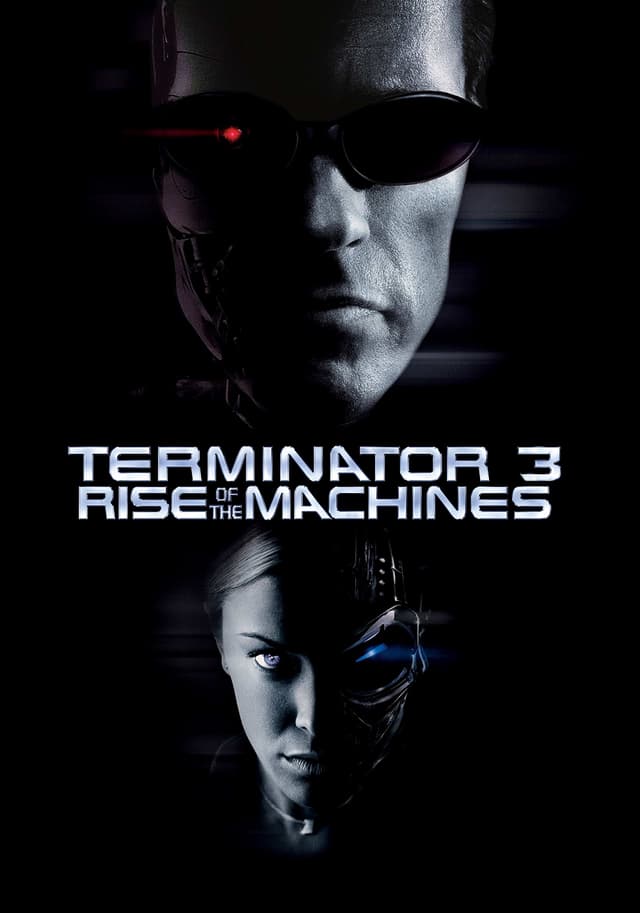
"Terminator 3: Rise of the Machines" continues the iconic saga of humanity's battle against machines. Set a decade after the events of "Terminator 2: Judgment Day," John Connor, now a disillusioned drifter, is trying to evade his fate as the future leader of the human resistance. However, his past catches up with him when a new, advanced Terminator known as the T-X is sent back in time to eliminate him and his future lieutenants.
As the T-X wreaks havoc, Connor is joined by Kate Brewster, a veterinarian with her own ties to the impending apocalypse. Together, they must escape the relentless pursuit of the T-X while uncovering the truth about Skynet's imminent activation. The film escalates into a race against time, culminating in a battle that reveals the harsh realities of their future and the sacrifices required to fight against a seemingly unstoppable force. With thrilling action sequences and a blend of science fiction and drama, "Terminator 3" explores themes of fate, resilience, and the human spirit's struggle against technological domination.
What is the budget of Terminator 3 Rise of the Machines?
"Terminator 3 Rise of the Machines," an action released in 2003, was directed by Jonathan Mostow and stars Arnold Schwarzenegger, Nick Stahl. The production budget was $200,000,000, placing it in the blockbuster range for action productions of its era.
Key Budget Allocation Categories
While specific budget breakdowns are not publicly available, typical cost drivers for an action production like this include:
- Stunts, Action Sequences & Visual Effects: Action films allocate a substantial portion of their budget to choreographing and executing practical stunts, pyrotechnics, and CGI-heavy sequences.
- Above-the-Line Talent (Cast & Director): A-list talent commands significant upfront fees plus backend participation.
- Production Design, Sets & Locations: Action films frequently require multiple international shooting locations, large-scale set construction, vehicle acquisitions and modifications, and specialized equipment , all of which drive production costs well above those of dialogue-driven genres.
How Does Terminator 3 Rise of the Machines's Budget Compare to Similar Films?
At $200,000,000, Terminator 3 Rise of the Machines sits in the blockbuster range. Here is how it compares to productions with a similar budget:
- 2012 (2009): Budget $200,000,000, Worldwide Gross $791,217,826
- Alice in Wonderland (2010): Budget $200,000,000, Worldwide Gross $1,025,467,110
- Ant-Man and the Wasp: Quantumania (2023): Budget $200,000,000 , Gross $476,071,180
- Argylle (2024): Budget $200,000,000, Worldwide Gross $96,221,061
- Black Adam (2022): Budget $200,000,000, Worldwide Gross $393,452,111
The median budget for wide-release action films in the 2000s ranges from $30 to 80M for mid-budget to $150M+ for tentpoles.
Terminator 3 Rise of the Machines Box Office Performance
"Terminator 3 Rise of the Machines" earned $150,371,112 domestically and $435,000,000 worldwide at the box office. Against a production budget of $200,000,000, the film showed modest profitability in theatrical release.
Box Office Breakdown
Terminator 3: Rise of the Machines

At approximately +118%, Terminator 3: Rise of the Machines returned roughly $2.17 for every $1 of production budget invested during its theatrical run.
The 35/65 domestic-to-international split saw $150,371,112 from North America and $284,628,888 from overseas markets.
Awards and Recognition
3 wins & 24 nominations total
Production History
Terminator 3 endured a protracted development cycle rooted in corporate upheaval. Carolco Pictures filed for bankruptcy in November 1995, triggering a rights auction. Andrew G. Vajna and Mario Kassar acquired the franchise rights for $8 million by October 1997, and they secured Gale Ann Hurd's remaining stake in March 1998 for an additional $8 million. James Cameron was approached but ultimately declined involvement.
Jonathan Mostow signed on as director in March 2001, bringing a clear vision for the project. He told the studio: "Here's the movie I'm going to make, here's how I'm going to do it. If you don't want to do it my way, you should find a different director." Mostow brought in John Brancato and Michael Ferris to rewrite Tedi Sarafian's original script. The $187.3 million budget was the largest greenlit for any film at that time, including Arnold Schwarzenegger's record $30 million salary.
Principal photography ran from April 15 to September 8, 2002, filmed primarily in California at Los Angeles Center Studios. Notable casting changes occurred during production: Edward Furlong was replaced by Nick Stahl as John Connor due to substance abuse concerns, and Sophia Bush was replaced by Claire Danes as Kate Brewster in May 2002 when Mostow felt Bush appeared too young for the role.
Critical Reception
Terminator 3 received generally favorable reviews. On Rotten Tomatoes, the film holds a 70% approval rating based on 203 reviews, with the consensus noting that "although T3 never reaches the heights of the second movie, it is a welcome addition to the Terminator franchise." Metacritic assigned a score of 66 out of 100 from 41 critics, indicating generally favorable reviews. Audiences gave the film a B+ CinemaScore grade.
Roger Ebert gave the film two and a half stars, describing it as "essentially one long chase and fight, punctuated by comic, campy or simplistic dialogue." A. O. Scott characterized it as "essentially a B movie, content to be loud, dumb and obvious." Both critics acknowledged the film delivered on its action promises despite narrative limitations.
Director Mostow later offered a candid self-assessment, acknowledging that "some of it's too shticky, some of it has not aged well with time." He maintained, however, that the film worked effectively with theatrical audiences at the time of release. The film's bold ending, which depicted the nuclear apocalypse actually occurring, drew particular praise from fans and critics who appreciated the willingness to subvert franchise expectations.
Frequently Asked Questions
How much did Terminator 3: Rise of the Machines cost to make?
The production budget was approximately $200,000,000, making it one of the most expensive films ever produced at the time of its release. Warner Bros. and Columbia Pictures co-distributed, with C-2 Pictures, Intermedia, and IMF (Internationale Medien und Film) co-financing.
How much did Terminator 3 earn at the box office?
The film grossed $150,371,112 domestically and $283,000,000 internationally, for a worldwide total of approximately $433,000,000. It opened to $44,041,440 over its three-day debut on July 2, 2003, the Wednesday before the Fourth of July holiday weekend.
How much did Arnold Schwarzenegger earn for Terminator 3?
Arnold Schwarzenegger received an unprecedented compensation package valued at approximately $29,250,000 in salary plus 20% of gross, plus a perks package that included a private jet, all-expenses-paid hotel accommodations, and additional personal guarantees. The contract was widely cited at the time as one of the richest in Hollywood history.
Who directed Terminator 3?
Jonathan Mostow directed the film. Mostow had previously directed Breakdown (1997) and U-571 (2000). James Cameron, who directed the original two Terminator films, was not involved in Terminator 3 due to a rights dispute with Carolco Pictures founders Andrew Vajna and Mario Kassar.
Who stars in Terminator 3?
Arnold Schwarzenegger returns as the T-850 Terminator, with Nick Stahl replacing Edward Furlong as John Connor, Claire Danes as Kate Brewster, and Kristanna Loken as the T-X antagonist. Linda Hamilton does not return as Sarah Connor, who is established as having died of leukemia between Judgment Day and Rise of the Machines.
Where was Terminator 3 filmed?
Principal photography took place in Los Angeles, with location work in Lancaster, California, and at the Vasquez Rocks. Substantial vehicular stunt sequences were filmed on closed streets in downtown Los Angeles, including the climactic crane-truck chase.
What did critics think of Terminator 3?
Reviews were mixed, with a 70% approval rating on Rotten Tomatoes and a 66 out of 100 score on Metacritic. Critics praised the visual effects and action sequences but objected to a less substantive screenplay than Terminator 2: Judgment Day (1991). Audiences gave the film a B+ CinemaScore.
Was Terminator 3 profitable?
The theatrical performance was solidly profitable. Against the $200,000,000 production budget and an estimated $100,000,000 in worldwide marketing spend, the $433,000,000 worldwide theatrical gross delivered a clear theatrical return before substantial home video and broadcast revenue.
How does Terminator 3 compare to Terminator 2?
Terminator 3 grossed $433,000,000 worldwide against Terminator 2: Judgment Day (1991) at $520,900,000 worldwide. The 12-year gap, combined with inflation, ultimately favored the original sequel on a real-dollar basis, although Terminator 3 outperformed the subsequent franchise entries Salvation (2009) and Genisys (2015).
What happened with the Terminator franchise after Terminator 3?
The franchise has struggled commercially since, with Terminator Salvation (2009, $200,000,000 budget, $371,400,000 worldwide), Terminator Genisys (2015, $155,000,000 budget, $440,600,000 worldwide), and Terminator: Dark Fate (2019, $185,000,000 budget, $261,100,000 worldwide) all underperforming relative to their budgets and the original two James Cameron films.
Filmmakers
Terminator 3: Rise of the Machines

Official Trailer
Build budgets like this one in Saturation
Start from an industry-standard feature film template, import the schedule and rates you already have, and let the cost report keep itself current as you spend. Real-time collaboration, no spreadsheets.