Swing Vote Budget
 Comedy
Updated
Synopsis
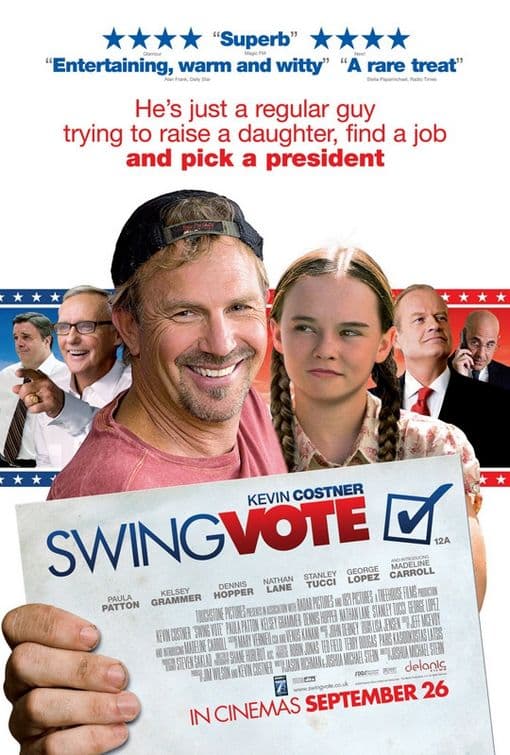
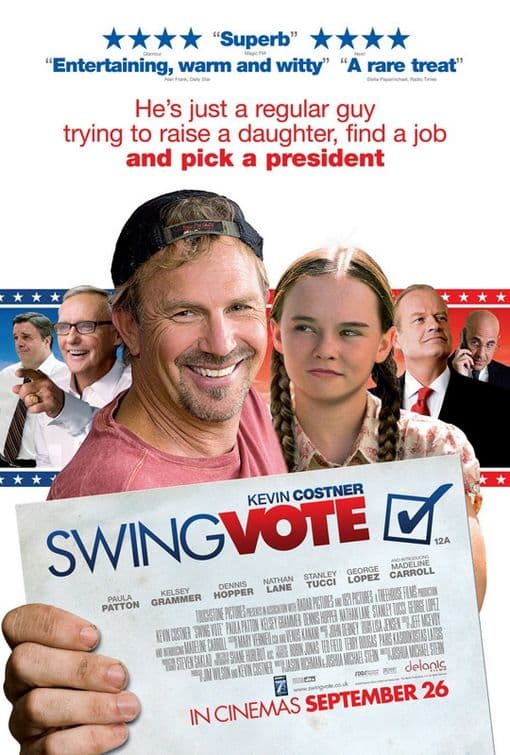
Through a clerical error at his small-town New Mexico polling station, Bud Johnson, a beer-soaked single father and indifferent voter, becomes the only person whose ballot in a deadlocked presidential election will determine the next President of the United States. As both campaigns descend on his town to court his single vote, his 12-year-old daughter Molly tries to push him toward the responsibility he has spent his life avoiding.
What Is the Budget of Swing Vote (2008)?
Swing Vote (2008), directed by Joshua Michael Stern and distributed by Touchstone Pictures, was produced on a reported budget of $21,000,000. The film originated as a Stern-Jason Richman spec screenplay that the writing duo had developed across the late 2000s. Kevin Costner attached as the lead and producer in 2007 through his Treehouse Films company, with Disney's Touchstone label financing the production for a summer 2008 release timed to the U.S. presidential election cycle.
The investment reflected a contained mid-budget star-driven comedy play. Kevin Costner took a reduced upfront fee in exchange for back-end participation and producer credits. The supporting cast included Kelsey Grammer (as the Republican incumbent), Dennis Hopper (as the Republican campaign manager), Nathan Lane (as the Democratic campaign manager), Stanley Tucci (as the Democratic candidate's strategist), and newcomer Madeline Carroll as Costner's daughter Molly. Most cast members worked at well-below-quote rates to participate in the timely political comedy.
Key Budget Allocation Categories
Swing Vote's $21,000,000 budget was distributed across these core production areas:
- Above-the-Line Talent: Kevin Costner commanded the largest single line item, with his upfront fee reduced against back-end participation and producer credits through Treehouse Films. The supporting bench of established character actors (Grammer, Hopper, Lane, Tucci) took chapter-specific weekly fees rather than full feature quotes. Director Joshua Michael Stern and co-writer Jason Richman received feature scale plus producer credit.
- New Mexico Location Shoot: Principal photography ran across the small towns of New Mexico, including Belen, Albuquerque, and the surrounding rural geography that established the fictional Texico setting. The New Mexico film production tax credit served as the production's primary financial anchor.
- Production Design: Production designer Anne Stuhler dressed the central Texico bowling alley, Bud's trailer-park home, and the campaign-bus interiors that anchor the second half of the film. The design budget covered both practical location modifications and several constructed interior sets at Albuquerque Studios.
- Cinematography: Cinematographer Shane Hurlbut, fresh off Terminator Salvation prep work, shot the film in widescreen 2.39:1 with a sun-bleached desaturated palette appropriate to the New Mexico desert setting. The Arri Alexa-equivalent (Genesis-era) camera package and lighting equipment came in at typical mid-budget studio comedy levels.
- Wardrobe: Costume designer Mona May dressed Costner in carefully aged blue-collar wardrobe and contrasted the candidates' aspirational campaign clothing with the deliberately rumpled Bud Johnson silhouette.
- Score and Music: Composer John Debney scored the film with an Americana-orchestral palette built around acoustic guitar, mandolin, and small orchestra figures, and the soundtrack featured prominent licensed source cues from Kenny Chesney, Mavis Staples, and several country and Americana artists.
- Election-Cycle Marketing Tie-in: A portion of the production budget was allocated to creating broadcast-ready fictional campaign commercials seen in the film, made by an actual political ad team to ensure the satirical content read as period-authentic. These cost in the low six figures.
How Does Swing Vote's Budget Compare to Similar Films?
At $21,000,000, Swing Vote sits in the mid-range of late-2000s mid-budget star-led political comedies. The comparison set illustrates how its commercial outcome diverged from comparable election-cycle releases:
- Wag the Dog (1997): Budget $15,000,000 | Worldwide $64,300,000. Barry Levinson's De Niro-Hoffman political satire cost less than three quarters of Swing Vote and grossed nearly four times as much, providing the most direct genre peer for the timely political comedy register.
- The Manchurian Candidate (2004): Budget $80,000,000 | Worldwide $96,100,000. Jonathan Demme's election-cycle Denzel Washington thriller cost nearly four times Swing Vote and grossed five times as much, illustrating the studio-scale reference point for politically-themed feature releases in the same demographic.
- W. (2008): Budget $25,000,000 | Worldwide $29,500,000. Oliver Stone's contemporaneous George W. Bush biopic cost slightly more than Swing Vote and grossed roughly the same worldwide, providing the closest 2008 election-cycle peer for studio-scale political content.
- Man of the Year (2006): Budget $20,000,000 | Worldwide $41,000,000. Barry Levinson's Robin Williams political comedy cost roughly the same as Swing Vote and grossed more than twice as much, illustrating the genre's ceiling at the same budget tier two years earlier.
- Lions for Lambs (2007): Budget $35,000,000 | Worldwide $63,200,000. Robert Redford's political ensemble cost 67% more than Swing Vote and grossed nearly four times as much, providing the prestige-cast peer reference.
Swing Vote Box Office Performance
Swing Vote opened domestically on August 1, 2008 across 2,231 theaters, earning $6,237,235 over its opening weekend and finishing fifth behind The Dark Knight, The Mummy: Tomb of the Dragon Emperor, Step Brothers, and Mamma Mia. The film fell sharply in subsequent weekends and ended its domestic theatrical run with $16,261,565. International receipts added $1,490,000, for a worldwide total of $17,752,000. Here is the financial breakdown:
Box Office Breakdown
Swing Vote (2008)

Swing Vote returned approximately $0.36 in worldwide theatrical gross for every $1 invested when measured against total estimated production and marketing spend, placing it among the clearer commercial disappointments of the 2008 August corridor. The domestic share of the worldwide gross was 92%, an unusually high split that reflected both the specifically American political subject matter and the limited international appetite for U.S. election-cycle content. Home-entertainment revenue on DVD and Blu-ray through Disney's home-entertainment division recovered a portion of the loss.
The commercial result contributed to a difficult late-2000s period for Touchstone Pictures, which Disney would effectively wind down as an active production label in the early 2010s. Kevin Costner's subsequent feature roles moved further into supporting and prestige character work, with his next significant lead role coming in The Company Men (2010) and his next major leading-man feature in Mr. Brooks (2007) preceding rather than following Swing Vote.
Swing Vote Production History
Joshua Michael Stern and Jason Richman wrote the Swing Vote screenplay in the early-to-mid 2000s, structuring the central conceit (one voter, one decisive vote) around the post-2000 Bush v. Gore Florida recount discourse. Kevin Costner attached in 2007 after several years of development, with Touchstone Pictures closing the production financing through Costner's Treehouse Films company for a summer 2008 release timed to the U.S. presidential election cycle.
Principal photography ran from August to October 2007 across small towns in New Mexico, including Belen, Albuquerque, and the surrounding rural geography that established the fictional Texico setting. The New Mexico film production tax credit served as the production's primary financial anchor, and several supporting cast members (including the unbilled cameos by working politicians and broadcast journalists) shot their material during the New Mexico production block.
The film included an unusual number of cameo appearances by real political figures and broadcast journalists, including Larry King, Chris Matthews, Bill Maher, Aaron Brown, James Carville, Mary Matalin, Tucker Carlson, Arianna Huffington, and Campbell Brown, all of whom shot their material in single-day visits to the New Mexico base. The cameo coordination expanded the production schedule but kept the celebrity participations to specific compressed visits.
Post-production stretched from November 2007 through May 2008, with Touchstone positioning the film for an August 1, 2008 release that aligned with the heat of the McCain-Obama general election campaign. Director Stern, editor Jeff McEvoy, and composer John Debney delivered the finished picture in late June 2008, with marketing aligned to the election-cycle news coverage.
Awards and Recognition
Swing Vote received minimal awards recognition. The film was not nominated at the Academy Awards, BAFTAs, Golden Globes, Screen Actors Guild Awards, or Critics' Choice Awards. Young actress Madeline Carroll received a Young Artist Award nomination for her supporting performance as Molly Johnson. The film also received a Phoenix Film Critics Society nomination for Best Supporting Young Performer for Carroll.
Within Kevin Costner's late-2000s filmography, the picture is generally considered alongside Mr. Brooks (2007) and The Company Men (2010) as part of a sustained character-actor phase that bridged his earlier leading-man period and his subsequent television work (Hatfields & McCoys, Yellowstone). Within Joshua Michael Stern's directing career, Swing Vote sits as his most commercially-positioned feature before his subsequent biographical work on Jobs (2013).
Critical Reception
Swing Vote received mixed reviews on release. The film holds a 38% approval rating on Rotten Tomatoes based on 162 critic reviews, with the consensus calling it "an amiable Capra-esque comedy that softens its political points until they no longer cut." On Metacritic, the film scored 53 out of 100, indicating mixed or average reviews. Audiences gave the film a B CinemaScore.
Roger Ebert gave the film three out of four stars, writing that "Costner is at his most engaging as a likably hopeless father, and the satire is more affectionate than sharp." Manohla Dargis at The New York Times was more critical, calling the film "a politically toothless fantasy that wants to flatter everyone in the room." Variety's Brian Lowry wrote that "Costner anchors a movie that wants to be both Mr. Smith Goes to Washington and an after-school special, and never finds the rhythm of either."
Positive reviews concentrated on the Costner-Carroll father-daughter dynamic and the genuine emotional centerpiece of Bud's final-act decision-making. Negative reviews focused on what Owen Gleiberman at Entertainment Weekly called "the script's relentless refusal to commit to any actual political position." The film has not undergone meaningful critical reappraisal in the years since release and remains a mid-tier entry in Costner's mid-to-late career filmography.
Frequently Asked Questions
How much did it cost to make Swing Vote (2008)?
The reported production budget was $21,000,000. Touchstone Pictures (through The Walt Disney Studios) financed the production with Kevin Costner's Treehouse Films and Radar Pictures, anchored by the New Mexico film production tax credit during the autumn 2007 shoot.
How much did Swing Vote (2008) earn at the box office?
The film grossed $16,261,565 domestically and $1,490,000 internationally, for a worldwide total of $17,752,000. It opened to $6,237,235 across 2,231 theaters on August 1, 2008, finishing fifth behind The Dark Knight, The Mummy: Tomb of the Dragon Emperor, Step Brothers, and Mamma Mia.
Was Swing Vote (2008) a box office bomb?
Yes. Against a $21,000,000 production budget and an estimated $25,000,000 to $30,000,000 in marketing spend, the film returned approximately $0.36 in worldwide gross for every $1 invested. The release coincided with the heart of the McCain-Obama election cycle but failed to translate the political moment into theatrical attendance.
Who directed Swing Vote (2008)?
Joshua Michael Stern directed the film, co-writing the screenplay with Jason Richman. Stern would go on to direct the Steve Jobs biopic Jobs (2013). Swing Vote was his second theatrical feature after Neverwas (2005).
Where was Swing Vote (2008) filmed?
Principal photography ran from August to October 2007 across small towns in New Mexico, including Belen, Albuquerque, and the surrounding rural geography that established the fictional Texico setting. The New Mexico film production tax credit served as the production's primary financial anchor.
Who stars in Swing Vote (2008)?
Kevin Costner stars as Bud Johnson, with Madeline Carroll as his 12-year-old daughter Molly. The political ensemble includes Kelsey Grammer (Republican incumbent President Andrew Boone), Dennis Hopper (Republican strategist Martin Fox), Nathan Lane (Democratic strategist Art Crumb), and Stanley Tucci (Democratic strategist Galena Greenleaf), with Paula Patton as TV reporter Kate Madison.
Are there real politicians in Swing Vote (2008)?
Yes. The film features unusually deep cameos by working journalists and political commentators of the era, including Larry King, Chris Matthews, Bill Maher, Aaron Brown, James Carville, Mary Matalin, Tucker Carlson, Arianna Huffington, and Campbell Brown, all of whom shot their material in single-day visits to the New Mexico production base.
When does Swing Vote take place?
The film is set during a fictional U.S. presidential election cycle in 2008, with a plot mechanism in which the entire result hinges on the recast vote of a single voter from the fictional New Mexico town of Texico. The film was released on August 1, 2008, three months before the actual McCain-Obama election.
What did critics think of Swing Vote (2008)?
The film received mixed reviews, with a 38% Rotten Tomatoes approval (162 reviews), a 53 out of 100 Metacritic score, and a B CinemaScore from audiences. Roger Ebert gave it three out of four stars, calling Costner "at his most engaging." Negative reviews focused on what critics described as a "politically toothless" middle position.
Did Swing Vote (2008) win any awards?
No. The film received Young Artist Award and Phoenix Film Critics Society nominations for young actress Madeline Carroll's supporting performance, but no nominations at the Academy Awards, BAFTAs, Golden Globes, Screen Actors Guild Awards, or Critics' Choice Awards.
Filmmakers
Swing Vote (2008)

Build budgets like this one in Saturation
Start from an industry-standard feature film template, import the schedule and rates you already have, and let the cost report keep itself current as you spend. Real-time collaboration, no spreadsheets.