Surf’s Up Budget
 Adventure
Updated
Synopsis
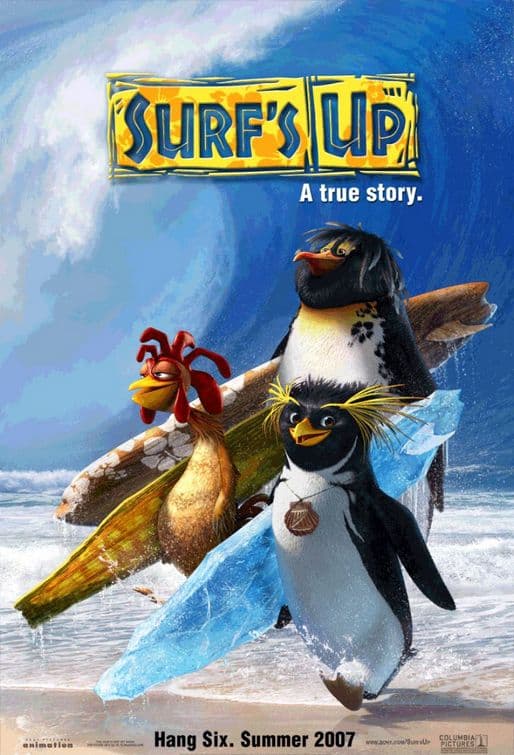
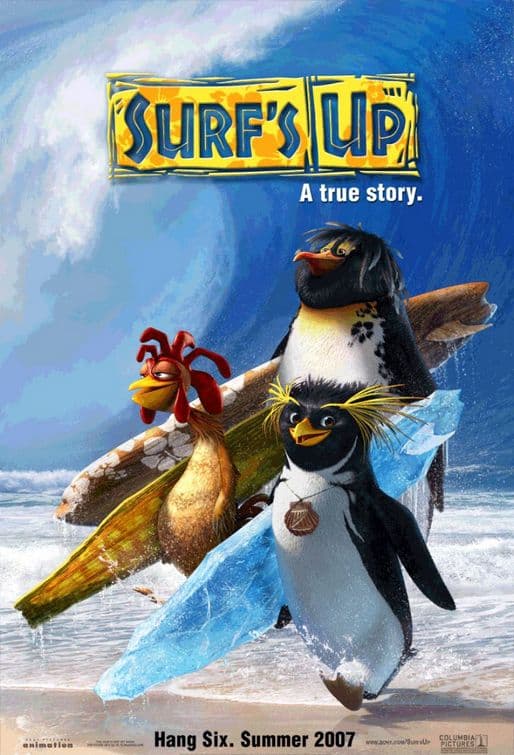
Teenage penguin Cody Maverick travels from Antarctica to a tropical surf island to compete in the annual Big Z Memorial Surf Off, the most prestigious event in the surf world. A documentary crew follows Cody as he meets his idols, makes new friends, and discovers that winning is not always what it seems in this mockumentary-style animated adventure from Sony Pictures Animation.
What Is the Budget of Surf's Up (2007)?
Surf's Up (2007), directed by Ash Brannon and Chris Buck and distributed by Sony Pictures Releasing, was produced on a reported budget of $100,000,000. The mockumentary-style computer-animated feature was made by Sony Pictures Animation, the studio's then-young in-house animation division, as a stylistic experiment that combined surfing photography conventions with talking-animal animation. Producers Christopher Jenkins and Sandra Rabins oversaw the film as Sony's third theatrical animated feature after Open Season (2006) and the brief Re-Animated television pilot.
The investment reflected a deliberate technical ambition. Sony Pictures Animation built a custom render pipeline to simulate handheld surf cinematography, including realistic water dynamics, lens flare, focus pulls, and faux-documentary camera shake. The math required the film to earn roughly $250,000,000 worldwide to clear breakeven after marketing, a target it missed by a meaningful margin despite generally favorable critical reception and an eventual Academy Award nomination for Best Animated Feature.
Key Budget Allocation Categories
Surf's Up's $100,000,000 budget was distributed across several core production areas:
- Above-the-Line Talent: Co-directors Ash Brannon (Toy Story 2 co-director) and Chris Buck (Tarzan co-director) worked at established animation feature director rates. The voice cast was assembled around Shia LaBeouf as Cody, Jeff Bridges as Big Z, Zooey Deschanel as Lani, Jon Heder as Chicken Joe, and James Woods as Reggie Belafonte, with each performer recording over multiple sessions across the extended animation production window.
- Animation Production: Sony Pictures Animation and Sony Pictures Imageworks handled the entirety of the animation in-house, with more than 250 artists working over roughly three years. The animator-to-shot ratio was higher than typical computer-animated features because of the mockumentary aesthetic's requirement for naturalistic motion that simulated handheld camera work.
- Water Simulation R&D: The water effects pipeline required substantial research and development investment, building proprietary tools for foam, wake, spray, and barrel rendering that could match real surf cinematography. The team spent months at North Shore Oahu and other surf destinations photographing reference footage that the simulation tools then matched.
- Mockumentary Camera Pipeline: The film simulated handheld documentary cinematography with virtual cameras that introduced focus errors, lens distortion, frame slip, and other realistic imperfections. The pipeline required a parallel animation track in which animators worked from rough animatic camera angles before the final virtual camera "operator" decided where to land focus and frame.
- Music and Soundtrack: Composer Mychael Danna scored the film with a surf-rock infused orchestral palette. The soundtrack album leaned heavily on licensed surf-rock and ska tracks from Sublime, Sugar Ray, Lauryn Hill, Pearl Jam, and others. Music licensing was a meaningful budget line item, particularly for the multi-language theatrical and home-video versions.
- Marketing and Promotional Partnerships: Sony partnered with surf-industry brands including Quiksilver and Billabong for cross-promotion, with branded products appearing throughout the film as authenticity markers rather than traditional product placement. Domestic P&A spend was estimated at $75,000,000 to $90,000,000, a meaningful share of the total investment.
How Does Surf's Up's Budget Compare to Similar Films?
At $100,000,000, Surf's Up sat at the lower end of the 2007 computer-animated feature bracket but earned well below most peers:
- Ratatouille (2007): Budget $150,000,000 | Worldwide $623,722,818. Pixar's contemporaneous animated feature cost 50% more and earned more than 5x Surf's Up worldwide, winning Best Animated Feature at the Academy Awards over the Sony film.
- Shrek the Third (2007): Budget $160,000,000 | Worldwide $799,003,892. DreamWorks' Shrek sequel cost 60% more and earned roughly 7x Surf's Up worldwide.
- Bee Movie (2007): Budget $150,000,000 | Worldwide $293,524,738. DreamWorks' Jerry Seinfeld vehicle cost 50% more and earned 2.5x Surf's Up worldwide.
- Open Season (2006): Budget $85,000,000 | Worldwide $200,837,561. Sony Pictures Animation's prior theatrical feature cost 15% less and earned 75% more worldwide than Surf's Up, an outcome that troubled studio leadership.
- Happy Feet (2006): Budget $100,000,000 | Worldwide $384,335,608. Warner Bros' contemporaneous talking-penguin animated feature cost the same as Surf's Up and earned more than 3x worldwide while winning Best Animated Feature the prior year.
Surf's Up Box Office Performance
Surf's Up opened on June 8, 2007 to $17,640,249 across 3,475 theaters, finishing third for the weekend behind Ocean's Thirteen and Knocked Up. The opening fell well below Sony's projections and the film struggled against the same-day release of Ocean's Thirteen and the still-strong second weekend of Pirates of the Caribbean: At World's End. Subsequent weeks saw steady but unspectacular holds.
Against a $100,000,000 production budget the film needed approximately $250,000,000 worldwide to reach breakeven after marketing. Here is the financial breakdown:
Box Office Breakdown
Surf’s Up (2007)

Surf's Up returned approximately $0.83 in theatrical revenue for every $1 invested. The domestic share was $58,867,694 against an international share of $93,134,490, a 39/61 split that performed in line with category norms but failed to deliver the breakout overseas multiplier that contemporary Pixar and DreamWorks releases enjoyed. Home video and television revenue eventually closed the theatrical gap and the film made modest profit on the full lifecycle, but the original franchise plans were scaled back significantly.
A direct-to-video sequel, Surf's Up 2: WaveMania, was released in 2017 with significantly reduced budget and creative input from the original team, an outcome that reflected the original's modest theatrical performance rather than its broadly positive critical reception.
Surf's Up Production History
Development on Surf's Up began at Sony Pictures Animation in 2003 under the working title "Behind the Wave," with co-director Ash Brannon and producer Christopher Jenkins developing the mockumentary concept after extensive viewing of surf documentaries including Bruce Brown's The Endless Summer and Stacy Peralta's Riding Giants. Chris Buck joined as co-director in 2004, bringing experience from Tarzan and a deep familiarity with the surf community through his Southern California roots.
Voice casting solidified through 2005, with Shia LaBeouf cast as Cody Maverick while he was still in the early years of his post-Even Stevens transition to feature work. Jeff Bridges took the role of retired surf legend Big Z, drawing on his own surf-adjacent California heritage. Zooey Deschanel, Jon Heder, and James Woods rounded out the principal cast at standard voice-acting rates with the principal recording sessions taking place in late 2005 and early 2006.
Animation production ran from late 2004 through early 2007, with more than 250 artists at Sony Pictures Imageworks working on the custom mockumentary pipeline. The team spent months at North Shore Oahu and other surf destinations photographing reference footage that the simulation tools then matched. The naturalistic camera work required animators to deliver "two takes" of every shot, one with traditional clean camera framing and one with simulated handheld imperfection that the editor could choose between.
Composer Mychael Danna delivered the score in early 2007 ahead of the June theatrical release. Sony built the marketing campaign around the mockumentary premise, with character-as-interview-subject trailers and press materials that maintained the documentary conceit. The film opened the 2007 Annecy International Animated Film Festival as the festival's centerpiece selection before its theatrical release, an unusual programming choice for a studio production that signaled the festival's recognition of the technical innovation.
Awards and Recognition
Surf's Up received an Academy Award nomination for Best Animated Feature at the 80th Academy Awards in February 2008, competing against Persepolis and the eventual winner Ratatouille. The nomination was a meaningful recognition for Sony Pictures Animation's early ambitions and validated the technical innovation behind the mockumentary pipeline.
The film also received an Annie Award nomination for Best Animated Feature, and Sony Pictures Imageworks won the Visual Effects Society Award for Best Animated Character in an Animated Feature Motion Picture (for Cody Maverick). The Critics' Choice Movie Awards nominated the film for Best Animated Feature, and the Producers Guild of America recognized the film with a nomination for Outstanding Producer of Animated Theatrical Motion Pictures. Despite the broadly positive industry reception, the film failed to convert nominations to commercial momentum.
Critical Reception
Surf's Up received largely positive reviews. The film holds a 78% approval rating on Rotten Tomatoes based on 137 critic reviews, with a critical consensus that called it "a smart, original family film that finds humor in places few animated films have explored." On Metacritic, the film scored 64 out of 100, indicating generally favorable reviews. Audiences surveyed by CinemaScore gave the film an A-, a strong response that reflected the film's family appeal despite the soft commercial performance.
Critics praised the mockumentary conceit, the water animation, and the voice performances, particularly Jeff Bridges' relaxed turn as Big Z. Roger Ebert awarded the film 3 stars and called it "clever and original." A.O. Scott of the New York Times wrote that the film's technical innovation "sets a new bar for what computer animation can simulate beyond clean cartoon photography."
The mockumentary structure drew the most analytical attention. Animation Magazine called the film "the first animated feature to take documentary aesthetics seriously," and several critics flagged the production as a benchmark moment in the medium's stylistic vocabulary. The combination of positive reviews, an Oscar nomination, and soft theatrical performance made Surf's Up a frequent case study in subsequent analyses of how animated features can fail to convert critical and industry recognition to ticket sales.
Frequently Asked Questions
How much did it cost to make Surf's Up (2007)?
The reported production budget was $100,000,000. The film was financed by Sony Pictures and made in-house by Sony Pictures Animation and Sony Pictures Imageworks, the studio's then-young in-house animation division. It was Sony Pictures Animation's third theatrical animated feature after Open Season (2006) and the brief Re-Animated television pilot.
How much did Surf's Up earn at the box office?
The film grossed $58,867,694 domestically and $93,134,490 internationally, for a worldwide total of $152,002,184. It opened to $17,640,249 in the United States, finishing third on its June 8, 2007 opening weekend behind Ocean's Thirteen and Knocked Up.
Was Surf's Up a box office bomb?
It underperformed but did not crater. Against a $100,000,000 production budget and an estimated $75,000,000 to $90,000,000 in marketing spend, the film returned approximately $0.83 in worldwide gross for every $1 invested. Home video and television revenue eventually closed the theatrical gap and the film made modest profit on the full lifecycle.
Who directed Surf's Up?
Ash Brannon and Chris Buck co-directed the film. Brannon previously co-directed Toy Story 2, and Buck co-directed Tarzan. Buck later directed Frozen and Frozen II for Walt Disney Animation Studios, but at the time of Surf's Up he was best known for his Disney 2D animation work.
How was Surf's Up animated?
The film was made using a custom mockumentary animation pipeline developed at Sony Pictures Imageworks. The pipeline simulated handheld documentary cinematography with virtual cameras that introduced focus errors, lens distortion, frame slip, and other realistic imperfections. Animators delivered "two takes" of every shot, one clean and one with simulated handheld imperfection.
Did Surf's Up win the Best Animated Feature Oscar?
No. The film was nominated for Best Animated Feature at the 80th Academy Awards in February 2008 but lost to Pixar's Ratatouille. Persepolis was the third nominee. Despite the loss, the nomination was a meaningful recognition for Sony Pictures Animation's early ambitions and validated the technical innovation behind the mockumentary pipeline.
Who voices Cody Maverick in Surf's Up?
Shia LaBeouf voices Cody Maverick, the teenage penguin protagonist. LaBeouf recorded the role while still in the early years of his post-Even Stevens transition to feature work, with subsequent breakout roles in Transformers (2007) and Indiana Jones and the Kingdom of the Crystal Skull (2008). The supporting voice cast includes Jeff Bridges, Zooey Deschanel, Jon Heder, and James Woods.
Was there a sequel to Surf's Up?
A direct-to-video sequel, Surf's Up 2: WaveMania, was released in 2017 with significantly reduced budget and creative input from the original team. The sequel featured WWE wrestlers as voice cast members and was widely regarded as a brand-extension product rather than a creative continuation. The original's modest theatrical performance ended any prospect of a theatrical sequel.
How does Surf's Up compare to other 2007 animated films?
Surf's Up cost $100M and earned $152M worldwide. Ratatouille cost $150M and earned $623M (winning the Oscar over Surf's Up). Shrek the Third cost $160M and earned $799M. Bee Movie cost $150M and earned $293M. Surf's Up had the lowest worldwide gross of the four major 2007 computer-animated features despite the lowest production budget.
What did critics think of Surf's Up?
The film received largely positive reviews, with a 78% approval rating on Rotten Tomatoes (based on 137 critics) and a 64 out of 100 score on Metacritic. Audiences gave it an A- CinemaScore. Critics praised the mockumentary conceit, the water animation, and the voice performances, particularly Jeff Bridges' relaxed turn as Big Z. Roger Ebert awarded the film 3 stars.
Filmmakers
Surf’s Up (2007)

Build budgets like this one in Saturation
Start from an industry-standard feature film template, import the schedule and rates you already have, and let the cost report keep itself current as you spend. Real-time collaboration, no spreadsheets.