Stop-Loss Budget
 Drama
DramaUpdated
Synopsis
A decorated Iraq War veteran returns home to Texas only to be ordered back to active duty under the U.S. military's stop-loss policy. Refusing to redeploy, he goes AWOL with his best friend's fiancée in a cross-country flight that forces him to confront the moral cost of the war and the friendships it claimed.
What Is the Budget of Stop-Loss (2008)?
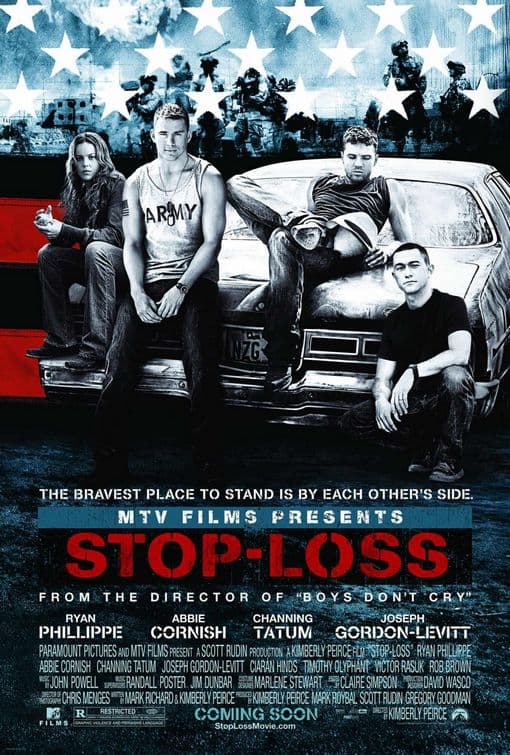
Stop-Loss (2008), directed by Kimberly Peirce and distributed by Paramount Pictures through its MTV Films label, was produced on a budget of $25,000,000. The film was Peirce's second feature after her acclaimed 1999 debut Boys Don't Cry, and it marked her studio-financed return after a nearly decade-long absence from directing. Scott Rudin and Mark Roybal produced through Scott Rudin Productions, with MTV Films co-financing as part of a slate of socially conscious mid-budget dramas the cable label was developing in the mid-2000s.
The budget reflected the realities of dramatic war pictures aimed at adult audiences. Paramount priced the film well below the studio's tentpole tier, betting that a cast of rising stars (Ryan Phillippe, Channing Tatum, Joseph Gordon-Levitt, Abbie Cornish) and topical subject matter could push the film into modest profitability through theatrical release, awards-season visibility, and downstream home entertainment revenue. The math required the film to clear roughly $50,000,000 worldwide to break even after marketing, a target it ultimately missed by a wide margin.
Key Budget Allocation Categories
Stop-Loss's $25,000,000 budget was distributed across several core production areas:
- Above-the-Line Talent: Director Kimberly Peirce commanded a feature-director rate appropriate to a Boys Don't Cry follow-up, and Ryan Phillippe led an ensemble that also featured Channing Tatum (then on the rise after Step Up), Joseph Gordon-Levitt, Abbie Cornish, Ciarán Hinds, and Timothy Olyphant. Pre-stardom rates kept the talent line manageable.
- Location Shooting: Production filmed in Morocco, doubling for Iraq combat sequences, then relocated to Austin, Texas and the surrounding Hill Country for the bulk of the homefront story. Texas tax credits offset a portion of in-state spend, and Morocco's subsidized production economy made the Iraq sequences affordable.
- Combat Sequences: The opening firefight in a fictionalized Tikrit street ambush required armored vehicles, military-grade pyrotechnics, blanks-firing weaponry, military advisors, and an extensive stunt unit. The sequence was shot over multiple weeks in Morocco with a dedicated second unit.
- Score and Music Licensing: Composer John Powell wrote the original score. The soundtrack was a defining feature of the film's marketing, featuring Toby Keith, Drive-By Truckers, Will Hoge, and the Pharrell-produced "Trying To Find a Way Out" by John Mayer, with licensing fees driving a music line larger than typical for a $25M drama.
- Veteran Consultants and Authenticity: Peirce, whose half-brother served in Iraq, retained Iraq War veterans as consultants and cast several real soldiers in supporting roles. Authenticity costs included extended pre-production research, weapons training for cast, and military protocol advisors on set.
- Post-Production: The film's editing required negotiating tonal shifts between visceral combat, intimate drama, and a road-movie second act. Sound design captured both Iraq combat and the texture of small-town Texas, expanding the post timeline beyond a typical drama schedule.
How Does Stop-Loss's Budget Compare to Similar Films?
At $25,000,000, Stop-Loss sits squarely in the mid-range of Iraq War dramas of the late 2000s. The comparison set illustrates how the entire cycle of post-9/11 war pictures underperformed expectations:
- In the Valley of Elah (2007): Budget $25,000,000 | Worldwide $29,478,016. Paul Haggis's Tommy Lee Jones-led drama cost the same as Stop-Loss and earned just shy of three times its worldwide haul, still falling far short of break-even.
- Lions for Lambs (2007): Budget $35,000,000 | Worldwide $63,224,154. The Robert Redford-directed United Artists relaunch spent more, earned more, and still lost money on a property positioned for awards attention.
- The Hurt Locker (2008): Budget $15,000,000 | Worldwide $49,230,772. Kathryn Bigelow's eventual Best Picture winner cost 40% less than Stop-Loss and earned more than four times its worldwide gross, the rare Iraq War film that achieved both critical and commercial traction.
- Rendition (2007): Budget $27,500,000 | Worldwide $27,772,937. The Reese Witherspoon-Jake Gyllenhaal political thriller from New Line cost slightly more than Stop-Loss and barely broke even at the worldwide box office.
- Grace Is Gone (2007): Budget $3,500,000 | Worldwide $128,597. The John Cusack indie demonstrated the floor for the cycle, suggesting that Iraq-themed material was a commercial liability across every budget tier.
Stop-Loss Box Office Performance
Stop-Loss opened on March 28, 2008, debuting to $4,551,491 in its opening weekend across 1,291 theaters. That figure placed the film eighth on the weekend chart and well below Paramount's internal projections, which had targeted an $8,000,000 to $10,000,000 opening based on Phillippe and Tatum's rising commercial profiles. The film never recovered from its soft debut.
Against a $25,000,000 production budget, Stop-Loss needed roughly $50,000,000 in worldwide gross to reach profitability when accounting for marketing and distribution costs. Here is the financial breakdown:
Box Office Breakdown
Stop-Loss

Stop-Loss returned approximately $0.25 in theatrical revenue for every $1 invested when measured against total estimated production and marketing spend. The domestic share of the gross was $10,915,744 against a tiny $294,742 international total, a 97/3 split that confirmed the film's subject matter did not translate outside the United States.
Paramount and MTV Films absorbed the loss as part of a broader retreat from the Iraq War theatrical cycle. By the end of 2008, virtually every major studio had reclassified the subject as a streaming and basic-cable category, accelerating the shift of socially conscious mid-budget dramas off the theatrical slate.
Stop-Loss Production History
Development began in 2002 when Kimberly Peirce, drawing on conversations with her half-brother's deployed Marine unit, started reporting and interviewing returning servicemembers. The script, co-written with Mark Richard, went through multiple drafts as the Iraq War evolved, with Peirce attending Texas-based reunions and integrating soldier testimony into the screenplay. Scott Rudin attached as producer, with MTV Films and Paramount Pictures co-financing.
Ryan Phillippe was cast in the lead role of Sergeant Brandon King in late 2006, with Channing Tatum (Steve Shriver), Joseph Gordon-Levitt (Tommy Burgess), and Abbie Cornish (Michele) filling out the principal ensemble. Tatum, who had served in the Florida Army National Guard, drew on personal contacts for character work, while Phillippe trained extensively with veteran consultants.
Principal photography ran from late 2006 into early 2007. Combat sequences were shot in Morocco doubling for Tikrit, with armored vehicles and pyrotechnics supplied through local production services. The unit then relocated to Austin and the Texas Hill Country for the homefront sequences, taking advantage of Texas production rebates and pre-existing crew infrastructure from years of feature work in the region.
Paramount and MTV positioned the film for a Q1 2008 release, ultimately selecting March 28 in an attempt to avoid the awards-season Iraq War glut of late 2007 (Rendition, Lions for Lambs, In the Valley of Elah, Redacted) that had collectively underperformed. The strategy did not work, as audiences had already telegraphed disinterest in the subject across multiple releases.
Awards and Recognition
Stop-Loss received no major awards recognition. It was not nominated at the Academy Awards, Golden Globes, BAFTAs, or SAG Awards, despite Paramount's initial positioning as a fall 2007 awards contender (a slot that was ultimately abandoned for the March 2008 release).
Kimberly Peirce was nominated for the Discover Award at the 2008 GLAAD Media Awards, and the film received a nomination for Outstanding Motion Picture from the NAACP Image Awards. Ryan Phillippe and Channing Tatum each received "Choice Movie Actor" nominations at the Teen Choice Awards, reflecting the film's marketing pivot toward younger demographics following its disappointing opening.
Critical Reception
Stop-Loss received mixed-to-positive reviews. The film holds a 65% approval rating on Rotten Tomatoes based on 168 critic reviews, with a critical consensus that called it a thoughtful but uneven addition to the cycle. On Metacritic, the film scored 60 out of 100, indicating mixed-to-favorable reviews. Audiences surveyed by CinemaScore gave the film a B, slightly below the B+ that typically signals a film with viable word-of-mouth.
Critics broadly praised Peirce's direction, Ryan Phillippe's grounded central performance, and the documentary-style authenticity of the homefront sequences, but objected to a final-act road-movie structure that several reviewers found tonally inconsistent. Roger Ebert wrote that "Peirce shows once again that she has a gift for portraying people pushed beyond their endurance," awarding three and a half stars. The New York Times' A.O. Scott called the film "thoroughly sincere and not without artistry, but ultimately too schematic to fully resonate."
Among veteran reviewers and military publications, reception was more cautious. The Stars and Stripes review praised the film's respect for the stop-loss policy debate but criticized the climactic decision tree as a screenwriter's contrivance. The mixed-to-positive critical response, combined with the commercial collapse, has cemented Stop-Loss as a credibly mounted but commercially doomed entry in the Iraq War cycle, remembered primarily for Peirce's direction and the pre-stardom ensemble.
Frequently Asked Questions
How much did it cost to make Stop-Loss (2008)?
The production budget was $25,000,000. The film was co-financed by Paramount Pictures and MTV Films, with Scott Rudin Productions producing.
How much did Stop-Loss earn at the box office?
The film grossed $10,915,744 domestically and $294,742 internationally, for a worldwide total of $11,210,486. It opened to $4,551,491 across 1,291 theaters on March 28, 2008.
Was Stop-Loss a box office bomb?
Yes. Against a $25,000,000 production budget and an estimated $20,000,000 to $25,000,000 in marketing spend, the film returned approximately $0.25 in worldwide gross for every $1 invested. It is widely cited as one of the most decisive losses in the Iraq War theatrical cycle.
Who directed Stop-Loss?
Kimberly Peirce directed the film, co-writing the screenplay with Mark Richard. Stop-Loss was Peirce's second feature after her 1999 debut Boys Don't Cry, ending a nearly decade-long directorial absence.
Where was Stop-Loss filmed?
Combat sequences were shot in Morocco doubling for Tikrit, Iraq. The homefront story was filmed in Austin, Texas and the surrounding Texas Hill Country, taking advantage of Texas production rebates and local crew infrastructure.
Who stars in Stop-Loss?
Ryan Phillippe stars as Sergeant Brandon King, with Channing Tatum as Steve Shriver, Joseph Gordon-Levitt as Tommy Burgess, and Abbie Cornish as Michele. Ciarán Hinds, Timothy Olyphant, Victor Rasuk, and Rob Brown round out the cast.
What is the stop-loss policy?
Stop-loss is a U.S. military involuntary extension of an active-duty enlistment beyond the contracted end date. The policy was widely invoked during the Iraq War to maintain troop levels, and the film dramatizes one soldier's decision to refuse a stop-loss order rather than redeploy.
How does Stop-Loss compare to other Iraq War films?
Stop-Loss earned $11.2M worldwide on a $25M budget, similar to In the Valley of Elah (2007) which earned $29.4M on the same budget. Lions for Lambs (2007) earned $63.2M on $35M. The Hurt Locker (2008) was the rare commercial outlier, earning $49.2M on $15M and winning Best Picture.
Why did Stop-Loss flop at the box office?
Audiences had telegraphed disinterest in Iraq War material throughout late 2007 (Rendition, Lions for Lambs, Redacted all underperformed). Paramount's March 2008 release attempted to avoid the awards-season glut but found the same audience resistance, and the film opened to just $4.5M against an $8M to $10M studio target.
What did critics think of Stop-Loss?
The film holds a 65% approval rating on Rotten Tomatoes (168 reviews) and scored 60 out of 100 on Metacritic. Audiences gave it a B CinemaScore. Roger Ebert awarded three and a half stars, praising Peirce's direction and Ryan Phillippe's central performance.
Filmmakers
Stop-Loss

Build budgets like this one in Saturation
Start from an industry-standard feature film template, import the schedule and rates you already have, and let the cost report keep itself current as you spend. Real-time collaboration, no spreadsheets.