Stigmata Budget
 Horror
Updated
Synopsis
A young Pittsburgh hairdresser named Frankie Paige begins exhibiting the stigmata, the wounds of the crucifixion, after her mother sends her a rosary acquired in Brazil. A Vatican investigator priest is dispatched to determine whether the phenomenon is divine, demonic, or evidence of a Church coverup of a long-suppressed gospel.
What Is the Budget of Stigmata (1999)?
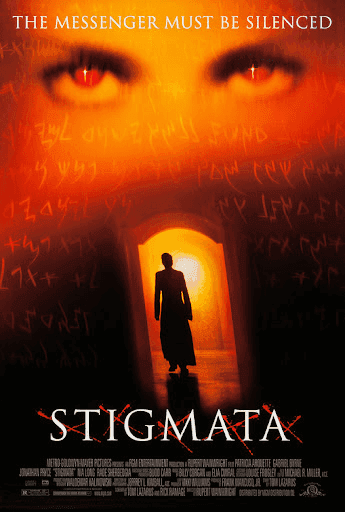
Stigmata (1999), directed by Rupert Wainwright and distributed by Metro-Goldwyn-Mayer through its FGM Entertainment label, was produced on a reported budget of $32,000,000. The religious horror thriller was financed by MGM and FGM Entertainment as a counter-programming release for the late September 1999 corridor, slotted into a release window between The Sixth Sense's extended summer run and the holiday-season tentpoles. Producer Frank Mancuso Jr., who had previously shepherded the Friday the 13th and Species franchises, structured the production to look more expensive than its budget suggested through stylized visual effects and Pittsburgh location work.
The investment positioned Stigmata as a mid-budget genre play. MGM wanted a property that could ride the late-1990s religious-horror trend revived by The Exorcist re-release and the buzz around End of Days. The math required roughly $80,000,000 in worldwide gross to break even after marketing, a target the film cleared comfortably thanks to a stronger-than-expected opening weekend.
Key Budget Allocation Categories
Stigmata's $32,000,000 budget was distributed across several core production areas:
- Above-the-Line Talent: Director Rupert Wainwright, coming off Blank Check, worked at a feature-director rate appropriate to a mid-budget genre play. Patricia Arquette signed on after True Romance and Lost Highway had positioned her as a credible adult lead, and Gabriel Byrne accepted the priest role at a working-actor rate. Jonathan Pryce in a supporting villain role and Nia Long in a friend role rounded out the principal cast at modest fees.
- Pittsburgh Location Shoot: Principal photography took place primarily in Pittsburgh, Pennsylvania, with additional unit work in Belo Horizonte, Brazil for the opening sequence. Pittsburgh provided the rain-slicked urban exteriors and church interiors that anchor the film's visual identity, and the production benefited from local crew and lower studio overhead compared with a Los Angeles or New York shoot.
- Visual Effects and Stigmata Sequences: The film required extended digital and practical effects work for the stigmata wounds that appear progressively on Frankie Paige's body. Effects houses worked with prosthetic teams to deliver the visceral wound reveals, which were a major selling point of the trailer campaign and the film's most expensive technical line item.
- Music and Soundtrack: Composer Billy Corgan of The Smashing Pumpkins, along with Mike Garson, scored the film, blending orchestral elements with the alternative-rock textures that defined the late-1990s soundtrack market. The soundtrack album, released by Virgin Records, became a marketing centerpiece and partially offset music licensing costs through cross-promotion.
- Set Design and Cinematography: Production designer Waldemar Kalinowski and cinematographer Jeffrey L. Kimball constructed elaborate interiors for the Vatican corridors and the climactic confrontation. The visual approach leaned on shadow, slow-motion, and water imagery, all of which require additional shooting time and rigging.
- Post-Production and Marketing: MGM positioned the film with an aggressive theatrical marketing campaign emphasizing its religious-horror angle. Domestic marketing spend was estimated in the $25,000,000 to $30,000,000 range, with a global premiere strategy timed to the late-September corridor.
How Does Stigmata's Budget Compare to Similar Films?
At $32,000,000, Stigmata sat in the mid-range of late-1990s religious-horror productions:
- End of Days (1999): Budget $100,000,000 | Worldwide $211,989,043. Universal's contemporary Schwarzenegger millennial-horror release cost more than 3x what Stigmata did and earned roughly 2.6x its worldwide gross.
- The Ninth Gate (1999): Budget $38,000,000 | Worldwide $58,401,898. Roman Polanski's contemporary occult thriller cost slightly more and earned less than half what Stigmata grossed.
- The Sixth Sense (1999): Budget $40,000,000 | Worldwide $672,806,292. M. Night Shyamalan's genre benchmark cost only 25% more and earned more than 8x what Stigmata did, the impossible-to-match comparable that defined the genre year.
- The Exorcist (1973 re-release): Re-release earnings of $58,000,000 in 2000. The William Friedkin classic's re-release fell into Stigmata's commercial neighborhood and demonstrated the audience appetite that MGM had targeted.
- Bless the Child (2000): Budget $65,000,000 | Worldwide $40,448,839. Paramount's follow-up religious-horror release cost twice what Stigmata did and earned roughly half its worldwide gross, illustrating how badly the subgenre could miss.
Stigmata Box Office Performance
Stigmata opened on September 10, 1999 to $18,309,931 across 2,521 theaters, finishing first at the domestic box office and ending The Sixth Sense's five-week run at the top of the chart. The opening came in ahead of MGM's internal projections and validated the late-September religious-horror strategy.
Against a $32,000,000 production budget the film needed roughly $80,000,000 worldwide to clear the breakeven line after marketing. Here is the financial breakdown:
Box Office Breakdown
Stigmata

Stigmata returned approximately $1.44 in theatrical revenue for every $1 invested when measured against total estimated production and marketing spend, a solid result for a religious-horror release. The domestic share of the gross was $50,041,883 against an international share of $39,390,117, a 56/44 split close to balanced for a faith-themed property.
Home video was where Stigmata further extended its return. The VHS and DVD release in early 2000 captured a meaningful share of the genre rental market and the Billy Corgan and Mike Garson soundtrack also performed well at retail. The film became a steady catalog title for MGM for years afterward.
Stigmata Production History
Development on Stigmata began at MGM in 1997 with a screenplay by Tom Lazarus, later rewritten by Rick Ramage. Frank Mancuso Jr. produced through FGM Entertainment, working alongside producers Wesley Strick and Dan Lupovitz. Rupert Wainwright was attached as director in early 1998 on the strength of his music-video and commercial directing background, which the producers believed would translate well to the stylized religious imagery the screenplay called for.
Patricia Arquette was cast as Frankie Paige in mid-1998, with Gabriel Byrne signing on shortly after to play Father Andrew Kiernan, a Vatican investigator. Principal photography ran from late 1998 into early 1999, with most of the production based in Pittsburgh, Pennsylvania, and additional second-unit work in Belo Horizonte, Brazil for the opening Marian apparition sequence. Pittsburgh's mix of urban grit and historic church architecture provided the production with a New York stand-in at a lower cost.
Composer Billy Corgan of The Smashing Pumpkins came on with Mike Garson to score the film during post-production in early 1999. The soundtrack was released by Virgin Records ahead of the theatrical premiere as part of the marketing campaign. MGM scheduled the release for September 10, 1999, after summer slot competition cleared and ahead of the holiday tentpole window.
Awards and Recognition
Stigmata received limited mainstream awards recognition but earned a notable presence on the genre-awards circuit. The film was nominated at the 2000 Saturn Awards for Best Horror Film, with Patricia Arquette nominated for Best Actress. Billy Corgan received critical attention for his score work, and the soundtrack album reached number 17 on the Billboard 200.
The film also received Razzie nominations, with Patricia Arquette nominated for Worst Actress, reflecting the polarized critical reaction. Stigmata's legacy within awards conversation has been mixed, with the religious-horror genre rarely competing in mainstream ceremonies but the film retaining a steady cult presence.
Critical Reception
Stigmata received mixed-to-negative reviews. The film holds a 22% approval rating on Rotten Tomatoes based on 96 critic reviews, with a critical consensus calling it a stylish but incoherent thriller that buries its provocative premise in horror-movie excess. On Metacritic, the film scored 34 out of 100, indicating generally unfavorable reviews. Audiences surveyed by CinemaScore gave the film a B-, modest for a horror title where stronger word of mouth typically signals legs.
Critics praised the visual style, Jeffrey Kimball's cinematography, and the Corgan-Garson score, but objected to the muddled theology, the rushed final act, and what Roger Ebert called "a movie that puts so much energy into looking ominous that it forgets to scare us." Janet Maslin of The New York Times wrote that the film "presents religious mystery as music-video atmosphere, which is both its appeal and its limitation." Variety's Todd McCarthy called it "an MTV-styled supernatural thriller more interested in cinematography than in coherence."
Catholic press coverage was particularly hostile. The U.S. Conference of Catholic Bishops reviewer condemned the film's anti-Vatican plot, and several Catholic publications urged readers to avoid it. The controversy fueled additional ticket sales in the opening weeks but contributed to the film's muted second-weekend hold.
Frequently Asked Questions
How much did it cost to make Stigmata (1999)?
The reported production budget was $32,000,000. Metro-Goldwyn-Mayer financed the production through its FGM Entertainment label, with producer Frank Mancuso Jr. structuring the religious-horror thriller as a mid-budget counter-programming release for the late-September corridor.
How much did Stigmata earn at the box office?
The film grossed $50,041,883 domestically and $39,390,117 internationally, for a worldwide total of $89,432,000. It opened to $18,309,931 in the United States on September 10, 1999, finishing first at the domestic box office and ending The Sixth Sense's five-week run at the top.
Was Stigmata a box office hit?
Yes, modestly. Against a $32,000,000 production budget and an estimated $25,000,000 to $30,000,000 in marketing spend, the film returned roughly $1.44 in worldwide gross for every $1 invested. It ended The Sixth Sense's five-week run at the top of the domestic chart and remained a solid catalog title for MGM.
Who directed Stigmata?
Rupert Wainwright directed the film, working from a screenplay by Tom Lazarus with rewrites by Rick Ramage. Wainwright had previously directed Blank Check (1994) and was known primarily for music videos and commercials before this project.
Where was Stigmata filmed?
Principal photography took place primarily in Pittsburgh, Pennsylvania, with additional second-unit work in Belo Horizonte, Brazil for the opening Marian apparition sequence. Pittsburgh provided rain-slicked urban exteriors and historic church interiors at a lower cost than New York or Los Angeles.
Who composed the Stigmata score?
Billy Corgan of The Smashing Pumpkins composed the score with Mike Garson, blending orchestral and alternative-rock elements. The soundtrack album was released by Virgin Records and reached number 17 on the Billboard 200, becoming a meaningful part of the marketing campaign.
How does Stigmata compare to other 1999 religious-horror films?
Stigmata cost less than a third of End of Days (1999, $100,000,000) and slightly less than The Ninth Gate (1999, $38,000,000). Against The Sixth Sense ($40,000,000 budget, $672,806,292 worldwide), Stigmata was a small fraction of the year's genre benchmark, but it cleared profitability where contemporaries like Bless the Child (2000) did not.
What did critics think of Stigmata?
The film received mixed-to-negative reviews, with a 22% approval rating on Rotten Tomatoes (based on 96 critics) and a 34 out of 100 score on Metacritic. Audiences gave it a B- CinemaScore. Critics praised the visual style and the Corgan-Garson score but objected to the muddled theology and rushed final act.
Why was Stigmata controversial?
The film's plot involves a Vatican conspiracy to suppress a discovered gospel, and the U.S. Conference of Catholic Bishops reviewer condemned the anti-Vatican narrative. The Catholic press coverage was particularly hostile, which fueled additional ticket sales in the opening weeks while contributing to a muted second-weekend hold.
Did Stigmata win any awards?
The film received Saturn Award nominations for Best Horror Film and Best Actress (Patricia Arquette) in 2000. The soundtrack album reached number 17 on the Billboard 200. The film also received a Razzie nomination for Worst Actress, reflecting the polarized critical reaction.
Filmmakers
Stigmata

Build budgets like this one in Saturation
Start from an industry-standard feature film template, import the schedule and rates you already have, and let the cost report keep itself current as you spend. Real-time collaboration, no spreadsheets.