Stealing Harvard Budget
 Comedy
Updated
Synopsis
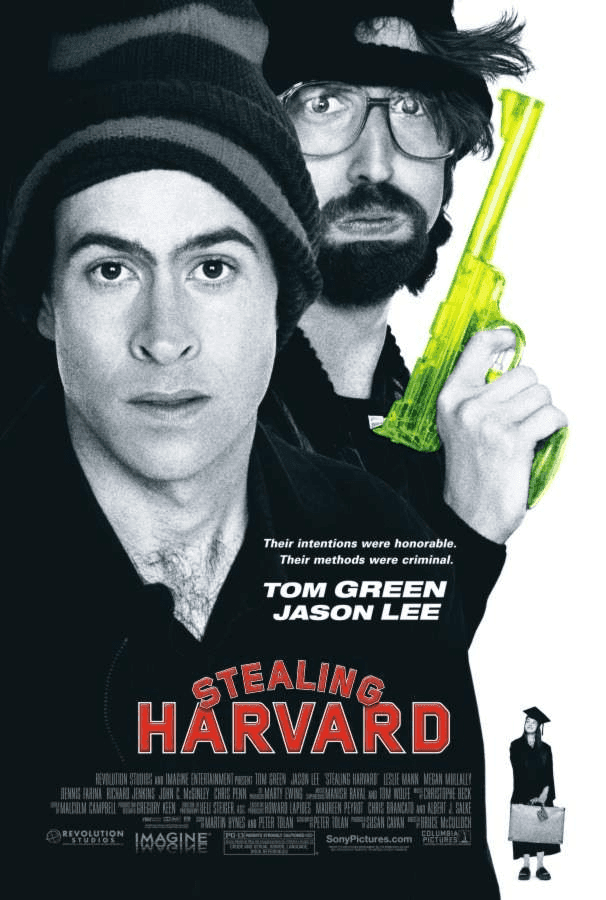
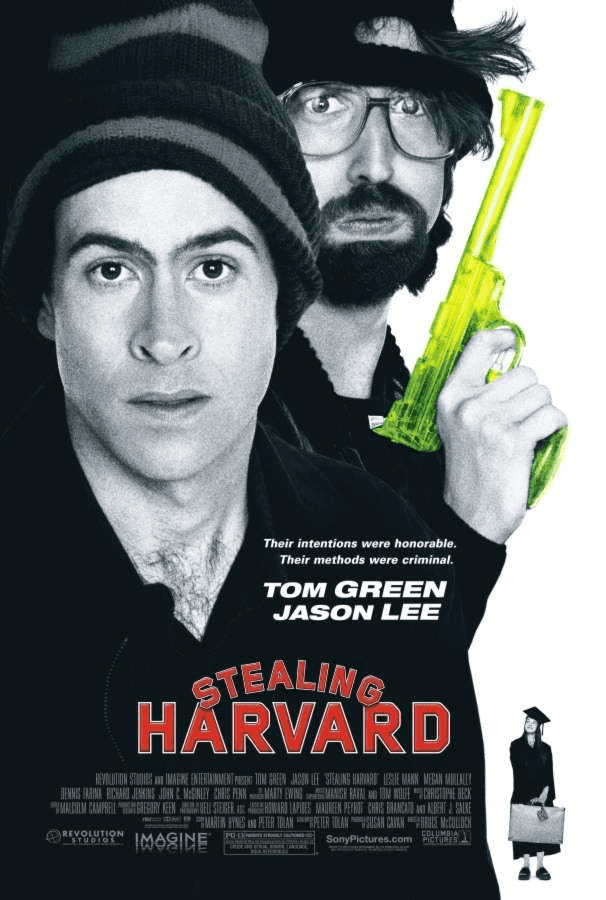
John Plummer (Jason Lee), a soon-to-be-married storage facility employee, has saved $30,000 to buy a house with his fiancée Elaine (Leslie Mann). But when his niece Noreen is accepted to Harvard, John discovers he is the only family member who promised her tuition. Forced to choose between his future and his promise, John reluctantly teams up with his unbalanced best friend Duff (Tom Green) to commit a series of escalating crimes to raise the cash before Elaine catches on or the law catches up.
What Is the Budget of Stealing Harvard (2002)?
Stealing Harvard (2002), directed by Bruce McCulloch and distributed by Columbia Pictures, was produced on a reported budget of $25,000,000. The caper comedy paired Jason Lee, fresh off his lead turn in My Name Is Earl development and his supporting work in Mallrats and Almost Famous, with Tom Green, who was working through the controversial reception of Freddy Got Fingered (2001) and his Drew Barrymore-divorce media cycle.
The $25,000,000 budget reflected the comedy-genre economics of the early-2000s Columbia and Imagine Entertainment slate. The film was produced by Ron Howard and Brian Grazer's Imagine Entertainment, packaged as a buddy-comedy vehicle for Lee and Green following the success of Imagine's 2001 Dr. Dolittle 2 and 2002 Blue Crush projects.
Key Budget Allocation Categories
Stealing Harvard's reported $25,000,000 budget was distributed across these production areas:
- Above-the-Line Talent: Jason Lee played the lead John Plummer at a mid-six-figure rate, with Tom Green commanding a meaningful salary as the project's co-lead Duff. Dennis Farina and Megan Mullally filled out the supporting cast at character-actor rates. Director Bruce McCulloch, working in his fourth feature directing credit, took a debut-tier fee.
- Vancouver Production: The film shot extensively in Vancouver, British Columbia from January to April 2002, doubling Canadian locations for the United States small-town suburban settings. British Columbia's film tax credit program supported the production.
- Practical Comedy Set Pieces: The film's heist-driven plot required practical stunt coordination, the pet-cemetery sequence, the cross-dressing comedy beats, and the bank-robbery climax. The physical-comedy approach minimized visual-effects spend.
- Visual Effects: A minimal VFX line covered the few digital augmentations required for the film's comedy gags and continuity inserts. Multiple smaller vendors handled the work.
- Score and Music: Christophe Beck composed the score in his early-2000s comedy register. Music licensing covered a small selection of needle drops.
- Marketing Setup: Columbia positioned the film as the September 2002 comedy-counter-programming release, with an aggressive trailer cycle leveraging Lee's post-Vanilla Sky visibility and Green's ongoing reality-television and tabloid presence.
How Does Stealing Harvard's Budget Compare to Similar Films?
At $25,000,000, Stealing Harvard sits in the lower mid-range of early-2000s buddy comedies:
- Freddy Got Fingered (2001): Budget $14,000,000 | Worldwide $14,300,000. Tom Green's previous directorial-lead vehicle cost less and matched its worldwide gross to its budget, an outcome Stealing Harvard failed to replicate.
- Jay and Silent Bob Strike Back (2001): Budget $22,000,000 | Worldwide $33,800,000. Kevin Smith's contemporaneous buddy-comedy with Jason Lee in support modestly outperformed Stealing Harvard worldwide.
- Bandits (2001): Budget $75,000,000 | Worldwide $67,600,000. Barry Levinson's Bruce Willis-Billy Bob Thornton caper comedy benchmarks a higher-budget A-list version of the same caper-comedy genre.
- Saving Silverman (2001): Budget $25,000,000 | Worldwide $26,400,000. The Jack Black-Jason Biggs-Steve Zahn buddy comedy matched Stealing Harvard's budget and slightly outperformed its worldwide gross.
- Old School (2003): Budget $24,000,000 | Worldwide $87,800,000. The Todd Phillips Will Ferrell-Vince Vaughn-Luke Wilson comedy released the year after Stealing Harvard demonstrates what the genre could earn at the same budget tier.
Stealing Harvard Box Office Performance
Stealing Harvard opened on September 13, 2002, earning $5,853,531 over its three-day opening weekend and finishing fourth at the domestic box office. The opening was well below analyst expectations for a Columbia comedy at the $25,000,000 budget tier and represented a clear underperformance against the studio's September comedy benchmarks.
Against a reported production budget of $25,000,000, the film needed approximately $55,000,000 in worldwide gross to reach profitability accounting for marketing and distribution costs. Here is the financial breakdown:
Box Office Breakdown
Stealing Harvard

Stealing Harvard returned approximately $0.30 in worldwide theatrical revenue for every $1 invested when measured against total estimated production and marketing spend. The film grossed $13,919,348 domestically and just $88,846 internationally, a 99/1 split that confirmed the property's complete failure to register outside the United States market. International distribution was effectively a non-event.
The commercial failure was a clear bomb for Columbia and Imagine Entertainment. The outcome contributed to Tom Green's subsequent removal from major studio theatrical features and to Jason Lee's pivot toward television (My Name Is Earl, 2005-2009) as his primary lead vehicle. The film effectively ended Bruce McCulloch's American feature directing career, though he continued to work in television.
Stealing Harvard Production History
Peter Tolan, the prolific television and feature writer (Analyze This, Just Shoot Me, later Rescue Me), wrote the original screenplay in the late 1990s. Imagine Entertainment acquired the project in 2001 with Brian Grazer and Susan Stremple producing. Bruce McCulloch (Kids in the Hall) attached as director on the strength of his previous comedies Dog Park (1998) and Superstar (1999).
Casting Jason Lee as the lead John Plummer gave the project its dramatic anchor. Tom Green was cast as Duff, Plummer's eccentric best friend, on the strength of his Drew Barrymore-cycle visibility and despite the toxic reception of Freddy Got Fingered (2001). Dennis Farina was cast as Plummer's antagonistic father-in-law-to-be, with Megan Mullally as Plummer's sister Patty.
Principal photography ran from January to April 2002 in Vancouver, British Columbia, with Vancouver-area locations doubling for the United States small-town suburban setting. British Columbia's film tax credit program supported the production. Columbia scheduled the United States release for September 13, 2002.
Awards and Recognition
Stealing Harvard received no significant industry awards recognition. The film registered no Oscar, Golden Globe, or comedy-specific awards-circuit nominations. It received two Razzie nominations: Worst Actor (Tom Green) and Worst Screen Couple (Jason Lee and Tom Green), but did not win in either category. Tom Green's Razzie nomination here continued a string of similar nominations across his early-2000s output.
The film has been almost entirely absent from awards conversation since its release, fitting within the broader pattern of early-2000s mid-budget buddy comedies that failed to register outside their immediate commercial cycle. Subsequent retrospective coverage has occasionally cited it as an example of the post-Freddy Got Fingered Tom Green career collapse.
Critical Reception
Stealing Harvard received largely negative reviews. The film holds a 19% approval rating on Rotten Tomatoes based on 110 critic reviews, with a critical consensus that called the premise dated and the chemistry between Lee and Green strained. On Metacritic, the film scored 35 out of 100, indicating generally unfavorable reviews. No CinemaScore was issued for the release.
Critics broadly objected to Peter Tolan's screenplay (which several reviewers characterized as a relic of a previous comedy era), the underdeveloped Jason Lee-Tom Green pairing, and the generic suburban setting. The Hollywood Reporter's Kirk Honeycutt wrote that the film "feels like a lost relic of late-1990s broad comedy stranded in a marketplace that has moved on," while Variety's Robert Koehler called it "an awkwardly paced and aesthetically uninvolving caper that wastes a likable lead in Jason Lee."
Roger Ebert was more positive, giving the film two and a half stars in the Chicago Sun-Times and praising Lee's comedic timing despite the script's problems. The mixed-to-negative reception combined with the catastrophic commercial outcome cemented Stealing Harvard's reputation as a representative example of the failed early-2000s Tom Green theatrical-comedy cycle and a low point in Jason Lee's pre-Earl filmography.
Frequently Asked Questions
How much did it cost to make Stealing Harvard (2002)?
The reported production budget was $25,000,000. The film was produced by Brian Grazer and Susan Stremple through Imagine Entertainment and Revolution Studios, and distributed by Columbia Pictures.
How much did Stealing Harvard earn at the box office?
The film grossed $13,919,348 domestically and just $88,846 internationally for a worldwide total of $14,008,194. It opened to $5,853,531 over its September 13, 2002 weekend, finishing fourth at the domestic box office and well below Columbia's targets.
Was Stealing Harvard a box office bomb?
Yes. Against a $25,000,000 production budget and approximately $20 to $25 million in marketing costs, the film returned just $0.30 in worldwide theatrical revenue for every $1 invested. The international gross of $88,846 was effectively a non-event, with the film failing to register outside the United States market.
Who directed Stealing Harvard?
Bruce McCulloch directed the film. McCulloch was a Kids in the Hall alum who had previously directed Dog Park (1998) and Superstar (1999). Stealing Harvard effectively ended his American feature directing career, though he continued to work in television.
Where was Stealing Harvard filmed?
Principal photography ran from January to April 2002 in Vancouver, British Columbia, with Vancouver-area locations doubling for the United States small-town suburban setting. British Columbia's film tax credit program supported the production.
Who stars in Stealing Harvard?
Jason Lee stars as John Plummer, with Tom Green as his best friend Duff, Leslie Mann as Plummer's fiancée Elaine, Dennis Farina as Elaine's father, Megan Mullally as Plummer's sister, Tammy Blanchard as his niece Noreen, John C. McGinley as a police lieutenant, and Richard Jenkins in a supporting role.
What is Stealing Harvard about?
The film follows John Plummer (Jason Lee), who has saved $30,000 to buy a house with his fiancée. When his niece is accepted to Harvard, Plummer discovers he is the only family member who promised her tuition. He reluctantly teams up with his unbalanced best friend Duff (Tom Green) to commit a series of escalating crimes to raise the cash.
What did critics think of Stealing Harvard?
The film received largely negative reviews, with a 19% Rotten Tomatoes score based on 110 critics and a 35 Metacritic score. Critics objected to Peter Tolan's screenplay, the underdeveloped Lee-Green pairing, and the generic setting. Roger Ebert was an outlier, giving the film two and a half stars.
Did Stealing Harvard win any awards?
No. The film received two Razzie nominations (Worst Actor for Tom Green and Worst Screen Couple for Jason Lee and Tom Green) but did not win. It registered no other significant industry-awards nominations.
How did Stealing Harvard affect Tom Green's career?
The commercial failure of Stealing Harvard, following the toxic reception of Freddy Got Fingered (2001), effectively ended Tom Green's tenure as a leading-man in major studio theatrical features. He subsequently pivoted to talk-show hosting, podcasting, and self-distributed comedy projects.
Filmmakers
Stealing Harvard

Build budgets like this one in Saturation
Start from an industry-standard feature film template, import the schedule and rates you already have, and let the cost report keep itself current as you spend. Real-time collaboration, no spreadsheets.