Starsky & Hutch Budget
 Comedy
Updated
Synopsis
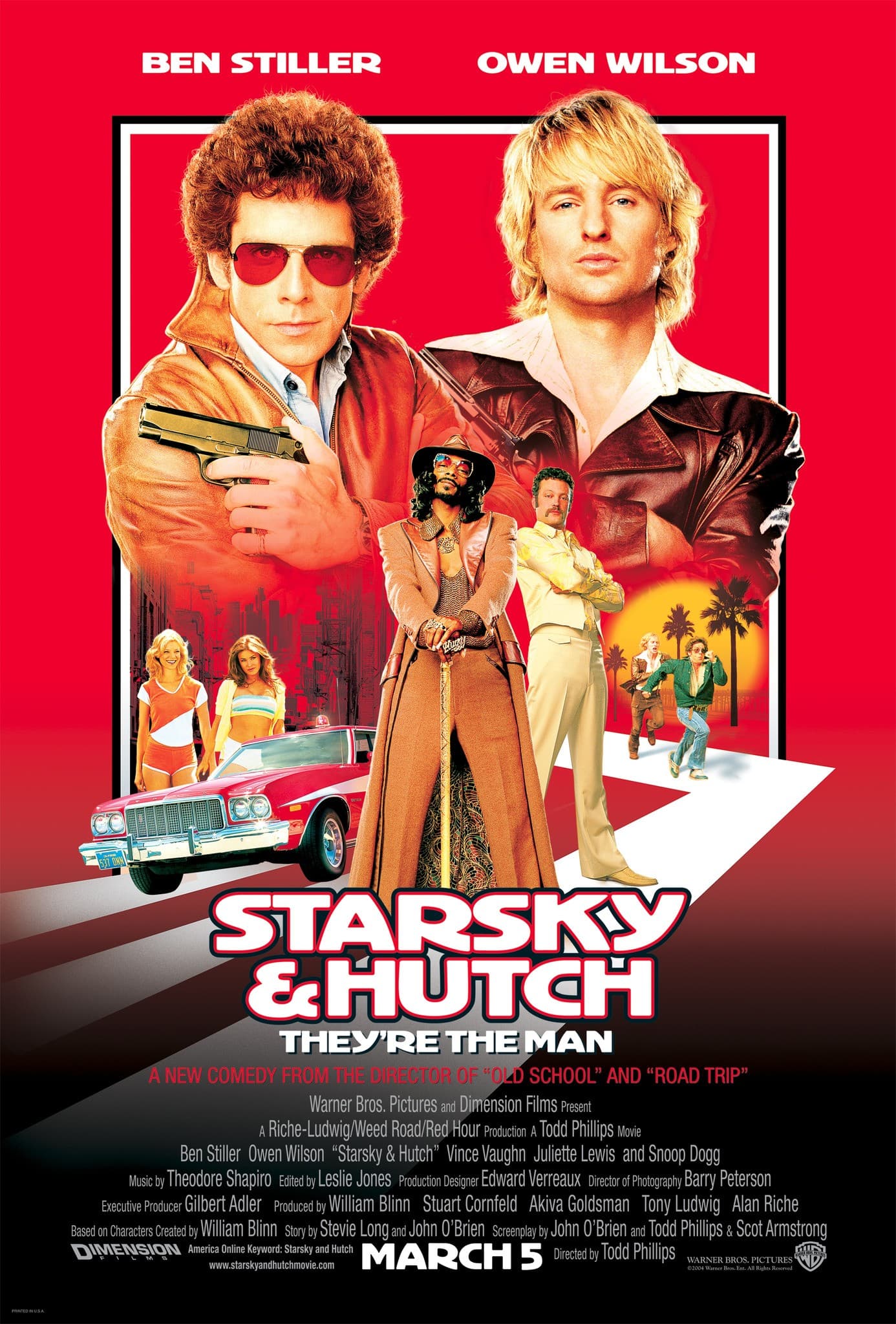
In Bay City in the 1970s, by-the-book detective David Starsky and laid-back undercover cop Ken Hutchinson are paired against their will and pulled into a coke-dealer investigation involving a slick Bay City businessman named Reese Feldman, an informant nicknamed Huggy Bear, and a custom red 1976 Ford Gran Torino. Todd Phillips's 2004 buddy-cop comedy stars Ben Stiller, Owen Wilson, Vince Vaughn, and Snoop Dogg in an affectionate retro pastiche of the 1975 to 1979 ABC television series.
What Is the Budget of Starsky & Hutch (2004)?
Starsky & Hutch (2004), directed by Todd Phillips from a screenplay by John O'Brien, Phillips, and Scot Armstrong, was produced on a reported budget of $60,000,000. Warner Bros. Pictures financed and distributed the picture alongside Dimension Films (The Weinstein Company's genre subsidiary) and Red Hour Films, Ben Stiller's production company. The picture adapted the 1975 to 1979 ABC television series of the same name, with the rights acquired by Dimension Films in the late 1990s.
The investment supported Ben Stiller and Owen Wilson as a marquee buddy-cop pairing, a Los Angeles-based shoot that recreated the 1970s Bay City fictional setting, full-period production design including the iconic red-with-white-stripe 1976 Ford Gran Torino (the production built several stunt-spec cars for the picture), and extensive licensed period music. The worldwide gross of $170,300,000 made the picture one of Warner Bros.' clear theatrical winners of the 2004 spring slate.
Key Budget Allocation Categories
Starsky & Hutch's $60,000,000 budget was distributed across several major production areas:
- Above-the-Line Talent Ben Stiller and Owen Wilson, by 2003 the most reliable buddy-pairing in studio comedy following Meet the Parents (2000), Zoolander (2001), Royal Tenenbaums (2001), and Shanghai Knights (2003), led the cast at their combined star fee. Vince Vaughn played the antagonist drug dealer Reese Feldman, Snoop Dogg made his major-studio acting debut as Huggy Bear, and Juliette Lewis, Carmen Electra, Amy Smart, Jason Bateman, and Will Ferrell filled out the supporting cast.
- Period Production Design Production designer Charles Wood built the 1970s Bay City visual environment, including the police precinct, the various nightclub interiors, Reese Feldman's mansion, and the dockside drug-deal climax. The production filmed extensively in vintage Los Angeles neighborhoods that had retained 1970s architectural character.
- Costume Design Costume designer Louise Mingenbach built more than 200 period 1970s wardrobe pieces, including the picture's most-discussed costume work: Ben Stiller's tight Adidas tracksuit-and-cardigan combinations referencing Paul Michael Glaser's original television wardrobe, and Owen Wilson's denim-and-leather aesthetic referencing David Soul's original Hutch.
- Picture Cars and Stunts The custom red 1976 Ford Gran Torino with white-stripe livery (referencing the television series) required the construction of multiple stunt-spec vehicles. The picture's action sequences include several extended chases through Los Angeles streets standing in for 1970s Bay City. Stunt coordinator Charlie Picerni oversaw the choreography with the picture-car department.
- Music Licensing The 1970s licensed-music soundtrack carried significant publishing and master-recording licensing costs. The picture features Don't Give Up On Us (David Soul's 1976 hit), Afternoon Delight (Starland Vocal Band), Sweet Marie (Bob Dylan), and numerous funk and disco-era tracks. The music budget was a substantial line item.
- Score Composer Theodore Shapiro delivered an orchestral and funk score that referenced the original Lalo Schifrin and Mark Snow television scores while standing alone as a 2004 feature work. The music was recorded at Los Angeles facilities.
- Director and Producing Team Todd Phillips, by 2003 a rising studio-comedy director after Road Trip (2000) and Old School (2003), directed at his standard studio-feature rate. Producer Stuart Cornfeld of Red Hour Films and the Weinstein Company's Dimension Films took the lead producing roles.
How Does Starsky & Hutch's Budget Compare to Similar Films?
At $60,000,000, Starsky & Hutch sits in the mid-to-high budget range for studio buddy-cop comedies. The comparison set illustrates how its commercial outcome compared with peer productions:
- Charlie's Angels (2000): Budget $93,000,000 | Worldwide $264,100,000. McG's same-format 1970s-TV-adaptation cost roughly 55% more than Starsky & Hutch and earned roughly 55% more, providing the studio template that Warner Bros. and Dimension targeted.
- Anchorman: The Legend of Ron Burgundy (2004): Budget $26,000,000 | Worldwide $90,600,000. Adam McKay's same-period 1970s ensemble comedy cost less than half of Starsky & Hutch and earned roughly half the worldwide gross, providing a closer-budget peer.
- Bad Boys II (2003): Budget $130,000,000 | Worldwide $273,300,000. Michael Bay's previous-year action-buddy-cop sequel cost more than twice Starsky & Hutch and earned roughly 60% more, illustrating the high-end of the buddy-cop action-comedy genre.
- The Dukes of Hazzard (2005): Budget $50,000,000 | Worldwide $111,000,000. Jay Chandrasekhar's same-format 1970s-TV-adaptation released the year after Starsky & Hutch cost roughly 20% less and earned roughly 35% less, providing the closest direct successor peer.
- Rush Hour 2 (2001): Budget $90,000,000 | Worldwide $347,300,000. Brett Ratner's buddy-cop sequel cost roughly 50% more than Starsky & Hutch and earned roughly twice the worldwide gross, illustrating the higher-end of the buddy-cop comedy template.
Starsky & Hutch Box Office Performance
Starsky & Hutch opened in North America on March 5, 2004 with $28,140,000 across the three-day weekend, finishing first ahead of The Passion of the Christ (in its second weekend) and Hidalgo. The opening was strong for a non-franchise studio comedy and demonstrated the durable commercial appeal of the Stiller-Wilson pairing in their post-Royal Tenenbaums period.
Against a $60,000,000 production budget, the film needed approximately $140,000,000 worldwide to clear marketing and distribution. Here is the financial breakdown:
Box Office Breakdown
Starsky & Hutch

Starsky & Hutch returned roughly $1.50 in theatrical revenue for every $1 invested when measured against estimated production and marketing spend, making it a clear theatrical profit and one of the most successful 1970s-TV-adaptation comedies of the post-Charlie's Angels cycle. The domestic gross of $88,200,000 outpaced the international take of $82,100,000, a fairly balanced 52/48 split that demonstrated the picture's broad international appeal despite its culturally specific American-television source material.
Home video performance was strong through DVD and Blu-ray release in summer 2004 and through subsequent television syndication. Warner Bros. issued multiple DVD editions including an extended unrated cut. The picture has remained a stable cable-television and SVOD catalog title, frequently appearing in retrospective rankings of the Stiller-Wilson pairing and as one of Todd Phillips's defining pre-Hangover studio comedies.
Starsky & Hutch Production History
The rights to Starsky & Hutch (the 1975 to 1979 ABC television series created by William Blinn) were acquired by Dimension Films from Aaron Spelling Productions in the late 1990s. Various directors and writers cycled through development across the early 2000s before Todd Phillips attached to direct in 2002 on the strength of Road Trip (2000) and Old School (2003). Ben Stiller and Owen Wilson committed to the lead roles in 2002, with the Stiller-Wilson pairing positioning the picture as a marquee buddy-comedy.
John O'Brien, Phillips, and Scot Armstrong developed the screenplay across 2002 and 2003, treating the source material with affectionate pastiche rather than direct dramatic adaptation. The picture's tone was deliberately positioned between the Charlie's Angels (2000) tongue-in-cheek-action approach and the Anchorman (2004) deadpan-comedy register. Paul Michael Glaser and David Soul (the original television series stars) appeared in cameo roles.
Principal photography took place in Los Angeles in summer 2003. The production used vintage Los Angeles neighborhoods that had retained 1970s architectural character, with set decoration teams returning the locations to 1970s appearance during shooting days. The custom red Ford Gran Torino picture cars were built by the production's picture-car department, with multiple stunt-spec vehicles built for the action sequences.
Snoop Dogg's casting as Huggy Bear (originally played by Antonio Fargas in the television series) was one of the picture's most discussed casting decisions, with the rapper-turned-actor's major-studio acting debut becoming a marketing hook. Will Ferrell's uncredited cameo as Big Earl, the imprisoned dragon-themed informant, became one of the picture's most-quoted comic sequences and was largely improvised during production.
Awards and Recognition
Starsky & Hutch received no major prestige awards recognition. The picture was not nominated at the Academy Awards, Golden Globes, BAFTAs, or any major guild ceremony. The picture received various genre-specific and comedy-specific nominations including MTV Movie Awards consideration for Ben Stiller and Owen Wilson and Teen Choice Awards nominations for the lead pairing.
The picture's most durable contribution to its talent's awards profile may be its positioning within Todd Phillips's pre-Hangover studio-comedy run (Road Trip, Old School, Starsky & Hutch, School for Scoundrels) that established the director's commercial track record before the Hangover trilogy and his subsequent dramatic turn with Joker (2019). Snoop Dogg's screen presence as Huggy Bear became a stepping-stone in the rapper's acting career.
Critical Reception
Starsky & Hutch received mixed-to-positive reviews. The film holds a 64% approval rating on Rotten Tomatoes based on 159 critic reviews, with a critical consensus that praised the chemistry between Ben Stiller and Owen Wilson and the affectionate retro pastiche while noting the picture's narrative thinness. On Metacritic, the film scored 62 out of 100, indicating generally favorable reviews. Audiences surveyed by CinemaScore gave the film a B+, a solid mainstream-comedy grade.
Roger Ebert gave the film three out of four stars, praising the Stiller-Wilson chemistry and the disco-dance sequence as one of the year's most enjoyable comic set pieces. Variety's Robert Koehler called the picture "a slick and amiable enough recreation" while noting the narrative coasting. The New York Times' Stephen Holden was more reserved, calling the picture "genial but inessential." The Hollywood Reporter's Kirk Honeycutt praised Vince Vaughn's antagonist performance as the picture's most reliable comic energy.
The picture's reputation has stabilized as a representative entry in the early-2000s 1970s-TV-adaptation comedy cycle alongside Charlie's Angels (2000), The Dukes of Hazzard (2005), and Bewitched (2005). Online retrospective coverage frequently positions Starsky & Hutch as one of the more enjoyable entries in the cycle, with the Stiller-Wilson pairing widely cited as the picture's most durable asset. The Snoop Dogg performance as Huggy Bear has aged into a recurring cultural reference point.
Frequently Asked Questions
How much did Starsky & Hutch (2004) cost to make?
The reported production budget was $60,000,000. Warner Bros. Pictures financed and distributed the picture alongside Dimension Films and Red Hour Films, Ben Stiller's production company. The rights to the source television series had been acquired by Dimension Films from Aaron Spelling Productions in the late 1990s.
How much did Starsky & Hutch earn at the box office?
The film grossed $88,200,000 domestically and $82,100,000 internationally, for a worldwide total of $170,268,750. It opened to $28,140,000 in the United States, finishing first on its March 5, 2004 opening weekend ahead of The Passion of the Christ (in its second weekend) and Hidalgo.
Was Starsky & Hutch a box office success?
Yes. Against a $60,000,000 budget and roughly $50,000,000 to $60,000,000 in marketing, the worldwide gross of $170,300,000 produced a theatrical profit of approximately $50,000,000 to $60,000,000 before home video. The picture was one of Warner Bros.' clear winners of the 2004 spring slate.
Who directed Starsky & Hutch?
Todd Phillips directed the film. It was Phillips's third studio comedy after Road Trip (2000) and Old School (2003). The picture sat within Phillips's pre-Hangover studio-comedy run that established his commercial track record before The Hangover (2009) trilogy and his subsequent dramatic turn with Joker (2019).
Who stars in Starsky & Hutch?
Ben Stiller and Owen Wilson star as detectives David Starsky and Ken Hutchinson. Vince Vaughn plays the antagonist drug dealer Reese Feldman, Snoop Dogg makes his major-studio acting debut as Huggy Bear, and Juliette Lewis, Carmen Electra, Amy Smart, Jason Bateman, and Will Ferrell appear in supporting roles. Paul Michael Glaser and David Soul (the original television series stars) appear in cameo roles.
Where was Starsky & Hutch filmed?
Principal photography took place in Los Angeles in summer 2003. The production used vintage Los Angeles neighborhoods that had retained 1970s architectural character, with set decoration teams returning locations to 1970s appearance during shooting days. The fictional Bay City setting was a composite created from various Los Angeles exteriors.
Is Starsky & Hutch based on a TV show?
Yes. The 2004 film adapts the 1975 to 1979 ABC television series Starsky & Hutch, created by William Blinn and starring Paul Michael Glaser and David Soul. The film is structured as an affectionate retro pastiche rather than a direct dramatic adaptation, with Glaser and Soul appearing in cameo roles.
What car do Starsky and Hutch drive?
Starsky and Hutch drive a custom red 1976 Ford Gran Torino with a white-stripe livery, referencing the iconic vehicle from the original television series. The production built multiple stunt-spec versions of the car for the picture's action sequences. The vehicle has remained one of the most recognizable picture cars in television-to-film adaptation history.
What did critics think of Starsky & Hutch?
The film received mixed-to-positive reviews. It holds a 64% approval rating on Rotten Tomatoes from 159 critics and a 62 out of 100 score on Metacritic. Audiences gave it a B+ CinemaScore. Reviews praised the Stiller-Wilson chemistry and the disco-dance sequence as one of the year's most enjoyable comic set pieces.
Was there a Starsky & Hutch sequel?
No. Despite the picture's clear theatrical success, no sequel was produced. Various discussions of a follow-up circulated in the mid-2000s and again following the success of Todd Phillips's subsequent comedies, but Warner Bros. and Dimension Films never moved a sequel into production. The picture remains a standalone entry in the early-2000s 1970s-TV-adaptation comedy cycle.
Filmmakers
Starsky & Hutch

Build budgets like this one in Saturation
Start from an industry-standard feature film template, import the schedule and rates you already have, and let the cost report keep itself current as you spend. Real-time collaboration, no spreadsheets.