Star Trek: Nemesis Budget
 Adventure
Updated
Synopsis
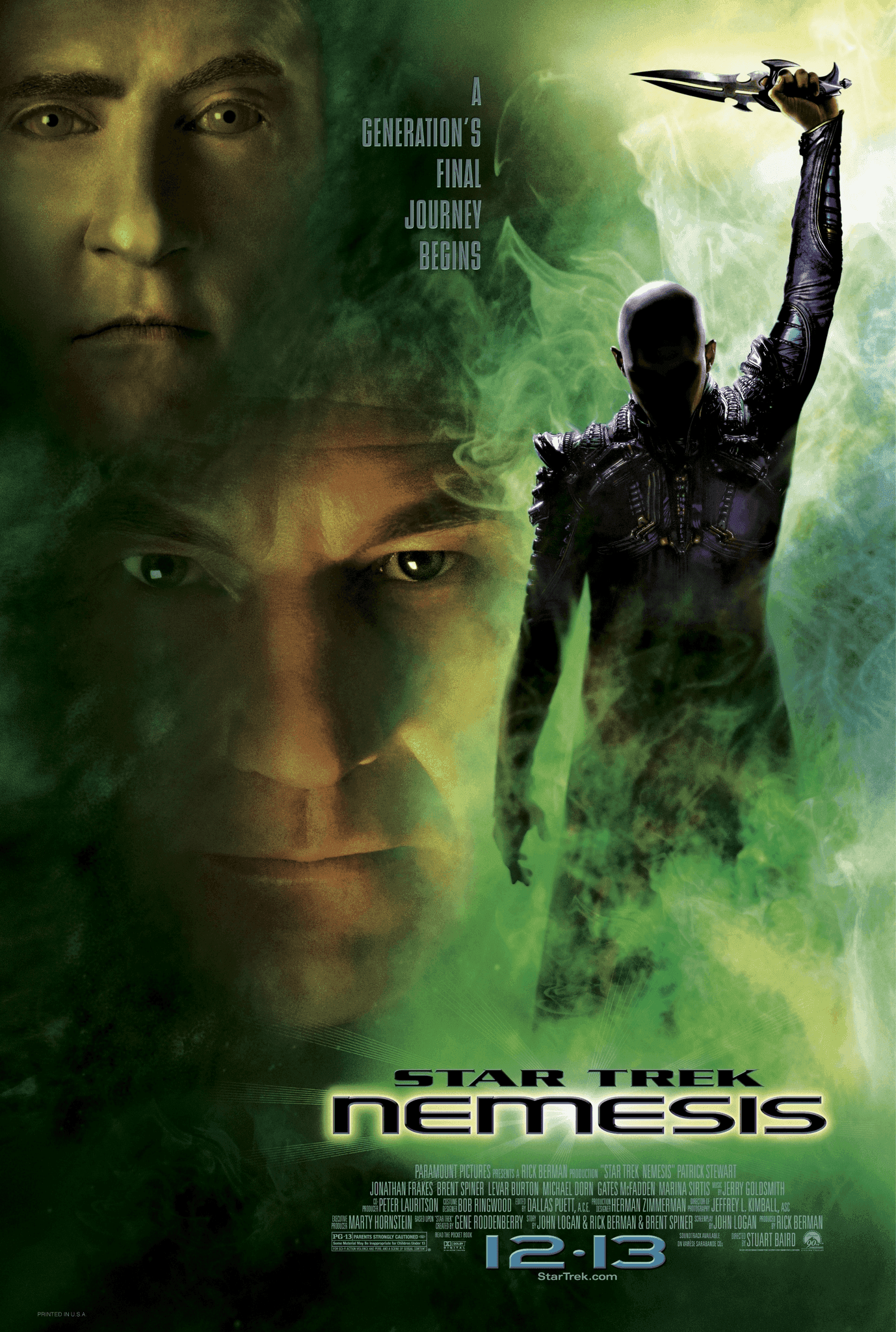
When Captain Jean-Luc Picard and the U.S.S. Enterprise are sent to be ambassadors to the rebellious Romulan Senate's new leader, they find that he is not what he seems to be. Shinzon, a clone of Picard created by the Romulans to infiltrate Starfleet, takes command of a powerful new Reman warship and unleashes a plot to destroy Earth, forcing Picard and his crew into a confrontation that will close their generation's mission.
What Is the Budget of Star Trek: Nemesis (2002)?
Star Trek: Nemesis (2002), directed by Stuart Baird and distributed by Paramount Pictures, was produced on a reported budget of $60,000,000. The film served as the tenth Star Trek feature and the fourth (and ultimately final) installment built around the Next Generation cast, with Patrick Stewart's Captain Jean-Luc Picard facing off against a young Tom Hardy as Shinzon, a Romulan-engineered clone of Picard. Rick Berman produced through the long-standing Berman-Braga Trek production team.
The investment reflected a calculated step down from the $75,000,000 spent on Star Trek: Insurrection (1998) four years earlier, with Paramount tightening the franchise's financial commitment after that film's soft commercial performance. The budget accommodated standing-set use of the existing Enterprise sets at Paramount Stages 8 and 9, location work at El Mirage Dry Lake in California for the Argo dune-buggy sequence, and elaborate practical and CGI effects for the Reman warship Scimitar and the climactic Enterprise-versus-Scimitar battle.
Key Budget Allocation Categories
Star Trek: Nemesis's reported $60,000,000 budget was distributed across several core production areas:
- Above-the-Line Talent: Director Stuart Baird (Executive Decision, U.S. Marshals), a veteran film editor making his Star Trek debut, commanded a feature-director rate. Patrick Stewart, who had been the Next Generation lead since 1987, commanded a top-tier Trek-franchise quote with profit participation. Brent Spiner (Data), Jonathan Frakes (Riker), LeVar Burton (Geordi), Michael Dorn (Worf), Marina Sirtis (Troi), and Gates McFadden (Crusher) all signed at established Trek quotes, with Tom Hardy receiving his first major studio role as Shinzon.
- Standing-Set Use and Set Construction: Production designer Herman Zimmerman and his department reused existing Enterprise-E bridge, ready-room, conference-room, and corridor sets from the Star Trek: Generations, Star Trek: First Contact, and Star Trek: Insurrection productions. New construction was concentrated on the Romulan Senate chamber, the Reman warship Scimitar interior, and the Picard family vineyard exterior, with the Argo dune-buggy build adding a meaningful additional line item.
- Costume and Makeup: Costume designer Robert Blackman designed the Romulan and Reman wardrobes, with Michael Westmore's makeup department creating the Reman prosthetics and Shinzon's aging-via-clone-collapse makeup. The prosthetic count was lower than for earlier Trek features, with the Romulan-Reman society being deliberately stripped down compared with the elaborate prosthetic builds of First Contact and Insurrection.
- Visual Effects: Approximately 600 visual effects shots, supervised by Allen Hall and delivered primarily by Digital Domain, covered the Enterprise-versus-Scimitar battle, the Romulan Senate destruction, the Argo dune-buggy chase, and various warp-and-transporter beats. The shot count represented a meaningful portion of the overall budget and was reduced from earlier Trek features as part of the cost-control measures.
- Score by Jerry Goldsmith: Composer Jerry Goldsmith, who had scored multiple previous Trek features (Star Trek: The Motion Picture, First Contact, Insurrection), returned for what would be his final Trek score before his death in 2004. The soundtrack budget covered original composition and orchestra recording with the Hollywood Studio Symphony.
- Reshoots and Reedits: The film underwent multiple post-production rounds with reshoots in 2002 to clarify several plot points and to address test-screening concerns about the Shinzon-Picard confrontation pacing. The reshoots added cost late in post-production, and the loss of a significant subplot featuring B-4 (Data's android predecessor) to the editor's bay generated documented friction between director Stuart Baird and the long-standing Trek production team.
How Does Star Trek: Nemesis's Budget Compare to Similar Films?
At a reported $60,000,000, Star Trek: Nemesis sat in the mid-range of late franchise installments. The comparison set frames its commercial outcome:
- Star Trek: Insurrection (1998): Budget $58,000,000 | Worldwide $112,587,658. The immediately previous Next Generation film cost 3% less and earned 68% more worldwide, the in-franchise comparison Paramount could not avoid and the result that informed the post-Nemesis decision to retire the cast.
- Star Trek: First Contact (1996): Budget $45,000,000 | Worldwide $146,027,888. The most commercially successful Next Generation film cost 25% less and earned 117% more worldwide, the benchmark Paramount and Berman-Braga had hoped Nemesis would approach.
- Star Trek (2009): Budget $150,000,000 | Worldwide $385,680,446. The J. J. Abrams reboot released seven years later cost 150% more and earned 475% more worldwide, the franchise reset that Nemesis's commercial collapse helped make commercially necessary.
- Die Another Day (2002): Budget $142,000,000 | Worldwide $431,971,116. The contemporaneous Pierce Brosnan James Bond installment released a month earlier cost 137% more and earned 545% more worldwide, the genre-peer comparison that highlighted how much sci-fi franchise economics had moved beyond Trek's scale.
- The Two Towers (2002): Budget $94,000,000 | Worldwide $946,034,461. The Peter Jackson Lord of the Rings sequel released six days after Nemesis cost 57% more and earned 14 times the worldwide total, the corridor competitor that decisively buried the film's opening-weekend ambitions.
Star Trek: Nemesis Box Office Performance
Star Trek: Nemesis opened on December 13, 2002, finishing second at the domestic box office with $18,513,305 over its opening weekend. That figure trailed The Lord of the Rings: The Two Towers, which had opened five days earlier and continued to dominate the corridor, and the picture's second weekend dropped 76% to $4,422,762, one of the steepest second-weekend declines in major-studio history.
Against a reported production budget of $60,000,000, the film needed approximately $130,000,000 in worldwide gross to reach profitability when accounting for marketing and distribution costs. Here is the financial breakdown:
Box Office Breakdown
Star Trek: Nemesis

Star Trek: Nemesis returned approximately $0.61 in worldwide theatrical revenue for every $1 invested when measured against total estimated production and marketing spend, placing it among the largest franchise-installment losses on Paramount's 2002 slate. The domestic share of the gross was $43,254,409 against an international share of $24,058,417, a 64/36 split that demonstrated the property's weak overseas pull and confirmed Paramount's strategic concerns about Trek's exportability.
The commercial result effectively ended the Next Generation cast's feature-film career and triggered the broader franchise reset that culminated in the 2009 J. J. Abrams reboot. The Berman-Braga Trek production team was wound down, the planned Captain Sulu spin-off was killed, and Paramount placed the franchise into hiatus for nearly seven years before the 2009 reboot revived it under entirely new creative leadership.
Star Trek: Nemesis Production History
Development on a tenth Star Trek feature began at Paramount in 1999 immediately after Insurrection (1998) underperformed relative to First Contact. John Logan, who had recently completed work on Gladiator (2000), pitched a Picard-centric finale story to Rick Berman and Patrick Stewart, with the premise of a Picard clone (Shinzon) commanding a Reman warship developed across 2000 and 2001.
Stuart Baird, a veteran film editor (The Omen, Lethal Weapon 2) who had directed Executive Decision (1996) and U.S. Marshals (1998), attached as director in mid-2001. Baird was a controversial choice from the perspective of the long-standing Trek production team, having no prior Trek experience and reportedly being unfamiliar with the Next Generation continuity. The Berman-Braga team's tension with Baird became a documented production-history element.
Casting Tom Hardy as Shinzon was the production's defining creative discovery. Hardy, then 24 and largely unknown outside of his Band of Brothers (2001) miniseries role, was cast in November 2001 after an extensive search for a young actor who could plausibly play a Picard clone. Hardy's performance was widely praised even by negative reviewers and represented his breakout American-feature debut, prefiguring his subsequent careers in Bronson (2008), Inception (2010), and Mad Max: Fury Road (2015).
Principal photography began on November 28, 2001 at Paramount Stages 8 and 9 in Hollywood, with the Enterprise-E sets reused from prior Trek features. The unit shot location work at El Mirage Dry Lake (the Argo dune-buggy sequence), at Wisteria Lane and at the Paramount Pictures backlot. Shooting wrapped in March 2002 after a roughly fifteen-week schedule.
Post-production ran through 2002 with extensive reshoots and editorial reworking. Stuart Baird removed several scenes featuring the android B-4, including a closing-credit reveal that suggested Data's memories had been transferred into B-4 (later restored in the DVD director's cut), in editorial decisions that generated documented friction with the Berman-Braga team. The final cut was approximately 116 minutes, down from a longer initial assembly.
Awards and Recognition
Star Trek: Nemesis received no Academy Award, Golden Globe, or BAFTA nominations. The film received a Saturn Award nomination for Best Science Fiction Film at the 29th Saturn Awards in June 2003, which it lost to Minority Report.
Tom Hardy received a Saturn Award nomination for Best Supporting Actor for his performance as Shinzon, which he lost to Andy Serkis for The Two Towers. The film's broader awards-season absence reflected the franchise-installment positioning, the commercial collapse, and the soft critical reception.
Critical Reception
Star Trek: Nemesis received mixed-to-negative reviews. The film holds a 38% approval rating on Rotten Tomatoes based on 199 critic reviews, with the consensus calling it a tired franchise installment that fails to deliver the dramatic closure the cast deserved. On Metacritic, the film scored 51 out of 100, indicating mixed or average reviews. Audiences surveyed by CinemaScore gave the film a B-.
Roger Ebert wrote in the Chicago Sun-Times that the film "goes through the motions of a Trek movie without finding any new ones," and Variety's Todd McCarthy called it "a misfire from a director and a writer who never quite locate their characters." Manohla Dargis in the Los Angeles Times observed that "only Tom Hardy's Shinzon brings genuine menace to a film otherwise content to rehearse familiar Trek beats."
Genre and Trek-press reaction was significantly more divided. Trek-fandom websites including TrekNation, TrekToday, and Memory Alpha documented extensive debates about the Shinzon plotline, the Baird-Berman friction, and the cut B-4 subplot. The reception, combined with the commercial collapse, has cemented Star Trek: Nemesis's reputation as the lowest-regarded of the Next Generation films and as the inflection point that forced Paramount to reset the franchise entirely.
Frequently Asked Questions
How much did it cost to make Star Trek: Nemesis (2002)?
The reported production budget was $60,000,000. Paramount Pictures produced the film, with Rick Berman producing through the long-standing Berman-Braga Trek production team. The budget represented a calculated step down from the $75,000,000 spent on Star Trek: Insurrection (1998).
How much did Star Trek: Nemesis earn at the box office?
The film grossed $43,254,409 domestically and $24,058,417 internationally, for a worldwide total of $67,312,826. It opened to $18,513,305 in the United States, finishing second on its December 13, 2002 opening weekend behind The Lord of the Rings: The Two Towers, and dropped 76% in its second weekend.
Was Star Trek: Nemesis a box office bomb?
Yes. Against a $60,000,000 production budget and an estimated $40,000,000 to $50,000,000 in marketing spend, the film returned approximately $0.61 in worldwide gross for every $1 invested. The commercial result effectively ended the Next Generation cast's feature-film career and triggered the broader franchise reset that culminated in the 2009 J. J. Abrams reboot.
Who directed Star Trek: Nemesis?
Stuart Baird directed the film, working from a screenplay by John Logan (Gladiator). Baird was a veteran film editor (The Omen, Lethal Weapon 2) who had directed Executive Decision (1996) and U.S. Marshals (1998), with no prior Star Trek experience. His unfamiliarity with the Next Generation continuity became a documented production-history element.
Where was Star Trek: Nemesis filmed?
Principal photography began on November 28, 2001 at Paramount Stages 8 and 9 in Hollywood, with the Enterprise-E sets reused from prior Trek features. The unit shot location work at El Mirage Dry Lake (the Argo dune-buggy sequence), at the Paramount Pictures backlot, and on additional Los Angeles area locations. Shooting wrapped in March 2002.
Who plays Shinzon in Star Trek: Nemesis?
Tom Hardy plays Shinzon, the Romulan-engineered clone of Captain Jean-Luc Picard. Hardy was 24 at the time of casting and largely unknown outside of his Band of Brothers (2001) miniseries role. The film was his American feature debut, and his performance was widely praised even by negative reviewers, prefiguring his subsequent careers in Bronson (2008), Inception (2010), and Mad Max: Fury Road (2015).
Is Star Trek: Nemesis the last Next Generation film?
Yes. Nemesis is the fourth and final theatrical Star Trek feature built around the Next Generation cast (preceded by Generations, First Contact, and Insurrection). The Next Generation crew did not return to feature films after Nemesis. Patrick Stewart eventually returned to the role of Picard in the CBS All Access (later Paramount+) television series Star Trek: Picard (2020 to 2023), which is set after the events of Nemesis.
What did critics think of Star Trek: Nemesis?
The film received mixed-to-negative reviews, with a 38% approval rating on Rotten Tomatoes (based on 199 critics) and a 51 out of 100 score on Metacritic. Audiences gave it a B- CinemaScore. Roger Ebert noted that the film "goes through the motions of a Trek movie without finding any new ones," and Variety's Todd McCarthy called it a misfire from director and writer alike.
Did Star Trek: Nemesis win any awards?
The film received no Academy Award, Golden Globe, or BAFTA nominations. It received a Saturn Award nomination for Best Science Fiction Film at the 29th Saturn Awards in June 2003 and Tom Hardy received a Saturn Award nomination for Best Supporting Actor for his performance as Shinzon. The film did not win either nomination.
Why was Star Trek: Nemesis a commercial failure?
A combination of factors contributed: the release window was dominated by The Lord of the Rings: The Two Towers, which had opened five days earlier; reviews were mixed-to-negative; and franchise fatigue had set in after fifteen years of continuous Next Generation content across television and film. The 76% second-weekend drop, one of the steepest in major-studio history, reflected weak word-of-mouth that prevented any subsequent recovery.
Filmmakers
Star Trek: Nemesis

Build budgets like this one in Saturation
Start from an industry-standard feature film template, import the schedule and rates you already have, and let the cost report keep itself current as you spend. Real-time collaboration, no spreadsheets.