Spaceballs Budget
 Comedy
Updated
Synopsis
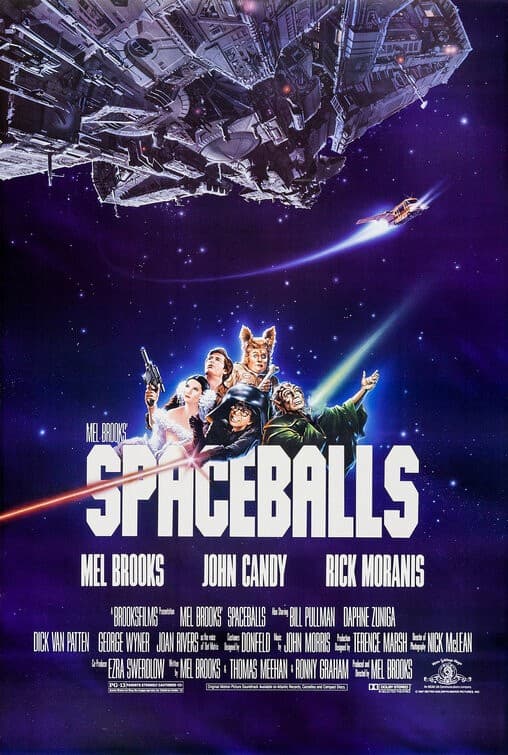
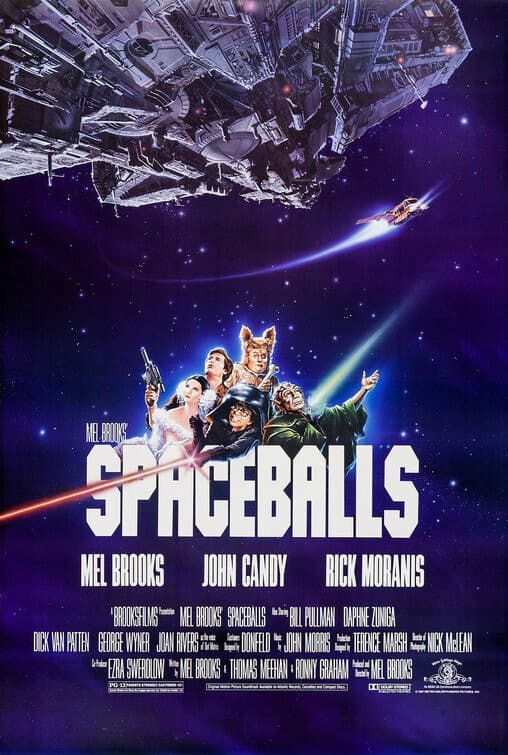
"Spaceballs," released in 1987, is a hilarious sci-fi parody directed by Mel Brooks. The film follows the adventures of Lone Starr, a rogue pilot, and his sidekick, Barf, as they attempt to rescue Princess Vespa from the clutches of the evil Dark Helmet and his master, President Skroob. Set in a galaxy far, far away, the story cleverly satirizes popular sci-fi franchises, particularly "Star Wars." With a mix of slapstick humor, clever wordplay, and memorable characters, "Spaceballs" delivers a comedic take on the classic hero's journey, showcasing the absurdity of space opera tropes while providing a nostalgic nod to fans of the genre.
What Is the Budget of Spaceballs?
Spaceballs (1987) was produced on an estimated budget of $22.7 million, a significant investment for a comedy parody at the time. Mel Brooks and his production company Brooksfilms secured financing through MGM, which handled domestic distribution. The budget covered a wide-ranging shoot at Elstree Studios in Hertfordshire, England, practical and visual effects work, and an all-star comic ensemble.
The $22.7 million figure was substantial for a mid-1980s comedy. By comparison, Beverly Hills Cop (1984) cost $14 million and Ghostbusters (1984) cost $30 million. Spaceballs landed in between, spending lavishly on production design and creature effects to sell the Star Wars parody while still operating within the constraints of a comedy rather than a tentpole blockbuster.
Key Budget Allocation Categories
- Above-the-Line Talent: Mel Brooks served as director, co-writer, and played two roles (President Skroob and Yogurt), making him the central creative and financial force. John Candy, Rick Moranis, Bill Pullman, and Daphne Zuniga formed a costly ensemble of established stars. Joan Rivers provided the voice of robot Dot Matrix. This above-the-line package likely consumed $7 to $9 million of the total budget.
- Production Design and Sets: The film was shot almost entirely at Elstree Studios in Hertfordshire, England, the same facility used for the original Star Wars trilogy. Production designer Terence Marsh built elaborate spacecraft interiors and the iconic Eagle 5 Winnebago-in-space, which became one of the film's most beloved visual jokes. Set construction likely accounted for $4 to $5 million.
- Visual Effects and Creature Work: ILM (Industrial Light and Magic) provided some effects work, a noteworthy arrangement given that ILM was the visual effects house behind the very films Spaceballs was parodying. The Mog (half man, half dog) creature suit for John Candy and the animatronic facehugger parody sequences added further costs. Effects likely totaled $3 to $4 million.
- Cinematography and Camera: Nick McLean (director of photography on Fletch and Short Circuit) shot the film in anamorphic widescreen to visually echo the epic scope of the space operas being parodied. The wide-format photography required additional equipment and increased lighting budgets across the large-scale sets.
- Music and Score: Composer John Morris, Brooks's longtime collaborator (Blazing Saddles, Young Frankenstein, The Elephant Man), wrote the original score. The film also licensed popular songs including the title track performed by Van Halen and 'Good Enough' from the band's 5150 album. Music licensing and recording costs added to the above-the-line total.
How Does Spaceballs' Budget Compare to Similar Films?
Spaceballs sits in a tier of mid-to-upper-budget studio comedies from the late 1980s. Its $22.7 million cost reflects MGM's confidence in Mel Brooks following the success of his earlier parodies, while remaining well below the blockbuster budgets it was lampooning.
- Ghostbusters (1984): Budget $30M | Worldwide $295M. Ivan Reitman's supernatural comedy set the benchmark for expensive, effects-heavy comedy films of the era. Ghostbusters outgrossed Spaceballs by a factor of six and remains the gold standard for commercial comedy success in the 1980s.
- Airplane! (1980): Budget $3.5M | Worldwide $83M. The ZAZ team's disaster-movie parody was made for a fraction of Spaceballs' cost and generated massive returns. Airplane! demonstrated that parody films did not require large budgets to succeed, making Spaceballs' $22.7 million spend look relatively risky in retrospect.
- Young Frankenstein (1974): Budget $2.8M | Worldwide $86M. Brooks's earlier monster-movie parody was produced on a shoestring and became one of his most beloved films. The comparison illustrates how much production scale had grown between Brooks's classic parodies and Spaceballs.
- Innerspace (1987): Budget $27M | Worldwide $25.9M. The Joe Dante science fiction comedy opened the same year as Spaceballs and faced a similar challenge: spending blockbuster money on a genre-comedy hybrid that did not deliver blockbuster returns. Both films underperformed theatrically but found strong secondary-market audiences.
Spaceballs Box Office Performance
Spaceballs opened on June 24, 1987, distributed by MGM. It earned $6.6 million in its opening weekend and finished its domestic theatrical run with $38.1 million in North America. International grosses brought the worldwide total to approximately $45 million, giving the film a combined global gross that fell short of its total investment.
MGM invested approximately $22.7 million in production costs plus an estimated $12 million in prints and advertising, bringing total investment to roughly $34.7 million. Because theaters retain approximately 50 percent of ticket revenue, the studio's actual share of the $45 million worldwide gross was approximately $22.5 million. On its theatrical run alone, Spaceballs did not recoup its total cost. However, the film became a massive success in the home video and cable television markets, where it generated revenue well into the 1990s and cemented its cult status.
Box Office Breakdown
Spaceballs (1987)

On its production budget alone, Spaceballs earned roughly $1.98 for every dollar invested in production, but after accounting for prints, advertising, and theatrical splits, the film did not generate a profit in its initial theatrical window. Its long-term profitability came from VHS sales and cable licensing, where the absence of any merchandise restriction still left money on the table due to the George Lucas no-merchandise agreement.
Spaceballs Production History
Spaceballs originated from Mel Brooks's desire to parody the science fiction genre, particularly the Star Wars franchise that had dominated popular culture since 1977. Brooks approached George Lucas directly for permission to make the parody. Lucas agreed, with one significant condition: no Spaceballs merchandise could be produced, specifically to prevent the film from competing with Lucasfilm's own Star Wars merchandise business. Brooks accepted the restriction and turned it into one of the film's running jokes, most notably in the scene where Yogurt (played by Brooks) presents a warehouse full of Spaceballs merchandise including a flamethrower and toilet paper.
Principal photography took place primarily at Elstree Studios in Hertfordshire, England, from mid-1986. The same soundstages had housed the original Star Wars trilogy, giving the production an authentic connection to the material being parodied. ILM, Lucas's own visual effects company, contributed some effects work to the film, a remarkable arrangement that meant the house responsible for creating Star Wars's visual language was also helping replicate it for comic purposes. Production designer Terence Marsh built extensive spacecraft sets including the command bridge of Spaceball One and the interior of Eagle 5, the Winnebago-converted starship.
John Candy, cast as Barf the half-man, half-dog Mog, improvised much of his dialogue on set and brought a warmth to the role that made Barf one of the film's most beloved characters. Rick Moranis prepared obsessively for Lord Dark Helmet, reportedly wearing the oversized helmet for hours before filming to get used to the physical comedy. Daphne Zuniga initially hesitated to take the role of Princess Vespa but was persuaded by the strength of the script and Brooks's track record.
The film was released on June 24, 1987, against significant summer competition. While its theatrical performance was modest by MGM's expectations, it performed consistently in the home video market and became a staple of cable television programming. The film's quotability and its self-aware humor, including a sequence where characters watch a VHS copy of Spaceballs itself mid-chase, made it a cult classic by the early 1990s. A sequel was discussed repeatedly over the following decades, but the combination of John Candy's death in 1994 and ongoing negotiations with Lucasfilm made it a persistent but ultimately unrealized project.
Awards and Recognition
Spaceballs received a nomination for the Saturn Award for Best Science Fiction Film from the Academy of Science Fiction, Fantasy and Horror Films. While it did not win major awards in its original theatrical release, the film's reputation grew substantially in subsequent decades. The satirical treatment of George Lucas's no-merchandise restriction, the John Candy performance as Barf, and Rick Moranis's Lord Dark Helmet became touchstones of 1980s comedy.
The film's influence extended into later parody and comedy filmmaking. Mel Brooks cited it as one of his favorite productions in interviews throughout the 1990s and 2000s. The Eagle 5 Winnebago spacecraft design was recognized by numerous publications as one of the most iconic comedy vehicles in film history. Spaceballs was included in multiple retrospective lists of the greatest parody films ever made, and regularly appears in rankings of the best comedies of the 1980s.
Critical Reception
Spaceballs received mixed reviews from critics on its initial release, earning a 57 percent rating on Rotten Tomatoes. Many critics noted that the film's humor was uneven, with inspired moments balanced against stretches where the gags did not land as consistently as in Brooks's earlier work such as Blazing Saddles or Young Frankenstein. Roger Ebert gave the film two and a half stars, acknowledging the quality of the performances while finding the overall comedy too scattered.
Audience reception was considerably warmer than the critical consensus. The film holds an 80 percent audience score on Rotten Tomatoes, reflecting the gap between critical expectations and popular enjoyment. For audiences raised on Star Wars, Spaceballs offered an accessible and affectionate deconstruction of the franchise's conventions. John Candy's Barf and Rick Moranis's Dark Helmet became particularly beloved, with Moranis's performance often singled out as the comedic highlight of the film.
Over time, critical reassessment has been broadly positive. The film's self-referential humor, including its meta-jokes about merchandising and sequels, has aged unusually well. Contemporary reviews frequently note that Spaceballs anticipated the franchise-and-merchandise culture that would come to define Hollywood in the 2000s and 2010s. What seemed like a gag in 1987 reads as pointed satire in hindsight. The film is now considered one of Mel Brooks's essential works and a defining entry in the science fiction parody genre.
Frequently Asked Questions
How much did Spaceballs cost to make?
The production budget was $22,700,000. Mel Brooks' Brooksfilms financed the parody, with MGM/UA Communications handling theatrical distribution.
How much did Spaceballs earn at the box office?
Spaceballs grossed $38,119,483 domestically. Limited international distribution added approximately $1,000,000, for a worldwide total of approximately $39,000,000. It opened to $6,613,837 on June 24, 1987, finishing second behind Roxanne.
Who directed Spaceballs?
Mel Brooks directed, co-wrote, produced, and starred in the film as both President Skroob and the Yoda parody Yogurt. Spaceballs was Brooks' first feature as director since History of the World, Part I (1981).
Who stars in Spaceballs?
Bill Pullman stars as Lone Starr, John Candy plays his half-man, half-dog companion Barf, Daphne Zuniga plays Princess Vespa, and Rick Moranis plays the villainous Dark Helmet. Mel Brooks plays dual roles as Yogurt and President Skroob, with Joan Rivers voicing the gold robot Dot Matrix.
Did George Lucas approve of Spaceballs?
Yes. Mel Brooks personally sought permission from George Lucas before proceeding with the parody, and Lucas allowed Industrial Light & Magic to provide some of the visual effects work. The one stipulation was that no Spaceballs merchandise could be produced, a joke Brooks turned into a major sequence in the film itself.
Where was Spaceballs filmed?
Principal photography took place at Culver Studios in Culver City, California, with desert exterior sequences shot in Yuma, Arizona, and additional location work at the Vasquez Rocks Natural Area Park in Agua Dulce, California.
What did critics think of Spaceballs?
Reviews were mixed on release, with a 56% approval rating on Rotten Tomatoes and a 46 out of 100 score on Metacritic. Critics praised individual gags and the central cast performances but objected to an uneven pace. The film grew significantly in cultural standing on home video.
Was Spaceballs profitable?
Yes. Against the $22,700,000 production budget and an estimated $10,000,000 to $15,000,000 in marketing spend, the worldwide gross of approximately $39,000,000 produced a modest theatrical return. Strong VHS and cable broadcast revenue extended profitability significantly.
Is there a Spaceballs sequel?
Mel Brooks announced in June 2024 that Spaceballs 2 had received a greenlight at Amazon MGM Studios, with Josh Gad attached to write and star alongside Brooks. Production is targeted for 2026, nearly four decades after the original.
How does Spaceballs compare to other Mel Brooks films?
Spaceballs' $39,000,000 worldwide gross fell below Brooks' commercial peaks Blazing Saddles (1974, $2,600,000 budget, $119,500,000 worldwide) and Young Frankenstein (1974, $2,800,000 budget, $86,300,000 worldwide). It tracks closer to History of the World, Part I (1981, $11,000,000 budget, $31,700,000 worldwide).
Filmmakers
Spaceballs (1987)

Build budgets like this one in Saturation
Start from an industry-standard feature film template, import the schedule and rates you already have, and let the cost report keep itself current as you spend. Real-time collaboration, no spreadsheets.