
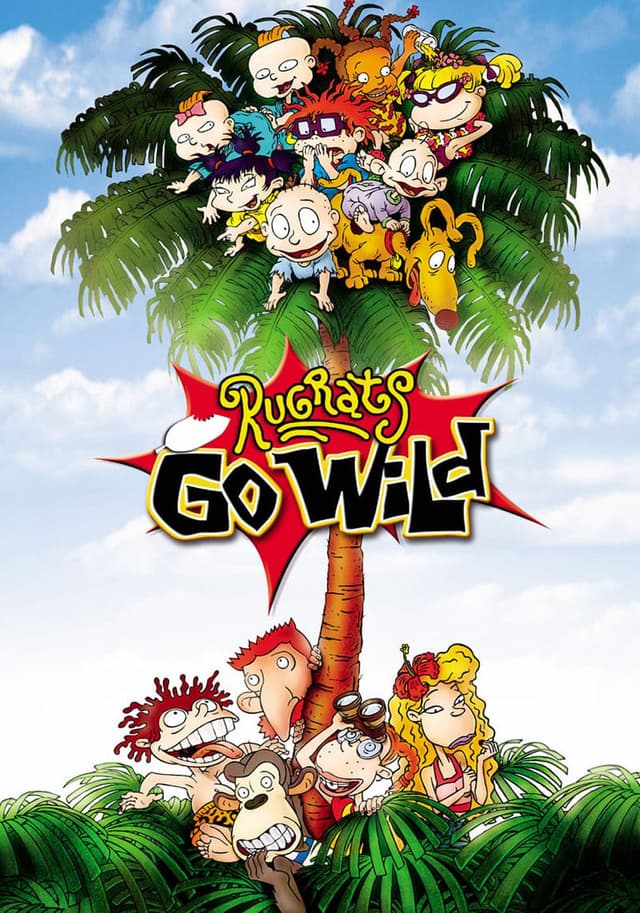
Rugrats Go Wild Budget
 FamilyComedyAdventureAnimationFantasy1h 21m
Updated
Synopsis
"Rugrats Go Wild" is an animated adventure that brings together two beloved Nickelodeon franchises: "Rugrats" and "The Wild Thornberrys." The story unfolds as the Rugrats, led by Tommy Pickles, embark on a family vacation aboard a cruise ship. However, their excitement takes a wild turn when they find themselves stranded on a deserted island after a storm capsizes their ship.
As the Rugrats explore their new surroundings, they encounter the Thornberry family, who are on a mission to document wildlife. The two groups of kids quickly bond, with Eliza Thornberry using her unique ability to communicate with animals to help them navigate the challenges of island life. Together, they face various adventures, from befriending exotic creatures to overcoming obstacles that test their teamwork and courage.
Amidst the fun and chaos, the film emphasizes themes of friendship, bravery, and the importance of family. With humor and heartwarming moments, "Rugrats Go Wild" captures the essence of childhood exploration and the joy of discovering the world around us.
What is the budget of Rugrats Go Wild?
"Rugrats Go Wild," a family released in 2003, was directed by John Eng, Norton Virgien and stars E. G. Daily, Nancy Cartwright. The production budget was $25,000,000, placing it in the mid-budget range for family productions of its era.
Key Budget Allocation Categories
While specific budget breakdowns are not publicly available, typical cost drivers for a family production like this include:
- Talent Salaries & Producing Deals: Established comedic talent can command $15 to 20 million per film, with top-tier stars earning even more through producing credits and backend deals.
- Production & Location Filming: While comedies generally avoid the VFX costs of action films, location shooting in recognizable cities or exotic locales adds meaningful production expense.
- Marketing & P&A (Prints & Advertising): Comedies rely heavily on marketing to build opening-weekend momentum.
- Music & Score: An original soundtrack was released on June 10, 2003, from Hollywood Records.
What were the major cost factors in Rugrats Go Wild?
Several factors contributed to the overall production costs of "Rugrats Go Wild."
- Talent Salaries: Talent Salaries & Producing Deals is one of the primary cost drivers in family productions of this scale.
- Production: Production & Location Filming is one of the primary cost drivers in family productions of this scale.
- Marketing: Marketing & P&A (Prints & Advertising) is one of the primary cost drivers in family productions of this scale.
How Does Rugrats Go Wild's Budget Compare to Similar Films?
At $25,000,000, Rugrats Go Wild sits in the mid-budget range. Here is how it compares to productions with a similar budget:
- 1408 (2007): Budget $25,000,000, Worldwide Gross $133,000,000
- A Journal for Jordan (2021): Budget $25,000,000, Worldwide Gross $6,700,000
- Abandon (2002): Budget $25,000,000, Worldwide Gross $10,719,357
- All My Life (2020): Budget $25,000,000, Worldwide Gross $2,000,000
- August Rush (2007): Budget $25,000,000, Worldwide Gross $66,122,026
The median budget for wide-release family films in the 2000s ranges from $30 to 80M for mid-budget to $150M+ for tentpoles.
Rugrats Go Wild Box Office Performance
"Rugrats Go Wild" earned $39,402,572 domestically and $55,443,032 worldwide at the box office. Against a production budget of $25,000,000, the film showed modest profitability in theatrical release.
A film typically needs to earn approximately twice its production budget to cover marketing and distribution costs. For "Rugrats Go Wild," that break-even threshold was roughly $50,000,000. With worldwide earnings of $55,443,032, the film cleared that threshold comfortably.
Box Office Breakdown
Rugrats Go Wild

At 121.8%, "Rugrats Go Wild" earned roughly $2.22 for every $1 invested in production.
Rugrats Go Wild Production History
An original soundtrack was released on June 10, 2003, from Hollywood Records. The following is a list of songs that appear on the Rugrats Go Wild soundtrack.
Awards and Recognition
2 nominations
Critical Reception
Audiences polled by CinemaScore gave the film an average grade of "A-" on an A+ to F scale.
Frequently Asked Questions
How much did Rugrats Go Wild (2003) cost to make?
Rugrats Go Wild was produced on a budget of approximately $25,000,000 for Paramount Pictures and Nickelodeon Movies, with animation production handled by Klasky Csupo. The film was the first Nickelodeon crossover feature, combining characters from Rugrats with those from The Wild Thornberrys.
How much did Rugrats Go Wild earn at the box office?
The film grossed $39,402,572 domestically and approximately $15,857,000 internationally, for a worldwide total of $55,317,945. Against its $25,000,000 production budget plus an estimated $30,000,000 in marketing spend, the film was a modest profit but a clear decline from prior Rugrats theatrical releases.
Who directed Rugrats Go Wild?
John Eng and Norton Virgien directed the film. Eng had previously co-directed Rugrats in Paris: The Movie (2000), and Virgien had directed The Rugrats Movie (1998). The screenplay was written by Kate Boutilier.
How did the Rugrats and Wild Thornberrys crossover work?
The film stranded the Rugrats families on a tropical island where they encountered Eliza Thornberry and her wildlife-documentary-filmmaker family from The Wild Thornberrys. The two casts had previously been kept in separate Nickelodeon properties, and the crossover was promoted as a Saturday-morning event for fans of both shows. The film used Eliza's ability to talk to animals as a plot device that allowed the Rugrats babies' Spike the dog to vocalize for the first time.
Who voiced the characters in Rugrats Go Wild?
The film retained the original Rugrats voice cast including E.G. Daily as Tommy, Nancy Cartwright as Chuckie, Cheryl Chase as Angelica, and Kath Soucie as Phil, Lil, and Betty. The Wild Thornberrys cast included Lacey Chabert as Eliza, Tim Curry as Nigel Thornberry, and Tom Kane as Darwin. Bruce Willis voiced Spike the dog in his first significant animated role.
What did critics think of Rugrats Go Wild?
The film holds a 39% approval rating on Rotten Tomatoes. Reviews were mixed, with critics generally finding the animation serviceable and the crossover concept clever in principle but the execution thin. Roger Ebert gave it two and a half stars and noted that the film "works better as a Nickelodeon promotional event than as a coherent story."
Why was Rugrats Go Wild presented in Odorama?
Select theatrical screenings included scratch-and-sniff Odorama cards distributed in the lobby, a gimmick previously used in John Waters' Polyester (1981). The Rugrats Go Wild Odorama cards had numbered scents that audiences would scratch when prompted by on-screen cues. The promotional stunt was retired after the theatrical run and did not appear on the home video release.
Did Rugrats Go Wild win any awards?
The film received no major industry awards but was nominated for a Razzie for Worst Excuse for a Movie (which it lost to Daredevil). Bruce Willis received a Golden Raspberry nomination for Worst Supporting Actor specifically for his Spike voice work. The film did not register at the Annie Awards or other animation-specific ceremonies.
How does Rugrats Go Wild compare to other Rugrats films?
The Rugrats Movie (1998) grossed $140,894,029 worldwide against a $24,000,000 budget. Rugrats in Paris (2000) grossed $103,291,131 against a $30,000,000 budget. Rugrats Go Wild's $55,317,945 worldwide total marked a steep franchise decline, attributed to brand fatigue, the diminishing cultural footprint of the Rugrats TV series by 2003, and the saturated family-animation marketplace.
Was Rugrats Go Wild the final Rugrats theatrical film?
Yes. After Rugrats Go Wild underperformed, Paramount and Nickelodeon did not commission a fourth theatrical entry. The Rugrats brand continued in television form including a 2021 Paramount+ revival series but has not returned to the big screen.
Official Trailer
Build budgets like this one in Saturation
Start from an industry-standard feature film template, import the schedule and rates you already have, and let the cost report keep itself current as you spend. Real-time collaboration, no spreadsheets.