Peter Pan Budget
 AnimationFamilyAdventureFantasy1h 17m
Updated
Synopsis
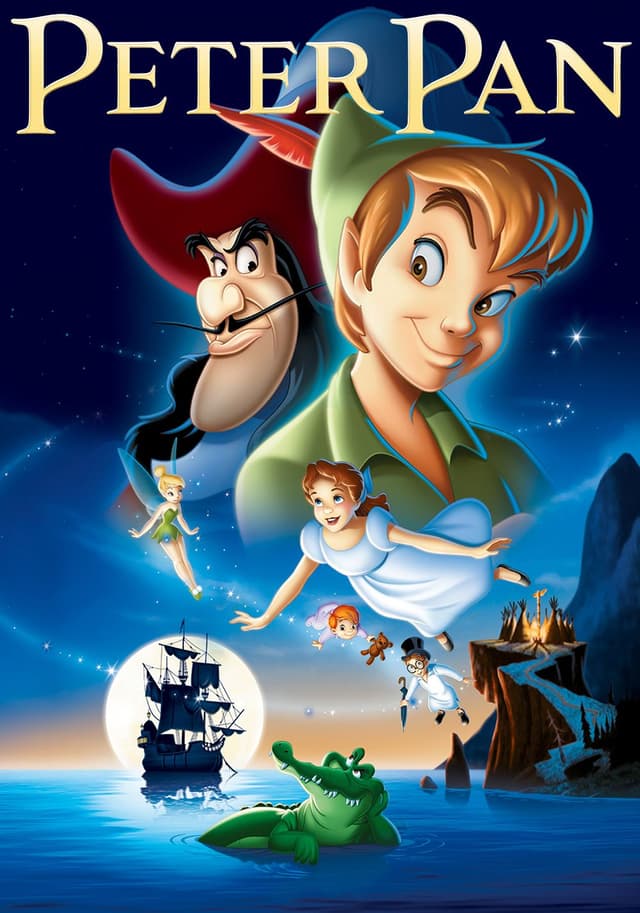
"Peter Pan" (2003) is a live-action adaptation of J.M. Barrie's beloved tale, bringing to life the enchanting story of a boy who never grows up. Set in the magical world of Neverland, the film follows Peter Pan, a mischievous and adventurous young boy who can fly and leads a group of lost children known as the Lost Boys. When he encounters Wendy Darling and her brothers, John and Michael, he invites them to join him on a thrilling journey to his fantastical home.
As they explore Neverland, the children face off against the villainous Captain Hook and his crew of pirates, all while discovering the importance of friendship, bravery, and the bittersweet nature of growing up. With stunning visuals and a captivating score, this adaptation captures the essence of childhood wonder and the timeless struggle between innocence and maturity. Ultimately, "Peter Pan" is a heartwarming tale that reminds viewers of the magic of imagination and the inevitable passage of time.
What is the budget of Peter Pan?
"Peter Pan," a animation released in 2003, was directed by Clyde Geronimi, Wilfred Jackson, Hamilton Luske and stars Bobby Driscoll, Kathryn Beaumont. The production budget was $4,000,000, placing it in the micro-budget range for animation productions of its era.
Key Budget Allocation Categories
While specific budget breakdowns are not publicly available, typical cost drivers for a animation production like this include:
- Animation Production Pipeline: The bulk of an animated film's budget funds the multi-year production pipeline: storyboarding, character modeling, rigging, animation, lighting, rendering, and compositing.
- Voice Talent: Celebrity voice casting has become standard for studio animation, with A-list actors earning $5 to 15 million for voice roles.
- Music, Songs & Sound Design: Original songs and orchestral scores are central to animated storytelling. Sound design for animated worlds must be created entirely from scratch.
- Casting: Walt Disney originally wanted to cast Mary Martin as Peter Pan, but Roy Disney disagreed, finding Martin's voice "too heavy, matured and sophisticated".
What were the major cost factors in Peter Pan?
Several factors contributed to the overall production costs of "Peter Pan."
- Animation Production Pipeline: Animation Production Pipeline is one of the primary cost drivers in animation productions of this scale.
- Voice Talent: Voice Talent is one of the primary cost drivers in animation productions of this scale.
- Music: Music, Songs & Sound Design is one of the primary cost drivers in animation productions of this scale.
How Does Peter Pan's Budget Compare to Similar Films?
At $4,000,000, Peter Pan sits in the micro-budget range. Here is how it compares to productions with a similar budget:
- Ghost in the Shell (1995): Budget $3,000,000, Worldwide Gross $10,000,000
- Cinderella (1950): Budget $2,900,000, Worldwide Gross $263,600,000
The median budget for wide-release animation films in the era ranges from $30 to 80M for mid-budget to $150M+ for tentpoles.
Peter Pan Box Office Performance
"Peter Pan" earned $87,404,651 domestically and $87,400,000 worldwide at the box office. Against a production budget of $4,000,000, the film performed strongly at the box office.
A film typically needs to earn approximately twice its production budget to cover marketing and distribution costs. For "Peter Pan," that break-even threshold was roughly $8,000,000. With worldwide earnings of $87,400,000, the film cleared that threshold comfortably.
Box Office Breakdown
Peter Pan

At 2085%, "Peter Pan" earned roughly $21.85 for every $1 invested in production.
Peter Pan Production History
Walt Disney originally wanted to cast Mary Martin as Peter Pan, but Roy Disney disagreed, finding Martin's voice "too heavy, matured and sophisticated". Jean Arthur also approached Walt Disney to consider her for the role. Bobby Driscoll, who was Disney's first contract child actor and had previously starred in such films as Song of the South (1946), So Dear to My Heart (1948), and Treasure Island (1950), was ultimately cast.
Frank Churchill wrote several songs for the film during the early 1940s, and Charles Walcott wrote additional songs in 1941. When work on Peter Pan resumed in 1944, Eliot Daniel composed songs for the film. However, this version of Peter Pan was shelved so the studio could complete Cinderella.
Awards and Recognition
2 wins & 2 nominations total
Frequently Asked Questions
How much did it cost to make Peter Pan (1953)?
The production budget was $4,000,000, covering principal photography, visual effects, cast and crew salaries, locations, sets, post-production, and music. Marketing and distribution (P&A) costs are estimated at an additional $2,000,000 - $3,200,000, bringing the total studio investment to approximately $6,000,000 - $7,200,000.
How much did Peter Pan (1953) earn at the box office?
Peter Pan grossed $87,404,651 domestic, $-4,651 international, totaling $87,400,000 worldwide.
Was Peter Pan (1953) profitable?
Yes. Against a production budget of $4,000,000 and estimated total costs of ~$10,000,000, the film earned $87,400,000 theatrically - a 2085% ROI on production costs alone.
What were the biggest costs in producing Peter Pan?
The primary cost drivers were above-the-line talent (Bobby Driscoll, Kathryn Beaumont, Hans Conried); multi-year animation production, celebrity voice talent, and original musical compositions.
How does Peter Pan's budget compare to similar animation films?
At $4,000,000, Peter Pan is classified as a micro-budget production. The median budget for wide-release animation films in the era ranges from $30 - 80M for mid-budget to $150M+ for tentpoles. Comparable budgets: Ghost in the Shell (1995, $3,000,000); Cinderella (1950, $2,900,000).
Did Peter Pan (1953) go over budget?
There are no widely reported accounts of significant budget overruns for this production. However, studios rarely disclose precise budget overrun figures publicly. The reported production budget reflects the final estimated cost.
What was the return on investment (ROI) for Peter Pan?
The theatrical ROI was 2085.0%, calculated as ($87,400,000 − $4,000,000) ÷ $4,000,000 × 100. This measures gross revenue against production budget only - it does not account for P&A or exhibitor shares.
What awards did Peter Pan (1953) win?
2 wins & 2 nominations total.
Who directed Peter Pan and who were the key crew members?
Directed by Clyde Geronimi, Wilfred Jackson, Hamilton Luske, written by Ted Sears, Erdman Penner, Bill Peet, Winston Hibler, with music by Oliver Wallace, edited by Donald Halliday.
Where was Peter Pan filmed?
Peter Pan was filmed in United States of America.
Filmmakers
Peter Pan

Official Trailer
Build budgets like this one in Saturation
Start from an industry-standard feature film template, import the schedule and rates you already have, and let the cost report keep itself current as you spend. Real-time collaboration, no spreadsheets.