Moonraker Budget
 ActionAdventureThrillerScience Fiction2h 6m
Updated
Synopsis
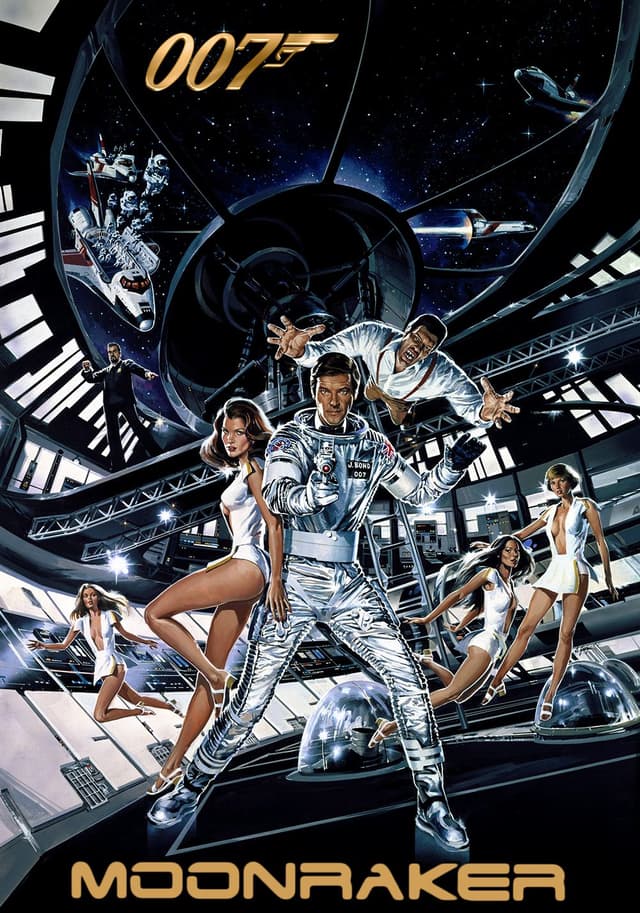
"Moonraker," released in 1979, is the eleventh installment in the James Bond film series, featuring Roger Moore as the iconic British secret agent. The story begins when a space shuttle, Moonraker, is hijacked, prompting MI6 to send Bond on a mission to investigate the incident. His journey takes him from the lush landscapes of California to the opulent streets of Venice and ultimately to a secret space station in orbit.
As Bond delves deeper into the mystery, he uncovers a nefarious plot orchestrated by the villainous Hugo Drax, played by Michael Lonsdale. Drax, a wealthy industrialist, aims to eliminate the majority of humanity and create a new race in space. Along the way, Bond encounters a series of thrilling challenges, including breathtaking aerial dogfights, high-stakes poker games, and a captivating romance with the beautiful Dr. Holly Goodhead, portrayed by Lois Chiles.
With its blend of action, espionage, and science fiction elements, "Moonraker" showcases Bond's resourcefulness and charm as he races against time to thwart Drax's plans and save the world from destruction. The film is notable for its extravagant set pieces and special effects, making it a memorable entry in the Bond franchise.
What is the budget of Moonraker?
"Moonraker," an action released in 1979, was directed by Lewis Gilbert and stars Roger Moore, Lois Chiles. The production budget was $34,000,000, placing it in the mid-budget range for action productions of the 1970s.
Key Budget Allocation Categories
While specific budget breakdowns are not publicly available, typical cost drivers for an action production like this include:
- Stunts, Action Sequences & Visual Effects: Action films allocate a substantial portion of their budget to choreographing and executing practical stunts, pyrotechnics, and CGI-heavy sequences.
- Above-the-Line Talent (Cast & Director): A-list talent commands significant upfront fees plus backend participation.
- Production Design, Sets & Locations: Action films frequently require multiple international shooting locations, large-scale set construction, vehicle acquisitions and modifications, and specialized equipment , all of which drive production costs well above those of dialogue-driven genres.
- Casting: Roger Moore had originally signed a three-film contract with Eon Productions, which covered his first three appearances: Live and Let Die in 1973, The Man with the Golden Gun in 1974 and The Spy Who Loved Me in 1977.
What were the major cost factors in Moonraker?
Several factors contributed to the overall production costs of "Moonraker."
- Stunts: Stunts, Action Sequences & Visual Effects is one of the primary cost drivers in action productions of this scale.
- Above-the-Line Talent (Cast: Above-the-Line Talent (Cast & Director) is one of the primary cost drivers in action productions of this scale.
- Production Design: Production Design, Sets & Locations is one of the primary cost drivers in action productions of this scale.
How Does Moonraker's Budget Compare to Similar Films?
At $34,000,000, Moonraker sits in the mid-budget range. Here is how it compares to productions with a similar budget:
- Baby Driver (2017): Budget $34,000,000, Worldwide Gross $226,945,087
- Chill Factor (1999): Budget $34,000,000, Worldwide Gross $11,263,966
- Greenland (2020): Budget $34,000,000, Worldwide Gross $52,300,000
- I Dreamed of Africa (2000): Budget $34,000,000, Worldwide Gross $14,400,327
- 1941 (1979): Budget $35,000,000, Worldwide Gross $94,900,000
The median budget for wide-release action films in the era ranges from $30 to 80M for mid-budget to $150M+ for tentpoles.
Moonraker Box Office Performance
"Moonraker" earned $70,308,099 domestically and $210,308,099 worldwide at the box office. Against a production budget of $34,000,000, the film performed strongly at the box office.
A film typically needs to earn approximately twice its production budget to cover marketing and distribution costs. For "Moonraker," that break-even threshold was roughly $68,000,000. With worldwide earnings of $210,308,099, the film cleared that threshold comfortably.
Box Office Breakdown
Moonraker

At 518.6%, "Moonraker" earned roughly $6.19 for every $1 invested in production.
Moonraker Production History
Roger Moore had originally signed a three-film contract with Eon Productions, which covered his first three appearances: Live and Let Die in 1973, The Man with the Golden Gun in 1974 and The Spy Who Loved Me in 1977. From Moonraker onwards, Moore was contracted on a film-by-film basis. Initially, the chief villain, Hugo Drax, was to be played by British actor James Mason, but once the decision was made that the film would be an Anglo-French co-production under the 1965 to 1979 film treaty, French actor Michael Lonsdale was cast as Drax and Corinne Cléry was chosen for the part of Corinne Dufour, to comply with qualifying criteria of the agreement.
Production began on 14 August 1978. The main shooting was switched from the usual 007 Stage at the Pinewood Studios to Epinay and Billancourt Studios in France, because of the high taxation in Britain at the time. Only the cable car interiors and space battle exteriors were filmed at Pinewood.
The soundtrack of Moonraker was composed by John Barry and recorded in Paris, again, as with production, marking a turning point away from the prior studio, CTS Studios in London. The score also marked a turning point in John Barry's output, abandoning the Kentonesque brass of his earlier Bond scores in favor of slow, rich string passages,a trend which Barry would continue in the 1980s with scores such as Out of Africa and Somewhere in Time. For Moonraker, for the first time since Diamonds Are Forever (1971), Barry used a piece of music called "007" (on track 7), the secondary Bond theme composed by Barry and introduced in From Russia with Love during Bond's escape with the Lektor; some classical music pieces were also included in the film.
Awards and Recognition
Nominated for 1 Oscar. 1 win & 7 nominations total
Official Trailer
Build budgets like this one in Saturation
Start from an industry-standard feature film template, import the schedule and rates you already have, and let the cost report keep itself current as you spend. Real-time collaboration, no spreadsheets.