Laws of Attraction Budget
 Romantic Comedy
Updated
Synopsis
Two of New York's most successful divorce attorneys, the meticulous Audrey Woods and the rakishly charming Daniel Rafferty, find themselves repeatedly facing off in court and grudgingly attracted to each other outside it. When they are assigned to opposing sides of a high-profile divorce involving a rock star and his celebrity-designer wife, the case sends them to Ireland, where a drunken evening at an Irish wedding leads to a marriage of their own and a contested castle they must somehow divide.
What Is the Budget of Laws of Attraction (2004)?
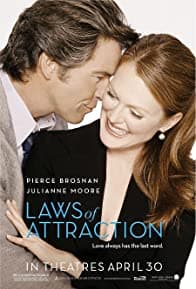
Laws of Attraction (2004), directed by Peter Howitt and distributed by New Line Cinema, was produced on a reported budget of $32,000,000. The film was developed as a star-driven romantic comedy pairing Pierce Brosnan (during his James Bond era between Die Another Day and his exit from the role) and Julianne Moore (between The Hours and Far from Heaven). Aaron Zigman and Robert Harling wrote the screenplay, which positioned the leads as rival divorce attorneys whose courtroom adversarial relationship gives way to romance amid an Irish wedding and a contested castle.
The relatively modest $32,000,000 budget reflected New Line's positioning of the film as a mid-budget adult romantic comedy in a market that still supported the genre at this tier. The production exploited Irish location work for the castle and rural sequences, taking advantage of Section 481 film incentives, while keeping the New York courtroom scenes in studios and limited Manhattan exteriors.
Key Budget Allocation Categories
The reported $32,000,000 budget was distributed across several core production areas:
- Above-the-Line Talent: Pierce Brosnan, near the peak of his Bond-era earning power, commanded a substantial fee. Julianne Moore, fresh off back-to-back Academy Award nominations for The Hours and Far from Heaven, also took significant compensation. Supporting cast included Parker Posey, Michael Sheen, and Frances Fisher. Director Peter Howitt, coming off the box-office hit Antitrust (2001) and earlier success with Sliding Doors (1998), commanded a mid-tier feature director's rate.
- Ireland Location Shoot: Principal photography took place primarily in Ireland, with the castle sequences shot at Markree Castle in County Sligo and surrounding rural locations standing in for the contested estate. The production qualified for Ireland's Section 481 film incentive, which at the time provided a meaningful percentage of qualifying spend as a tax credit, offsetting a portion of the location budget.
- New York Studio and Location Work: The New York courtroom and Manhattan interiors were shot at Kaufman Astoria Studios in Queens and at limited exterior locations in Manhattan. Production design by Sophie Becher emphasized the visual contrast between the polished urban offices and the rougher Irish countryside, requiring distinct color palettes and set decoration across the two production hubs.
- Costumes and Wardrobe: Costume designer Aggie Guerard Rodgers built principal-cast wardrobes that emphasized the leads' professional polish in courtroom scenes and a casual transformation across the Irish sequences. The wardrobe department also dressed several hundred background performers for the wedding and reception sequences.
- Music and Soundtrack: Composer Edward Shearmur wrote the score, supplementing it with a soundtrack of contemporary pop and Irish folk-influenced tracks. The music supervision team licensed needle drops from established artists for the romantic montage sequences, with the song "Holding Out for a Hero" by Frou Frou featuring prominently in the trailer marketing.
- Marketing Tier: New Line's marketing investment was substantial relative to the production budget, with an estimated $25,000,000 to $30,000,000 in worldwide P&A spend, leveraging the star pairing of Brosnan and Moore as the central campaign element.
How Does Laws of Attraction's Budget Compare to Similar Films?
At $32,000,000, Laws of Attraction sat in the standard mid-budget tier for early-2000s adult romantic comedies. Comparing it with peers:
- Two Weeks Notice (2002): Budget $60,000,000 | Worldwide $199,043,242. The Sandra Bullock and Hugh Grant pairing cost nearly twice as much and grossed nearly seven times Laws of Attraction worldwide, illustrating the box office gulf between the established Bullock-Grant pairing and the Brosnan-Moore combination.
- How to Lose a Guy in 10 Days (2003): Budget $50,000,000 | Worldwide $177,495,335. Kate Hudson and Matthew McConaughey's romantic comedy cost 56% more and grossed nearly six times Laws of Attraction worldwide, a similar studio-tier romantic comedy from one year prior that exposed the limited audience appeal of the Laws of Attraction pairing.
- Intolerable Cruelty (2003): Budget $60,000,000 | Worldwide $120,807,228. The Coen Brothers' courtroom romantic comedy featuring George Clooney and Catherine Zeta-Jones cost 88% more and grossed four times as much, providing the closest direct comparison given the divorce-attorney premise that anchored both films.
- Wimbledon (2004): Budget $31,000,000 | Worldwide $41,693,290. Working Title's same-year romantic comedy paired Paul Bettany and Kirsten Dunst at almost exactly the Laws of Attraction budget tier and earned 40% more worldwide while still landing as a clear commercial disappointment, illustrating that the mid-budget star-pairing romantic comedy was a treacherous category by 2004.
- Down with Love (2003): Budget $35,000,000 | Worldwide $39,213,090. The Ewan McGregor and Renée Zellweger pastiche cost slightly more and grossed only marginally more than Laws of Attraction, another adult romantic comedy that struggled at the box office in the years leading up to the genre's late-2000s collapse.
Laws of Attraction Box Office Performance
Laws of Attraction opened domestically on April 30, 2004, earning $6,533,059 in its opening weekend and finishing fourth at the U.S. box office behind Mean Girls, Man on Fire, and 13 Going on 30. That figure was at the low end of pre-release tracking and well below the $10,000,000-plus opening New Line had projected for a Brosnan-Moore vehicle. Word of mouth was tepid, and the film fell sharply in subsequent weeks.
Against a $32,000,000 production budget, the film required approximately $75,000,000 in worldwide gross to reach profitability after marketing and distribution costs. The financial breakdown:
Box Office Breakdown
Laws of Attraction

Laws of Attraction returned approximately $0.49 to $0.53 in theatrical revenue for every $1 invested when measured against total estimated production and marketing spend, placing it in the clear-loss category for New Line that year. The domestic share of the gross was $17,872,066 against an international share of $12,067,525, a 60/40 split that confirmed slight residual international appeal for Pierce Brosnan during his Bond era.
The disappointing performance contributed to a broader contraction of New Line's mid-budget romantic comedy slate over the following years. Pierce Brosnan exited the James Bond role later in 2004 and pivoted toward more eclectic projects, including The Matador (2005) and Mamma Mia! (2008), while Julianne Moore returned to dramatic work with films including The Forgotten (2004) and Children of Men (2006).
Laws of Attraction Production History
New Line Cinema developed Laws of Attraction beginning in 2002 with Aaron Zigman's original screenplay, which Robert Harling subsequently revised. Pierce Brosnan came aboard as both star and producer through his Irish DreamTime production company, and Julianne Moore was attached as the female lead in early 2003. Peter Howitt was hired to direct on the strength of Sliding Doors (1998) and Antitrust (2001), with shooting scheduled for spring and summer 2003.
Principal photography began in May 2003 in Ireland, leveraging the Section 481 film incentive. Locations included Markree Castle in County Sligo (standing in for the contested estate), surrounding rural villages, and Dublin interiors. The production then moved to Kaufman Astoria Studios in Queens, New York, and limited Manhattan exteriors for the courtroom and urban office sequences. Shooting wrapped in August 2003.
Post-production was straightforward by major studio standards, with the film completed in late 2003 ahead of an originally planned February 2004 release. New Line subsequently pushed the release to April 30, 2004 to avoid a crowded Valentine's Day window and to position the film as counter-programming against the spring Disney and Universal slates. The marketing campaign emphasized the star pairing and the Irish countryside imagery, with the Frou Frou cover of "Holding Out for a Hero" anchoring the trailer.
The film opened against Mean Girls, which dominated the youth-quadrant audience, and 13 Going on 30, which competed directly for the adult-female romantic comedy quadrant. The double pincer of two strong female-led releases on the same weekend significantly limited Laws of Attraction's available audience and contributed to the soft opening.
Awards and Recognition
Laws of Attraction received minimal awards recognition. The film was largely absent from year-end critics' lists and the major industry awards circuit. Pierce Brosnan and Julianne Moore received no individual nominations from major bodies for their work in the film, with both performers garnering most of their 2004-2005 awards attention for other projects. The film did not register at the Academy Awards, Golden Globes, BAFTAs, or major critics' associations.
On the production side, the film drew limited recognition from craft guilds. Production design by Sophie Becher and costume design by Aggie Guerard Rodgers received industry recognition from craft trade publications, but neither rose to the level of major guild nominations. The film's commercial underperformance and mixed reception largely defined its industry reputation rather than any awards momentum.
Critical Reception
Laws of Attraction received mixed-to-negative reviews. The film holds a 25% approval rating on Rotten Tomatoes based on 134 critic reviews, with a critical consensus that called it "a tired romantic comedy that wastes its appealing leads on a formulaic story." On Metacritic, the film scored 43 out of 100, indicating mixed or average reviews. Audiences surveyed by CinemaScore gave the film a B, a moderate response that nevertheless failed to translate into legs at the box office.
Critics broadly praised the chemistry between Pierce Brosnan and Julianne Moore and the picturesque Irish location work, but objected to a screenplay that reviewers characterized as predictable and overly reliant on romantic-comedy conventions. Roger Ebert gave the film two and a half stars, writing that "Brosnan and Moore have undeniable chemistry, but the screenplay never gives them characters worth their effort." The Washington Post's Stephen Hunter called the film "a glossy, professional, and entirely conventional romantic comedy that goes through the motions without ever finding a reason to exist."
Defenders pointed to the leads' charm, the Irish countryside cinematography by Adrian Biddle, and what The New York Times' Stephen Holden called "a low-key Hollywood professionalism increasingly rare in adult romantic comedies of the era." A.O. Scott in the same paper offered a mixed review that acknowledged the film's competence while concluding that "professional polish is not the same as inspiration." The film has not undergone significant critical reappraisal and remains best known as one of several Pierce Brosnan transitional projects from his Bond-era exit.
Frequently Asked Questions
How much did it cost to make Laws of Attraction (2004)?
The reported production budget was $32,000,000. Costs were controlled by mid-tier above-the-line compensation outside the two leads, principal photography in Ireland that leveraged the Section 481 film incentive, and modest visual effects requirements appropriate to a romantic comedy.
How much did Laws of Attraction earn at the box office?
The film grossed $17,872,066 domestically and $12,067,525 internationally, for a worldwide total of $29,939,591. It opened to $6,533,059 in the United States, finishing fourth on its April 30, 2004 opening weekend behind Mean Girls, Man on Fire, and 13 Going on 30.
Was Laws of Attraction a box office success?
No. Against a $32,000,000 production budget and an estimated $25-30 million in marketing, the film returned approximately $0.49 in worldwide gross for every $1 invested. It was a clear commercial disappointment for New Line and contributed to the broader contraction of the studio's mid-budget romantic comedy slate.
Who directed Laws of Attraction?
Peter Howitt directed the film. The British filmmaker had previously directed Sliding Doors (1998) and Antitrust (2001) before taking on the Laws of Attraction project for New Line and Pierce Brosnan's Irish DreamTime production company.
Where was Laws of Attraction filmed?
Principal photography took place from May to August 2003 in Ireland (leveraging the Section 481 film incentive) and at Kaufman Astoria Studios in Queens, New York. Irish locations included Markree Castle in County Sligo, which stood in for the contested estate, and surrounding rural villages.
Who stars in Laws of Attraction?
Pierce Brosnan and Julianne Moore play rival divorce attorneys Daniel Rafferty and Audrey Woods. Brosnan was filming during his James Bond era between Die Another Day (2002) and his exit from the role later in 2004, while Moore was between The Hours and Far from Heaven, both of which had earned her Academy Award nominations.
Is Laws of Attraction a remake?
No, the film is an original screenplay credited to Aline Brosh McKenna and Robert Harling, though critics frequently noted its tonal and structural debt to classic-era Hollywood courtroom romantic comedies including Adam's Rib (1949). The script's rival-attorneys-falling-in-love premise sits squarely within an established subgenre rather than adapting a specific source.
What did critics think of Laws of Attraction?
The film received mixed-to-negative reviews, with a 25% approval rating on Rotten Tomatoes (134 critics) and a 43 score on Metacritic. Audiences gave it a B CinemaScore. Critics praised the chemistry between Brosnan and Moore and the Irish location work but objected to a predictable screenplay overly reliant on romantic-comedy conventions.
How does Laws of Attraction compare to other 2000s romantic comedies?
Laws of Attraction grossed $29.9 million worldwide on a $32 million budget. By comparison, Two Weeks Notice (2002) earned $199 million on a $60 million budget, How to Lose a Guy in 10 Days (2003) earned $177 million on a $50 million budget, and Intolerable Cruelty (2003) earned $121 million on a $60 million budget. Laws of Attraction was a clear commercial outlier in the lower tier of the cycle.
Did Laws of Attraction win any awards?
No. The film was largely absent from year-end critics' lists and major industry awards. Neither Pierce Brosnan nor Julianne Moore received individual nominations for their work in the film, with both performers garnering their 2004-2005 awards attention for other projects.
Filmmakers
Laws of Attraction

Official Trailer
Build budgets like this one in Saturation
Start from an industry-standard feature film template, import the schedule and rates you already have, and let the cost report keep itself current as you spend. Real-time collaboration, no spreadsheets.