Notting Hill Budget
 Romantic Comedy
Updated
Synopsis
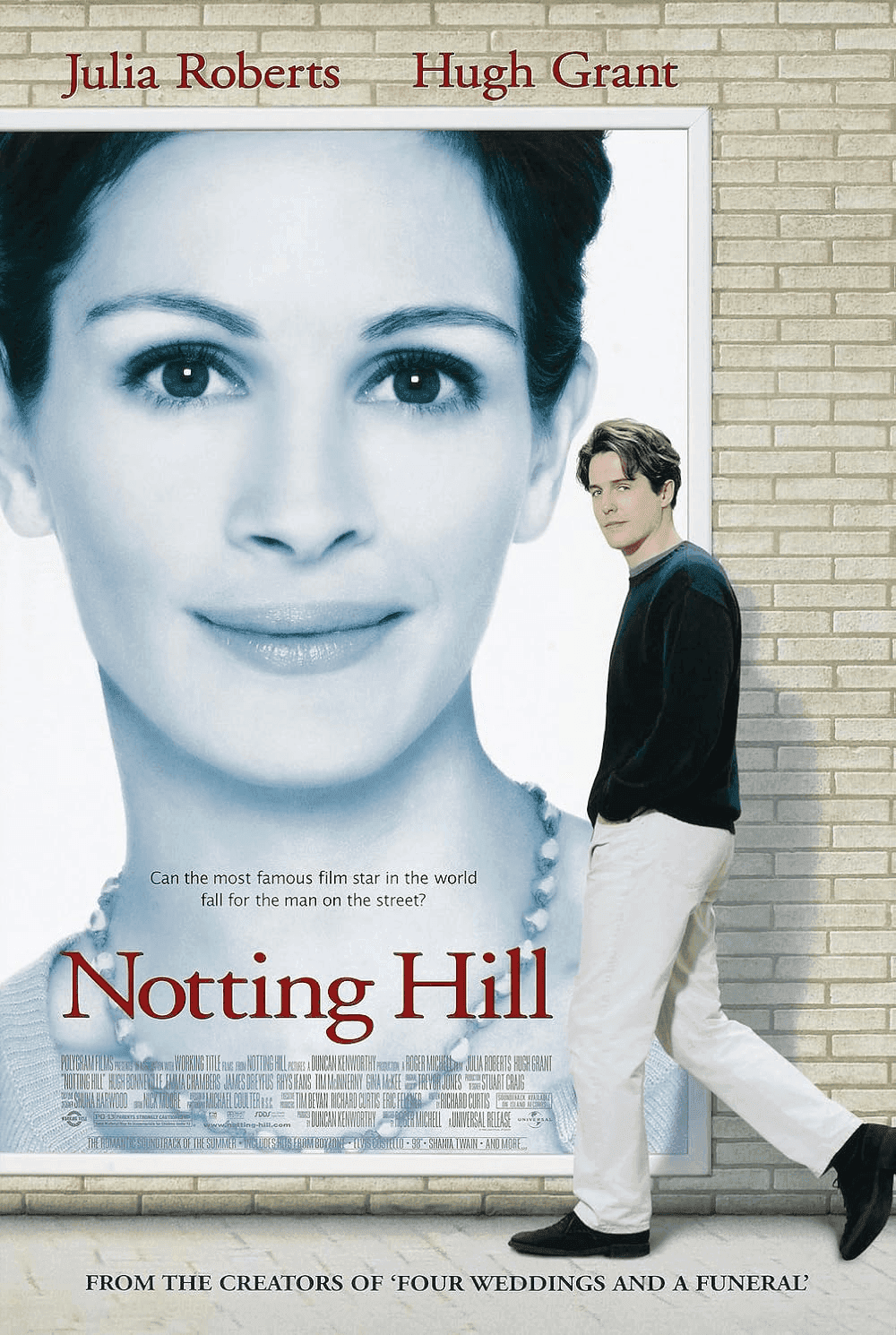
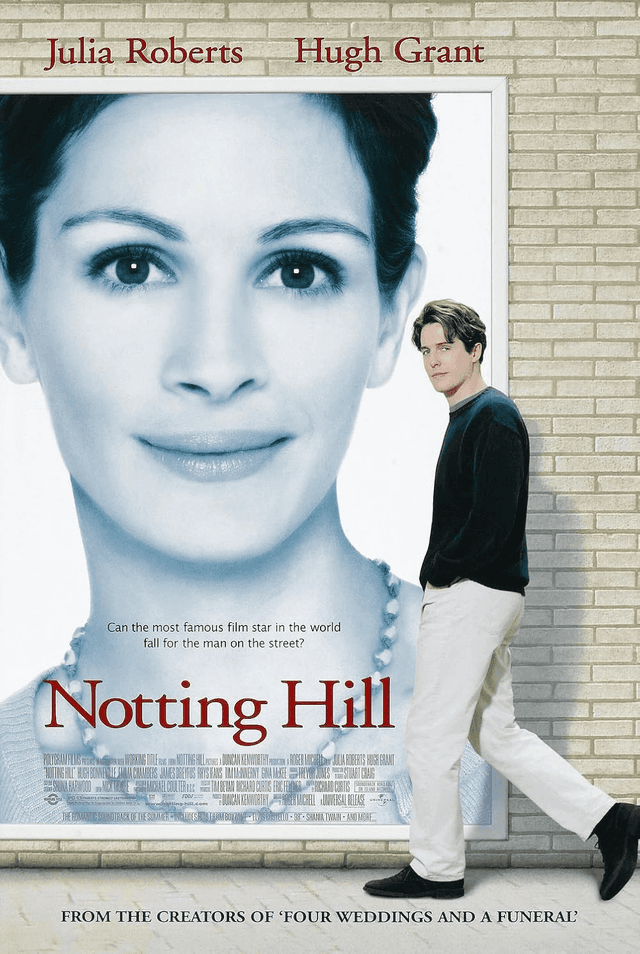
William Thacker, a quiet, hapless bookseller in London's Notting Hill neighborhood, has his improbable day when Hollywood superstar Anna Scott walks into his small travel-bookshop. After a meeting in a King's Road juice bar where he spills his orange juice on her, their fragile romance survives invasive press attention, the constant intrusion of William's eccentric flatmate Spike, and Anna's complicated public life.
What Is the Budget of Notting Hill (1999)?
Notting Hill (1999), directed by Roger Michell and distributed by Universal Pictures, was produced on a reported budget of $42,000,000. The film paired Hugh Grant (Four Weddings and a Funeral) with Julia Roberts (Pretty Woman, My Best Friend's Wedding) in a Working Title Films-produced transatlantic romantic comedy that screenwriter Richard Curtis described as a partial reverse-engineering of his earlier Four Weddings success. Working Title's Tim Bevan and Eric Fellner produced through their standing Universal output deal, with Duncan Kenworthy (Four Weddings) producing alongside.
The investment reflected a calculated mid-budget step up from the $4,400,000 spent on Four Weddings and a Funeral (1994), with Working Title leveraging that film's $260,000,000-plus worldwide success to negotiate a substantially larger production package. The budget accommodated London location production, Julia Roberts's top-tier $15,000,000-plus quote, and a multi-week shoot block that allowed Richard Curtis's screenplay to develop its leisurely pace.
Key Budget Allocation Categories
Notting Hill's reported $42,000,000 budget was distributed across several core production areas:
- Above-the-Line Talent: Director Roger Michell commanded a feature-director rate appropriate to his Persuasion (1995) and My Night with Reg credits. Hugh Grant, post-Four Weddings, commanded a top-tier transatlantic-comedy quote. Julia Roberts, fresh off My Best Friend's Wedding (1997), Stepmom (1998), and Notting Hill's pre-production simultaneous Runaway Bride, commanded a $15,000,000-plus quote with profit participation, the production's single largest line item.
- Notting Hill London Production: Principal photography took place primarily on practical Notting Hill, Westbourne Park Road, and Portobello Road locations in West London. The production negotiated extensive location permits with the City of Westminster and the Royal Borough of Kensington and Chelsea, with the Travel Bookshop at 13 Blenheim Crescent serving as the central setpiece (the shop has since become a tourist attraction and is now operating as Notting Hill Bookshop in commemoration).
- Production Design: Production designer Stuart Craig (later the designer of all eight Harry Potter films) and his department dressed the practical Notting Hill locations to maintain the film's heightened-romantic-realism aesthetic, with bespoke set design for the Travel Bookshop interior, William's blue-door flat, and the Savoy Hotel press-junket sequences.
- Costume Design: Costume designer Shuna Harwood designed and constructed contemporary London wardrobes for the principal cast and supporting ensemble, with multiple bespoke wardrobes per principal accommodating the film's multi-season narrative timeline and Julia Roberts's role-within-a-role (period sci-fi shoot, contemporary press junkets, and personal-life Anna Scott).
- Score by Trevor Jones: Composer Trevor Jones scored the film, blending romantic-comedy themes with the licensed pop and rock tracks that anchored several of the film's most-discussed sequences (Elvis Costello's "She," Bill Withers's "Ain't No Sunshine," Boyzone's "No Matter What," Ronan Keating's "When You Say Nothing at All"). Music licensing was higher than typical for a romantic comedy of this budget given the screenplay's extensive needle drops.
- Reshoots and Test-Screening Adjustments: The film underwent multiple rounds of test screenings and reshoots in late 1998 and early 1999 to refine the ending and the press-attention sequences. The reshoots, including the Savoy Hotel press-junket coverage, added incremental cost in late post-production.
How Does Notting Hill's Budget Compare to Similar Films?
At a reported $42,000,000, Notting Hill sat in the mid-range of late-1990s major-studio romantic comedies. The comparison set frames its commercial outcome:
- Four Weddings and a Funeral (1994): Budget $4,400,000 | Worldwide $245,700,000. The previous Richard Curtis-Working Title romantic comedy cost roughly 10% of Notting Hill and earned 68% of the worldwide total, the in-house comparison Working Title leveraged to negotiate the Notting Hill production package.
- You've Got Mail (1998): Budget $65,000,000 | Worldwide $250,800,000. The Nora Ephron-Tom Hanks-Meg Ryan romantic comedy released six months earlier cost 55% more and earned 69% of Notting Hill's worldwide total, the genre-peer comparison Universal could not avoid.
- Runaway Bride (1999): Budget $70,000,000 | Worldwide $309,500,000. Julia Roberts's contemporaneous Paramount romantic comedy released two months after Notting Hill cost 66% more and earned 85% of Notting Hill's worldwide total, the in-actor comparison that highlighted the value of the Hugh Grant pairing.
- My Best Friend's Wedding (1997): Budget $38,000,000 | Worldwide $299,300,000. Julia Roberts's previous Tristar romantic comedy cost 10% less and earned 82% of Notting Hill's worldwide total, the immediate Roberts predecessor that informed her Notting Hill quote.
- Sleepless in Seattle (1993): Budget $21,000,000 | Worldwide $227,800,000. The Nora Ephron-Tom Hanks-Meg Ryan romantic comedy released six years earlier cost half and earned 63% of Notting Hill's worldwide total, an earlier major-studio romantic-comedy benchmark Notting Hill exceeded.
Notting Hill Box Office Performance
Notting Hill opened on May 28, 1999 in the United Kingdom and on May 28, 1999 in the United States, finishing second on its US opening weekend with $21,815,535 (the US opening trailed only Star Wars: Episode I - The Phantom Menace in its second weekend). The film posted strong domestic legs through summer 1999, holding into the top ten for six weeks, and its international rollout was even stronger, with the UK opening generating £6,200,000 on its first weekend (a UK record for a non-James Bond release at the time).
Against a reported production budget of $42,000,000, the film needed approximately $100,000,000 in worldwide gross to reach profitability when accounting for marketing and distribution costs. Here is the financial breakdown:
Box Office Breakdown
Notting Hill

Notting Hill returned approximately $4.33 in worldwide theatrical revenue for every $1 invested when measured against total estimated production and marketing spend, a decisive commercial outcome that became one of the most lucrative romantic-comedy productions of the 1990s. The domestic share of the gross was $116,089,678 against an international share of $247,800,000, a 32/68 split heavily weighted toward international markets where Hugh Grant's post-Four Weddings stardom and Julia Roberts's broader international appeal had compounded.
The commercial result extended Working Title's Universal romantic-comedy run through Bridget Jones's Diary (2001), About a Boy (2002), Love Actually (2003), and beyond, anchoring more than a decade of British romantic-comedy product. Richard Curtis's subsequent screenplay-and-direction work (Bridget Jones, Love Actually, About Time, Yesterday) all carried Notting Hill's DNA. Hugh Grant continued in romantic-comedy material through Bridget Jones (2001) and About a Boy (2002) before pivoting toward darker character work in subsequent decades.
Notting Hill Production History
Development on Notting Hill began at Working Title Films in 1996 immediately after Richard Curtis's Four Weddings and a Funeral success. Curtis wrote the screenplay between 1996 and 1998, deliberately conceiving it as a partial reverse-engineering of Four Weddings (one British everyman in romantic-encounter with one American superstar, rather than four wedding-ensembles). Roger Michell attached as director in early 1998, with Tim Bevan, Eric Fellner, and Four Weddings producer Duncan Kenworthy producing.
Hugh Grant attached in mid-1998 following his Four Weddings and Sense and Sensibility success. Casting Julia Roberts was the production's defining commercial decision. Roberts attached in October 1998 on the strength of My Best Friend's Wedding (1997) and the simultaneous Stepmom and Runaway Bride pre-production. Her $15,000,000-plus quote made the package the most-expensive romantic-comedy in Working Title's history to date.
Principal photography began on April 27, 1998 in London, with extensive location work in Notting Hill, Westbourne Park Road, and Portobello Road. The Travel Bookshop at 13 Blenheim Crescent served as the central setpiece (the shop has since become a tourist attraction). Additional location work took place at the Savoy Hotel, Kenwood House, Hampstead Heath, and at the Ritz Hotel London. Interior soundstage work took place at Shepperton Studios. Shooting wrapped in July 1998 after a roughly twelve-week schedule.
Post-production ran through fall 1998 and into spring 1999, with test-screening reshoots in early 1999 refining the ending and the Savoy Hotel press-junket coverage. Universal positioned the film as international summer counter-programming against Star Wars: Episode I - The Phantom Menace, a strategic choice that captured the romantic-comedy audience absent from the Star Wars opening corridor and produced the second-place opening on May 28, 1999.
Awards and Recognition
Notting Hill received minimal awards recognition. The film was not nominated at the Academy Awards or BAFTA Awards.
Julia Roberts won the Golden Globe for Best Actress in a Motion Picture, Musical or Comedy at the 57th Golden Globe Awards in January 2000, an outcome that prefigured her Best Actress Oscar win for Erin Brockovich the following year. The film also won the British Academy of Film and Television Arts Award (BAFTA) for Outstanding Film and Audience Award. Roger Michell received a BAFTA nomination for Best Direction. The film's mainstream awards-season absence in the United States reflected the contemporary academy's historical dismissal of mainstream romantic comedy.
Critical Reception
Notting Hill received generally positive reviews. The film holds a 83% approval rating on Rotten Tomatoes based on 92 critic reviews, with the consensus calling it an effortlessly charming romantic comedy powered by Hugh Grant's and Julia Roberts's genuine chemistry. On Metacritic, the film scored 76 out of 100, indicating generally favorable reviews. Audiences surveyed by CinemaScore gave the film an A-, well above the B+ range typical for romantic comedies of the era.
Roger Ebert wrote in the Chicago Sun-Times that the film "earns its happy ending by understanding how unhappy its leads are willing to be along the way," and Janet Maslin in The New York Times observed that "Hugh Grant and Julia Roberts have the kind of unforced chemistry that screenwriters spend careers chasing." Variety's Todd McCarthy noted that "Roger Michell directs with a restraint that lets the leads carry the film's emotional weight."
Genre and British-press reaction was even more positive. Empire magazine gave the film five stars, and The Guardian's Peter Bradshaw praised Richard Curtis's screenplay as "the best romantic-comedy screenplay since Annie Hall." The reception, combined with the commercial triumph, has cemented Notting Hill's reputation as one of the defining mainstream romantic comedies of the late 1990s and a foundational entry in the Working Title-Richard Curtis British comedy canon.
Frequently Asked Questions
How much did it cost to make Notting Hill (1999)?
The reported production budget was $42,000,000. Universal Pictures distributed the film, with Working Title Films and Polygram Filmed Entertainment co-financing and producing through Working Title's standing Universal output deal.
How much did Notting Hill earn at the box office?
The film grossed $116,089,678 domestically and $247,800,000 internationally, for a worldwide total of $363,889,678. It opened to $21,815,535 in the United States on May 28, 1999, finishing second behind Star Wars: Episode I - The Phantom Menace (in its second weekend). The UK opening generated £6,200,000, a UK record for a non-James Bond release at the time.
Was Notting Hill a box office success?
Yes, decisively. Against a $42,000,000 production budget and an estimated $35,000,000 to $45,000,000 in marketing spend, the film returned approximately $4.33 in worldwide gross for every $1 invested. It became one of the most lucrative romantic-comedy productions of the 1990s and extended Working Title's Universal romantic-comedy run through Bridget Jones's Diary (2001), About a Boy (2002), and Love Actually (2003).
Who directed Notting Hill?
Roger Michell directed the film, working from a screenplay by Richard Curtis. Michell had previously directed the BBC television adaptation of Jane Austen's Persuasion (1995). Curtis had previously written Four Weddings and a Funeral (1994), and Notting Hill represented his deliberate follow-up to that film's commercial success.
Where was Notting Hill filmed?
Principal photography began on April 27, 1998 in London, with extensive location work in the Notting Hill neighborhood including Westbourne Park Road and Portobello Road. The Travel Bookshop at 13 Blenheim Crescent served as the central setpiece (the shop has since become a tourist attraction and now operates as the Notting Hill Bookshop). Additional location work took place at the Savoy Hotel, Kenwood House, Hampstead Heath, and the Ritz Hotel London, with interior soundstage work at Shepperton Studios. Shooting wrapped in July 1998.
Who stars in Notting Hill?
Hugh Grant plays William Thacker, the bookseller protagonist, and Julia Roberts plays Anna Scott, the Hollywood superstar. Supporting cast includes Rhys Ifans as William's eccentric flatmate Spike, Emma Chambers as William's sister Honey, Hugh Bonneville as William's friend Bernie, Tim McInnerny as Max, Gina McKee as Bella, and James Dreyfus as Tony.
Did Julia Roberts win an award for Notting Hill?
Yes. Julia Roberts won the Golden Globe for Best Actress in a Motion Picture, Musical or Comedy at the 57th Golden Globe Awards in January 2000. The win prefigured her Best Actress Oscar win for Erin Brockovich the following year. The film also won the BAFTA for Outstanding Film and Audience Award, and Roger Michell received a BAFTA nomination for Best Direction.
Is the Travel Bookshop in Notting Hill a real place?
Yes. The Travel Bookshop at 13 Blenheim Crescent in Notting Hill served as the central setpiece for the film. Richard Curtis based the bookshop on a real travel bookshop he had visited in the neighborhood. The original Travel Bookshop closed in 2011, but the location now operates as the Notting Hill Bookshop, which has become a tourist attraction due to the film.
What did critics think of Notting Hill?
The film received generally positive reviews, with an 83% approval rating on Rotten Tomatoes (based on 92 critics) and a 76 out of 100 score on Metacritic. Audiences gave it an A- CinemaScore. Roger Ebert praised the film's emotional honesty, and Janet Maslin in The New York Times praised the unforced Hugh Grant-Julia Roberts chemistry. Empire magazine gave the film five stars.
How does Notting Hill compare to Four Weddings and a Funeral?
Both films share Richard Curtis as screenwriter and Working Title as producer, with overlapping casting (Hugh Grant headlined both). Notting Hill cost $42,000,000 versus Four Weddings's $4,400,000 (roughly ten times more), reflecting the post-Four Weddings premium Working Title could negotiate and the addition of Julia Roberts's top-tier quote. The two films grossed $363,889,678 (Notting Hill) and $245,700,000 (Four Weddings) respectively, with Four Weddings retaining the more legendary cultural status while Notting Hill ultimately earned more total revenue.
Filmmakers
Notting Hill

Official Trailer
Build budgets like this one in Saturation
Start from an industry-standard feature film template, import the schedule and rates you already have, and let the cost report keep itself current as you spend. Real-time collaboration, no spreadsheets.