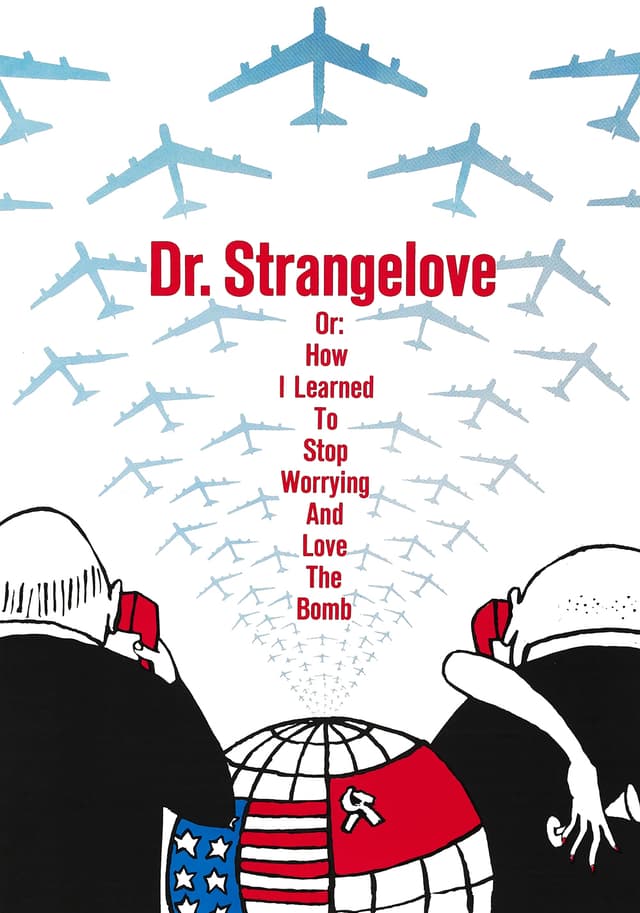
Dr. Strangelove or How I Learned to Stop Worrying and Love the Bomb Budget
 ComedyWar1h 35m
Updated
Synopsis
Paranoid Brigadier General Jack D. Ripper of Burpelson Air Force Base, believing that fluoridation of the American water supply is a Soviet plot to poison the U.S. populace, is able to deploy through a back door mechanism a nuclear attack on the Soviet Union without the knowledge of his superiors, including the Chair of the Joint Chiefs of Staff, General Buck Turgidson, and President Merkin Muffley. Only Ripper knows the code to recall the B-52 bombers and he has shut down communication in and out of Burpelson as a measure to protect this attack. Ripper's executive officer, RAF Group Captain Lionel Mandrake (on exchange from Britain), who is being held at Burpelson by Ripper, believes he knows the recall codes if he can only get a message to the outside world. Meanwhile at the Pentagon War Room, key persons including Muffley, Turgidson and nuclear scientist and adviser, a former Nazi named Dr. Strangelove, are discussing measures to stop the attack or mitigate its blow-up into an all out nuclear war with the Soviets. Against Turgidson's wishes, Muffley brings Soviet Ambassador Alexi de Sadesky into the War Room, and get his boss, Soviet Premier Dimitri Kisov, on the hot line to inform him of what's going on. The Americans in the War Room are dismayed to learn that the Soviets have an as yet unannounced Doomsday Device to detonate if any of their key targets are hit. As Ripper, Mandrake and those in the War Room try and work the situation to their end goal, Major T.J. "King" Kong, one of the B-52 bomber pilots, is working on his own agenda of deploying his bomb where ever he can on enemy soil if he can't make it to his intended target.
What is the budget of Dr. Strangelove or How I Learned to Stop Worrying and Love the Bomb?
"Dr. Strangelove or How I Learned to Stop Worrying and Love the Bomb," a comedy released in 1964, was directed by Stanley Kubrick and stars Peter Sellers, George C. Scott. The production budget was $1,800,000, placing it in the micro-budget range for comedy productions of the 1960s.
Key Budget Allocation Categories
While specific budget breakdowns are not publicly available, typical cost drivers for a comedy production like this include:
- Talent Salaries & Producing Deals: Established comedic talent can command $15 to 20 million per film, with top-tier stars earning even more through producing credits and backend deals.
- Production & Location Filming: While comedies generally avoid the VFX costs of action films, location shooting in recognizable cities or exotic locales adds meaningful production expense.
- Marketing & P&A (Prints & Advertising): Comedies rely heavily on marketing to build opening-weekend momentum.
- Filming & Locations: Dr. Strangelove was filmed at Shepperton Studios, near London, as Sellers was in the middle of a divorce at the time and unable to leave England.
What were the major cost factors in Dr. Strangelove or How I Learned to Stop Worrying and Love the Bomb?
Several factors contributed to the overall production costs of "Dr. Strangelove or How I Learned to Stop Worrying and Love the Bomb."
- Talent Salaries: Talent Salaries & Producing Deals is one of the primary cost drivers in comedy productions of this scale.
- Production: Production & Location Filming is one of the primary cost drivers in comedy productions of this scale.
- Marketing: Marketing & P&A (Prints & Advertising) is one of the primary cost drivers in comedy productions of this scale.
How Does Dr. Strangelove or How I Learned to Stop Worrying and Love the Bomb's Budget Compare to Similar Films?
At $1,800,000, Dr. Strangelove or How I Learned to Stop Worrying and Love the Bomb sits in the micro-budget range. Here is how it compares to productions with a similar budget:
- Dog Day Afternoon (1975): Budget $1,800,000, Worldwide Gross $56,665,856
- A Nightmare on Elm Street (1984): Budget $1,800,000, Worldwide Gross $57,004,513
- Carrie (1976): Budget $1,800,000, Worldwide Gross $33,800,000
- The Art of Self-Defense (2019): Budget $1,800,000, Worldwide Gross $2,400,000
- Bone Tomahawk (2015): Budget $1,800,000, Worldwide Gross $475,846
The median budget for wide-release comedy films in the era ranges from $30 to 80M for mid-budget to $150M+ for tentpoles.
Dr. Strangelove or How I Learned to Stop Worrying and Love the Bomb Box Office Performance
"Dr. Strangelove or How I Learned to Stop Worrying and Love the Bomb" earned $9,440,000 domestically and $9,500,000 worldwide at the box office. Against a production budget of $1,800,000, the film performed strongly at the box office.
A film typically needs to earn approximately twice its production budget to cover marketing and distribution costs. For "Dr. Strangelove or How I Learned to Stop Worrying and Love the Bomb," that break-even threshold was roughly $3,600,000. With worldwide earnings of $9,500,000, the film cleared that threshold comfortably.
Box Office Breakdown
Dr. Strangelove or How I Learned to Stop Worrying and Love the Bomb

At 427.8%, "Dr. Strangelove or How I Learned to Stop Worrying and Love the Bomb" earned roughly $5.28 for every $1 invested in production.
Dr. Strangelove or How I Learned to Stop Worrying and Love the Bomb Production History
Dr. Strangelove was filmed at Shepperton Studios, near London, as Sellers was in the middle of a divorce at the time and unable to leave England. For the War Room, Ken Adam first designed a two-level set which Kubrick initially liked, only to decide later that it was not what he wanted.
Awards and Recognition
Nominated for 4 Oscars. 14 wins & 11 nominations total
- New York Film Critics Circle Award for Best Director: Stanley Kubrick
- Bodil Award for Best Non-American Film: Stanley Kubrick
- BAFTA Award for Best British Film: Stanley Kubrick
- BAFTA Award for Best Film: Stanley Kubrick
- United Nations Awards
- Hugo Award for Best Dramatic Presentation: Stanley Kubrick
- Hugo Award for Best Dramatic Presentation: Peter George
- Hugo Award for Best Dramatic Presentation: Terry Southern
Frequently Asked Questions
How much did Dr. Strangelove cost to make?
The production budget was approximately $1,800,000, an unusually modest figure even for 1964, reflecting Stanley Kubrick's decision to shoot the entire film at Shepperton Studios in England with no location work. Columbia Pictures distributed.
How much did Dr. Strangelove earn at the box office?
The film grossed approximately $9,400,000 worldwide on its initial 1964 release, a strong return against the modest $1,800,000 production budget. Subsequent re-releases and home video have generated substantial additional revenue across more than six decades of continuous availability.
Who directed Dr. Strangelove?
Stanley Kubrick directed the film, his ninth feature. Kubrick co-wrote the screenplay with Terry Southern and Peter George, who had written the 1958 novel Red Alert that served as the film's source material.
How many roles did Peter Sellers play in Dr. Strangelove?
Peter Sellers plays three roles: Group Captain Lionel Mandrake, U.S. President Merkin Muffley, and Dr. Strangelove, a former Nazi scientist now advising the American government. Sellers had been intended to also play Major T.J. Kong, the B-52 pilot, before an injury and his discomfort with the Texas accent led to Slim Pickens being cast in the role.
Is Dr. Strangelove based on a book?
Yes. The film adapts Peter George's 1958 novel Red Alert, originally published under the pseudonym Peter Bryant. Kubrick had purchased the rights with the intention of making a straight thriller before deciding the material worked better as a black comedy.
Where was Dr. Strangelove filmed?
The entire film was shot at Shepperton Studios in Surrey, England. Production designer Ken Adam built the iconic War Room set on Shepperton's Stage B, with a domed ceiling and the central circular table that became one of the most influential production design pieces in cinema history.
What did critics think of Dr. Strangelove?
Critical reception in 1964 was strongly positive, and the film's reputation has only grown. It holds a 99% approval rating on Rotten Tomatoes and is consistently ranked among the greatest films ever made. The American Film Institute placed it at number 39 on its 1998 top 100 list and ranks it as the third-greatest American comedy.
Did Dr. Strangelove win any Academy Awards?
No, although it received four Academy Award nominations: Best Picture, Best Director (Stanley Kubrick), Best Actor (Peter Sellers), and Best Adapted Screenplay. The film lost Best Picture to My Fair Lady at the 37th Academy Awards.
Is Dr. Strangelove on the Library of Congress National Film Registry?
Yes. The Library of Congress selected Dr. Strangelove for the National Film Registry in 1989, the first year of the registry's existence, recognizing the film as culturally, historically, and aesthetically significant.
Is there a custard pie fight scene that was cut?
Yes. Kubrick filmed an extended pie-fight sequence to serve as the film's climax, ultimately cutting it because he felt the tonal shift from black comedy to farce was too jarring. The footage has been described by participants but remains officially unreleased.
Official Trailer
Build budgets like this one in Saturation
Start from an industry-standard feature film template, import the schedule and rates you already have, and let the cost report keep itself current as you spend. Real-time collaboration, no spreadsheets.