Billie Eilish - Hit Me Hard and Soft: The Tour (Live in 3D) Budget
 MusicDocumentary114 minutes
Updated
Synopsis
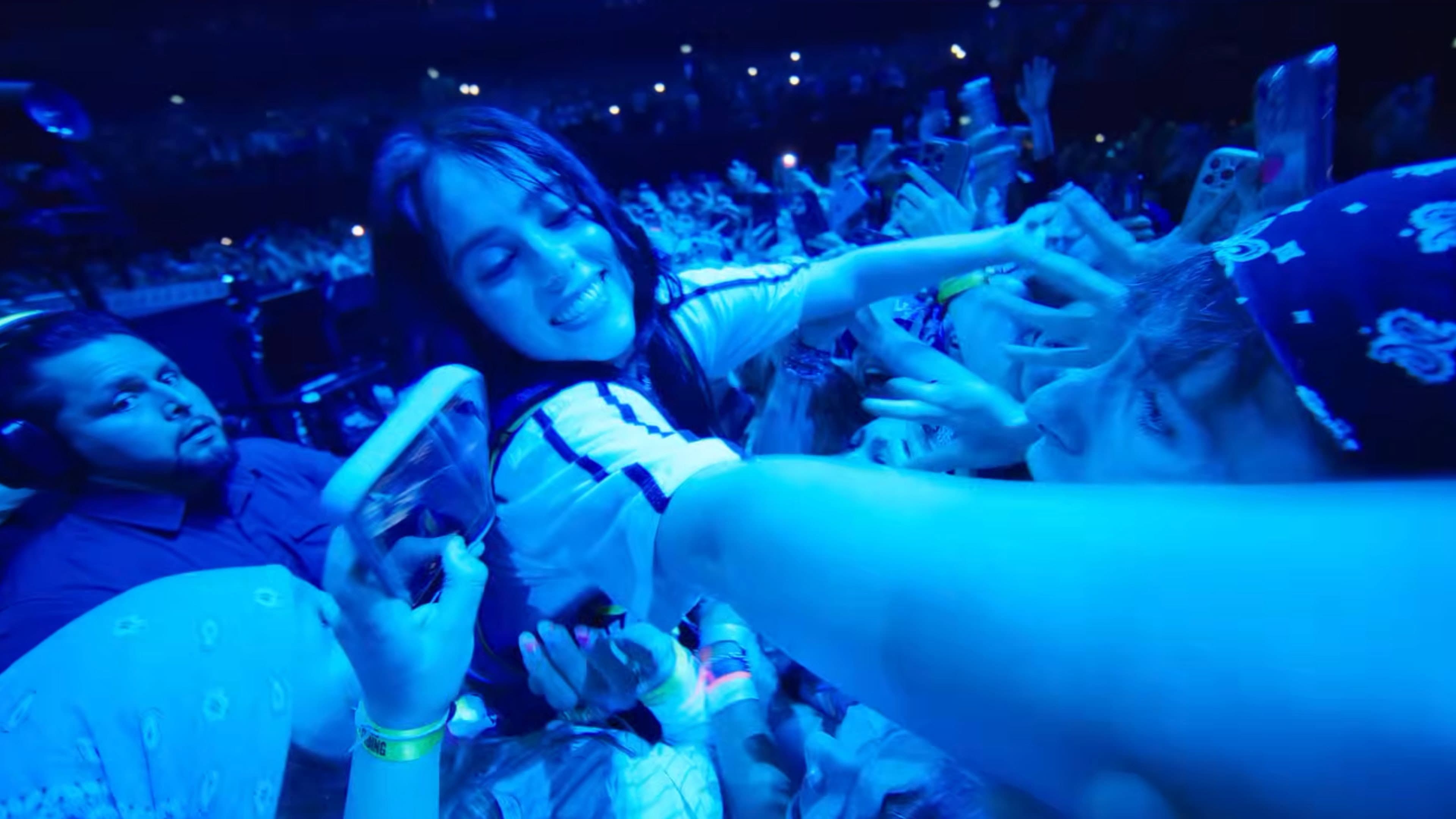
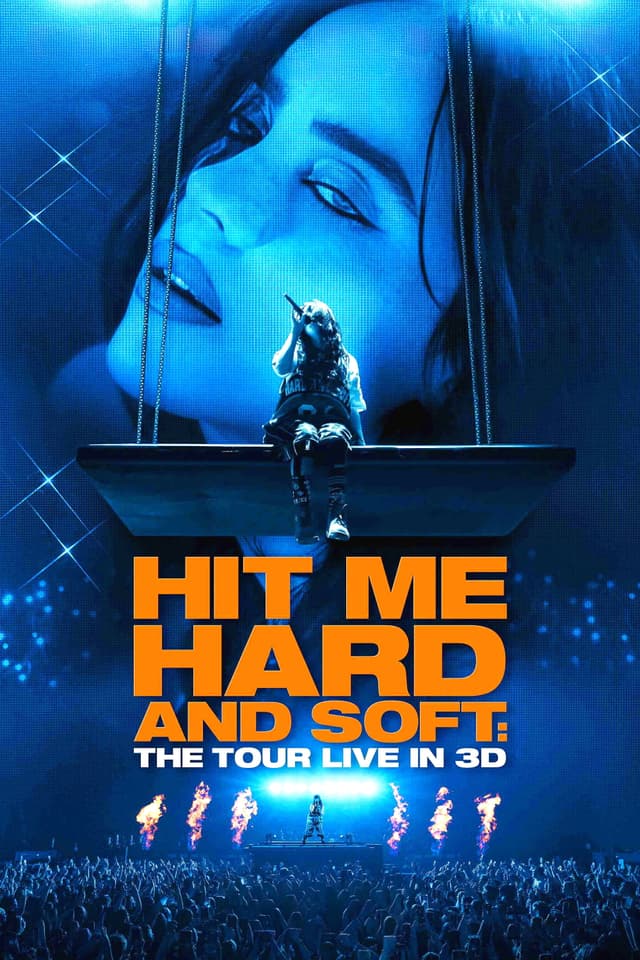
Captured during Billie Eilish's sold-out world tour, a concert experience from one of the most celebrated and successful artists of her generation, presented in immersive 3D.
What Is the Budget of Billie Eilish: Hit Me Hard and Soft: The Tour (Live in 3D)?
The production budget for Billie Eilish: Hit Me Hard and Soft: The Tour (Live in 3D) is $65,000,000, making it one of the most expensive concert films ever produced. To put that figure in context, Taylor Swift's blockbuster The Eras Tour (2023) was filmed and produced for approximately $10 million, and even the lavishly staged Renaissance: A Film by Beyoncé (2023) came in around $20 million. Billie Eilish's film cost more than three times the Beyoncé production.
The dramatic cost increase stems directly from the involvement of James Cameron, who co-directed the film alongside Billie Eilish herself. Cameron's production philosophy, refined across Titanic, Avatar, and Avatar: The Way of Water, centers on immersive 3D capture at a level of technical precision that standard concert film crews simply do not attempt. His company Lightstorm Earth co-produced the project, bringing that entire infrastructure to bear on Eilish's arena tour.
The $65 million budget reflects multi-venue IMAX 3D camera deployments, custom stereoscopic rigging designed to capture dynamic stage performances without motion artifacts, and an extensive post-production pipeline dedicated to finishing the film in premium large-format presentation. No other concert film has been made with this level of technical ambition.
Key Budget Allocation Categories
- IMAX and 3D Camera Rigging — Deploying Lightstorm's proprietary stereoscopic camera systems across multiple sold-out arena venues required custom rigging solutions at each location. The rigs had to capture Eilish's full stage production, including elaborate overhead lighting arrays and pyrotechnics, without impeding sight lines for the live audience.
- James Cameron's Stereoscopic Production Team — Cameron brought his Avatar-era 3D specialists to the project. This team handles real-time depth management, stereo convergence adjustments, and on-the-fly calibration between cameras, all of which require senior technicians earning feature-film rates across the length of the tour.
- Lighting Design Integration — Concert lighting designed for a live arena audience performs differently under stereoscopic 3D capture. Additional lighting passes and coordination with Eilish's production designers were required to ensure the visual design translated faithfully to IMAX screens without strobing artifacts or depth distortion.
- Dolby Atmos Audio Recording and Mixing — The film targets premium Dolby Atmos playback in cinema formats. Recording the live band, which includes FINNEAS, Andrew Marshall, Solomon Smith, Abraham Nouri, and Tom Crouch, in a format suitable for spatial audio post-production required multi-channel isolation recording at every venue alongside the primary live mix.
- Post-Production Stereoscopic Finishing — 3D concert films require extensive post work to correct stereo mismatches, manage depth budgets for different screen sizes, and create separate presentation deliverables for IMAX 3D, standard 3D, and digital flat formats. This pipeline runs for months after principal photography concludes.
- Tour Documentation and Multi-Venue Production Costs — Filming across multiple dates of a world tour involves full crew travel, equipment logistics, local venue coordination, and redundant systems to ensure no single technical failure results in lost footage. Each venue represents a standalone production deployment.
How Does This Film's Budget Compare to Similar Concert Films?
The $65 million production budget places Billie Eilish: Hit Me Hard and Soft: The Tour (Live in 3D) in an entirely different tier from the concert film category it nominally belongs to. A comparison against major recent and historical titles makes the scale clear:
- Taylor Swift: The Eras Tour (2023) — Budget: approximately $10 million; Worldwide gross: $261 million. The benchmark modern concert film, shot with a conventional multi-camera setup and released theatrically and via streaming. It generated roughly 26x its production cost. Eilish's film cost 6.5x as much to produce.
- Renaissance: A Film by Beyoncé (2023) — Budget: approximately $20 million; Worldwide gross: $41 million. A more cinematic production with elaborate visual elements, yet still less than a third of the Eilish film's budget. It broke even on production costs but did not reach blockbuster territory.
- Justin Bieber: Never Say Never (2011) — Budget: approximately $13 million; Worldwide gross: $99 million. Shot in 3D, this was one of the early premium concert films that demonstrated the format could work theatrically. It was profitable on its production budget alone, though the marketing spend was significant.
- This Is It (Michael Jackson, 2009) — Budget: approximately $7 million; Worldwide gross: $261 million. The all-time concert film gross leader, assembled from rehearsal footage with minimal post-production cost. Its extraordinary box office was driven by Michael Jackson's death rather than production spectacle.
What separates the Eilish film from all of these is the cost basis. Even the most optimistic comparable, The Eras Tour, would need to multiply its worldwide gross by more than two to justify the Eilish production budget on theatrical returns alone. The $65 million figure implies either a streaming component that will absorb a significant portion of the returns, or an understanding that the theatrical run is primarily a premium promotional event for the album and artist brand rather than a standalone profit center.
Billie Eilish: Hit Me Hard and Soft Box Office Performance
Billie Eilish: Hit Me Hard and Soft: The Tour (Live in 3D) opened in the United States on May 8, 2026, in IMAX 3D and premium large-format presentations, distributed by Paramount Pictures. The film earned $7,011,311 domestically over its opening weekend across 2,613 theaters. International markets outperformed domestic from the start, reflecting Eilish's stronger fanbase presence outside the US. The film has reached $9,901,485 domestically and $16,525,598 internationally for a worldwide total of $26,427,083 as tracked by Box Office Mojo, with the theatrical run ongoing. The worldwide gross represents a significant shortfall against the film's $65,000,000 production budget and estimated $30,000,000 marketing spend.
Box Office Breakdown
Billie Eilish - Hit Me Hard and Soft: The Tour (Live in 3D) (2026)

The theatrical math is difficult at current box office figures. For every $1 invested across production and marketing, the film has returned approximately $0.28 in gross ticket sales. Studios typically receive 50 to 55 percent of gross after exhibitor splits, meaning the actual studio revenue from the worldwide gross is closer to $13,000,000 against a $95,000,000 total outlay. That gap will need to be substantially closed by streaming and ancillary rights to make the production economically viable.
The economics of the premium 3D concert experience have always been complicated by the streaming alternative. Fans choosing between a $25 to $30 IMAX 3D ticket and a future streaming release will increasingly choose the latter, particularly when the artist's music is already deeply familiar. The value proposition for theatrical concert films in premium formats rests on the argument that the IMAX 3D experience is genuinely irreproducible at home, which is Cameron's core creative thesis. The current $26,427,083 worldwide gross suggests that argument was not convincing enough to Eilish's fanbase at scale at this production cost. The streaming release will determine the film's ultimate financial story.
Billie Eilish: Hit Me Hard and Soft Production History
The film documents Billie Eilish's "Hit Me Hard and Soft" album world tour, which ran through 2024 and 2025 in support of her third studio album of the same name, released in May 2024. The album debuted to widespread critical acclaim and commercial success, and the supporting tour became one of the most sought-after live events of that period, selling out arenas across North America, Europe, and beyond.
The decision to bring James Cameron aboard as co-director was the defining creative and commercial choice that shaped everything about the production. Cameron's work on the Avatar films established stereoscopic 3D cinematography as a genuine art form rather than a gimmick, and his reputation for technical perfectionism meant that his involvement would require a fundamentally different production apparatus than any concert film before it. Lightstorm Earth, the production company Cameron founded as an extension of his Avatar production infrastructure, co-produced the film alongside Interscope Films and Eilish's own label, Darkroom Records.
Billie Eilish and Tarik Mikou share writing credits on the film, suggesting a genuine collaborative authorship between the artist and Cameron's directing partner rather than a purely technical production engagement. Eilish, who has always maintained unusually tight creative control over her visual presentation from music videos through album packaging, appears to have extended that control into the concert film format.
Principal photography took place across multiple arena dates on the tour. Concert films of this technical ambition typically require multiple performances at the same venue to ensure sufficient coverage, particularly for stereoscopic 3D capture where camera positioning relative to performers is critical and cannot always be adjusted between shots the way a conventional film crew can work. The post-production period for a feature-length 3D film of this complexity runs many months, with the May 2026 theatrical release suggesting the primary photography concluded well into 2025.
Paramount Pictures distributed the film theatrically, giving it access to the studio's domestic and international distribution infrastructure. The PG-13 rating and 114-minute runtime position it firmly as a theatrical event film rather than a niche fan document. IMAX 3D and premium large-format presentations were the primary exhibition strategy, consistent with Cameron's stated belief that the film was designed to be experienced at that scale.
Awards and Recognition
Billie Eilish is among the most decorated young artists in Grammy history. She has won seven Grammy Awards, including Album of the Year for When We All Fall Asleep, Where Do We Go? (2020), making her the youngest artist to win the Recording Academy's top honor. She swept all four general field categories that year, a feat achieved previously only by Christopher Cross in 1981.
In film, Eilish has established herself as a rare songwriter capable of winning in the original song category at the Academy Awards. She and her brother FINNEAS received the Academy Award for Best Original Song for "No Time to Die" from the James Bond film of the same name (2022). The pair won again at the 96th Academy Awards (2024) for "What Was I Made For?" from the Barbie film, giving Eilish two Oscar wins before age 23.
For the concert film itself, awards consideration would fall primarily in documentary and music categories. The Grammy Awards include categories for music film and best music video that could apply. The Cinema Audio Society Awards and Motion Picture Sound Editors Golden Reel Awards represent natural targets given the film's emphasis on Dolby Atmos audio production. If the stereoscopic cinematography is as technically distinguished as Cameron's involvement suggests, awards consideration from the American Society of Cinematographers is possible in their documentary or non-theatrical categories. Specific nominations and wins from the May 2026 release will be determined by the 2027 awards cycle.
Critical Reception
Billie Eilish: Hit Me Hard and Soft: The Tour (Live in 3D) received strongly positive reviews upon its May 2026 release. On Rotten Tomatoes, the film holds a 91% Tomatometer score from 78 critics, with an average rating of 7.6 out of 10. The site's consensus reads: "Directed with kinetic flair by James Cameron, Hit Me Hard and Soft doesn't unpack Billie Eilish's artistry so much as let her fans revel in it from multiple dimensions." On Metacritic, the film holds a 73 out of 100 from 23 critics, indicating generally favorable reviews. Audiences responded enthusiastically: CinemaScore gave the film an A, and the Rotten Tomatoes Popcornmeter audience score stands at 97%, one of the highest audience ratings for any 2026 release.
Critical response centered on the tension between James Cameron's technical ambitions and the fundamental nature of a concert film as documentation of a live performance. Cameron's visual approach, honed across decades of underwater filming and computer-generated 3D worldbuilding, represents a genuinely unprecedented application of stereoscopic technique to the concert film genre. Owen Gleiberman of Variety wrote: "Hit Me Hard and Soft is a concert film that doesn't look and feel like other concert films. It's a true experience, because of a combination of the show itself and the way that Cameron has filmed it." The depth of field management across a large arena stage, the handling of Eilish's signature lighting design in three dimensions, and the spatial audio presentation in Dolby Atmos venues all received specific attention as technical achievements.
The more divided critical conversation concerned whether the Cameron production aesthetic serves Eilish's artistic identity. Her work as a live performer has always emphasized intimacy, emotional directness, and a vulnerability that sits in some tension with the spectacle-first grammar of Cameron's filmmaking. Some critics found the combination genuinely revelatory, arguing that the 3D format creates a physical proximity to the performer that standard camera coverage cannot achieve. Others found the technical apparatus overwhelming for material that derives its power from restraint. The 91% Tomatometer reflects a critic cohort that landed largely in the first camp, while the more muted Metacritic score of 73 captures the subset who found the format and the subject an imperfect fit.
Comparisons to Taylor Swift: The Eras Tour were inevitable given the shared pop star documentary format. Where Sam Wrench's direction of the Swift film prioritized fan service and accessibility, Cameron's direction prioritizes cinematic spectacle and technical innovation. Critics largely agreed that these are different films with different goals rather than direct competitors, though the box office comparison between them is inescapable: The Eras Tour opened to $92,800,000 domestically on its opening weekend versus $7,011,311 here, a gap that reflects both the scale of Swift's cultural moment and the narrower appeal of a premium-format commitment at higher ticket prices.
Billie Eilish's own performance received uniformly positive notices regardless of reviewer positions on the production choices. Her live show has been widely recognized as one of the most thoughtfully staged arena productions in contemporary pop music, and that reputation carries through in every review. The 97% Popcornmeter and A CinemaScore confirm that audiences who committed to the theatrical experience came away satisfied, making the box office story primarily one of reach rather than quality: the film delivered on its creative promise for those who saw it, but did not attract a broad enough audience to justify the $65,000,000 production investment at the theatrical window.
Filmmakers
Billie Eilish - Hit Me Hard and Soft: The Tour (Live in 3D) (2026)

Official Trailer
Build budgets like this one in Saturation
Start from an industry-standard feature film template, import the schedule and rates you already have, and let the cost report keep itself current as you spend. Real-time collaboration, no spreadsheets.