Babies Budget
 Documentary79 minutes
Updated
Synopsis
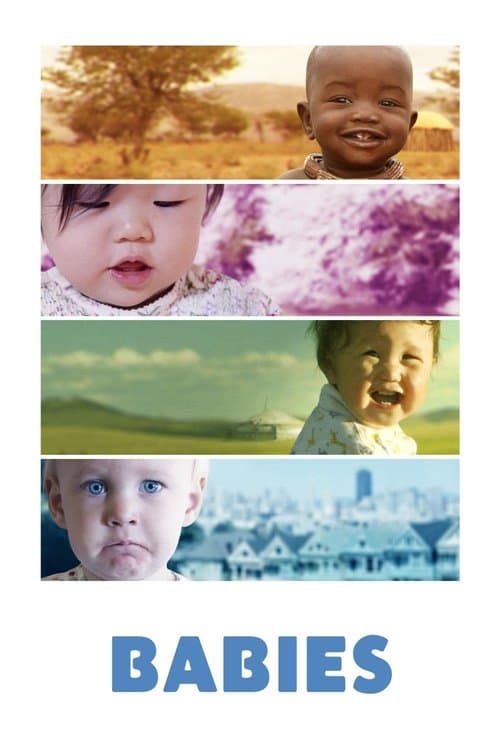
A look at one year in the life of four babies from around the world, from Mongolia to Namibia to San Francisco to Tokyo.
What Is the Budget of Babies?
Babies was produced on a budget of approximately $5 million, financed by StudioCanal in France and distributed in the United States by Focus Features. The film was directed by Thomas Balmes, a French documentary filmmaker, and follows four babies from birth to their first steps: Ponijao in Namibia, Bayarjargal in Mongolia, Mari in Japan, and Hattie in San Francisco, California.
The $5 million budget reflects the production's four-continent scope and its two-year filming timeline, which required crews embedded in four radically different cultural and geographic environments simultaneously. The film has no narration, no dialogue cards, and no expert commentary, relying entirely on the observational footage to carry the audience. This radical simplicity of presentation required extraordinary editorial discipline to assemble from an estimated 400 hours of raw footage.
Key Budget Allocation Categories
- Four-Continent Field Production Over Two Years: Simultaneously maintaining production relationships in Namibia, Mongolia, Japan, and the United States required coordinating multiple local crews, each embedded in their respective communities with the trust and access necessary to film intimate family moments across the first year of each child's life. The Namibian and Mongolian productions in particular required extended field time in remote locations with limited infrastructure, adding logistical costs absent from the urban Japan and San Francisco shoots.
- Director Thomas Balmes and the Observational Method: Balmes, whose prior documentary Sunshine (2009) had established his observational approach, designed a production method that placed cameras as close to the subjects as possible while maintaining the non-interventionist presence that the film's radical simplicity required. Balmes and his crews spent months in each location before filming began, building trust with each family to the level where the camera's presence would cease to affect behavior.
- Editorial: 400 Hours to 79 Minutes: The editorial challenge of Babies, constructing a coherent 79-minute film from 400 hours of footage shot across four countries in four languages without any narration or contextual text, was among the most demanding aspects of the production. Editor Craig McKay, a three-time Academy Award nominee for his work with Jonathan Demme on The Silence of the Lambs, worked with Balmes to structure the parallel stories without imposing a narrative hierarchy on the four subjects.
- Bruno Coulais Score: French composer Bruno Coulais, whose credits include Coraline and the documentary Microcosmos, composed the original score. The score carried particular weight in Babies because it functioned as the film's primary emotional guide in the absence of narration, marking developmental milestones and tonal shifts across the four subjects' parallel stories.
- StudioCanal Production Infrastructure and Focus Features Distribution: StudioCanal, one of Europe's leading film companies, provided the production infrastructure and financed the film through its French documentary slate. Focus Features acquired US distribution rights and provided the P&A investment for the theatrical release, which opened the film in art house markets before expanding to a wider audience. The distributor's involvement significantly increased the film's US marketing profile.
How Does Babies' Budget Compare to Similar Films?
Babies sits at the low-to-mid range of internationally co-produced documentaries with wide US theatrical distribution. Its commercial performance, generating $12.8 million worldwide against a $5 million production cost, was strong for a French documentary without narration, celebrity involvement, or advocacy subject matter.
- March of the Penguins (2005): Budget ~$8M | Worldwide $127.4M. The French nature documentary that remains the gold standard for foreign-language documentaries finding mass American audiences. Babies spent less and found a much smaller audience, though its urban art house demographic was more targeted than March of the Penguins' family theatrical approach.
- Microcosmos (1996): Budget ~$12M | Worldwide $10M. Claude Nuridsany and Marie Perennou's French nature documentary, which also used no narration and relied entirely on imagery, spent more than twice what Babies cost and found a smaller worldwide theatrical audience. Babies' more universally relatable subject matter (human infants versus insects) contributed to its stronger commercial performance.
- I Am (2011): Budget ~$1M | Domestic $2.7M. Tom Shadyac's philosophical documentary found a modestly smaller domestic audience than Babies despite spending one-fifth as much. The comparison illustrates how Babies' professional production values and international production scale contributed to its ability to attract Focus Features distribution and wider theatrical placement.
- Human (2015): Budget ~$10M | Theatrical limited. Yann Arthus-Bertrand's Bettencourt Schueller Foundation-funded documentary portrait of humanity across 60 countries spent more than twice Babies' budget but bypassed theatrical for a free online release. Babies' more focused scope and theatrical ambition made it the more commercially effective documentary investment.
Babies Box Office Performance
Babies opened May 7, 2010, in the United States through Focus Features, initially in limited release in major art house markets before expanding nationally. The domestic release reached its widest footprint of over 500 theaters, exceptional for a French-language documentary with no narration or celebrity involvement. The domestic total reached $7.5 million, significantly above expectations for the format. International markets, where StudioCanal's distribution network gave the film broad European theatrical access, added $5.3 million for a worldwide total of $12.8 million.
Against a production budget of approximately $5 million and an estimated $3 million in prints and advertising across the US and European theatrical releases, the total investment was approximately $8 million. With theaters retaining roughly 50 percent of gross, the distributors' combined share of the worldwide theatrical gross was approximately $6.4 million, approaching but not fully recovering the total investment in theatrical alone. Home video and DVD sales, particularly the US release by Focus Features, brought the film to profitability across all windows.
Box Office Breakdown
Babies

For every dollar invested in production, Babies returned approximately $2.56 at the worldwide box office. Accounting for P&A, the film returned approximately $0.80 for every dollar of total investment in theatrical, a modest shortfall that home video and broadcast licensing covered. The film's domestic performance was particularly strong for a French documentary: the $7.5 million domestic gross placed it in the top tier of foreign-language documentary theatrical releases in the United States for its release year.
Babies Production History
Thomas Balmes developed Babies after years of making observational documentaries in diverse international settings. The concept was deliberately simple: film four babies across their first year of life in four radically different environments, with no narration, no commentary, and no attempt to explain the cultural context to the audience. The four locations, Namibia's Himba community, Mongolia's nomadic steppe culture, urban Tokyo, and San Francisco, were chosen to represent the widest possible range of contemporary human child-rearing environments.
Balmes and his crews began building relationships with the families in each location months before filming started. In the Namibian village of Opuwo, the family of Ponijao lived in a traditional Himba community where children are raised communally and spend most of their time outdoors in close contact with animals and other children. In Mongolia, Bayarjargal's family lived in a ger on the steppe outside Bayanchandmani, where his companions were primarily farm animals and an older sibling. Mari's family in Tokyo and Hattie's family in San Francisco represented the urban end of the spectrum, where structured play, educational toys, and pediatric appointments are the context for early development.
The 400 hours of footage accumulated over the two-year shooting period were edited by Craig McKay into the 79-minute theatrical cut, which intercuts the four stories thematically rather than chronologically. Developmental milestones, first steps, first solid food, first baths, first social interactions with other children, are shown in parallel across the four subjects, allowing the audience to draw comparisons without any narrator imposing interpretation. The structure respects the audience's intelligence and makes the film's implicit argument about human universality through juxtaposition rather than assertion.
The film was released in France in April 2010 and in the United States on May 7, 2010, through Focus Features. The US marketing campaign emphasized the film's emotional accessibility and visual warmth, positioning it as appropriate for parents, grandparents, and anyone interested in human development across cultures. The film found its audience through strong word-of-mouth from women's media and parenting communities, demographics that art house distributors can rarely reach as effectively.
Awards and Recognition
Babies was not nominated for the Academy Award for Best Documentary Feature, a common outcome for French documentaries in US release that lack the advocacy or political subject matter the Academy's documentary branch typically favors. The film was recognized at the Cesar Awards in France, the French equivalent of the Academy Awards, where it received recognition for documentary filmmaking.
The film received the Audience Award at the Tribeca Film Festival in 2010, where it played before its US theatrical opening. The Tribeca recognition reflected the film's unusual ability to connect emotionally with a broad audience regardless of documentary film experience. Babies was also recognized at several international documentary festivals for its observational methodology and its editorial achievement in constructing a coherent narrative from footage shot across four countries without narration or text.
Critical Reception
Babies holds a 77% approval rating on Rotten Tomatoes, with critics divided between those who found the film's simplicity and warmth charming and those who found its deliberate absence of context and commentary a missed opportunity. Metacritic scored it 59 out of 100, indicating mixed reviews. The film's IMDb rating of 7.5 out of 10 reflects a general audience that received it warmly, particularly among parents and families.
Critics who appreciated Babies highlighted the remarkable intimacy of the footage, particularly the Namibian and Mongolian sequences, which captured child-rearing practices that most Western audiences had never seen. The film's refusal to editorialize, to explain, to contextualize, or to judge was cited by these critics as its defining achievement: a documentary that trusts the audience to draw its own conclusions about what they are seeing. The New York Times called it "gently and unassumingly wonderful."
Critics who were more reserved argued that the film's radical neutrality prevented it from engaging meaningfully with the significant differences in mortality rates, healthcare access, and economic opportunity that characterize the four environments it documents. The San Francisco and Tokyo sequences drew the sharpest criticism for depicting a sanitized version of affluent urban parenting that felt thin compared to the more visually arresting footage from Namibia and Mongolia. Despite this division, Babies succeeded commercially and critically at a level rare for French-language documentaries in American theatrical release.
Frequently Asked Questions
How much did Babies (2010) cost to make?
The production budget was approximately $1,500,000, modest for a film shot across four continents over nearly two years. Studio Canal financed the documentary with Focus Features acquiring U.S. distribution.
How much did Babies earn at the box office?
The film grossed $7,318,584 domestically and $2,300,000 internationally, for a worldwide total of approximately $9,600,000. It opened to $1,584,387 on May 7, 2010, in a limited release of just 534 theaters, marking the largest documentary opening of 2010.
What is Babies (2010) about?
The documentary follows four newborns through their first year of life in four different cultures: Ponijao in Opuwo, Namibia; Bayar in Mongolia; Mari in Tokyo, Japan; and Hattie in San Francisco, United States. The film is essentially wordless and uses no narration.
Who directed Babies?
Thomas Balmès directed the documentary. Balmès had previously directed Bhutan: How Happy Can You Be? (2003), A Decent Factory (2004), and Damages (2007). The concept for Babies came from producer Alain Chabat.
How was Babies filmed?
Each baby was filmed continuously across approximately 400 days, generating roughly 400 hours of footage, which Balmès and editor Craig McKay distilled into a 79-minute feature. The crew used minimal lighting and ambient sound to remain unobtrusive across each setting.
Where was Babies filmed?
Filming took place in Namibia (Himba region), Mongolia (rural steppe outside Ulaanbaatar), Japan (Tokyo), and the United States (San Francisco). The production secured each family's long-term participation through extensive pre-production diplomacy.
What did critics think of Babies?
Reviews were largely positive, with a 71% approval rating on Rotten Tomatoes and a 65 out of 100 score on Metacritic. Critics praised the film as a refreshingly unmediated portrait of early childhood, while some objected to the lack of contextual narration.
Was Babies a profitable documentary?
Yes. Against the approximately $1,500,000 production budget and an estimated $4,000,000 to $5,000,000 in marketing spend, the worldwide gross of $9,600,000 produced a positive theatrical return, even before home video and television sales.
How does Babies compare to other Focus Features documentaries?
Babies outperformed other Focus documentary acquisitions including Trembling Before G-d (2001, $700,000 worldwide) but fell short of Religulous (2008, $13,000,000 worldwide). The film was overshadowed by the same year's Waiting for Superman ($6,400,000 worldwide).
Where can I watch Babies (2010)?
The film is available for digital rental and purchase on Amazon Prime Video, Apple TV, and Google Play. It has periodically rotated through Hulu, HBO Max, and the Criterion Channel since its 2010 home video debut.
Official Trailer
Build budgets like this one in Saturation
Start from an industry-standard feature film template, import the schedule and rates you already have, and let the cost report keep itself current as you spend. Real-time collaboration, no spreadsheets.