Alien: Resurrection Budget
 Action
Updated
Synopsis
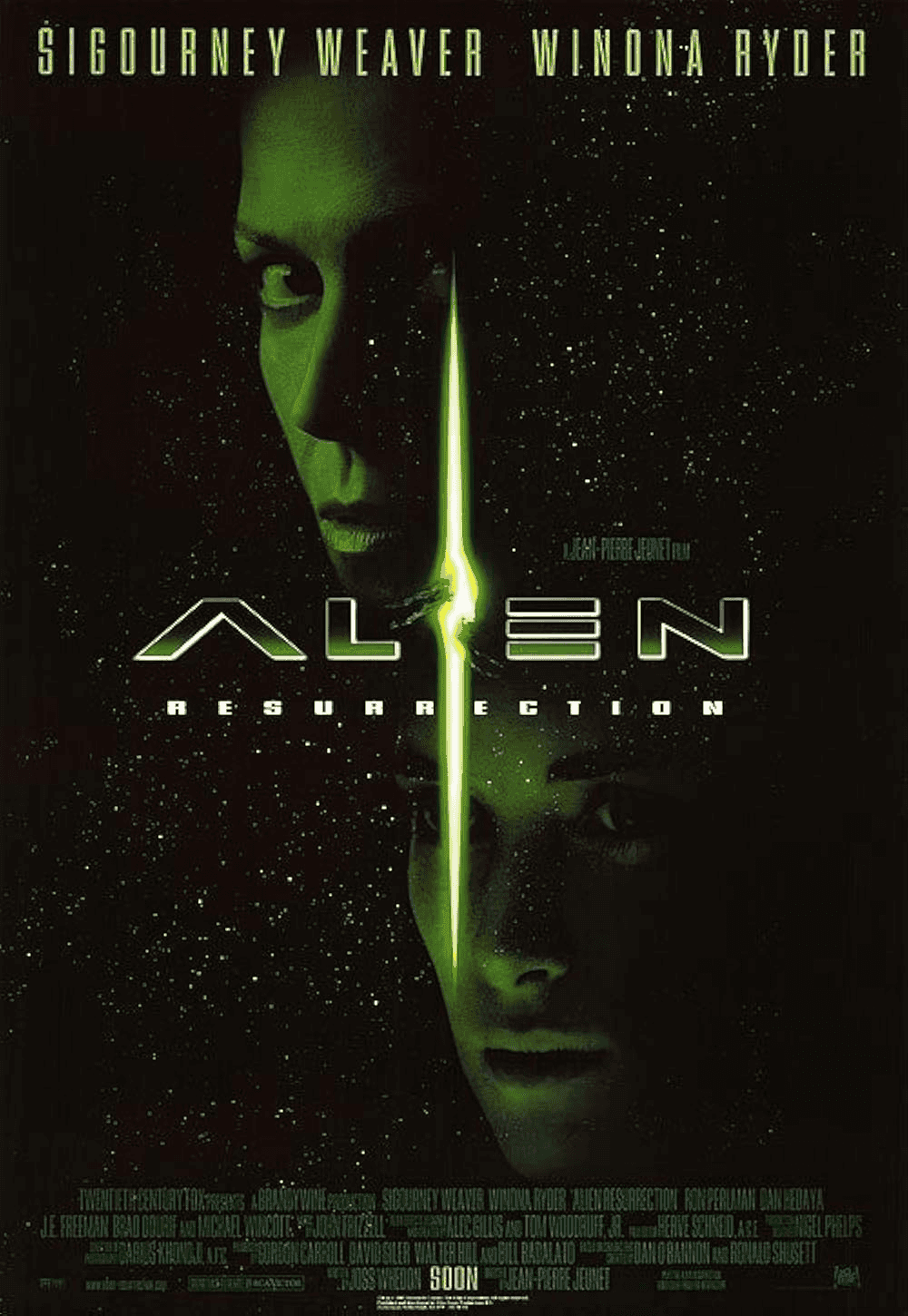
Two hundred years after the events of Alien 3, a team of scientists aboard the United Systems Military ship Auriga clone Ellen Ripley from blood samples in order to extract the Alien Queen embryo growing inside her. The cloning leaves Ripley with traces of Alien DNA, and when the captive xenomorphs escape, she joins a group of mercenaries fighting to survive and stop the creatures from reaching Earth.
What Is the Budget of Alien: Resurrection (1997)?
Alien: Resurrection, the fourth installment in the Alien franchise, was produced on a reported budget of $75,000,000. Twentieth Century Fox financed the film through Brandywine Productions, the same Walter Hill and David Giler outfit that had shepherded all three previous Alien films. The studio greenlit the project on the strength of Sigourney Weaver's return to the role of Ellen Ripley, paying her a then-franchise-record salary, and on the commercial hope that a clone-based premise could reset a series Fox had ended dramatically with Ripley's death at the close of Alien 3 in 1992.
The $75,000,000 figure represented a step up from the $50,000,000 spent on Alien 3 but remained well below the inflation-adjusted budgets of subsequent franchise entries. Fox brought in French director Jean-Pierre Jeunet, whose visually distinctive work on Delicatessen and The City of Lost Children gave the studio a way to differentiate the fourth film from the Ridley Scott, James Cameron, and David Fincher entries that preceded it. The investment covered a single sound-stage production at Fox's Century City studios in Los Angeles, extensive animatronic and computer-generated creature work, and a salary structure topped by Weaver's reported $11,000,000 payday.
Key Budget Allocation Categories
The $75,000,000 budget was distributed across several core production areas:
- Above-the-Line Talent: Sigourney Weaver received a reported $11,000,000 plus a percentage of the gross to reprise Ellen Ripley, the highest fee paid to a woman in Hollywood at the time. Director Jean-Pierre Jeunet commanded his first major studio paycheck, and screenwriter Joss Whedon, then on the rise after Toy Story, was paid a premium for the screenplay. Supporting cast Winona Ryder, Ron Perlman, Dominique Pinon, and Brad Dourif filled out the ensemble at established featured-player rates.
- Creature and Animatronic Effects: Practical effects house Amalgamated Dynamics, led by Tom Woodruff Jr. and Alec Gillis, designed and built the adult xenomorphs, the Newborn hybrid creature, and dozens of articulated alien puppets. The animatronic work alone consumed a significant portion of the practical effects budget, with multiple full-body suits, hydraulic Queen rigs, and the climactic Newborn puppet representing the most expensive single creature build in the franchise to that point.
- Visual Effects: Blue Sky/VIFX handled the digital alien swims, the underwater chase sequence in the flooded kitchen, and the spacecraft and Earth-approach shots. The underwater xenomorph sequence in particular required extensive CGI integration over plate photography shot in the Fox studio tank, a level of effects work unprecedented for the franchise.
- Production Design: Production designer Nigel Phelps and the art department built the entire Auriga ship interior on Fox sound stages, including the cloning lab, the mercenary ship Betty, the alien containment cells, and the flooded mess hall set used for the underwater sequence. The Auriga sets emphasized rust, organic curves, and tight industrial corridors that contrasted with the franchise's earlier Nostromo and Sulaco aesthetics.
- Cinematography and Lighting: Cinematographer Darius Khondji, fresh off Se7en and The City of Lost Children, brought a desaturated amber and copper palette to the film, requiring custom lighting rigs, extensive gel work, and bleach-bypass processing at Technicolor that added laboratory costs to post-production.
- Score and Sound Design: Composer John Frizzell, in his first major franchise score, recorded with a full orchestra in Los Angeles. The sound design team built layered xenomorph vocalizations, weapon effects, and the distinctive Newborn cries that anchored the climax.
- Reshoots and Post-Production: Test screenings prompted re-edits of the climax, and the underwater sequence required additional plate photography. Post-production stretched across most of 1997 to meet the November theatrical date.
How Does Alien: Resurrection's Budget Compare to Similar Films?
At $75,000,000, Alien: Resurrection sat in the upper-middle range of late-1990s studio science-fiction sequels. The comparison set illustrates how its commercial outcome stacked up against budgetary peers:
- Alien (1979): Budget $11,000,000 | Worldwide $104,931,801. Ridley Scott's original franchise entry cost less than one seventh of Resurrection in nominal dollars and remains the most profitable Alien film on a return-on-investment basis.
- Aliens (1986): Budget $18,500,000 | Worldwide $183,316,455. James Cameron's action-oriented sequel earned more worldwide than Resurrection on roughly a quarter of the budget, illustrating the franchise's diminishing returns as costs climbed.
- Alien 3 (1992): Budget $50,000,000 | Worldwide $159,814,498. David Fincher's troubled third installment earned virtually the same worldwide total as Resurrection on two thirds of the budget, a result that nonetheless prompted Fox to triple down on the franchise.
- Starship Troopers (1997): Budget $105,000,000 | Worldwide $121,214,377. Paul Verhoeven's contemporaneous Sony bug-hunt film cost 40% more than Resurrection and earned less worldwide, a parallel cautionary tale about late-1990s sci-fi spectacle.
- Event Horizon (1997): Budget $60,000,000 | Worldwide $42,000,000. Paul W.S. Anderson's haunted-spaceship film cost 20% less and earned a fraction of Resurrection's gross, making the Jeunet film look comparatively successful within the 1997 sci-fi class.
Alien: Resurrection Box Office Performance
Alien: Resurrection opened on November 26, 1997, with $16,425,581 across its three-day weekend (and $23,800,000 over the five-day Thanksgiving frame), finishing second at the domestic box office behind Flubber. The opening trailed the November 1992 debut of Alien 3 ($19,500,000) and signaled softer domestic interest in the franchise compared with the international market.
Against a $75,000,000 production budget, the film needed approximately $170,000,000 in worldwide gross to reach profitability after marketing and distribution costs. Here is the financial breakdown:
Box Office Breakdown
Alien: Resurrection

Alien: Resurrection returned approximately $1.32 in worldwide theatrical revenue for every $1 invested when measured against total estimated production and marketing spend. The domestic share of the gross was $47,795,658 against an international share of $113,580,410, a 30/70 split that mirrored the franchise's historical reliance on overseas markets and that confirmed Ripley's diminished pull with North American audiences.
The result was viewed inside Fox as a disappointment relative to the studio's sequel expectations. Home video and television revenue eventually pushed the film into clear profit, but the soft theatrical performance ended the original Alien continuity for nearly a decade. Fox subsequently pivoted to the Alien vs. Predator crossover concept for the 2004 and 2007 entries before Ridley Scott returned to the prequel timeline with Prometheus in 2012.
Alien: Resurrection Production History
Development on a fourth Alien film began at Fox in 1995, two years after the studio had appeared to definitively close the franchise with Ripley's death in Alien 3. Producers Walter Hill and David Giler commissioned Joss Whedon, then a sought-after script doctor coming off Speed and Toy Story, to break a story that could plausibly resurrect Ripley. Whedon delivered a screenplay in which Ripley is cloned two centuries after her death from blood samples preserved on Fiorina 161, allowing the franchise to resume with Sigourney Weaver while bypassing the third film's ending.
Director Jean-Pierre Jeunet was attached in 1996 on the strength of his European art-house filmography and his interest in the Alien series, which he had cited as an influence on The City of Lost Children. Jeunet brought regular collaborator Dominique Pinon and cinematographer Darius Khondji with him from his French productions, importing a distinctive European visual sensibility into a Hollywood studio tentpole. Casting Winona Ryder as Annalee Call, an android with hidden allegiances, gave the film a second top-billed star and broadened its appeal to younger audiences.
Principal photography ran from October 1996 through February 1997, entirely on sound stages at the Twentieth Century Fox studio lot in California. The production avoided location work in favor of a fully contained studio build, with the Auriga sets, the Betty mercenary ship, the cloning lab, and the flooded mess hall constructed across multiple stages. The underwater sequence was shot in a custom tank with the cast performing extended free-dive takes, a logistically demanding setup that consumed several weeks of the schedule.
Test screenings in mid-1997 prompted re-edits of the climax. Jeunet's preferred original ending, in which Ripley and Call arrive at a devastated Earth, was trimmed and altered for the theatrical cut, which delivers them to Earth with the planet largely intact. A Special Edition Blu-ray released in 2003 partially restored the original ending. The film opened wide on November 26, 1997, in 2,415 theaters as Fox's Thanksgiving tentpole.
Awards and Recognition
Alien: Resurrection received modest industry recognition. Composer John Frizzell's score was nominated for an ASCAP Film and Television Music Award, and the practical and visual effects work earned a Saturn Award nomination for Best Make-Up from the Academy of Science Fiction, Fantasy and Horror Films. Sigourney Weaver received a Saturn Award nomination for Best Actress, her fourth nomination for the Ripley role.
At the Academy Awards, the film received no nominations, a contrast with Alien (Best Visual Effects winner), Aliens (Best Sound Effects Editing and Best Visual Effects winner), and Alien 3 (Best Visual Effects nominee). The Saturn Awards ultimately recognized the film primarily for its makeup and creature design, with Jeunet's directorial work and the Joss Whedon screenplay receiving polite acknowledgment rather than awards traction.
Critical Reception
Alien: Resurrection received mixed reviews. The film holds a 56% approval rating on Rotten Tomatoes based on 75 critic reviews, with a critical consensus that praised Jeunet's visual flair while criticizing a tonally inconsistent screenplay. On Metacritic, the film scored 63 out of 100, indicating generally favorable reviews. Audiences surveyed by CinemaScore gave the film a B, indicating a softer reception than the A and A- scores earned by Aliens and Alien.
Critics praised Sigourney Weaver's committed performance as the Ripley clone, Darius Khondji's amber-saturated cinematography, and the practical creature effects from Amalgamated Dynamics, particularly the underwater xenomorph sequence and the Newborn finale. Roger Ebert gave the film three out of four stars and called Weaver "a striking presence," while Janet Maslin of The New York Times wrote that Jeunet had given the franchise "a vivid new visual style."
Detractors objected to the Newborn creature design, the comedic tone of Joss Whedon's screenplay, and a climax that critics felt undermined the franchise's horror foundations. Whedon himself publicly criticized the finished film over the following years, attributing the disappointment to direction and tone rather than the screenplay. Alien: Resurrection has since been reappraised by cult audiences who value Jeunet's baroque sensibility, but its critical reputation remains the most divisive of the original four Alien films.
Frequently Asked Questions
How much did it cost to make Alien: Resurrection (1997)?
The reported production budget was $75,000,000. Twentieth Century Fox financed the film through Brandywine Productions, with star Sigourney Weaver receiving a reported $11,000,000 salary plus a percentage of the gross, the highest fee paid to a woman in Hollywood at the time.
How much did Alien: Resurrection earn at the box office?
The film grossed $47,795,658 domestically and $113,580,410 internationally, for a worldwide total of $161,376,068. It opened to $16,425,581 over its three-day November 26, 1997 weekend, finishing second behind Flubber.
Was Alien: Resurrection profitable?
The film delivered a modest theatrical profit against its estimated $115,000,000 to $125,000,000 total investment (production plus marketing). It returned approximately $1.32 in worldwide gross for every $1 invested, with home video and television revenue eventually pushing the title into clearer profit.
Who directed Alien: Resurrection?
French filmmaker Jean-Pierre Jeunet directed the film, his first English-language feature. Jeunet was hired on the strength of his work on Delicatessen and The City of Lost Children, and he brought regular collaborators including cinematographer Darius Khondji and actor Dominique Pinon to the production.
Who wrote Alien: Resurrection?
Joss Whedon wrote the screenplay, working from the franchise characters originally created by Dan O'Bannon and Ronald Shusett. Whedon later publicly criticized the finished film, attributing the disappointment to direction and tone rather than the script.
Where was Alien: Resurrection filmed?
Principal photography took place entirely on sound stages at the Twentieth Century Fox studio lot in Century City, California, between October 1996 and February 1997. The Auriga ship interiors, the mercenary ship Betty, and the flooded mess hall set were all constructed across multiple stages, with no location shooting.
How much did Sigourney Weaver earn for Alien: Resurrection?
Sigourney Weaver was paid a reported $11,000,000 plus a percentage of the gross, the highest fee paid to a woman in Hollywood at the time. The salary reflected her status as the franchise's sole continuity anchor and Fox's recognition that her return was the principal commercial draw.
How does Alien: Resurrection compare to other Alien films?
Alien: Resurrection cost more than Alien ($11M), Aliens ($18.5M), and Alien 3 ($50M) but earned less worldwide than Aliens ($183M) while finishing nearly even with Alien 3 ($160M). It was viewed inside Fox as a disappointment relative to sequel expectations and ended the original continuity for nearly a decade.
What did critics think of Alien: Resurrection?
The film received mixed reviews, with a 56% approval rating on Rotten Tomatoes (based on 75 critics) and a 63 out of 100 score on Metacritic. Audiences gave it a B CinemaScore. Critics praised Sigourney Weaver's performance and Darius Khondji's cinematography but objected to the Newborn creature design and the tonally inconsistent screenplay.
Did Alien: Resurrection win any awards?
The film received no Academy Award nominations, a contrast with all three previous Alien films. Sigourney Weaver was nominated for a Saturn Award for Best Actress, and the practical creature effects earned a Saturn nomination for Best Make-Up. John Frizzell's score was nominated for an ASCAP Film and Television Music Award.
Filmmakers
Alien: Resurrection

Build budgets like this one in Saturation
Start from an industry-standard feature film template, import the schedule and rates you already have, and let the cost report keep itself current as you spend. Real-time collaboration, no spreadsheets.