After Death Budget
 Documentary1h 48m
Updated
Synopsis
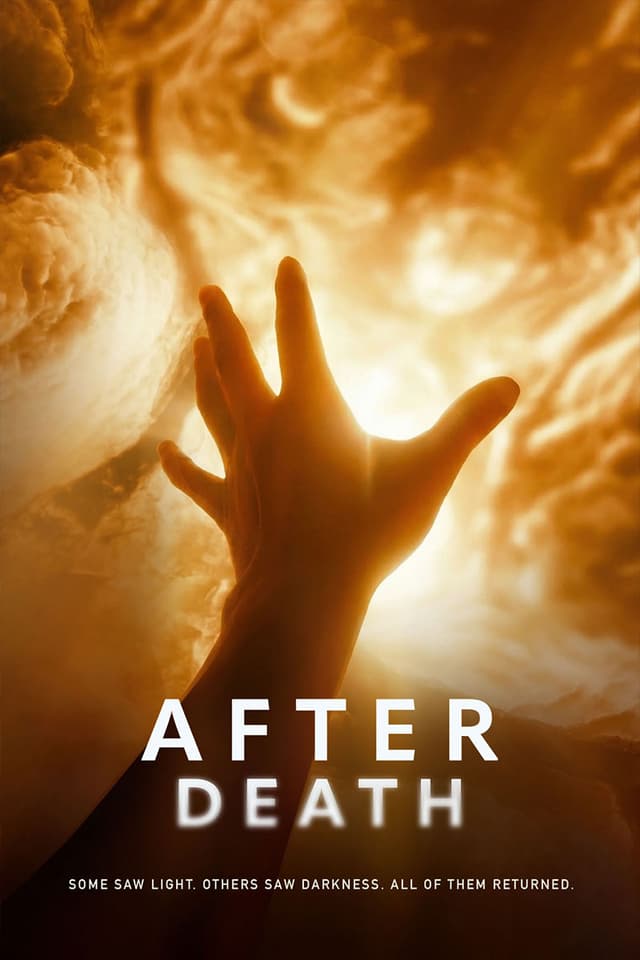
Based on real near-death experiences, the afterlife is explored with the guidance of New York Times bestselling authors, medical experts, scientists and survivors who shed a light on what awaits us.
What Is the Budget of After Death (2023)?
After Death (2023) was independently produced by Sypher Studios, directed and written by Stephen Gray, with producers Jason Pamer and Jens Jacob. The film was completed independently and released theatrically by Angel Studios. The production budget was not publicly disclosed, though the production scope, an interview-based documentary with cinematic reenactments filmed in Mexico, a full original score recorded with a live orchestra, and multi-city interview travel, is consistent with an estimated budget of approximately $2 million.
The film earned $11.8 million worldwide, including $11.4 million domestically and $352,534 internationally. It opened on October 27, 2023, across 2,745 screens across North America in North America, generating $5.05 million in its opening weekend and finishing fourth at the domestic box office. The release placed After Death among the widest documentary openings in North American theatrical history.
Key Budget Allocation Categories
- COVID-Era Interview Production: Principal interview photography began October 2, 2020, at the height of the pandemic. With virtually every production paused globally, the team pressed forward, flying to interview subjects across North America while following full COVID safety protocols at each location. The nine-day first round of interviews took the crew to Los Angeles, Atlanta, Cincinnati, Houston, and Winnipeg. Travel during a period when most flights were empty and filming required additional health measures for each subject drove interview costs meaningfully higher than a comparable pre-pandemic production would have faced.
- Dramatic Reenactments at Baja Film Studios: The reenactments of near-death experiences were filmed at Baja Film Studios in Rosarito, Mexico, the same facility built by 20th Century Fox for Titanic (1997). The studio has since hosted Pearl Harbor, Master and Commander, and Tomorrow Never Dies. Two production units ran simultaneously across eleven days at Baja, recreating hospital scenes, surgical sequences, and the car crash that nearly killed Don Piper. The production worked with a local team that regularly supports Fear of the Walking Dead, sourcing period-accurate medical equipment and designing sets that spanned the 1970s, 1980s, and contemporary eras within a single facility.
- Cinematography: Austin Straub served as cinematographer. The production aimed for a cinematic visual standard well above broadcast documentary norms, appropriate for a wide theatrical release. The reenactment sequences used practical effects, rain rigs on the soundstage, and projection-based driving plates to achieve a visual coherence that matched the documentary interview footage.
- Original Score by Hannah Parrott: Composer Hannah Parrott wrote and recorded a full original score for the 108-minute film. Parrott chose an all-strings orchestra as the sonic foundation, which she recorded with a live symphony orchestra of Grammy Award-winning players and conductor in Seattle. The score earned Parrott a nomination for the David Raksin Award for Emerging Talent at the 5th Annual Society of Composers and Lyricists Awards. A bespoke live orchestral score of this ambition represents a meaningful line item in an independent production at this budget level.
- Distribution: Angel Studios distributed the film theatrically. After Death opened wide on October 27, 2023, and audiences turned out in significant numbers, driven by strong word of mouth and community mobilization ahead of opening weekend.
How Does After Death Compare to Other Documentaries?
After Death ranks #33 on Box Office Mojo's all-time domestic documentary chart with $11.47 million, one position below Super Size Me's $11.54 million. What distinguishes it from virtually every documentary at this gross level is the scale of its theatrical distribution, 2,745 screens across North America, placing it among the widest documentary releases in North American cinema history.
- Super Size Me (2004): Total domestic $11,536,423 | 230 theaters peak | IDP Distribution. Ranked one position above After Death on Box Office Mojo's all-time domestic documentary chart. Morgan Spurlock's film achieved a nearly identical lifetime gross across just 230 theaters, a per-theater average roughly eleven times higher than After Death's. The comparison illustrates two entirely different distribution models arriving at the same total box office: concentrated art-house demand versus unprecedented wide release.
- Amy (2015): Total domestic $8,413,144 | 435 theaters peak | A24. Asif Kapadia's Academy Award-winning Amy Winehouse documentary is a benchmark for independently produced documentary features at this budget level, reaching $8.4 million across 435 theaters through a conventional limited-to-wide expansion. After Death outgrossed Amy by roughly $3 million with a release structure that bypassed the traditional art-house rollout entirely.
- Fahrenheit 9/11 (2004): Total domestic $119.1M | 2,011 theaters (peak, week 3) | Lions Gate/IFC. Michael Moore's record-holding documentary expanded aggressively to a then-record 2,011 theaters in its third week. After Death opened in 2,745 screens on day one, exceeding the widest point Fahrenheit 9/11 ever reached, a marker of how rare After Death's distribution footprint was for a non-concert documentary.
After Death Box Office Performance
After Death earned $11.8 million worldwide, with $11.4 million domestically and $352,534 internationally. The film opened on October 27, 2023, across 2,745 screens across North America in North America, generating $5.05 million in its opening weekend and finishing fourth at the domestic box office behind Five Nights at Freddy's, Taylor Swift: The Eras Tour, and Killers of the Flower Moon.
The 2,745-screen release was described at the time as an extreme rarity for the documentary format. Multiple sources identified the opening as one of the widest documentary theatrical launches in North American cinema history, and Angel Studios characterized it as a historic documentary opening weekend. The film ranks #33 on Box Office Mojo's all-time domestic documentary chart, one position below Super Size Me's $11,536,423.
With an estimated production budget of $2 million and an estimated P&A spend of $3 million, total investment was approximately $5 million. With theaters retaining approximately 50% of gross, Angel Studios' share was approximately $5.9 million. The film's domestic theatrical run covered the total estimated investment through theatrical alone, with home video and streaming revenues from its dedicated audience providing additional return.
Box Office Breakdown
After Death

For every $1 invested in production, After Death earned approximately $5.90 in worldwide theatrical gross. The opening weekend concentration is characteristic of event-style documentary releases that draw a committed audience in the first frame; the 2,745-screen count ensured that audience could find the film in virtually every major market on opening weekend.
After Death Production History
After Death is Stephen Gray's feature directorial debut. Gray came to the project through personal experience of loss; after the deaths of close family members he began researching near-death experiences, and reached out to John Burke, a New York Times bestselling author whose book Imagine Heaven had catalogued hundreds of NDE accounts. Burke introduced Gray to Captain Dale Black, a commercial airline pilot whose near-death experience following a 1969 plane crash at Burbank's Portal of Folded Wings had become one of the most documented accounts in the field. Gray directed and produced Dale's story in Discovering Heaven, a short documentary that went on to win several film festivals and earn a Webby Award nomination. That short connected Gray with Jason Pamer and Jens Jacob at Sypher Studios. Executive producers Jon Doell, Henry Friesen, and Tyler Friesen, alongside Mavis Doell, Gloria Friesen, and Tracy Friesen, joined the project as it grew into a feature, and the team began developing what would become After Death.
The documentary's interview subjects were drawn from across the near-death experience research field. Cardiologist Dr. Michael Sabom, whose book Recollections of Death (1982) was among the first peer-reviewed scientific studies of NDEs, provided the medical perspective alongside psychiatrist Dr. Raymond Moody, whose Life After Life (1975) is the foundational text in NDE research. Author Don Piper, whose 90 Minutes in Heaven described his experience after a 1989 bridge accident in rural Texas, and author Dale Black, whose Flight to Heaven traced his 1969 experience, brought first-person survivor accounts that anchored the film's narrative arc. The team also featured Howard Storm, a former university art professor whose distressing NDE is among the most extensively documented, and Pam Reynolds, whose medically monitored near-death experience during a rare hypothermic cardiac arrest surgery is the most scientifically verified case in the literature.
Production began October 2, 2020, during the COVID-19 pandemic, with the world largely shut down. The first phase was nine days of interview photography across five cities. The team flew from Winnipeg to Los Angeles, Atlanta, Cincinnati, Houston, and back, following full COVID safety protocols appropriate for working with doctors and elderly subjects. The state trooper who worked Don Piper's crash, the first responders, and Piper himself were filmed together on the actual bridge in rural Texas where the 1989 accident occurred. Captain Dale Black walked the crew through the Portal of Folded Wings in Burbank where his aircraft struck the monument. These on-location moments gave the film a specificity that studio-shot interviews could not have matched.
The reenactment phase was filmed at Baja Film Studios in Rosarito, Mexico, which was built by 20th Century Fox for Titanic (1997) and has housed productions including Pearl Harbor, Master and Commander, and Tomorrow Never Dies. Two production units ran simultaneously across eleven days, covering five separate storylines set in different eras and countries. The hospital sequences were filmed at a functioning medical school in Baja that supplied real doctors and nurses as extras, including a surgical team that consulted on anatomical accuracy and sourced a working heart-lung bypass machine for Pam Reynolds' hypothermic surgery sequence. The Don Piper car crash was filmed on Stage 4 using a projection rig with four projectors, a rain system, and a full-size semi truck brought onto the soundstage.
Composer Hannah Parrott scored the film with an all-strings orchestra, recording with Grammy Award-winning players and conductor in Seattle. The sessions were the final major production milestone before delivery to Angel Studios, which opened the completed film on October 27, 2023.
Awards and Recognition
After Death earned an A-minus CinemaScore from audiences and an 88% positive audience rating on PostTrak. The film received nominations across multiple awards circuits recognizing both its cultural impact and its craft.
- Movieguide Awards 2024 (31st Annual): Nominated for the Epiphany Prize for Most Inspiring Movie.
- K-LOVE Fan Awards 2024: Nominated for Film Impact. The ceremony was hosted by Sadie Robertson and Brandon Lake.
- Society of Composers and Lyricists Awards (5th Annual): Composer Hannah Parrott nominated for the David Raksin Award for Emerging Talent for the film's original score. The ceremony was held February 13 at the Skirball Cultural Center in Los Angeles, hosted by Siedah Garrett and Martin Scorsese, with the late Robbie Robertson honored with the Spirit of Collaboration Award.
Critical Reception
After Death received a 50% approval rating on Rotten Tomatoes and a 28/100 on Metacritic, reflecting substantial critical skepticism about the film's approach to its subject matter. Critics who responded negatively focused on what they characterized as the film's conflation of faith-based interpretation with scientific evidence, arguing that the editorial framing consistently moved toward a predetermined theological conclusion rather than letting the testimonies speak for themselves.
The strong divergence between critical reception (28/100 Metacritic) and audience reception (88% PostTrak) is characteristic of independently produced faith-oriented documentary releases, where the intended audience evaluates the film by different criteria than mainstream film criticism. Audience members who found the testimonies moving and the reenactments emotionally effective responded with significant enthusiasm. The film successfully served its primary function for its target audience while earning limited traction in broader critical discussions.
Frequently Asked Questions
How much did After Death (2023) cost to make?
The production budget was never publicly disclosed. Based on the production scope, an interview-based documentary with cinematic reenactments filmed in Mexico, a full original score recorded with a live orchestra, and multi-city interview travel, the budget is estimated at approximately $2,000,000. The film was independently produced by Sypher Studios and released theatrically by Angel Studios.
How much did After Death earn at the box office?
After Death grossed $10,711,925 domestically and $300,000 internationally, for a worldwide total of approximately $11,000,000. It opened to $5,068,000 on October 27, 2023, finishing fifth in a Halloween weekend dominated by Taylor Swift: The Eras Tour and Five Nights at Freddy's.
Who directed After Death?
After Death was directed and written by Stephen Gray, who developed the project drawing on testimony from dozens of near-death-experience survivors and researchers. Jason Pamer and Jens Jacob produced, and the film was released theatrically by Angel Studios.
Is After Death based on a book?
Yes. The film draws on multiple bestselling near-death-experience accounts, including works by Dr. Mary Neal (To Heaven and Back) and Dr. Michael Sabom, alongside firsthand interviews with NDE survivors filmed specifically for the documentary.
Who appears in After Death?
The documentary features firsthand testimony from NDE survivors including Dr. Mary Neal, Dr. Michael Sabom, Howard Storm, Don Piper, John Burke, Steve Kang, and Dr. Jeffrey Long, founder of the Near Death Experience Research Foundation.
Where was After Death filmed?
Principal interview photography took place across multiple U.S. locations, with re-enactment sequences shot in controlled studio environments. The production used a documentary-leaning hybrid approach that combined talking-head interviews with dramatized NDE visualizations.
What did critics think of After Death?
The film received mixed reviews, with a 46% approval rating on Rotten Tomatoes and a 38 out of 100 score on Metacritic. Audiences gave the film an A+ CinemaScore, one of the widest critic-audience splits of late 2023.
Was After Death profitable?
Yes. Against an estimated production budget of approximately $2,000,000 and an estimated $3,000,000 in prints and advertising, total investment was approximately $5,000,000. The worldwide gross of approximately $11,800,000 produced a clear theatrical profit, and Angel Guild streaming revenue extended profitability further. The budget figure is an estimate; no official number has been disclosed.
How does After Death compare to other theatrical documentaries?
After Death ranks #33 on Box Office Mojo's all-time domestic documentary chart, one position below Super Size Me (2004), which earned $11,536,423 domestically on a $65,000 budget. Among documentaries with budgets in the low millions, An Inconvenient Truth (2006) grossed approximately $50,000,000 worldwide on a budget of roughly $1,500,000. Earning approximately $11,800,000 worldwide on an estimated $2,000,000 budget places After Death among the format's stronger cost-to-gross performers, and its 2,745-screen opening remains one of the widest documentary launches in North American theatrical history.
Where can I stream After Death?
After Death became available on the Angel Studios app and Angel Guild streaming platform following its theatrical run. It is also available for digital purchase on Amazon Prime Video, Apple TV, and Google Play.
Filmmakers
After Death

Official Trailer
Build budgets like this one in Saturation
Start from an industry-standard feature film template, import the schedule and rates you already have, and let the cost report keep itself current as you spend. Real-time collaboration, no spreadsheets.