28 Years Later The Bone Temple Budget
 HorrorThrillerScience Fiction1h 49m
Updated
Synopsis
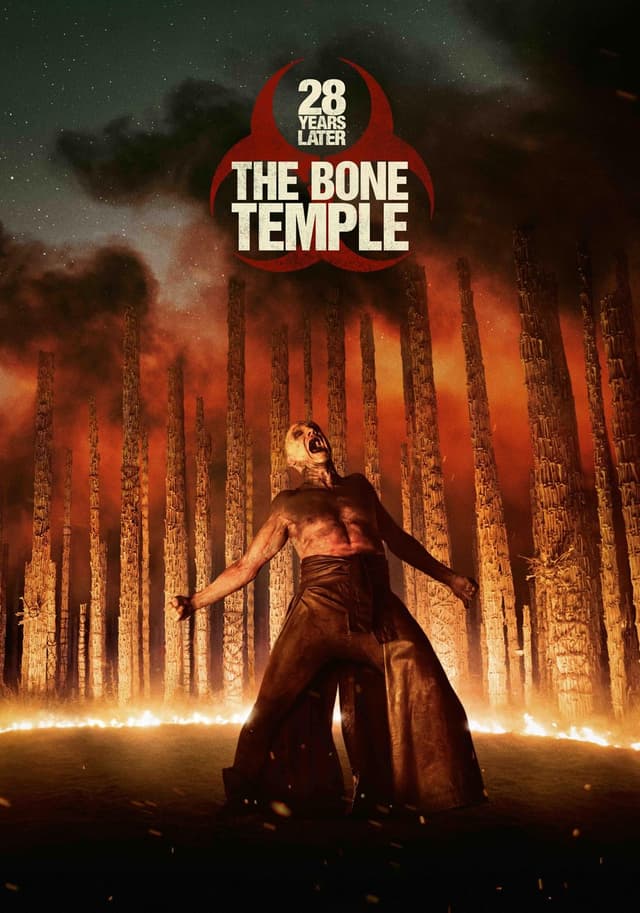
As Spike is inducted into Jimmy Crystal's gang on the mainland, Dr. Kelson makes a discovery that could alter the world.
What Is the Budget of 28 Years Later: The Bone Temple?
28 Years Later: The Bone Temple was produced on a budget of approximately $63 million, a substantial mid-range investment for Sony Pictures and DNA Films. The figure reflects the cost of assembling a distinguished cast including Ralph Fiennes and Jack O'Connell, mounting authentic location shoots across remote Yorkshire and Cumbria, and delivering the visceral practical effects that define the franchise.
By comparison, the original 28 Days Later (2002) cost roughly $8 million, and 28 Weeks Later (2007) was budgeted at $15 million. The Bone Temple represents a significant step up in production ambition, though its $58.5 million worldwide gross fell short of recouping that investment theatrically, putting pressure on the proposed third film in the trilogy.
Key Budget Allocation Categories
- Above-the-Line Talent: Ralph Fiennes as the enigmatic Dr. Ian Kelson and Jack O'Connell as Sir Lord Jimmy Crystal anchor the film with two of British cinema's most accomplished performers. Erin Kellyman and Alfie Williams round out a cast that likely consumed $15 to $20 million of the total budget, with the uncredited Cillian Murphy cameo adding marquee value at minimal cost.
- Location Shooting in Northern England: The production based itself in Redmire (North Yorkshire), Bradford, and Ennerdale (Cumbria), securing genuinely remote landscapes that no studio backlot could replicate. These locations required extensive logistical planning and period-appropriate production design to render a Britain two decades into the zombie pandemic, likely accounting for $8 to $12 million in below-the-line costs.
- Cinematography and Practical Effects: Director of Photography Sean Bobbitt, known for his work on 12 Years a Slave and Widows, brought a naturalistic, high-contrast visual grammar to the film. The franchise's signature approach of practical makeup and in-camera gore over CGI requires skilled prosthetics teams and stunt coordination, a cost-intensive but critically valued production choice.
- Score by Hildur Guðnadóttir: The Icelandic composer, who won an Academy Award for her Joker score, contributed an original soundtrack that critics singled out as one of the film's most effective atmospheric elements. A composer of her profile commands significant fees, with scores for major studio films typically running $2 to $4 million.
- Post-Production and Sound: Editor Jake Roberts shaped the film's 109-minute runtime, and the sound design, critical in a film where infected movement and ambient dread are storytelling tools, required extensive post-production work at professional facilities in the UK.
How Does 28 Years Later: The Bone Temple's Budget Compare to Similar Films?
The Bone Temple sits in a crowded tier of high-production-value horror sequels, where $60 to $80 million budgets are common but profitability is far from guaranteed, particularly when franchise goodwill is spread across long gaps between installments.
- 28 Weeks Later (2007): Budget $15M | Worldwide $64.2M -- The first sequel was made on a fraction of The Bone Temple's budget and earned a similar gross, suggesting the franchise's ceiling has not grown proportionally to its production spend.
- Alien: Romulus (2024): Budget $65M | Worldwide $350.9M -- The comparable-budget sci-fi horror revival of a dormant franchise showed what a returning IP can achieve when critical reception and audience enthusiasm align. The Bone Temple's more modest commercial performance reflects the difference in franchise scale.
- Halloween (2018): Budget $10M | Worldwide $255M -- The Blumhouse model of low-budget, high-IP horror demonstrates the upside when budget discipline meets franchise passion. The Bone Temple's larger budget reflects its more ambitious scope but also its greater financial risk.
- A Quiet Place Part II (2021): Budget $61M | Worldwide $297.4M -- The most direct structural analog: a horror sequel with a major-star-driven ensemble and elevated production values that succeeded commercially. The gap between its performance and The Bone Temple's illustrates both the strength of A Quiet Place's established franchise and the challenge of reviving a 23-year-old IP.
28 Years Later: The Bone Temple Box Office Performance
The Bone Temple opened in the United Kingdom on January 13, 2026, in a special double-bill event alongside 28 Years Later, before releasing in the United States on January 16, 2026. Distributed by Sony Pictures Releasing, the film opened to $12.5 million domestically on its opening weekend, a solid but not spectacular debut for a mid-winter horror release.
The film grossed $25.1 million domestically and $33.4 million internationally, for a worldwide total of $58.5 million against its $63 million production budget. With estimated prints and advertising spending of $30 to $40 million, the film required closer to $90 to $100 million in worldwide revenue to break even at the studio level. At roughly half that figure, the theatrical run left the film firmly in the red, with the studio looking to home video, streaming, and ancillary markets to recover costs.
Box Office Breakdown
28 Years Later The Bone Temple

The film earned roughly $0.93 for every $1 invested in production alone, before accounting for marketing. The underperformance creates genuine uncertainty around the planned third film, with Danny Boyle set to return as director and Alex Garland as writer, though financing will depend heavily on streaming performance.
28 Years Later: The Bone Temple Production History
Development on a second chapter of the 28 Days Later franchise accelerated in the early 2020s, with Danny Boyle and producer Andrew Macdonald returning alongside original writer and producer Alex Garland. The creative team made the strategic decision to position the sequel as the second part of a planned trilogy, releasing it in a special theatrical double-bill event in the UK with the first chapter to give audiences who missed the original a chance to experience both films.
Rather than directing the sequel himself, Boyle chose Nia DaCosta, whose Candyman (2021) demonstrated her facility with visceral, socially embedded horror. DaCosta became the second Black woman to direct a film that opened at number one in North America, a milestone that added cultural significance to the franchise's expansion. Garland retained the writing credit, ensuring narrative continuity with the broader trilogy arc.
Principal photography began August 19, 2024, in Yorkshire and Cumbria, England, with the production deliberately choosing remote natural landscapes over studio sets. The North Yorkshire locations, including the village of Redmire and Ennerdale Water in the Lake District, provided the isolated, windswept British environments that defined the original film's aesthetic. Bradford served as an urban environment rendered desolate by the rage virus.
Post-production brought in composer Hildur Guðnadóttir, whose Academy Award-winning score for Joker had established her as one of film's most distinctive sonic voices. Her work on The Bone Temple drew critical praise even from reviewers who had reservations about the film's narrative structure. The film premiered to strong reviews, earning 92% on Rotten Tomatoes and an 81/100 on Metacritic, with the theatrical performance ultimately proving a disappointment relative to both the film's quality and its production investment.
Awards and Recognition
28 Years Later: The Bone Temple received strong critical recognition despite its modest commercial performance. Hildur Guðnadóttir's score received particular attention from awards bodies, earning nominations from multiple critics' circles. Director Nia DaCosta and cinematographer Sean Bobbitt were cited by numerous critics' associations for their atmospheric visual approach, which several reviewers described as the strongest directorial work in the franchise. The film's 92% Rotten Tomatoes score and Metacritic score of 81 placed it in the universally acclaimed tier for genre cinema.
Critical Reception
28 Years Later: The Bone Temple opened to widespread critical praise, earning a 92% positive rating on Rotten Tomatoes from 338 reviews and an 81/100 score on Metacritic, placing it in the universally acclaimed category. CinemaScore gave the film an A-, indicating strong audience approval among opening-weekend viewers.
Critics consistently praised DaCosta's "unnerving direction" and her ability to generate sustained dread rather than relying on jump scares. Ralph Fiennes received particularly enthusiastic notices for his performance as the mysterious Dr. Ian Kelson, with several critics noting his work as among the best of his career. The practical effects, sound design, and Hildur Guðnadóttir's score were singled out as exceptional even by reviewers who found the film's narrative structure less satisfying than its predecessor. The consensus positioned The Bone Temple as a worthy continuation that elevated the franchise aesthetically even as it left audiences eager for the promised third chapter.
Frequently Asked Questions
How much did it cost to make 28 Years Later: The Bone Temple (2026)?
28 Years Later: The Bone Temple (2026) had a production budget of $NaN. This covers principal photography, cast and crew salaries, visual effects, production design, and post-production. Marketing and distribution costs (P&A) are typically estimated at an additional amount equal to the production budget.
How much did 28 Years Later: The Bone Temple (2026) earn at the box office?
28 Years Later: The Bone Temple (2026) earned $NaN domestically and $NaN worldwide.
Was 28 Years Later: The Bone Temple (2026) profitable?
Profitability data is not yet available for 28 Years Later: The Bone Temple (2026). The film has not reported public budget or box office figures sufficient for a profitability analysis.
What were the biggest costs in producing 28 Years Later: The Bone Temple (2026)?
The primary cost drivers for 28 Years Later: The Bone Temple (2026) included above-the-line talent (director, lead cast, and producers), visual effects and post-production, production design and set construction, location shooting, and music and scoring. The specific allocation varies by production, but these categories typically represent the majority of a Horror, Thriller, Science Fiction film's budget.
How does 28 Years Later: The Bone Temple's budget compare to similar films?
Budget comparison data is not available for 28 Years Later: The Bone Temple (2026) as the production budget has not been publicly reported.
Did 28 Years Later: The Bone Temple (2026) go over budget?
There are no public reports confirming whether 28 Years Later: The Bone Temple (2026) went over its original budget. Production budget overruns are common in the industry but are rarely disclosed publicly unless they become newsworthy due to significant delays, reshoots, or production issues.
What was the ROI of 28 Years Later: The Bone Temple (2026)?
ROI data is not yet available for 28 Years Later: The Bone Temple (2026). The film either has not been released or has not reported sufficient financial data for an ROI calculation.
What awards did 28 Years Later: The Bone Temple (2026) win?
28 Years Later: The Bone Temple (2026) has not yet received major award nominations as of mid-2026. The film's awards trajectory will depend on its release timing relative to the awards season calendar and critical reception.
Who directed 28 Years Later: The Bone Temple (2026)?
28 Years Later: The Bone Temple (2026) was directed by Nia DaCosta.
Where was 28 Years Later: The Bone Temple (2026) filmed?
Specific filming locations for 28 Years Later: The Bone Temple (2026) are based on publicly available production reports. Many Horror, Thriller, Science Fiction films utilize a combination of studio facilities and practical locations to achieve the desired visual scope.
Filmmakers
28 Years Later The Bone Temple

Official Trailer
Build budgets like this one in Saturation
Start from an industry-standard feature film template, import the schedule and rates you already have, and let the cost report keep itself current as you spend. Real-time collaboration, no spreadsheets.