Hush Budget
 HorrorThriller1h 22m
Updated
Synopsis
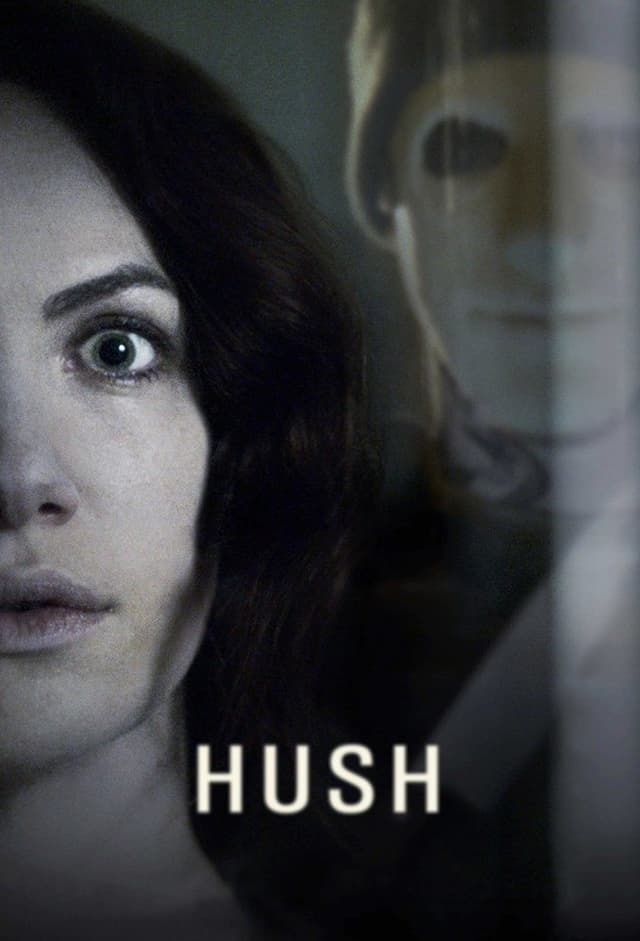
Maddie Young, a deaf and mute novelist living alone in a remote house in the woods, becomes the target of a masked intruder who realizes she cannot hear him approach. Over the course of a single night, Maddie must use her wits, her familiarity with her home, and her writer's instinct for narrative to outmaneuver the killer outside her windows. What begins as a one-sided stalking turns into a contest of strategy in which silence becomes both her greatest disadvantage and her sharpest weapon.
What Is the Budget of Hush (2016)?
Hush (2016), directed by Mike Flanagan and produced by Trevor Macy through Intrepid Pictures alongside Blumhouse Productions, was made on a production budget of approximately $1,000,000. The figure has been confirmed by Flanagan in multiple interviews and reflects a true microbudget approach: a single principal location, a tight ensemble of four credited speaking roles, and a contained twelve-day shoot. As a Netflix original acquired out of South by Southwest in March 2016, the film bypassed theatrical release entirely and was financed at a scale designed for direct-to-streaming economics.
At roughly one million dollars, Hush sits at the low end of even Blumhouse-style microbudget horror, well below the $3 to $5 million range typical of theatrical Blumhouse releases of the period. Flanagan, his wife and co-writer Kate Siegel, and producer Trevor Macy structured the project as a calling card after the success of Oculus, using the constrained budget to retain creative control and to demonstrate that a high-concept home-invasion thriller could be executed with discipline and craft rather than spectacle. The investment underwrote a tightly engineered genre exercise whose ambition is entirely on screen.
Key Budget Allocation Categories
On a one-million-dollar production, every line item is closely managed. The categories below represent where Hush concentrated its spend:
- Single-Location Production Design: The entire film takes place in and around an isolated house in the woods, with the production rebuilding and dressing a single residence to serve as both interior set and exterior playing area. Production designer Elizabeth Boller engineered the house to allow blocking through every room, deck, and window pane, which was the single most visible craft investment on the film.
- Above-the-Line Talent: Mike Flanagan directed, co-wrote, and edited; Kate Siegel co-wrote and starred; Trevor Macy produced through Intrepid Pictures. Consolidating multiple roles within a small creative team kept fees compressed, while John Gallagher Jr. came aboard in the antagonist role on an indie-scale deal that reflected the project's microbudget profile.
- Cast and Stunt Performance: With only four credited speaking roles (Kate Siegel, John Gallagher Jr., Samantha Sloyan, and Michael Trucco), the cast budget was minimal by genre standards. The savings funded the physical performance work, including the deaf-protagonist sign language coaching, the prolonged stalking sequences, and the practical violence that required stunt coordination on a single set.
- Cinematography and Camera Package: Cinematographer James Kniest shot in widescreen using a small camera package suited to night-for-night work, with extensive use of the house's glass walls and sliding doors to play tension through visible space. The lighting plot, which carries much of the film's atmosphere, was the major below-the-line line item.
- Sound Design and Score: Because the protagonist is deaf, the film alternates between hearing and non-hearing point-of-view sound mixes. The team of Trevor Gates and Jamey Scott engineered a layered design that drops the score and ambient effects whenever the audience is positioned with Maddie, then surges them back when the perspective shifts. Composers The Newton Brothers, Flanagan's regular collaborators, delivered a restrained string-led score.
- Twelve-Day Shooting Schedule: The compressed production schedule, with principal photography reportedly running about twelve days, limited overtime, catering, and accommodation costs that often dominate small-film budgets. Tight prep allowed the unit to execute the demanding night exterior and interior coverage within the window.
- Practical Effects and Makeup: Knife wounds, blood gags, and the prosthetic work supporting the violence are practical, allowing the team to avoid expensive digital cleanup. Special makeup effects by the Autonomous F/X team kept the film's on-screen carnage convincing while remaining within the financial scope of a one-million-dollar production.
How Does Hush's Budget Compare to Similar Films?
Placing Hush alongside other Mike Flanagan titles and home-invasion thrillers puts its scale into sharp relief:
- Oculus (2013): Budget $5,000,000 | Worldwide $44,000,000. Flanagan's breakout supernatural horror cost five times what Hush did and grossed roughly 44 million theatrically. The contrast illustrates how Flanagan deliberately stepped down in budget for Hush to chase a streaming-native model rather than another theatrical play.
- Doctor Sleep (2019): Budget $45,000,000 | Worldwide $72,400,000. Flanagan's Stephen King sequel to The Shining sits at a studio scale 45 times the Hush budget, demonstrating the director's range from one-million-dollar genre exercises to large Warner Bros. tentpole assignments within a six-year arc.
- Don't Breathe (2016): Budget $9,900,000 | Worldwide $157,800,000. Fede Alvarez's blind-antagonist home-invasion thriller released the same year as Hush at roughly ten times the budget and grossed nearly $158 million theatrically. The pairing shows two contemporary sensory-deprivation thrillers operating on opposite ends of the financing spectrum.
- The Strangers: Prey at Night (2018): Budget $5,000,000 | Worldwide $32,000,000. Johannes Roberts' studio home-invasion sequel cost five million and pursued a traditional theatrical release. Hush's direct-to-Netflix path traded the box office upside for a global streaming audience on day one.
- Get Out (2017): Budget $4,500,000 | Worldwide $255,500,000. Jordan Peele's Blumhouse social thriller, released a year after Hush, demonstrates the ceiling of low-budget horror in the theatrical lane, with a four-and-a-half-million-dollar production grossing over a quarter billion worldwide.
- The Blair Witch Project (1999): Budget $60,000 | Worldwide $248,600,000. The benchmark for microbudget horror profitability, made for sixty thousand dollars and grossing $248 million in theaters. The comparison shows the alternative path Hush could have taken theatrically, and why Netflix's buyout model still made sense for a streaming-first creative team.
Hush Box Office Performance
Hush did not have a conventional theatrical release. After premiering at South by Southwest on March 12, 2016, the film was acquired by Netflix and launched as a Netflix original on April 8, 2016, in territories worldwide. As a streaming-only release, Hush generated no reported theatrical receipts, and the commercial performance metric for the financiers was the Netflix licensing fee rather than ticket sales.
The available financial breakdown:
Box Office Breakdown
Hush

Because there is no theatrical gross to compare against the one-million-dollar production budget, the "dollars returned per dollar invested" calculation must be reframed. Netflix's acquisition fee for an exclusive worldwide streaming title of this profile in 2016 typically exceeded the production budget by a meaningful multiple, and industry trade reporting at the time indicated the deal was structured to make Hush profitable on day one of release.
Beyond the immediate licensing payout, Hush delivered substantial second-order value to its creators. The film served as the calling card that opened the door to Flanagan and Trevor Macy's ongoing Netflix relationship, including The Haunting of Hill House (2018), The Haunting of Bly Manor (2020), Midnight Mass (2021), The Midnight Club (2022), and The Fall of the House of Usher (2023). For a one-million-dollar genre experiment, the franchise pipeline it unlocked is arguably the largest return on investment in modern streaming horror.
Hush Production History
Hush originated from a conversation between Mike Flanagan and Kate Siegel about silent cinema and the limits of sound design in horror. Siegel pitched the conceit of a deaf and mute home-invasion victim, and the pair developed the screenplay together while Flanagan was finishing post-production on Oculus. Trevor Macy at Intrepid Pictures championed the project as a fast, contained follow-up to Oculus, and Blumhouse Productions came on board to support the financing and production under Jason Blum's microbudget model.
Principal photography took place in Fairhope, Alabama, in mid-2015, with the production using a single residence in the woods as the primary location. The Alabama shoot benefited from the state's 25 to 35 percent film production rebate, administered by the Alabama Film Office, which made the regional financing math work for a sub-two-million-dollar genre project. The unit reportedly completed the entire film in approximately twelve shooting days, a turnaround Flanagan has cited as one of the tightest schedules he has worked under.
Kate Siegel prepared for the role of Maddie by working with American Sign Language coaches and by spending time silent on set to inhabit the deaf perspective. The production developed a system of cue lights and visual signals so the cast and crew could communicate with Siegel during takes without breaking her sensory frame. John Gallagher Jr., cast as the masked intruder, joined the project after Flanagan saw his work in 10 Cleverfield Lane (which premiered around the same period) and pitched him the role directly.
Flanagan edited the film himself, as he does most of his projects, in close collaboration with cinematographer James Kniest and composers The Newton Brothers. The team designed the sound mix to alternate between hearing and deaf points of view, dropping the score and ambient layers whenever the camera occupies Maddie's sensory position. Post-production was compressed to allow a SXSW 2016 premiere slot, after which Netflix acquired the worldwide rights and set the April 8, 2016 launch date.
Awards and Recognition
Hush earned its most significant recognition at the 43rd Saturn Awards in 2017, where it was nominated for Best Horror Film alongside titles including Don't Breathe, Lights Out, and The Witch. The nomination from the Academy of Science Fiction, Fantasy and Horror Films placed Hush in direct competition with the year's strongest theatrical horror releases despite being a streaming-only acquisition, signaling that the Saturn voters were prepared to treat Netflix originals as peers to wide-release theatrical horror.
Kate Siegel received a Fangoria Chainsaw Award nomination for Best Actress for her largely silent performance as Maddie, and the film picked up additional genre festival recognition during its 2016 circuit run. Following the SXSW premiere, Hush played at Stanley Film Festival in Estes Park, Sitges Catalan International Film Festival in Spain, and Screamfest Horror Film Festival in Los Angeles, where genre audiences responded to the disciplined craft and the deaf-protagonist concept. The cumulative recognition established Flanagan as a director with substantive crossover appeal beyond the festival horror circuit.
Critical Reception
Hush received strong reviews upon its Netflix debut and currently holds a 94% approval rating on Rotten Tomatoes based on 76 reviews, with an average score of 7.4 out of 10. The Rotten Tomatoes critics' consensus described the film as a "lean, mean little thriller" that "earns its tension honestly," and the Metacritic score of 67 out of 100 from 12 reviews placed it firmly in the "generally favorable" range. The audience response was equally enthusiastic, with a 71% Rotten Tomatoes audience score reflecting strong word of mouth among streaming viewers.
Critics consistently singled out Kate Siegel's nearly wordless performance as the film's anchor. Brian Tallerico at RogerEbert.com praised the way Flanagan and Siegel "use the limitations of their setting and protagonist to amplify rather than diminish the tension," and Matt Zoller Seitz called it "a master class in sustained suspense at microbudget scale." The Guardian's Benjamin Lee credited the film with "wringing maximum dread from minimum resources," and Variety's Joe Leydon highlighted the sound design as "the secret weapon" of the production.
Detractors, where they emerged, found the home-invasion structure familiar and noted that the film's second half settles into a more conventional rhythm than the inventive setup promises. Even skeptical reviewers acknowledged the technical craft, however, and Hush's standing as a foundational early Flanagan title has only grown as his subsequent Netflix series have brought new audiences back to his microbudget origins. Among horror commentators, the film is now routinely cited as one of the best deaf-protagonist thrillers ever made and one of the strongest streaming-original horror titles of the 2010s.
Frequently Asked Questions
How much did it cost to make Hush (2016)?
Hush was made on a production budget of approximately $1,000,000. The figure has been confirmed by director Mike Flanagan in multiple interviews and reflects a microbudget approach with a single principal location, four credited speaking roles, and a tight twelve-day shooting schedule produced by Intrepid Pictures and Blumhouse Productions.
How much did Hush earn at the box office?
Hush had no conventional theatrical release. After premiering at South by Southwest on March 12, 2016, it was acquired by Netflix and launched globally as a Netflix original on April 8, 2016. The film generated revenue through the Netflix licensing fee rather than ticket sales, and industry reporting at the time indicated the deal made the production profitable on day one.
Who directed Hush?
Mike Flanagan directed Hush from a screenplay he co-wrote with his wife and lead actress Kate Siegel. Flanagan also served as editor on the film, and the project was produced by Trevor Macy through Intrepid Pictures with Jason Blum's Blumhouse Productions.
Where was Hush filmed?
Hush was filmed in Fairhope, Alabama, in mid-2015. The production used a single residence in the woods as the primary location and benefited from Alabama's 25 to 35 percent film production rebate, which made the regional financing math work for the sub-two-million-dollar budget.
How long did it take to film Hush?
Principal photography on Hush was completed in approximately twelve shooting days, a turnaround Mike Flanagan has cited as one of the tightest schedules of his career. The compressed schedule was enabled by the single-location setup, the small ensemble cast, and detailed prep before the unit moved to Alabama.
Did Hush premiere at SXSW?
Yes. Hush premiered at South by Southwest on March 12, 2016, in the Festival Favorites section. Netflix acquired the worldwide streaming rights shortly after the premiere and set the global launch date for April 8, 2016, less than a month after the SXSW debut.
Did Hush win any awards?
Hush was nominated for Best Horror Film at the 43rd Saturn Awards, competing against Don't Breathe, Lights Out, and The Witch. Kate Siegel received a Fangoria Chainsaw Award nomination for Best Actress, and the film played genre festivals including Stanley Film Festival, Sitges, and Screamfest during its 2016 circuit run.
How did Kate Siegel prepare for the deaf protagonist role?
Kate Siegel prepared for the role of Maddie by working with American Sign Language coaches and by spending time silent on set to inhabit the deaf perspective. The production developed a system of cue lights and visual signals so the cast and crew could communicate with her during takes without breaking her sensory frame.
What did critics think of Hush?
Hush received strong reviews, holding a 94% Rotten Tomatoes approval rating from 76 reviews and a 67 Metacritic score. Critics praised Kate Siegel's nearly wordless performance, the alternating hearing and deaf point-of-view sound mix, and the discipline of the microbudget execution. The audience response was equally positive at 71% on Rotten Tomatoes.
Is Hush part of a Mike Flanagan franchise?
Hush is a standalone film, but it served as the calling card that opened the door to Mike Flanagan and Trevor Macy's ongoing Netflix relationship. Subsequent Flanagan-Intrepid Netflix projects include The Haunting of Hill House (2018), The Haunting of Bly Manor (2020), Midnight Mass (2021), The Midnight Club (2022), and The Fall of the House of Usher (2023).
Filmmakers
Hush

Official Trailer
Build budgets like this one in Saturation
Start from an industry-standard feature film template, import the schedule and rates you already have, and let the cost report keep itself current as you spend. Real-time collaboration, no spreadsheets.