
Best Collaboration Tools for Film and Commercial Production Teams
Production collaboration is not one tool. It is a category of tools covering creative review, project management, asset sharing, live remote viewing, and financial coordination across departments. A typical feature film or commercial runs on 4 to 6 collaboration tools in parallel. This guide covers the best collaboration tools for film and commercial production teams in 2026, how each category fits, and what role financial collaboration plays alongside the creative stack.
The five categories of production collaboration
Production teams collaborate in structurally different ways:
- Creative review and approval. Timestamped comments on footage, cut versions tracked, feedback loops between director, editor, client. Frame.io, Wipster, Vimeo, Evercast.
- Project management. Tasks, deadlines, shot lists, call sheets, schedules. StudioBinder, Yamdu, Celtx, Flow Production Tracking, Asana.
- Asset sharing and media management. Footage storage, version control, remote editing access. LucidLink, Iconik, Frame.io Camera to Cloud.
- Live remote viewing. Director or producer watches the edit session in real time from another location. Evercast, Louper, Sohonet.
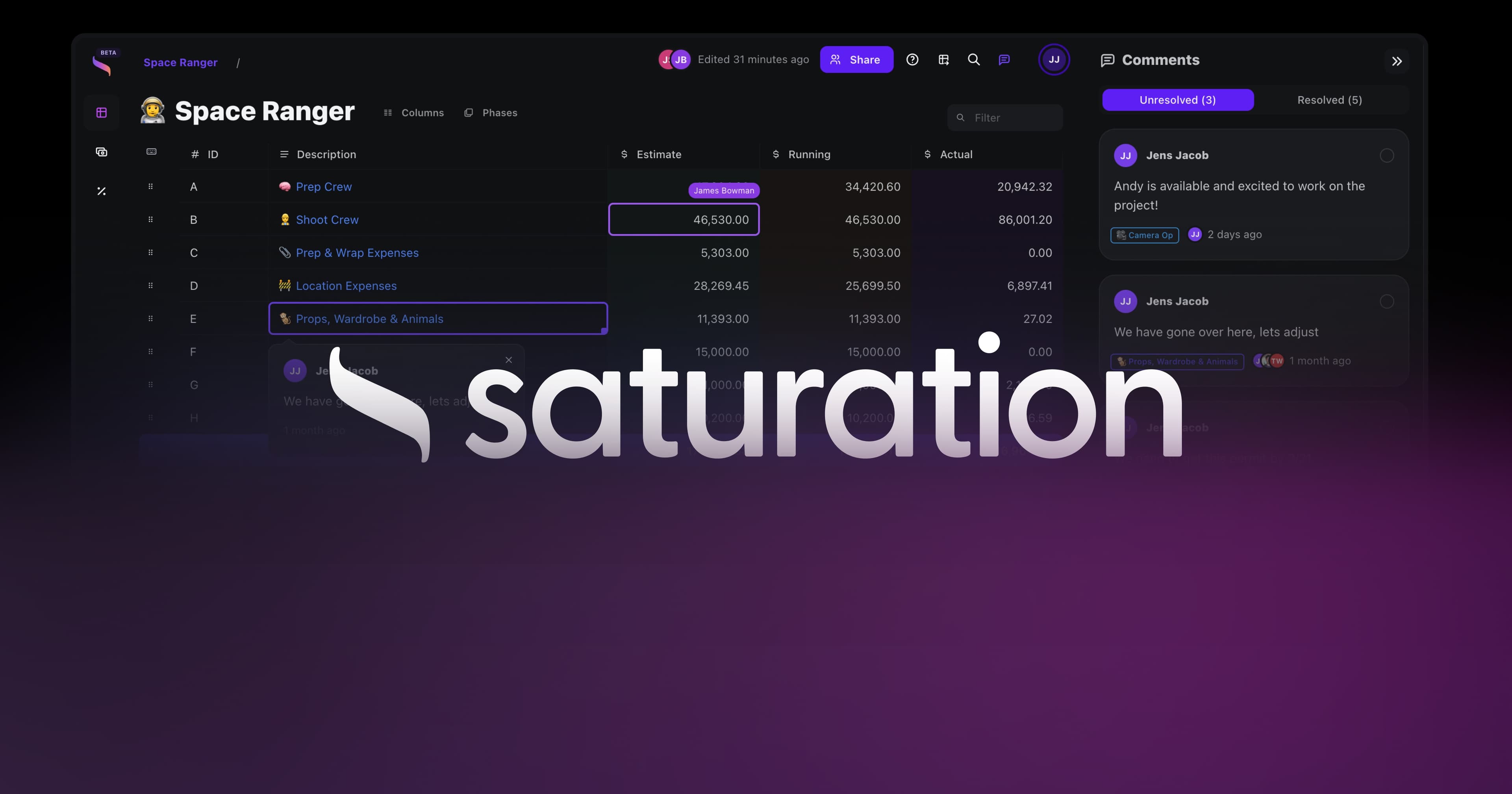
- Financial collaboration. Budget visibility, purchase order approvals, cost reporting across producer, UPM, department heads, production accountant. Saturation.
Each category solves a different collaboration problem. A stack that covers all five lets the production team work in sync; a stack that covers only one leaves gaps where teams email each other spreadsheets.
Creative review tools
Frame.io
Frame.io is the category leader for creative review and approval. Owned by Adobe, integrates with Premiere Pro, Final Cut Pro, and After Effects. Timestamped comments on footage, version tracking, upload from cameras via Camera to Cloud. Industry standard for dailies review and edit approval.
Wipster
Wipster is a direct alternative to Frame.io with similar features: video review, version comparison, client review workflows. Smaller market share but strong product.
Vimeo (Review)
Vimeo's review tools handle timestamped comments and version tracking alongside its hosting and distribution. Good fit for teams already using Vimeo as the hosting layer.
Evercast
Evercast focuses on live, low-latency remote editing. Directors watch edit sessions in real time from anywhere. Strong for post-production teams with distributed directors and editors. Less about commenting, more about live presence.
Louper
Louper is a newer entrant combining real-time collaboration with asynchronous feedback. 4K streaming with frame-accurate timecode.
Production project management tools
StudioBinder
StudioBinder is built for filmmakers. Call sheets, shot lists, schedules, scene breakdowns. Smart call sheets with automated weather and location data. Strong for directors, ADs, and production coordinators. See our Saturation vs StudioBinder comparison.
Yamdu
Yamdu unifies media production operations. Script breakdowns, shooting schedules, call sheets, time cards, visual scheduling. Strong for mid-size productions running multiple departments in parallel.
Celtx
Celtx covers script-to-budget workflows, pre-production, and production management. Useful for productions wanting script, breakdown, schedule, and budget in one tool. See our Saturation vs Celtx comparison.
Flow Production Tracking
Autodesk's Flow (formerly ShotGrid) handles VFX and animation production pipelines at studio scale. Complex asset and task tracking for high-end productions.
Asana, Monday, Notion, ClickUp
General project management tools often used for the production office side of production. Not film-specific, but good for internal team coordination.
Financial collaboration (Saturation)
Every creative collaboration tool above leaves a gap: none of them handle budget visibility, card issuance, invoice approvals, or cost reporting. That work happens on spreadsheets, email, or in separate accounting tools. Saturation fills the financial collaboration gap:
- Budget visibility across producer, UPM, department heads, production accountant
- PO submission and approval from mobile, wherever team members are
- Card spend visible in real time at the department and line level
- Cost reports that everyone sees the same version of, with comments and variance notes
- Integrations with payroll firms so wages flow without manual sync
For productions currently running financial workflows on email threads and Google Sheets, adding Saturation to the stack is a category move, not a tool swap. There is no direct competitor for the "financial collaboration for production" slot in the collaboration stack.
How the tools fit together
A representative modern stack for a feature film or large commercial:
- Frame.io for dailies review and client approval
- StudioBinder for call sheets, shot lists, schedules
- LucidLink or Iconik for asset management and remote editing access
- Evercast for live remote edit sessions (post)
- Saturation for financial collaboration across the team
- Slack or email for general text communication
Overlap is minimal. Each tool has a distinct scope. Productions trying to force one tool to do everything end up underserved in every category.
What does not work
- Google Drive for creative review. No timestamped comments, no version tracking, no integration with editing tools. Frame.io, Wipster, Vimeo solve problems Google Drive does not.
- Excel for project management. For call sheets and scheduling, purpose-built tools save hours per day.
- Email for approvals. Whether creative or financial, approval threads disappear into inboxes. Workflow tools make approvals trackable.
- A "one tool that does everything" platform. The all-in-one platforms on the market cover some workflows well but rarely all. Most productions are better served by 3 to 5 focused tools than 1 weak all-in-one.
Security and IP protection
Production collaboration tools handle some of the most sensitive content in the industry: pre-release footage, locked scripts, cast contracts, financial data. A security incident here is a headline event, not a quiet breach.
Minimum security bar for any production collaboration tool:
- SOC 2 Type II certification with annual audit
- Role-based access control with granular per-asset permissions
- Watermarking on pre-release content (visible or forensic)
- Download controls with audit logs for every asset access
- Multi-factor authentication required
- Session timeout and device restriction options
- Breach disclosure and incident response SLAs in the vendor contract
Studios increasingly require MPA TPN (Trusted Partner Network) certification for vendors handling pre-release content. Check each collaboration platform's certifications before onboarding a studio show.
Choosing by role on the production team
The right collaboration stack varies by who is using it. A quick reference:
- Director: Frame.io for edit review, StudioBinder or Yamdu for shot lists
- Producer and UPM: StudioBinder for call sheets, Saturation for budget visibility and approvals
- Production accountant: Saturation for financial workflow, Excel for specialized reports
- Editor and post team: Frame.io for review, LucidLink or Iconik for asset access, Evercast for live director sessions
- Department heads: StudioBinder for schedule, Saturation for line-level budget visibility and PO submission
- Crew (day-to-day): Mobile app access to schedule, call sheets, and receipt capture from wherever they are
Pricing patterns
Collaboration tools price by seats, storage, or productions. Frame.io runs $15 to $50 per user per month plus storage. StudioBinder runs $29 to $49 per user per month. Yamdu is project-based pricing. Evercast is $65 to $150+ per user per month due to low-latency streaming costs. Saturation is priced per production and includes unlimited users, reflecting the model that financial collaboration works best when everyone is on the platform.
How to evaluate a new collaboration tool for your production
Before adding another tool to the stack, run it through this checklist. Tools that pass all seven are worth piloting; tools that fail any are worth skipping.
- Does it solve a specific workflow our current stack does not handle? If not, the answer is probably an existing tool not a new one.
- Does it integrate with the tools we already use (Frame.io, StudioBinder, Saturation, payroll firm)? Isolation creates duplicate data entry.
- Does it have a mobile app, not just responsive web? On-set use requires real mobile.
- Is it SOC 2 Type II certified? Pre-release content requires the compliance floor.
- Can we pilot it on one production before rolling out broadly? Multi-show commitment up front is a red flag.
- What is the cost per seat or per production, including storage? Some tools have cheap base fees and expensive storage or bandwidth.
- Is the vendor responsive? Email support should reply within 24 hours; urgent issues should hit a live person.
Industry resources
For more on how production collaboration is evolving, see MovieLabs 2030 Vision on cloud-first production. For post-production specific workflows, American Cinematographer covers remote collaboration case studies.
Frequently asked questions about production collaboration tools
What is the difference between Frame.io and StudioBinder?
Frame.io is for creative review of video content (edit comments, version tracking). StudioBinder is for production management (call sheets, shot lists, schedules). They serve different workflows and most productions use both.
Do I need a separate tool for asset management?
For productions with significant footage volume (features, episodic series, long-form commercials), yes. LucidLink and Iconik manage the raw footage and edit files. For smaller productions, Frame.io Camera to Cloud or a simple shared drive can be enough.
How do collaboration tools handle remote teams?
All modern tools are cloud-first and work across locations. Frame.io, StudioBinder, Saturation all work identically whether the team is in one office or 10 cities. Evercast and Louper are specifically built for real-time remote video review.
Can I use Google Drive or Dropbox instead?
For simple file sharing, yes. For workflow collaboration (timestamped comments, approval chains, version tracking), no. The purpose-built tools solve workflow problems that generic file sharing does not.
Where does Saturation fit in a collaboration stack?
Saturation covers financial collaboration: budget visibility, approval chains, card spend, cost reporting. It does not replace creative review tools (Frame.io), production management (StudioBinder), or asset management (LucidLink). It complements them by handling the money and financial data side of production.
Are production collaboration tools SOC 2 compliant?
Most enterprise-focused ones are (Frame.io, StudioBinder, Saturation, Evercast). For productions handling pre-release IP, SOC 2 Type II is the compliance floor. Check each platform's trust center before moving sensitive content.
How do collaboration tools pricing compare across production sizes?
On a typical mid-budget feature ($5M-$15M), expect to spend $15K to $40K total on collaboration tools across all categories over the production run. On commercial productions, the cost is lower because timelines are shorter. Most tools offer project-based or short-term subscriptions suited to production timelines.
Can one platform replace email for production collaboration?
No. Email remains the fallback for external communication (vendors, clients, guild reps). Internal collaboration moves to tools like Slack, Teams, or in-app messaging inside the collaboration platform. Email survives for formal external threads and documentation.
Related posts
Ready to modernize your production finance?
Join thousands of production teams using Saturation to budget, track expenses, and manage payments.