Young Sherlock Holmes Budget
 Adventure
Updated
Synopsis
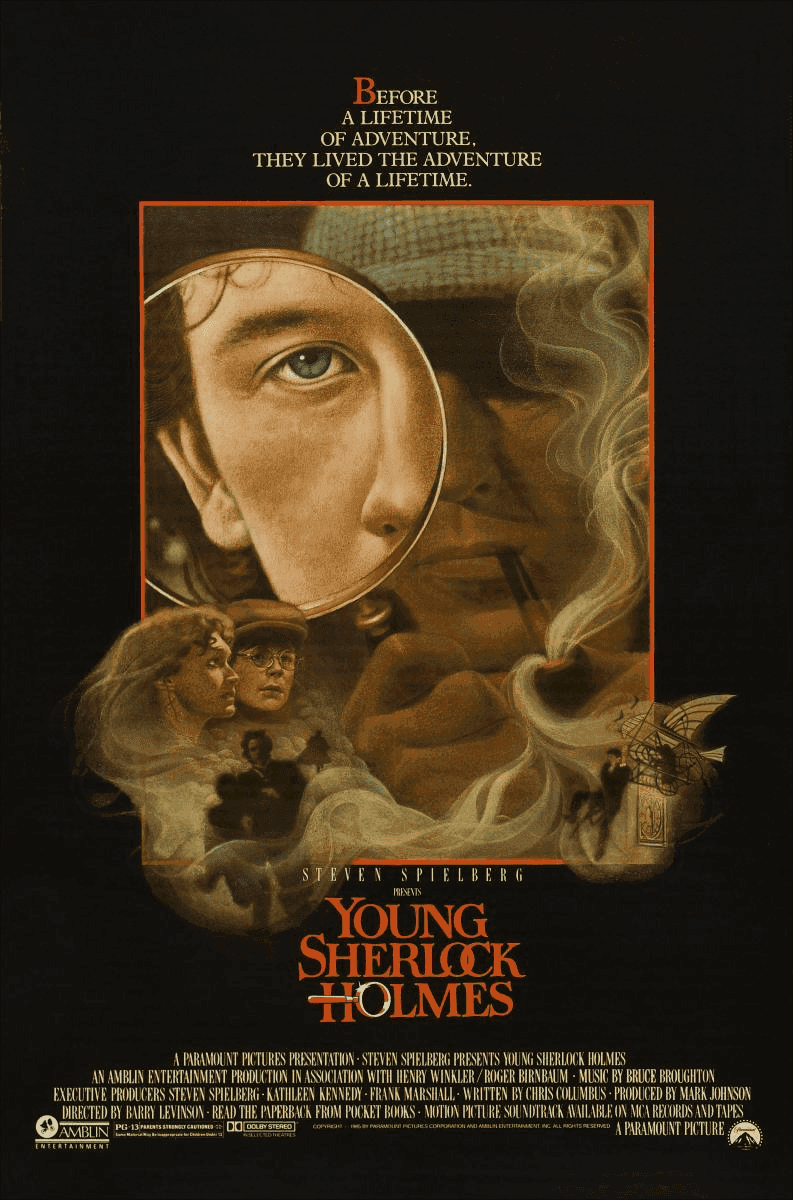
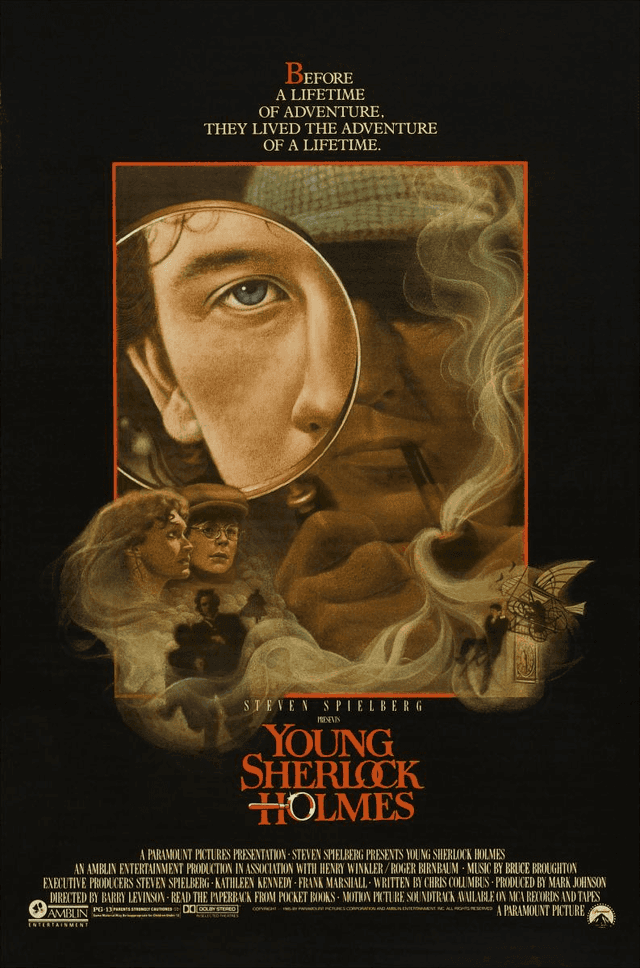
A teenage Sherlock Holmes meets fellow student John Watson at a Victorian London boarding school and the two unravel a series of bizarre suicides that all trace back to an ancient Egyptian cult operating beneath the city. Barry Levinson directs Steven Spielberg's Amblin Entertainment production credited with the first fully computer-generated character in feature film history.
What Is the Budget of Young Sherlock Holmes (1985)?
Young Sherlock Holmes was produced on a budget of approximately $18 million, supporting extensive period production design at Elstree Studios, large-scale set construction for the Victorian London boarding school setting, and groundbreaking visual effects work at Industrial Light and Magic that included the first fully computer-generated photorealistic character in feature film history.
Key Budget Allocation Categories
ILM Computer Graphics, the stained-glass knight sequence required ILM's computer graphics division to develop new techniques for photorealistic CGI character integration, work that directly informed the later Pixar Animation Studios.
Period Set Construction, recreating Victorian London at Elstree Studios required extensive set construction including the Brompton boarding school, an underground Egyptian cult chamber, and detailed street settings.
Costume and Props, Victorian-era costumes, props, and dressing for an extensive ensemble across student, faculty, and London street settings accounted for substantial below-the-line cost.
Visual Effects, in addition to the CGI knight, the film featured extensive practical and optical effects including ritual fire sequences, hallucinatory poison visions, and the climactic underground temple set piece.
English Location Shooting, location work at Eton College and various English locations required permits, location dressing, and unit transportation.
Music Score, Bruce Broughton composed an orchestral score with a memorable main theme recorded with a full British orchestra.
How Does Young Sherlock Holmes's Budget Compare to Similar Films?
The Goonies (1985), Budget $19,000,000 | Worldwide $125,000,000. A fellow Amblin Entertainment production from the same year produced for slightly more that grossed over six times as much.
Back to the Future (1985), Budget $19,000,000 | Worldwide $381,000,000. The Amblin tentpole released earlier the same year produced for a near-identical budget that vastly outperformed Young Sherlock Holmes.
The Witches of Eastwick (1987), Budget $24,000,000 | Worldwide $63,800,000. A comparable mid-budget supernatural-adjacent comedy released a year later that performed significantly better.
Without a Clue (1988), Budget $13,500,000 | Worldwide $8,400,000. A comparable comedic Sherlock Holmes-adjacent film from a few years later that also underperformed.
Young Sherlock Holmes Box Office Performance
Young Sherlock Holmes opened to weak results in North America in December 1985, struggling to find its target audience in a holiday season dominated by Out of Africa, Rocky IV, and Spies Like Us.
Box Office Breakdown
Young Sherlock Holmes

On theatrical revenue alone the film returned roughly $1.10 for every $1 invested at the production-budget level. After marketing the film posted a meaningful theatrical loss, only partially offset by home video and cable performance over subsequent years.
Comprehensive international theatrical figures are not consistently available for the era, but the film performed modestly outside North America with stronger relative reception in the United Kingdom. The film achieved cult status through home video circulation in the 1990s, particularly among aspiring computer graphics professionals studying the CGI stained-glass knight as a foundational moment for the medium.
Young Sherlock Holmes Production History
Young Sherlock Holmes was developed by screenwriter Chris Columbus through Steven Spielberg's Amblin Entertainment as part of a broader run of 1980s family-adventure projects including Goonies and Gremlins. Columbus had previously written Gremlins, and his screenplay reimagined the Holmes mythology with a contemporary Spielberg-influenced sensibility.
Barry Levinson, fresh off The Natural, was hired to direct, with Mark Johnson producing. The production took advantage of Amblin's relationship with Industrial Light and Magic, with ILM tasked with delivering the visual effects centerpiece: a sequence in which a stained-glass knight comes to life and pursues a character through a chapel.
Principal photography took place across spring 1985 at Elstree Studios outside London and at various English locations, including Eton College, which doubled for the fictional Brompton boarding school. The lead role of teenage Holmes went to relative newcomer Nicholas Rowe in his feature film debut, with Alan Cox playing the young Watson.
Post-production focused on the groundbreaking CGI knight sequence, which required ILM's computer graphics division to develop new techniques for photorealistic character integration. The work was led by John Lasseter and his collaborators, the same team that would later spin off as Pixar Animation Studios. The film was placed into the December 1985 release window where it struggled commercially.
Awards and Recognition
Young Sherlock Holmes received one Academy Award nomination, for Best Visual Effects, recognizing the stained-glass knight sequence. The nomination is widely cited as a milestone for computer graphics recognition by the Academy. The film did not win in the category.
The film received Saturn Award nominations for Best Fantasy Film, Best Music (Bruce Broughton), and Best Special Effects. It won the Saturn Award for Best Make-up.
Industry retrospectives have framed the film as a foundational text for digital character animation, with the CGI stained-glass knight sequence routinely cited in visual effects history alongside the genesis effect from Star Trek II and the lookalike T-1000 from Terminator 2 as defining moments in computer graphics evolution.
Critical Reception
Critical reception in 1985 was mixed to positive. Reviewers praised the visual effects, Barry Levinson's direction, and the production design while questioning whether the screenplay successfully integrated the Conan Doyle mythology with the Spielberg-influenced adventure register. Rotten Tomatoes settles at 67 percent positive reviews on aggregated retrospective coverage.
Roger Ebert awarded the film three and a half stars and wrote that "the special effects are stunning and the period detail is exquisite," while Janet Maslin at The New York Times called it "a visually impressive film that occasionally falters in its blending of pulp adventure and classical Sherlock Holmes character work."
Audience reception at the time was muted, contributing to the soft theatrical run. The film has acquired meaningful cult status over the following decades, particularly among visual effects historians and aspiring CGI artists studying the early Pixar team's pioneering work on the stained-glass knight sequence.
Frequently Asked Questions
What is the budget of Young Sherlock Holmes?
The film was produced on a budget of approximately $18 million, supporting extensive period production design and groundbreaking visual effects work at Industrial Light and Magic.
Who directed Young Sherlock Holmes?
Barry Levinson directed the film, his fourth feature, following Diner, The Natural, and the earlier production of The Wonders of Aladdin.
When was Young Sherlock Holmes released?
Paramount Pictures released the film in North America on December 4, 1985.
Where was Young Sherlock Holmes filmed?
Principal photography took place at Elstree Studios outside London and at various English location settings including Eton College, which doubled for the fictional Brompton boarding school.
How much did Young Sherlock Holmes earn?
The film grossed approximately $19.7 million in its domestic theatrical run. International figures from the era are not consistently reported.
Was Young Sherlock Holmes profitable?
No. On an $18 million budget plus roughly $15 million in marketing, the $19.7 million domestic gross was a sharp theatrical loss. The film became modestly profitable through home video and television.
What was groundbreaking about the visual effects?
Young Sherlock Holmes featured the first fully computer-generated photorealistic character in feature film history, a stained-glass knight that comes to life in a chapel sequence. The shot was created by ILM's computer graphics division, which later spun off as Pixar.
Did Young Sherlock Holmes win Oscars?
The film received one Academy Award nomination, for Best Visual Effects, though it did not win the category. The nomination is widely credited as a milestone in CGI recognition.
Who plays Young Sherlock?
Nicholas Rowe plays the teenage Sherlock Holmes in his feature film debut. Alan Cox plays the young Watson.
Is Young Sherlock Holmes canonical to Arthur Conan Doyle?
The film is not based directly on any Conan Doyle source material. It was developed as an original story by Chris Columbus and is not considered part of the literary Holmes canon, though it incorporates familiar character elements.
Filmmakers
Young Sherlock Holmes

Build budgets like this one in Saturation
Start from an industry-standard feature film template, import the schedule and rates you already have, and let the cost report keep itself current as you spend. Real-time collaboration, no spreadsheets.