Witness for the Prosecution Budget
Updated
Synopsis
An ailing barrister is thrust back into the courtroom in what becomes one of the most unusual and eventful murder cases of the lawyer's career when he finds himself defending a man being tried for the murder of a socialite.
What Is the Budget of Witness for the Prosecution?
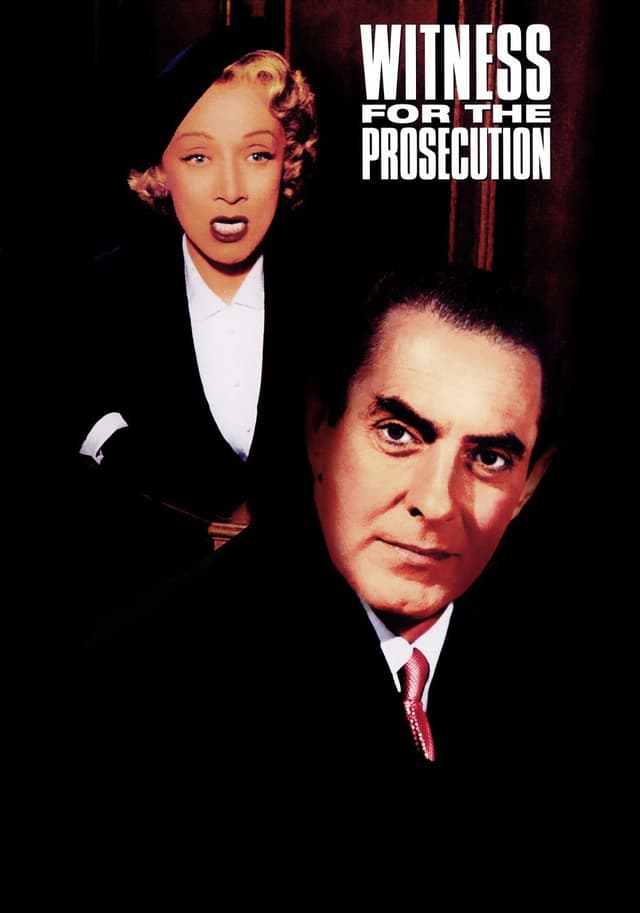
The estimated budget for Witness for the Prosecution (1957) was approximately $3 million, financed and distributed by United Artists. For a late-1950s courtroom drama, this was a moderately sized production. Director Billy Wilder, coming off the success of The Seven Year Itch and Stalag 17, commanded a significant salary, and the film required an elaborate Old Bailey courtroom set to be constructed on a Hollywood soundstage. The combined star power of Charles Laughton, Tyrone Power, and Marlene Dietrich also contributed to the overall production cost.
Key Budget Allocation Categories
- Above-the-Line Talent accounted for a large portion of the budget. Billy Wilder served as both director and co-writer, Charles Laughton was one of the highest-paid character actors of the era, Tyrone Power remained a top-billed leading man, and Marlene Dietrich brought international star cachet to the cast.
- Production Design and Set Construction required building a full-scale replica of London's Old Bailey courtroom at the Samuel Goldwyn Studios lot. Art director Alexandre Trauner designed the intricate set with period-accurate details, including the wood-paneled gallery, witness box, and judge's bench.
- Cinematography by Russell Harlan used carefully controlled lighting to create the moody, high-contrast look that defined the film's visual tension. The courtroom sequences demanded precise camera setups to capture both the claustrophobic intimacy and dramatic scale of the proceedings.
- Wardrobe and Makeup were critical for establishing authenticity. Edith Head designed costumes for the leads, and Marlene Dietrich's transformation scenes required extensive makeup and prosthetic work that pushed practical effects boundaries for the era.
- Post-Production and Music included scoring, sound mixing, and the careful editing of the film's twist-laden final act. The production also invested in a distinctive end-credits card asking audiences not to reveal the surprise ending, a marketing decision that became iconic.
How Does Witness for the Prosecution's Budget Compare to Similar Films?
- 12 Angry Men (1957) had an estimated budget of $350,000, making it far leaner than Wilder's film. Sidney Lumet's single-room drama proved that courtroom tension could be achieved on a fraction of the budget, though it lacked the star wattage and elaborate sets of Witness for the Prosecution.
- Anatomy of a Murder (1959) cost approximately $2.5 million. Otto Preminger's courtroom thriller shared a similar production scale and prestige-cast approach with James Stewart, though it shot partly on location in Michigan rather than building sets from scratch.
- The Bridge on the River Kwai (1957) carried a budget of roughly $2.8 million. David Lean's epic war film, released the same year, spent heavily on location shooting in Ceylon (Sri Lanka), showing how comparable budgets could yield vastly different production scopes depending on genre.
- Some Like It Hot (1959) cost an estimated $2.9 million. Wilder's next major hit operated at a nearly identical budget level but allocated funds toward comedy set pieces and Marilyn Monroe's contractual demands rather than courtroom construction.
- Vertigo (1958) was produced for approximately $2.5 million. Hitchcock's psychological thriller shared the same era and star-driven model, with costs concentrated on location shooting in San Francisco and innovative camera techniques rather than interior set builds.
Witness for the Prosecution Box Office Performance
Witness for the Prosecution was a substantial commercial success upon its release in late 1957. The film earned strong returns domestically, performing well above expectations for a courtroom drama. Industry estimates suggest the film grossed approximately $9 million in its initial domestic theatrical run, placing it among the top-grossing films of the 1957/1958 season.
Using the standard break-even calculation of roughly 2x the production budget to account for prints and advertising costs, the film needed approximately $6 million to reach profitability. With domestic grosses alone tripling the production budget, the film was clearly profitable before factoring in international returns, which were also strong thanks to the combined draw of its international cast. The ROI was approximately 200% ((9M - 3M) / 3M x 100) on domestic receipts alone, making it one of United Artists' most profitable releases of the year.
Box Office Breakdown
Witness for the Prosecution

Witness for the Prosecution Production History
The film originated from Agatha Christie's 1925 short story of the same name, which she later adapted into a successful stage play that premiered in London's West End in 1953 and on Broadway in 1954. The play's surprise ending made it one of Christie's most celebrated works, and film rights were quickly pursued by multiple studios. Producer Arthur Hornblow Jr. secured the adaptation for United Artists and brought Billy Wilder on board to direct and co-write the screenplay with Harry Kurnitz.
Wilder made the unconventional choice to film entirely on soundstages at Samuel Goldwyn Studios in Hollywood rather than traveling to London. Production designer Alexandre Trauner built an elaborate, highly detailed replica of the Old Bailey courtroom, which Wilder used to create a sense of theatrical confinement that served the story's escalating tension. Wilder also expanded the source material significantly, adding comic relief through the relationship between Sir Wilfrid Robarts (Laughton) and his nurse Miss Plimsoll (Elsa Lanchester), who was Laughton's real-life wife.
Casting brought together three screen legends at different points in their careers. Charles Laughton, at 58, delivered what many critics consider his finest screen performance as the ailing but brilliant barrister. Tyrone Power, once 20th Century Fox's biggest matinee idol, took the role of Leonard Vole as a deliberate move toward more serious dramatic work. Marlene Dietrich, who had known Wilder since their days in Weimar-era Berlin, brought her formidable screen presence to the role of Christine Vole. Tragically, Power died of a heart attack on the set of his next film, Solomon and Sheba, in November 1958, making Witness for the Prosecution one of his final completed performances.
Wilder was so protective of the film's twist ending that he insisted United Artists include a title card after the closing credits asking audiences not to reveal the surprise to those who had not yet seen it. This became one of the earliest and most famous examples of "spoiler protection" in cinema history, predating similar efforts by Alfred Hitchcock for Psycho by three years.
Awards and Recognition
Witness for the Prosecution received six Academy Award nominations at the 30th Oscars ceremony, including Best Picture, Best Director for Billy Wilder, and Best Actor for Charles Laughton. The film was also nominated for Best Supporting Actress for Elsa Lanchester, Best Film Editing, and Best Sound. While it did not win in any category (losing Best Picture to The Bridge on the River Kwai), the breadth of its nominations confirmed its status as one of the year's most acclaimed productions.
Beyond the Oscars, the film earned recognition from the Directors Guild of America, where Wilder received a nomination for Outstanding Directing. The film also won praise from the National Board of Review and various international critics' organizations. Charles Laughton's performance as Sir Wilfrid has been consistently cited as one of the great courtroom performances in cinema, regularly appearing on lists of the finest acting achievements of the 1950s.
Critical Reception
Witness for the Prosecution holds a perfect 100% approval rating on Rotten Tomatoes, reflecting universal critical acclaim both upon release and in retrospective assessments. Contemporary reviewers in 1957 praised Wilder's direction for balancing humor and suspense while extracting career-best performances from his cast. Bosley Crowther of The New York Times called it "a remarkably well-made courtroom thriller" and singled out Laughton's performance as "a sheer delight of dramatic art."
The film's reputation has only grown over the decades. It is widely regarded as one of the finest courtroom dramas ever made and one of the best Agatha Christie adaptations in cinema. The twist ending remains one of the most celebrated surprises in film history, frequently cited alongside Psycho and The Usual Suspects as a benchmark for narrative misdirection. Critics have noted that Wilder's decision to leaven the courtroom tension with Laughton and Lanchester's comedic byplay gives the film a rewatchability that many thrillers lack, as the performances remain compelling even after the surprise is known.
The American Film Institute has included Witness for the Prosecution in multiple retrospective surveys of classic American cinema, and it remains a staple of courtroom drama curricula in film studies programs. Laughton, Dietrich, and Power's performances continue to be studied as examples of how star charisma can elevate genre material into enduring art.
Frequently Asked Questions
How much did it cost to make Witness for the Prosecution (1957)?
The production budget was $3,000,000, covering principal photography, cast and crew salaries, locations, sets, post-production, and music. Marketing and distribution (P&A) costs are estimated at an additional $1,500,000 - $2,400,000, bringing the total studio investment to approximately $4,500,000 - $5,400,000.
How much did Witness for the Prosecution (1957) earn at the box office?
Witness for the Prosecution grossed $9,000,000 worldwide.
Was Witness for the Prosecution (1957) profitable?
Yes. Against a production budget of $3,000,000 and estimated total costs of ~$7,500,000, the film earned $9,000,000 theatrically - a 200% ROI on production costs alone.
What were the biggest costs in producing Witness for the Prosecution?
The primary cost drivers were above-the-line talent (Tyrone Power, Marlene Dietrich, Charles Laughton); talent compensation, authentic period production design, and meticulous post-production.
How does Witness for the Prosecution's budget compare to similar drama films?
At $3,000,000, Witness for the Prosecution is classified as a micro-budget production. The median budget for wide-release drama films in the era ranges from $30 - 80M for mid-budget to $150M+ for tentpoles. Comparable budgets: Ghost in the Shell (1995, $3,000,000); Perfect Blue (1998, $3,000,000); In the Mood for Love (2000, $3,000,000).
Did Witness for the Prosecution (1957) go over budget?
There are no widely reported accounts of significant budget overruns for this production. However, studios rarely disclose precise budget overrun figures publicly. The reported production budget reflects the final estimated cost.
What was the return on investment (ROI) for Witness for the Prosecution?
The theatrical ROI was 200.0%, calculated as ($9,000,000 − $3,000,000) ÷ $3,000,000 × 100. This measures gross revenue against production budget only - it does not account for P&A or exhibitor shares.
What awards did Witness for the Prosecution (1957) win?
Nominated for 6 Oscars. 3 wins & 15 nominations total.
Who directed Witness for the Prosecution and who were the key crew members?
Directed by Billy Wilder, written by Billy Wilder, Harry Kurnitz, shot by Russell Harlan, with music by Matty Malneck, edited by Daniel Mandell.
Where was Witness for the Prosecution filmed?
Witness for the Prosecution was filmed in United States of America.
Filmmakers
Witness for the Prosecution

Official Trailer
Build budgets like this one in Saturation
Start from an industry-standard feature film template, import the schedule and rates you already have, and let the cost report keep itself current as you spend. Real-time collaboration, no spreadsheets.