The Night of the Hunter Budget
Updated
Synopsis
In Depression-era West Virginia, a serial-killing preacher hunts two young children who know the whereabouts of a stash of money.
What Is the Budget of The Night of the Hunter?
The Night of the Hunter (1955) was produced on an estimated budget of $795,000, a modest sum even by mid-1950s standards. United Artists financed and distributed the film, with Paul Gregory producing under his independent banner. Gregory had previously partnered with director Charles Laughton on successful stage productions, and their working relationship carried over into this sole cinematic collaboration.
For context, the average Hollywood production budget in 1955 hovered around $1 million. The Night of the Hunter came in slightly under that benchmark, reflecting its limited location work and relatively compact shooting schedule. The film shot primarily at Republic Studios in the San Fernando Valley and on the backlot of Pathé Studios, with Stanley Cortez crafting its distinctive visual language almost entirely through controlled studio lighting and sets rather than expensive on-location photography.
Key Budget Allocation Categories
- Cast Salaries: Robert Mitchum commanded the largest acting fee as the charismatic and terrifying Preacher Harry Powell. Shelley Winters, Lillian Gish, and the child actors Billy Chapin and Sally Jane Bruce rounded out the principal cast at more modest rates
- Production Design and Sets: Hilyard Brown designed the stylized sets that blended realism with expressionist fantasy. The riverbank sequences, the underwater car scene, and the angular interiors of the Harper home all required careful construction within studio walls
- Cinematography: Stanley Cortez, known for his meticulous approach on The Magnificent Ambersons, brought an elaborate lighting design inspired by German Expressionism, D.W. Griffith, and silent-era visual storytelling. His work was time-intensive, contributing to schedule pressures
- Music and Score: Walter Schumann composed the haunting score, including the recurring "Leaning on the Everlasting Arms" hymn that became inseparable from the film. The score required full orchestral sessions plus children's choir arrangements
- Screenplay: James Agee wrote the initial adaptation of Davis Grubb's 1953 novel. Laughton substantially reworked the script himself, compressing Agee's sprawling draft into a tighter, more visually driven narrative
- Post-Production: Editing by Robert Golden shaped the film's unusual rhythm, balancing suspense sequences with the lyrical river journey. Optical effects for the underwater and nocturnal scenes added post-production costs
How Does The Night of the Hunter's Budget Compare to Similar Films?
- Sunset Boulevard (1950): Budget $1.75M | Worldwide $5M. Billy Wilder's dark Hollywood noir cost more than twice as much, benefiting from Paramount's full studio resources and a larger cast of name stars
- The 39 Steps (1935): Budget $150,000 | Worldwide $1.5M. Hitchcock's British thriller achieved iconic suspense on a fraction of the cost two decades earlier, proving that tension does not require lavish budgets
- Rebel Without a Cause (1955): Budget $1.5M | Worldwide $7.2M. Released the same year, Nicholas Ray's youth drama nearly doubled the Hunter budget and performed significantly better at the box office
- The Night of the Iguana (1964): Budget $2.8M | Worldwide $6.6M. John Huston's Tennessee Williams adaptation, made nine years later, shows how literary prestige projects scaled up in cost through the early 1960s
- Touch of Evil (1958): Budget $895,000 | Worldwide $2.3M. Orson Welles's noir thriller had a comparable budget and similarly divisive initial reception before later critical reassessment elevated it to classic status
The Night of the Hunter Box Office Performance
The Night of the Hunter earned approximately $1 million domestically during its original theatrical run, falling well short of profitability. With a production budget of $795,000 and estimated prints and advertising costs pushing the total investment past $1.5 million, the film needed roughly $1.6 million in theatrical revenue to break even. It did not reach that threshold.
International distribution in 1955 was limited, and no reliable worldwide gross figures exist beyond the domestic total. United Artists gave the film a standard release but did not mount an aggressive marketing campaign. The film opened to mixed reviews and confused audiences who expected a straightforward thriller rather than the fable-like, expressionist tone Laughton delivered.
Using standard break-even math (roughly 2x production budget to account for distribution and marketing), the film needed approximately $1.59 million to recoup. Its estimated ROI was approximately negative 37%, calculated as ($1M gross minus $1.59M total cost) divided by $1.59M, multiplied by 100. The commercial failure was devastating for Laughton, who never directed another film despite decades of subsequent acting work.
The financial picture reversed over the following decades through television broadcasts, repertory screenings, home video, and the Criterion Collection restoration. While these revenues are not captured in traditional box office reporting, the film became one of the most commercially successful catalog titles in American cinema, far exceeding its original production cost through long-tail distribution.
The Night of the Hunter Production History
Producer Paul Gregory optioned Davis Grubb's debut novel in 1953, the same year it was published to widespread acclaim. Gregory had a standing creative partnership with Charles Laughton dating back to their successful staged readings, including "Don Juan in Hell" and "John Brown's Body," and he saw the novel as an ideal vehicle for Laughton's directorial debut.
James Agee, the Pulitzer Prize-winning film critic and screenwriter of The African Queen, was hired to adapt the novel. Agee delivered a screenplay that ran over 300 pages, essentially a scene-by-scene transcription of the book. Laughton spent months reworking the material, cutting it down to a shootable length while amplifying the fairy-tale qualities that would define the finished film. The final shooting script bore Agee's sole credit per WGA rules, though Laughton's contribution was substantial.
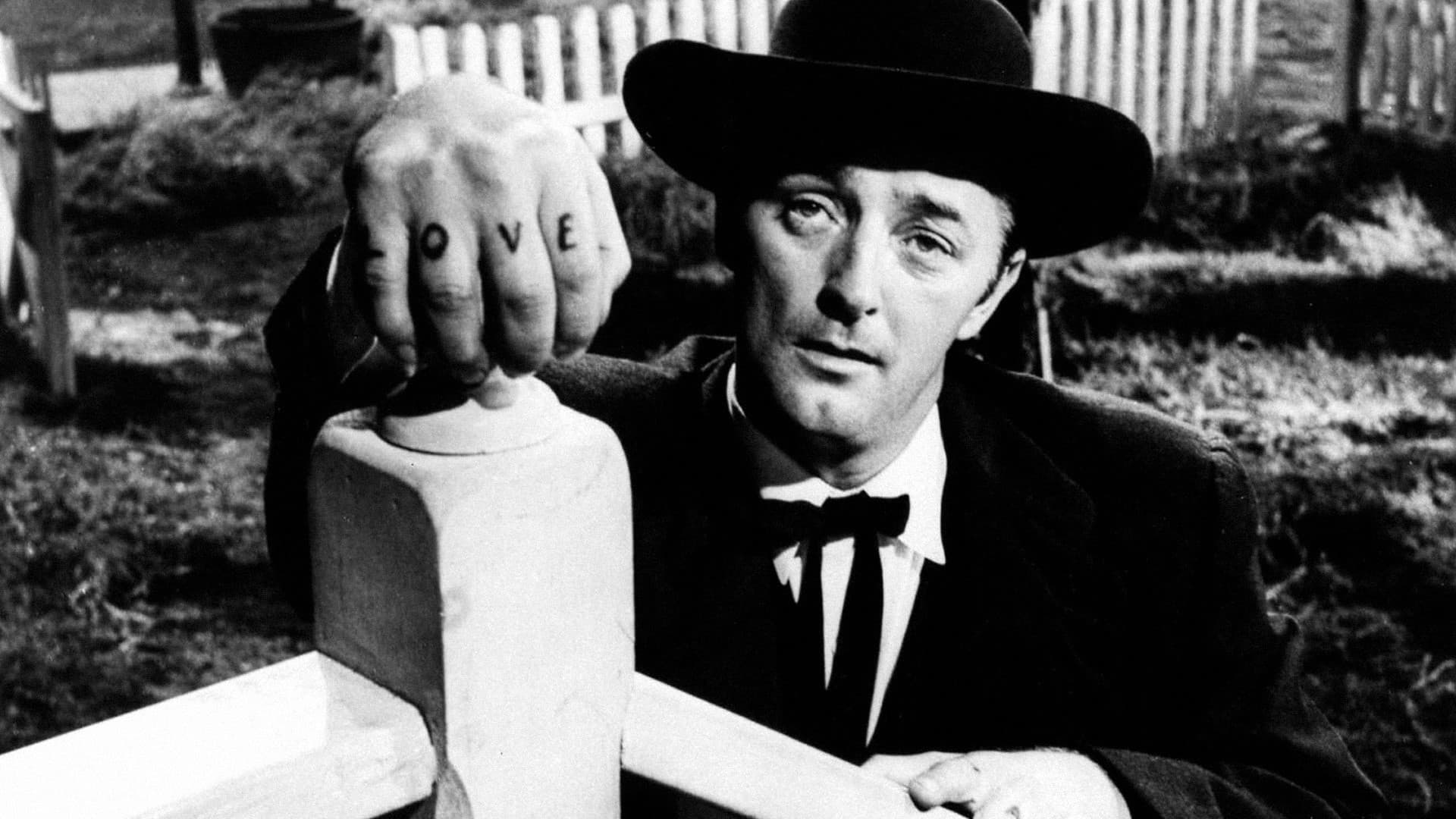
Laughton rehearsed extensively with the cast before cameras rolled. He worked particularly closely with Robert Mitchum, who later called Laughton the best director he ever worked with. Mitchum's portrayal of the murderous, scripture-quoting Preacher Harry Powell, complete with LOVE and HATE tattooed across his knuckles, became one of cinema's most iconic villain performances.
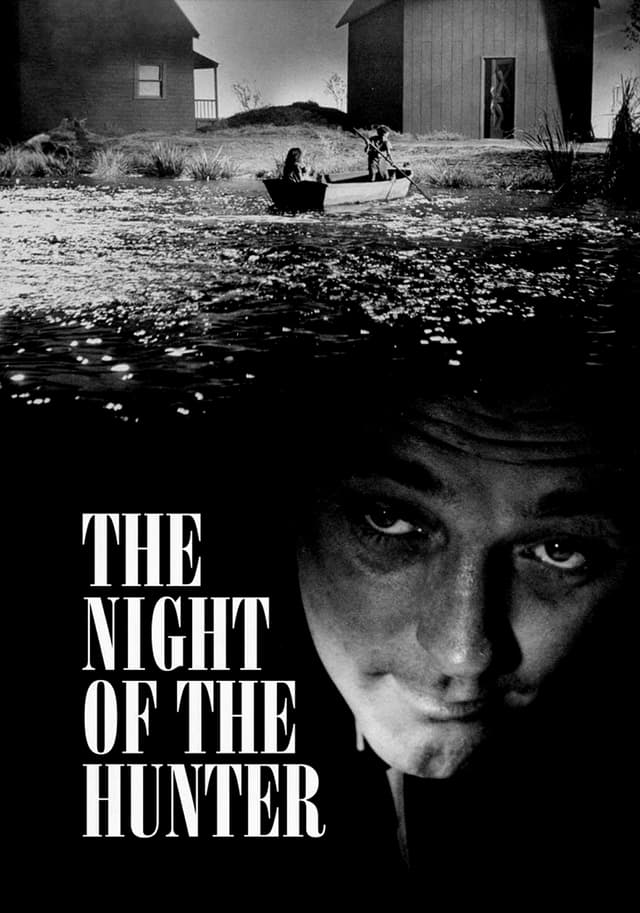
Cinematographer Stanley Cortez brought an exacting, time-consuming approach to the film's visual design. Drawing on influences from German Expressionism, silent film, and Griffith-era compositions, Cortez created images that looked like nothing else in 1950s American cinema. The river sequence, in which the children float downstream on a skiff past oversized foreground animals and vegetation, was shot on a soundstage with forced-perspective sets and careful rear projection. The result is one of the most celebrated sequences in film history.
Principal photography took place at Republic Studios and Pathé Studios in Los Angeles. Laughton's perfectionism and Cortez's deliberate lighting setups created tension with Gregory over the schedule, though the film ultimately came in close to its budget. Laughton brought Lillian Gish out of semi-retirement to play Rachel Cooper, the protective matriarch of the film's final act, in a performance that echoed Gish's own silent-film legacy.
Awards and Recognition
The Night of the Hunter received no Academy Award nominations upon its release, a reflection of its commercial failure and the critical indifference it faced in 1955. The film was largely overlooked by major awards bodies during its initial run.
The reassessment began in the 1960s and accelerated through the 1970s and 1980s as critics and filmmakers recognized the film's singular vision. In 1992, the Library of Congress selected The Night of the Hunter for preservation in the National Film Registry, citing its cultural, historical, and aesthetic significance.
The American Film Institute placed the film on multiple lists: the AFI 100 Years...100 Thrills list ranked it among the greatest screen thrillers, and the AFI 100 Years...100 Heroes & Villains list ranked Preacher Harry Powell as the 29th greatest screen villain. Sight & Sound's decennial critics' poll has consistently included the film, and it appeared in the 2012 poll's top 100. The Criterion Collection released a definitive restoration, further cementing its canonical status.
Critical Reception
Initial reviews in 1955 were sharply divided. Some critics praised Mitchum's menacing performance and the film's visual audacity, but many found the tonal shifts between thriller, fable, and comedy jarring. Audiences expecting a conventional suspense film were confused by Laughton's expressionist approach. The Los Angeles Times and several major outlets gave lukewarm notices, and the film disappeared from theaters quickly.
The critical reversal that followed is one of the most dramatic in American cinema. By the late 1960s, French critics at Cahiers du Cinema had championed the film, and American critics including Pauline Kael and Andrew Sarris reassessed it as a masterpiece. The film's influence became visible in the work of directors ranging from Martin Scorsese and David Lynch to Terrence Malick and the Coen Brothers. Spike Lee screened it for his NYU film students as an example of pure cinema.
Today The Night of the Hunter holds a 93% score on Rotten Tomatoes. It is regularly cited as one of the greatest American films ever made, with particular praise for Cortez's cinematography, Mitchum's performance, and Laughton's singular directorial vision. The tragedy of Laughton never directing again, discouraged by the film's commercial failure, is considered one of cinema's great losses. The film stands as proof that commercial performance at release is a poor predictor of lasting artistic significance.
Frequently Asked Questions
How much did it cost to make The Night of the Hunter (1955)?
The production budget was $795,000, covering principal photography, cast and crew salaries, locations, sets, post-production, and music. Marketing and distribution (P&A) costs are estimated at an additional $397,500 - $636,000, bringing the total studio investment to approximately $1,192,500 - $1,431,000.
How much did The Night of the Hunter (1955) earn at the box office?
Box office figures are not publicly available.
Was The Night of the Hunter (1955) profitable?
Insufficient data for a profitability assessment.
What were the biggest costs in producing The Night of the Hunter?
The primary cost drivers were above-the-line talent (Robert Mitchum, Shelley Winters, Lillian Gish); talent compensation, location cinematography, and tension-driven editorial.
How does The Night of the Hunter's budget compare to similar crime films?
At $795,000, The Night of the Hunter is classified as a ultra-low-budget production. The median budget for wide-release crime films in the era ranges from $30 - 80M for mid-budget to $150M+ for tentpoles. Comparable budgets: The Battle of Algiers (1966, $800,000); The Grapes of Wrath (1940, $800,000); Children of the Corn (1984, $800,000).
Did The Night of the Hunter (1955) go over budget?
There are no widely reported accounts of significant budget overruns for this production. However, studios rarely disclose precise budget overrun figures publicly. The reported production budget reflects the final estimated cost.
What awards did The Night of the Hunter (1955) win?
2 wins & 1 nomination total.
Who directed The Night of the Hunter and who were the key crew members?
Directed by Charles Laughton, written by James Agee, Charles Laughton, shot by Stanley Cortez, with music by Walter Schumann, edited by Robert Golden.
Where was The Night of the Hunter filmed?
The Night of the Hunter was filmed in United States of America. Principal photography of The Night of the Hunter began on August 15 and ended on October 7, 1954, a total of 36 days of shooting. Laughton kept the editor and musical composer on set during filming, which was very uncommon at the time.
Filmmakers
The Night of the Hunter

Official Trailer
Build budgets like this one in Saturation
Start from an industry-standard feature film template, import the schedule and rates you already have, and let the cost report keep itself current as you spend. Real-time collaboration, no spreadsheets.