What a Girl Wants Budget
 Comedy
Updated
Synopsis
An American teenager raised in New York by her single bohemian mother travels to London to find her father, a wealthy aristocratic British MP who never knew of her existence and is in the middle of a tightly contested parliamentary by-election bid. Her arrival at his Mayfair townhouse disrupts both his political prospects and his fiancée's social plans, and her own running into a young London musician threatens to derail the upper-class makeover her father's political advisors stage to manage the resulting press attention.
What Is the Budget of What a Girl Wants (2003)?
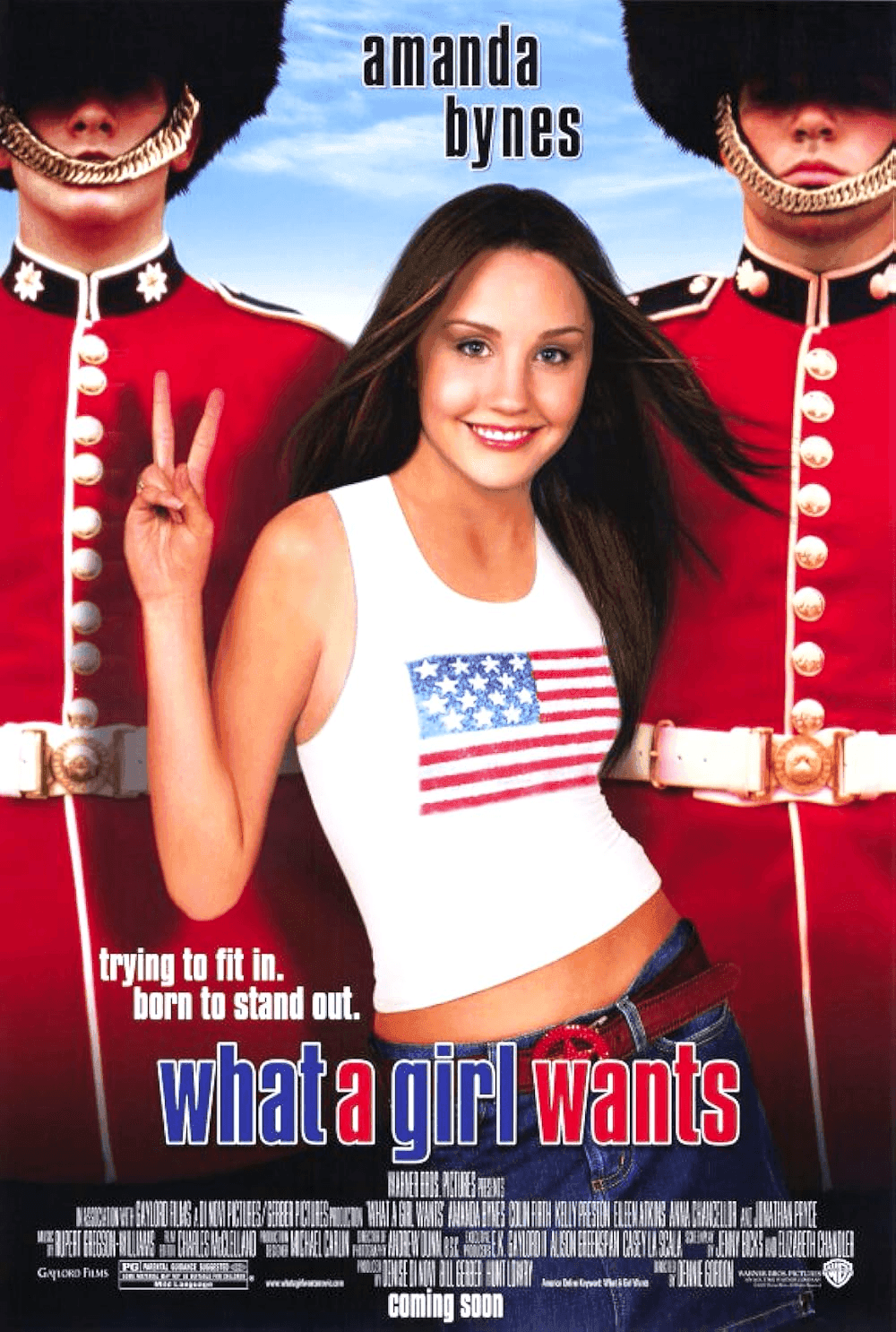
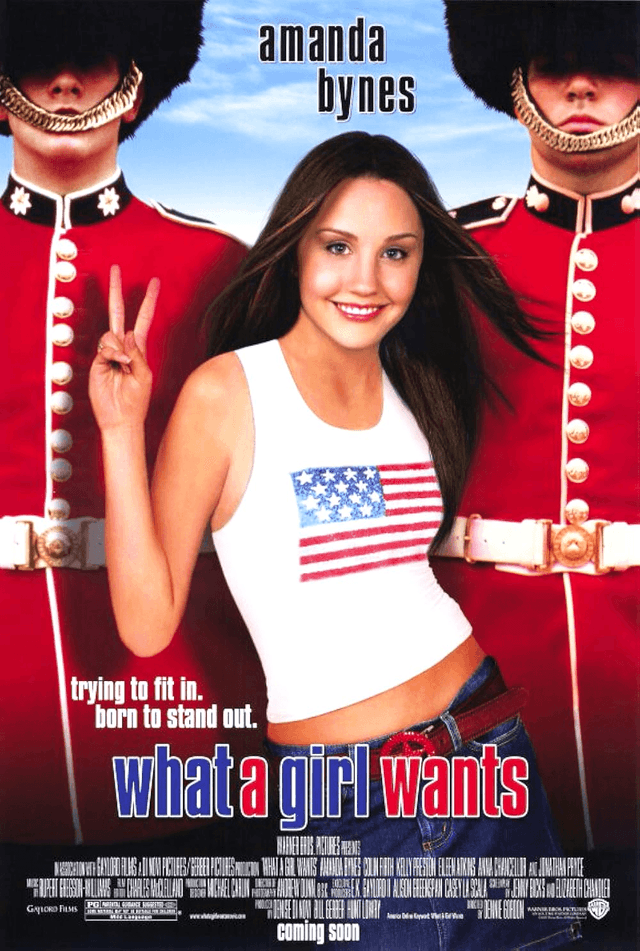
What a Girl Wants (2003), directed by Dennie Gordon and distributed by Warner Bros. Pictures, was produced on a reported budget of $35,000,000. The PG-rated teen romantic comedy starred Amanda Bynes as an American teenager who travels to London to meet her aristocratic British father, played by Colin Firth, while navigating the etiquette and social politics of the English upper class during the run-up to her father's parliamentary by-election bid. Gaylord Films and Di Novi Pictures produced for Warner Bros., with Bill Gerber, Denise Di Novi, and Hunt Lowry producing.
The investment reflected a substantial budget for a teen-romantic-comedy positioned as a Bynes star vehicle, with the UK location-heavy shoot anchoring the overall production cost. The film was conceived as an Easter-weekend family release positioned to convert Bynes's What I Like About You television audience into a feature-film draw, and Warner Bros. needed worldwide grosses of approximately $70,000,000 to clear marketing and distribution costs, a benchmark the film fell well short of by the end of its theatrical window.
Key Budget Allocation Categories
What a Girl Wants's reported $35,000,000 budget was distributed across several core production areas:
- Above-the-Line Talent: Amanda Bynes, in her first major studio feature lead, commanded the largest single fee against her teen-television-star rate. Colin Firth, in one of his first post-Bridget Jones's Diary (2001) studio roles, received a co-lead rate that proved a bargain given his subsequent rise. Director Dennie Gordon, primarily a television director (Ally McBeal, The Practice) with one previous feature credit (Joe Dirt, 2001), commanded a feature-director rate appropriate to a Warner Bros. mid-budget teen comedy.
- London and UK Location Shoot: Principal photography took place extensively in London and surrounding English countryside, with practical-location work at Hampton Court, Royal Hospital Chelsea, the Henley Royal Regatta, Stansted Park, and numerous London exteriors including Trafalgar Square, Notting Hill, and Oxford Street. UK location fees, lodging, and below-the-line crew rates absorbed a substantial share of the budget, with the production accessing modest UK film tax credits available at the time.
- Period and Aristocratic Wardrobe: Costume designer Shirley Russell built distinct wardrobe arcs for the lead character's transformation from American teenager to English aristocratic debutante, with multiple wardrobe sequences requiring custom builds. The Henley Royal Regatta ball sequence, the Trafalgar Square fashion-magazine cover shoot, and the parliamentary garden party each required period-correct or contemporary-British-upper-class formalwear at scale, including a full debutante-ball ensemble for the climactic sequence.
- Music and Soundtrack: Composer Rupert Gregson-Williams delivered the orchestral score, while music supervisors Carol Sue Baker and Pilar McCurry assembled an extensive soundtrack of contemporary teen-pop, British rock, and dance-pop placements aimed at the teen-girl target demographic. The soundtrack budget covered original composition, master licensing, and synchronization rights for the multiple needle drops used in shopping-montage, fashion-makeover, and dance sequences. The accompanying soundtrack album was released by Atlantic Records.
- Production Design: Production designer Jim Clay dressed the contrasting American suburban-house, central London townhouse, English country estate, and Houses of Parliament interiors required by the bicontinental story structure. The Dashwood family country estate, assembled across multiple practical English locations, required period-correct interior dressing on top of the practical exteriors.
- Visual Effects and Inserts: The film required minimal digital visual effects beyond standard period and continuity cleanup, but the production budgeted for elaborate insert sequences including a Big Ben tower establishing shot, fashion-magazine cover composites, and a parliamentary-debate composite involving extended UK-establishment background performers.
How Does What a Girl Wants's Budget Compare to Similar Films?
At a reported $35,000,000, What a Girl Wants sat in the upper-middle tier for teen romantic comedies of the early 2000s. The comparison set below illustrates how its production scale stacked up against contemporaneous teen-comedy peers:
- The Princess Diaries (2001): Budget $26,000,000 | Worldwide $165,335,153. Walt Disney's Anne Hathaway royal-makeover comedy cost roughly seventy-five percent of What a Girl Wants and grossed almost four times worldwide, providing the gold-standard benchmark for the American-girl-meets-European-royalty teen format that What a Girl Wants consciously chased and missed.
- What a Girl Wants-adjacent Ella Enchanted (2004): Budget $31,000,000 | Worldwide $27,236,388. Miramax's Anne Hathaway fairy-tale-Cinderella comedy cost eleven percent less than What a Girl Wants and grossed substantially less worldwide, providing a closer underperformance peer at a similar budget tier.
- A Cinderella Story (2004): Budget $19,000,000 | Worldwide $70,069,000. Warner Bros.'s Hilary Duff fairy-tale teen comedy cost roughly fifty-four percent of What a Girl Wants and grossed about fifty-five percent more worldwide, illustrating that the studio teen-comedy genre had clear commercial winners at much lower cost.
- Confessions of a Teenage Drama Queen (2004): Budget $19,000,000 | Worldwide $33,952,289. Walt Disney's Lindsay Lohan teen comedy cost roughly fifty-four percent of What a Girl Wants and grossed about seventy-five percent worldwide, providing the closest direct teen-star comp.
- Sleepover (2004): Budget $10,000,000 | Worldwide $30,055,565. MGM's Alexa Vega teen comedy cost less than one third of What a Girl Wants and grossed roughly two thirds worldwide, providing the lower-end benchmark and showing how much margin Warner Bros. gave up on the location-heavy UK production.
What a Girl Wants Box Office Performance
What a Girl Wants opened on April 4, 2003 to $11,621,031 in the United States, finishing third on its opening weekend behind A Man Apart and Phone Booth. The film held within thirty-five percent declines for several weeks on teen-girl word of mouth but never broke out into wider audience reach. It ended its domestic run at $36,109,652 and added only $8,937,989 internationally for a worldwide total of $45,047,641. Here is the financial breakdown:
Box Office Breakdown
What a Girl Wants

What a Girl Wants returned approximately $0.70 to $0.75 in theatrical revenue for every $1 invested when measured against total estimated production and marketing spend, placing it among the clearer commercial disappointments in Warner Bros.'s 2003 release calendar. The domestic share of the gross was $36,109,652 against an international share of just $8,937,989, an 80/20 split heavily weighted toward North America and a clear signal that despite the UK setting the film did not travel internationally.
The relatively poor international performance was particularly surprising for a London-set teen comedy positioned to leverage British audience interest in the country's own setting, and trade-press coverage at the time attributed the gap to weak Bynes name recognition outside the United States. Home video, DVD, and cable windows partially recovered the investment, with the film building a steady streaming-era catalog audience around Amanda Bynes's and Colin Firth's subsequent profiles.
What a Girl Wants Production History
Development began in 2001 when Warner Bros. acquired the rights to the 1958 William Douglas-Home play The Reluctant Debutante, with the intention of substantially modernizing the British-society source material for a contemporary teen-comedy audience. Screenwriters Jenny Bicks and Elizabeth Chandler adapted the play through 2001 and 2002, retaining the original's central American-debutante-in-London framework while contemporizing the social politics. Bill Gerber, Denise Di Novi, and Hunt Lowry produced through their respective Warner Bros. deals.
Amanda Bynes attached to the lead role in early 2002, signing a development deal that gave her input into the script and made the project effectively a starring vehicle. Colin Firth signed on as Henry Dashwood in mid-2002, with Kelly Preston cast as Bynes's American mother, Eileen Atkins as her aristocratic grandmother, and Anna Chancellor as her father's political advisor and the antagonist. Television director Dennie Gordon, with a strong situation-comedy background and one feature credit, signed on to direct.
Principal photography ran from August to November 2002 across London and the English countryside, with practical-location work at Hampton Court, Royal Hospital Chelsea, Stansted Park, the Henley Royal Regatta, and numerous London exteriors including Trafalgar Square, Notting Hill, and Oxford Street. UK Studios at Pinewood and Shepperton hosted the interior soundstage work, with the production accessing the modest UK film tax credits available at the time. The location-heavy shoot ran on schedule, with the Christmas-week wrap allowing post-production to extend through early 2003.
Post-production completed in early 2003, with Warner Bros. setting an April 4 release date in a clear Easter-weekend family-counter-programming slot. Marketing emphasized the Bynes-Firth pairing, the British-aristocratic-fish-out-of-water premise, and the contemporary makeover and romance hooks, with trailers structured around the comic Henley-regatta and parliamentary-garden-party sequences. The film opened to a moderate first weekend but never built the breakout audience reach Warner Bros. had hoped for.
Awards and Recognition
What a Girl Wants received limited but notable awards recognition primarily in the teen-and-popular-vote categories. Amanda Bynes received a Teen Choice Award nomination for Choice Movie Actress: Comedy at the 2003 Teen Choice Awards, and the film received an additional Teen Choice nomination for Choice Movie: Comedy. Bynes also received a Kids' Choice Award nomination for Favorite Movie Actress at the 2004 ceremony.
The film was not in serious contention at the major industry ceremonies such as the Oscars, the Golden Globes, the Screen Actors Guild Awards, or the major guild ceremonies. Colin Firth's supporting performance was not nominated at any major industry ceremony despite favorable mention in some critical coverage, with his subsequent A Single Man (2009) and The King's Speech (2010) nominations representing his more substantial industry recognition in the years following.
Critical Reception
What a Girl Wants received mixed-to-negative reviews. The film holds a 36% approval rating on Rotten Tomatoes based on 122 critic reviews, with a critical consensus describing it as a pleasant but unambitious teen comedy that wastes its UK setting and Colin Firth supporting performance. On Metacritic, the film scored 46 out of 100, indicating mixed or average reviews. Audiences surveyed by CinemaScore gave the film an A-, an exceptionally strong audience grade that contrasted notably with the critical reception.
Critics broadly praised Amanda Bynes's central comic performance, the London location work, and Colin Firth's supporting performance, but objected to the screenplay's broad pacing and the formulaic teen-makeover beats. Roger Ebert gave the film one and a half stars out of four, writing that "the screenplay seems to have been assembled from a teen-comedy template," while The New York Times's A.O. Scott called it "a movie that thinks it is more charming than it is." Variety's Robert Koehler praised Bynes but called the film "familiar to a fault."
A handful of mainstream outlets were marginally more forgiving, with Entertainment Weekly noting Bynes's comic timing as the principal saving grace, but the consensus across both trade press and mainstream outlets was that the film was a missed opportunity given its cast and UK setting. The film's reputation has been somewhat reassessed in subsequent years, particularly as Amanda Bynes's later well-publicized personal struggles drew streaming-era viewers to revisit her early-career work, but its critical and commercial reception remains a clear mid-tier outcome for a Warner Bros. teen comedy of the early 2000s.
Frequently Asked Questions
How much did it cost to make What a Girl Wants (2003)?
The reported production budget was $35,000,000, financed by Warner Bros. Pictures with Gaylord Films and Di Novi Pictures producing. The UK location-heavy shoot anchored the production cost, with modest UK film tax credits providing a partial offset against the London and English countryside production base.
How much did What a Girl Wants earn at the box office?
The film grossed $36,109,652 domestically and only $8,937,989 internationally, for a worldwide total of $45,047,641. It opened to $11,621,031 in the United States, finishing third on the weekend of April 4, 2003 behind A Man Apart and Phone Booth.
Was What a Girl Wants a box office flop?
It underperformed but did not collapse. Against a $35,000,000 production budget and an estimated $25,000,000 to $30,000,000 in marketing spend, the film returned approximately $0.70 to $0.75 in worldwide theatrical revenue for every $1 invested. Home video and cable windows partially recovered the investment, with the film classified as a commercial disappointment rather than a clear bomb.
Who directed What a Girl Wants?
Dennie Gordon directed the film, her second feature credit after Joe Dirt (2001). Gordon was primarily a television director with extensive credits on Ally McBeal, The Practice, and Sex and the City, and she went on to direct New York Minute (2004) and the television series Better Things.
Where was What a Girl Wants filmed?
Principal photography ran from August to November 2002 across London and the English countryside, with practical-location work at Hampton Court, Royal Hospital Chelsea, Stansted Park, the Henley Royal Regatta, Trafalgar Square, Notting Hill, and Oxford Street. UK studios at Pinewood and Shepperton hosted the interior soundstage work.
How does What a Girl Wants compare to The Princess Diaries?
What a Girl Wants cost about thirty-five percent more than The Princess Diaries ($26 million in 2001) and grossed only about twenty-seven percent as much worldwide. The Princess Diaries proved a much more durable franchise, generating a successful sequel and lasting streaming-era audience. What a Girl Wants represented a clear commercial disappointment by comparison and did not produce a sequel.
Who stars in What a Girl Wants?
Amanda Bynes plays Daphne Reynolds and Colin Firth plays her father Henry Dashwood. Kelly Preston plays her American mother, Eileen Atkins plays her aristocratic grandmother, Anna Chancellor plays her father's political advisor, and Jonathan Pryce plays her father's political opponent. Oliver James plays Daphne's London musician love interest Ian Wallace.
Did What a Girl Wants win any awards?
No major awards. The film received a Teen Choice Award nomination for Amanda Bynes (Choice Movie Actress: Comedy) at the 2003 ceremony and a Kids' Choice Award nomination for Favorite Movie Actress at the 2004 ceremony. It was not in serious contention at the major industry ceremonies such as the Oscars, Golden Globes, or Screen Actors Guild Awards.
What did critics think of What a Girl Wants?
The film received mixed-to-negative reviews. It holds a 36% approval rating on Rotten Tomatoes (122 critics) and a 46 out of 100 Metacritic score. Audiences gave it an A- CinemaScore, an exceptionally strong audience grade that contrasted with the critical reception. Critics broadly praised Bynes's performance and Colin Firth's supporting work but objected to the formulaic teen-makeover beats.
What is What a Girl Wants based on?
The film is loosely adapted from William Douglas-Home's 1958 stage play The Reluctant Debutante, which had previously been adapted as a 1958 MGM film starring Rex Harrison and Kay Kendall. Jenny Bicks and Elizabeth Chandler's 2003 screenplay substantially modernized the British-society source material, replacing the original's post-war debutante-season framework with a contemporary American-teen-meets-London-aristocracy premise.
Filmmakers
What a Girl Wants

Build budgets like this one in Saturation
Start from an industry-standard feature film template, import the schedule and rates you already have, and let the cost report keep itself current as you spend. Real-time collaboration, no spreadsheets.