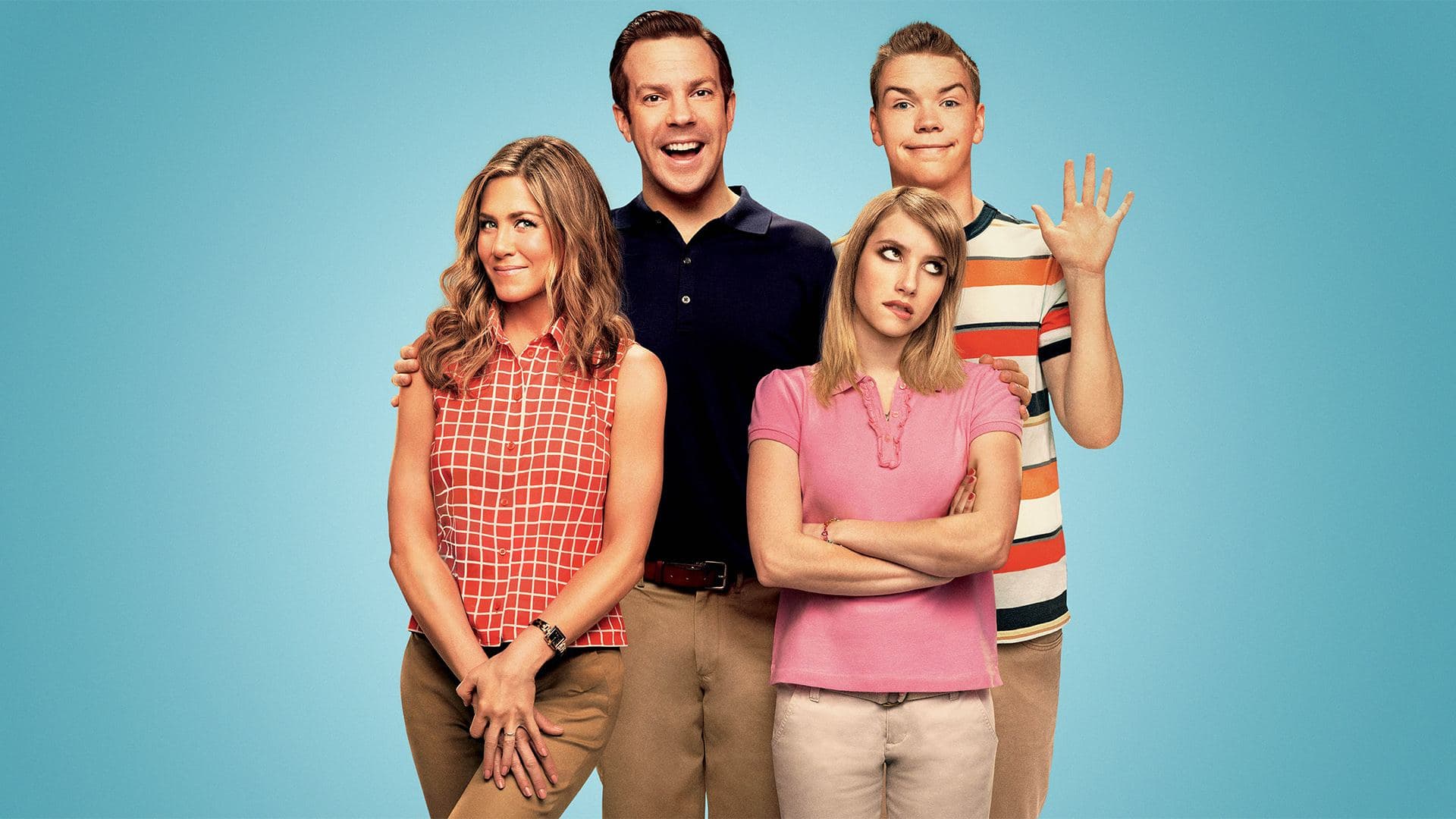
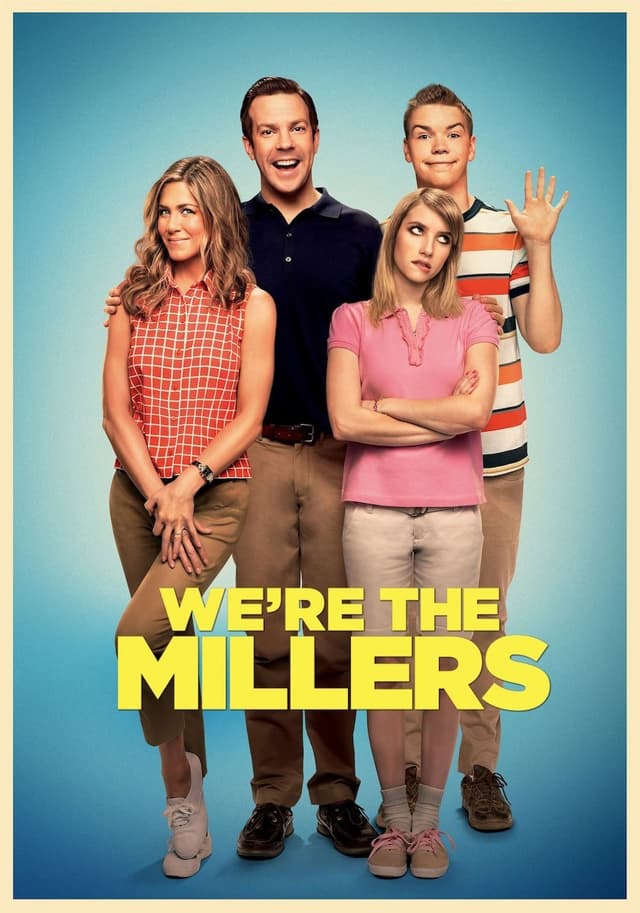
We're the Millers Budget
 ComedyCrime1h 50m
Updated
Synopsis
A veteran pot dealer creates a fake family as part of his plan to move a huge shipment of weed into the U.S. from Mexico.
What Is the Budget of We're the Millers?
We're the Millers was produced on a budget of $37 million, financed by New Line Cinema and distributed by Warner Bros. Pictures. For a mid-budget R-rated comedy, $37 million placed it squarely in the range that New Line and Warner Bros. had used successfully for Horrible Bosses (2011) and The Hangover (2009): enough to attract genuine stars and shoot on location, but disciplined enough that a modest domestic opening would not threaten profitability.
The economics of R-rated studio comedies in 2013 were straightforward: above-the-line talent (lead actors, director, writers) consumed the bulk of the budget, with production costs kept lean through a road-trip format that avoided expensive set construction. We're the Millers followed that formula precisely, assembling a recognizable cast around a high-concept premise and keeping production grounded in Wilmington, North Carolina.
Key Budget Allocation Categories
- Above-the-Line Talent: Jason Sudeikis had recently established himself as a leading man after leaving Saturday Night Live, while Jennifer Aniston remained one of Hollywood's most marketable stars. Aniston's willingness to take an R-rated role that included a notable striptease sequence was a calculated career move, and her above-the-line fee likely represented the single largest line item in the budget, estimated at $5 to $8 million for both leads combined.
- Wilmington Production Base: Principal photography was based at EUE/Screen Gems Studios in Wilmington, North Carolina, a full-service production facility that offered competitive rates and extensive stage space. North Carolina's film tax incentive program was in full operation in 2013, providing a meaningful rebate on qualified spend. The summer shoot avoided the congested Los Angeles production calendar and kept below-the-line costs predictable.
- Comedy Writing and Rewrites: The screenplay carries four credited writers: Bob Fisher, Steve Faber, Sean Anders, and John Morris. Multiple screenplay credits typically reflect a development process involving multiple drafts and paid rewrites. New Line had been developing the premise since the mid-2000s, and the credit count suggests a long development trajectory that added meaningful WGA residual liability to the upfront production budget.
- Practical Location Work: The film's road-trip structure required shooting actual highway sequences, a US-Mexico border crossing environment, and RV park locations. Mexico border sequences were filmed at practical locations rather than built sets, adding logistics cost and coordination with location scouts. The RV itself became a central production asset requiring mechanical preparation for driving sequences.
- Ludwig Goransson Score and Music Licensing: Ludwig Goransson composed the original score, one of his early major studio assignments before his career-defining work on Creed (2015) and Black Panther (2018). R-rated comedies also carry significant music licensing costs for needle-drop tracks, and the film's road-trip format provided natural moments for licensed songs throughout the runtime.
How Does We're the Millers' Budget Compare to Similar Films?
We're the Millers competed in the R-rated studio comedy market that Warner Bros. and New Line had dominated since The Hangover in 2009. Its $37 million budget and $270 million worldwide gross placed it among the most efficient R-rated comedies of the early 2010s.
- The Hangover (2009): Budget $35M | Worldwide $467.5M. The defining R-rated comedy hit of the era, also from Warner Bros. and produced for a near-identical budget. The Hangover's extraordinary returns reset the market for R-rated comedy ambition and created the template that We're the Millers followed four years later. We're the Millers matched the budget discipline but not the historic gross.
- Horrible Bosses (2011): Budget $35M | Worldwide $209.7M. A direct predecessor from the same New Line/Warner Bros. pipeline, also R-rated with an ensemble of known comedic actors. We're the Millers outperformed Horrible Bosses at the worldwide box office by approximately $60 million, confirming that the R-rated ensemble comedy format still had commercial runway in 2013.
- Identity Thief (2013): Budget $35M | Worldwide $173.4M. Universal's R-rated road comedy released the same year, starring Jason Bateman and Melissa McCarthy. Identity Thief performed well but fell short of We're the Millers at the global box office. The two films occupied similar market positions in 2013, and We're the Millers' superior worldwide performance validated its casting and marketing strategy.
- Dodgeball: A True Underdog Story (2004): Budget $20M | Worldwide $167.7M. Rawson Marshall Thurber's directorial debut and his highest-profile theatrical film before We're the Millers. Dodgeball was made for roughly half the budget and earned solid returns, but We're the Millers represented a major step up in production scale, casting ambition, and commercial result for Thurber.
We're the Millers Box Office Performance
We're the Millers opened on August 7, 2013, earning $26.4 million in its opening weekend from 3,445 theaters. The film held well through the summer, benefiting from strong word-of-mouth and repeat viewing driven by the cast chemistry and Jennifer Aniston's heavily marketed striptease sequence. Warner Bros. expanded the film internationally through August and September, adding meaningful overseas grosses to a domestic run that continued past Labor Day.
Against a $37 million production budget and an estimated $30 million in prints and advertising spending, We're the Millers required approximately $67 million in total investment to reach theaters. With theaters retaining roughly 50% of gross receipts, the studio's share of the $270 million worldwide gross was approximately $135 million. The film cleared its combined production and marketing investment substantially, generating a strong return by the standards of mid-budget studio comedy.
Box Office Breakdown
We're the Millers

On production budget alone, We're the Millers earned roughly $7.30 for every $1 invested. Factoring in the full $67 million cost-to-market, the film returned approximately $2.01 for every dollar spent reaching audiences, a result that comfortably justifies the budget and confirmed the commercial viability of the R-rated road comedy format for Warner Bros.
We're the Millers Production History
The screenplay for We're the Millers had a long development history at New Line Cinema, with the original concept circulating in the mid-2000s. Bob Fisher and Steve Faber worked on early drafts of the script, which centered on a drug dealer assembling a fake family to smuggle marijuana across the Mexican border. The premise languished in development before Sean Anders and John Morris were brought in to rewrite, eventually producing the draft that attracted the cast and greenlight.
Casting came together in 2012. Jason Sudeikis, who had left Saturday Night Live in 2013 after a decade as a featured player and cast member, had been building his film career with supporting roles in Horrible Bosses (2011) and The Campaign (2012). We're the Millers gave him his first genuine leading man role in a studio comedy. Jennifer Aniston's decision to take the role of Rose, which included a physically demanding striptease sequence, signaled a deliberate effort to expand her comedic range beyond romantic comedy leads. Emma Roberts and Will Poulter were cast as the fake children, with Poulter in particular delivering scenes that became central to the film's marketing.
Principal photography began in spring 2013 in Wilmington, North Carolina. The production used EUE/Screen Gems Studios as its base of operations, shooting interior sequences on stages and using Wilmington's surrounding geography for highway and location work. Mexico border crossing sequences were filmed at practical locations outside North Carolina, adding travel and logistics coordination to the production calendar. The shoot ran approximately 60 days and wrapped ahead of the August 7 release date.
Warner Bros. built its marketing campaign heavily around Jennifer Aniston's striptease scene, releasing footage and imagery that generated significant online attention in the weeks before opening. Rawson Marshall Thurber delivered a cut that tested well with preview audiences, and the studio committed to a wide summer release against relatively light competition in the first weeks of August 2013. The film opened at number one domestically and held the position for two weeks, establishing itself as one of the summer's reliable hits.
Awards and Recognition
We're the Millers did not receive any Academy Award nominations, which is consistent with the R-rated studio comedy category in the modern era. The film received nominations at the MTV Movie Awards, where Jennifer Aniston was nominated for Best Female Performance and the cast received a nomination for Best On-Screen Duo (Sudeikis and Aniston). Will Poulter was nominated for Best Scared-As-S**t Performance at the same ceremony for his character's memorably awkward sequences.
The film's cultural legacy rests primarily on its commercial performance and its place in the lineage of R-rated Warner Bros. comedies. We're the Millers helped validate the mid-budget R-rated ensemble comedy as a commercially viable format at a moment when many studios were retreating from original mid-budget content. Ludwig Goransson's early career involvement has become a footnote of interest as his subsequent work on Creed, Black Panther, Tenet, and Oppenheimer made him one of the most decorated composers of his generation.
Critical Reception
We're the Millers received mixed-to-positive reviews from critics, landing at approximately 61% on Rotten Tomatoes. Critics who responded favorably cited the cast chemistry as the film's primary asset: Sudeikis and Aniston's dynamic was widely praised as surprisingly effective, and Will Poulter received consistent notice for his comic timing. Reviewers who found the film lacking pointed to a formulaic structure, predictable escalation of road-trip complications, and a premise that required audiences to root for drug smugglers.
Audience reception was considerably warmer than the critical consensus. The film's CinemaScore was B+, and its strong holds in subsequent weekends reflected favorable word-of-mouth among the target demographic of adult comedy audiences. The striptease sequence generated ongoing discussion and sharing on social media, driving awareness among younger viewers who hadn't seen the film in theaters. We're the Millers has performed strongly in home video and streaming, cementing a reputation as a reliable crowd-pleaser in the R-rated comedy catalog.
Over the decade since its release, the film's reputation has settled into that of a well-executed studio comedy that delivered exactly what it promised: a talented cast in an absurd premise, executed with professional polish. The ensemble continues to be cited as an underrated example of casting chemistry in the genre, and Thurber's direction is credited with keeping the tonal balance between raunchy comedy and character-driven warmth throughout a narrative that could have become mean-spirited in less careful hands.
Frequently Asked Questions
How much did it cost to make We're the Millers (2013)?
The production budget was $37,000,000, covering principal photography, cast and crew salaries, locations, sets, post-production, and music. Marketing and distribution (P&A) costs are estimated at an additional $18,500,000 - $29,600,000, bringing the total studio investment to approximately $55,500,000 - $66,600,000.
How much did We're the Millers (2013) earn at the box office?
We're the Millers grossed $150,394,119 domestic, $119,605,881 international, totaling $270,000,000 worldwide.
Was We're the Millers (2013) profitable?
Yes. Against a production budget of $37,000,000 and estimated total costs of ~$92,500,000, the film earned $270,000,000 theatrically - a 630% ROI on production costs alone.
What were the biggest costs in producing We're the Millers?
The primary cost drivers were above-the-line talent (Jennifer Aniston, Jason Sudeikis, Emma Roberts); star comedian salaries, location filming, and aggressive marketing campaigns; international production across United Kingdom, United States of America.
How does We're the Millers's budget compare to similar comedy films?
At $37,000,000, We're the Millers is classified as a low-budget production. The median budget for wide-release comedy films in the 2010s ranges from $30 - 80M for mid-budget to $150M+ for tentpoles. Comparable budgets: House on Haunted Hill (1999, $37,000,000); Magnolia (1999, $37,000,000); Twilight (2008, $37,000,000).
Did We're the Millers (2013) go over budget?
There are no widely reported accounts of significant budget overruns for this production. However, studios rarely disclose precise budget overrun figures publicly. The reported production budget reflects the final estimated cost.
What was the return on investment (ROI) for We're the Millers?
The theatrical ROI was 629.7%, calculated as ($270,000,000 − $37,000,000) ÷ $37,000,000 × 100. This measures gross revenue against production budget only - it does not account for P&A or exhibitor shares.
What awards did We're the Millers (2013) win?
4 wins & 17 nominations total.
Who directed We're the Millers and who were the key crew members?
Directed by Rawson Marshall Thurber, written by Steve Faber, Bob Fisher, Sean Anders, John Morris, shot by Barry Peterson, with music by Theodore Shapiro, Ludwig Göransson, edited by Michael L. Sale.
Where was We're the Millers filmed?
We're the Millers was filmed in United Kingdom, United States of America.
Filmmakers
We're the Millers

Build budgets like this one in Saturation
Start from an industry-standard feature film template, import the schedule and rates you already have, and let the cost report keep itself current as you spend. Real-time collaboration, no spreadsheets.