Wayne's World Budget
 Comedy
Updated
Synopsis
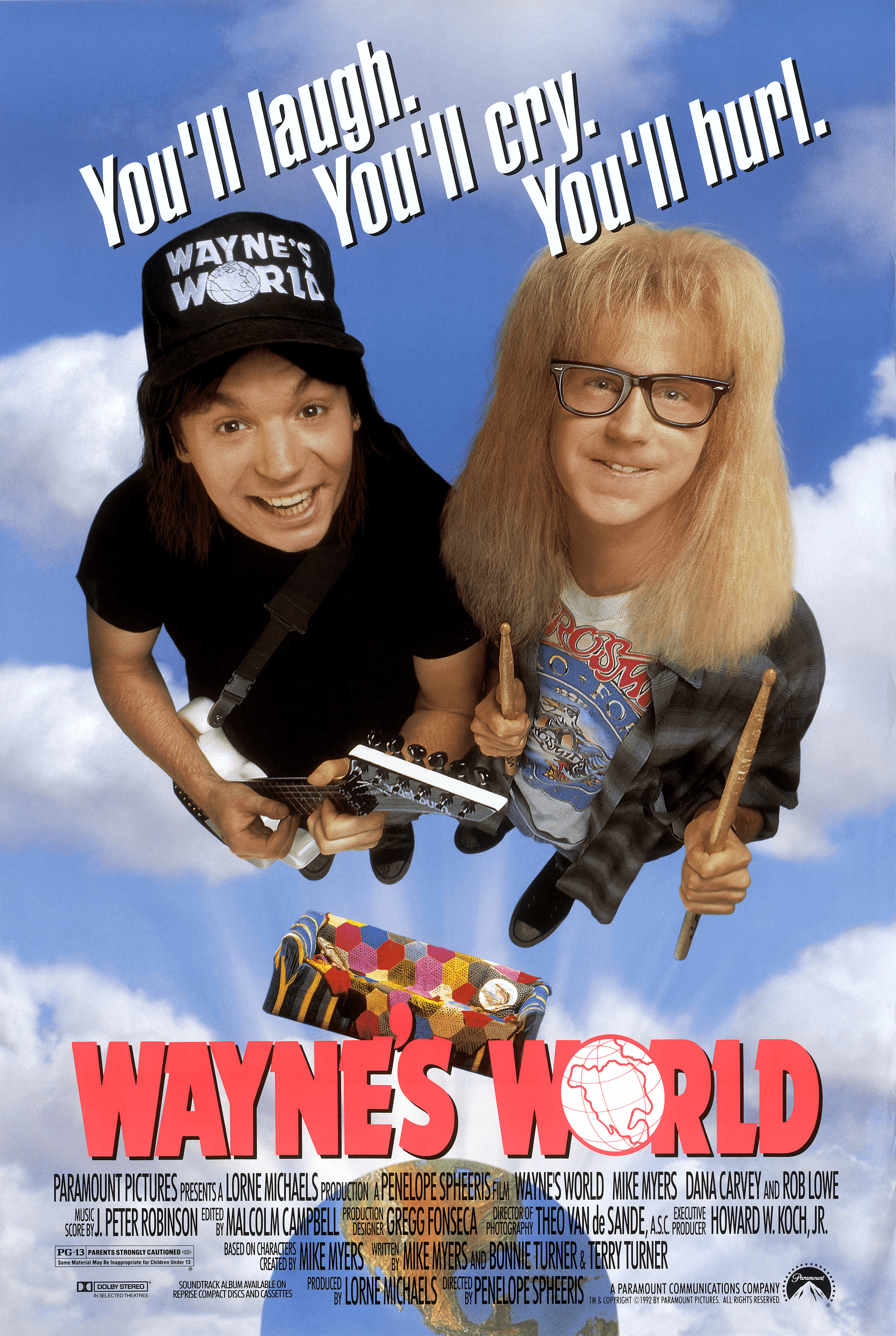
Two heavy-metal-loving slackers, Wayne Campbell and Garth Algar, host a low-budget public-access cable television show from Wayne's parents' basement in Aurora, Illinois. When a sleazy television producer buys their show as a sponsorship vehicle for a video-arcade tycoon, the friends must defend their integrity, their show, and Wayne's rock-club-singer girlfriend from a corporate makeover that threatens everything they hold sacred.
What Is the Budget of Wayne's World (1992)?
Wayne's World (1992), directed by Penelope Spheeris and distributed by Paramount Pictures, was produced on a budget of $20,000,000. Lorne Michaels produced through Broadway Video, the longtime SNL production banner, with Paramount providing studio finance and full marketing support. The film was the first theatrical feature spun off from a Saturday Night Live sketch since The Blues Brothers (1980), and it was developed as a calculated bet on Mike Myers's growing cultural visibility after multiple seasons of his and Dana Carvey's recurring Wayne's World sketches.
The budget reflected the cost discipline of a sketch-comedy theatrical translation. Paramount priced the film well below the action-tentpole tier, betting that the SNL sketch's existing audience awareness combined with a comparatively low cost basis could deliver outsized ROI. The math required the film to clear roughly $50,000,000 worldwide to break even after marketing, a target it cleared in its first ten days of domestic release. The studio's bet would ultimately produce one of the most profitable Paramount comedies of the early 1990s and reshape the studio's view of SNL-derived theatrical content.
Key Budget Allocation Categories
Wayne's World's $20,000,000 budget was distributed across several core production areas:
- Above-the-Line Talent: Mike Myers and Dana Carvey, both still under SNL contract, took ensemble-comedy rates significantly below their post-SNL earning potential. Supporting players Rob Lowe (cast as the villainous producer Benjamin Kane), Tia Carrere (cast as Cassandra after a casting search), Brian Doyle-Murray, and Lara Flynn Boyle filled out the principal ensemble at standard scale plus modest cable-and-television visibility premiums.
- Los Angeles Location Shoot: Production filmed almost entirely in Los Angeles and the San Fernando Valley, with the Aurora, Illinois exteriors created through dressed L.A. locations rather than on-location Illinois work. The Gasworks Park sequence used a Mountain View community college parking lot, and the famous Bohemian Rhapsody car sequence was shot on Burbank-area streets at night.
- Music Licensing: The soundtrack featured Queen's "Bohemian Rhapsody," Jimi Hendrix's "Foxy Lady," Black Sabbath's "Iron Man," and other classic-rock needle drops that carried significant clearance fees. Lorne Michaels and the production budgeted aggressively for music rights, recognizing that the Aerosmith and Queen sequences would be central to the film's identity and marketing.
- Aerosmith Cameo: The Aerosmith performance sequence at the local rock club required a dedicated shooting day with the full band, separate music licensing for "Dream On," and the cost of staging a rock-club performance with multiple cameras. The band took a featured-cameo fee in exchange for limited screen time.
- Production Design: Production designer Gregg Fonseca created Wayne's basement set, the public-access cable station, the Stan Mikita's donut shop, and the various Aurora exteriors. The basement set in particular required extensive props and dressing to anchor the film's central visual identity.
- Editing and Post-Production: Editor Malcolm Campbell assembled the film's deliberately self-aware structure, including the multiple-endings sequence, the breaking-the-fourth-wall asides, and the music-video-style needle-drop set pieces. The film's compressed post-production schedule met Paramount's accelerated February 1992 release window.
How Does Wayne's World's Budget Compare to Similar Films?
At $20,000,000, Wayne's World sits in the typical range of early-1990s SNL-derived and ensemble comedies. The comparison set illustrates the cycle's commercial range:
- The Blues Brothers (1980): Budget $27,500,000 | Worldwide $115,229,890. The original SNL-derived theatrical feature cost slightly more (in 1980 dollars) and earned 63% of Wayne's World's eventual worldwide gross, the previous high-water mark for the cycle.
- Sister Act (1992): Budget $31,000,000 | Worldwide $231,605,150. The Whoopi Goldberg Disney comedy from the same year cost 55% more and earned 27% more worldwide, the closest commercial comparison among 1992 comedy releases.
- Coneheads (1993): Budget $33,000,000 | Worldwide $21,274,717. Paramount's follow-up SNL theatrical adaptation cost 65% more than Wayne's World and earned just 12% of its worldwide gross, a cautionary tale that shaped subsequent SNL-derived greenlights.
- The Naked Gun 2½: The Smell of Fear (1991): Budget $23,000,000 | Worldwide $86,930,411. Paramount's contemporaneous Leslie Nielsen sequel cost slightly more and earned roughly half what Wayne's World earned worldwide.
- Wayne's World 2 (1993): Budget $40,000,000 | Worldwide $58,000,000. The direct sequel cost twice as much as the original and earned less than a third of its worldwide gross, a stark illustration of the original's outlier commercial performance.
Wayne's World Box Office Performance
Wayne's World opened on February 14, 1992, debuting to $18,118,368 in its opening weekend across 1,872 theaters, finishing first on the chart and dramatically exceeding Paramount's pre-release tracking. The opening weekend was the second-largest February debut in history at the time, trailing only Hannibal eight years later. The film held remarkably well through subsequent weekends, with Valentine's Day positioning, strong word-of-mouth, and limited competition for younger comedy audiences.
Against a $20,000,000 production budget, Wayne's World needed roughly $50,000,000 in worldwide gross to reach profitability when accounting for marketing and distribution costs. Here is the financial breakdown:
Box Office Breakdown
Wayne's World (1992)

Wayne's World returned approximately $4.15 in theatrical revenue for every $1 invested when measured against total estimated production and marketing spend, placing it among the most profitable studio comedies of the early 1990s. The domestic share of the gross was $121,697,323 against an international share of approximately $61,400,000, a 66/34 split heavily weighted toward North America, reflecting the SNL sketch's primarily American cultural awareness.
The strong commercial performance prompted Paramount to develop Wayne's World 2 (1993) as a direct sequel, which underperformed dramatically. The original's success also reshaped how Paramount and competing studios viewed SNL-derived theatrical content, leading to the late-1990s rush of SNL-to-film adaptations that included Coneheads (1993), It's Pat (1994), Stuart Saves His Family (1995), and A Night at the Roxbury (1998), most of which failed to replicate Wayne's World's commercial scale.
Wayne's World Production History
Development began in mid-1991 at Paramount, with Lorne Michaels structuring the project as the SNL sketch's theatrical translation. Mike Myers wrote the original screenplay with collaborators Bonnie Turner and Terry Turner, the latter pair longtime SNL writers. Penelope Spheeris was attached as director on the strength of her music-documentary work (The Decline of Western Civilization series) and her ability to capture youth subcultures authentically. Spheeris's hiring was unusual for a major studio comedy, with the production betting on her credibility with the metal and rock-club milieu the film depicted.
Casting was completed in late 1991. Rob Lowe took the Benjamin Kane villain role in what trade press described as a calculated rehabilitation move following his early-1990s career setback. Tia Carrere was cast as Cassandra after a casting search that included consideration of several established actresses, with her authentic guitar work and bilingual Cantonese dialogue scenes shaping the character around her specific skills. Brian Doyle-Murray took the executive role as Noah Vanderhoff, and Lara Flynn Boyle was cast as Wayne's manipulative previous girlfriend Stacy.
Principal photography ran from late 1991 through January 1992 in Los Angeles and the San Fernando Valley. The Aurora, Illinois exteriors were created through dressed L.A. locations rather than on-location Illinois work, a cost-control decision that allowed Spheeris and her crew to maintain the compressed schedule. The Bohemian Rhapsody car sequence was shot on Burbank-area streets at night, with the cast lip-syncing live to the song while Spheeris captured multiple angles. The Gasworks Park rock-club exterior was created on a Mountain View community college parking lot.
Post-production extended into early 1992 on an aggressive schedule to meet Paramount's February 14 release window. Editor Malcolm Campbell assembled the multiple-endings sequence, the breaking-the-fourth-wall asides, and the music-video-style set pieces under significant time pressure. Paramount's marketing campaign emphasized the Aerosmith cameo, the Queen needle drop, and the Wayne-and-Garth pairing, building on the existing SNL sketch awareness.
Awards and Recognition
Wayne's World received no major industry awards recognition. It was not nominated at the Academy Awards, Golden Globes, BAFTAs, or SAG Awards.
At the MTV Movie Awards, the film won Best On-Screen Duo (Mike Myers and Dana Carvey) and received nominations for Best Comedic Performance (Myers) and Best Movie. The film's role in returning Queen's "Bohemian Rhapsody" to the Billboard Hot 100 (where it peaked at number 2 in 1992, more than seventeen years after its original release) became one of the most cited soundtrack effects in pop-culture history. The American Film Institute included "Wayne's World, Wayne's World, party time, excellent!" on its lists of memorable American film quotations, and the Bohemian Rhapsody car sequence has been parodied, referenced, and homaged in dozens of subsequent films and television series.
Critical Reception
Wayne's World received broadly positive reviews. The film holds an 85% approval rating on Rotten Tomatoes based on 75 critic reviews, with a critical consensus that called it a self-aware, surprisingly clever sketch-to-feature translation. On Metacritic, the film scored 67 out of 100, indicating generally favorable reviews. Audiences surveyed by CinemaScore gave the film an A-, the rarefied tier signaling exceptional word-of-mouth.
Critics broadly praised the Myers-Carvey chemistry, Penelope Spheeris's authentic capture of the metal subculture, and the self-aware structure that broke the fourth wall, named its product-placement scenes, and offered multiple alternative endings. Roger Ebert awarded the film three stars, writing that "it's good-natured and surprisingly imaginative." The New York Times' Vincent Canby called it "a comedy that knows exactly what it wants to be and gets there with surprising precision." Janet Maslin wrote that the film "may be the only movie ever made about a basement-based public-access cable show, but it manages to be both specific to its subject and broadly funny."
Among audiences, the A- CinemaScore translated to extraordinary multi-week box office holds, with the film remaining in the top ten for nine consecutive weekends. The combination of critical respect, commercial dominance, and the cultural footprint of the Bohemian Rhapsody car sequence has made Wayne's World a permanent reference point in discussions of SNL-to-film adaptations, 1990s comedy, and the long career of Mike Myers. The film's status as one of the most successful SNL-derived theatrical productions remains essentially unchallenged three decades later.
Frequently Asked Questions
How much did it cost to make Wayne's World (1992)?
The production budget was $20,000,000. The film was produced by Lorne Michaels through Broadway Video, the longtime SNL production banner, and distributed worldwide by Paramount Pictures, which provided studio finance and full marketing support.
How much did Wayne's World earn at the box office?
The film grossed $121,697,323 domestically and approximately $61,400,000 internationally, for a worldwide total of $183,097,323. It opened to $18,118,368 across 1,872 theaters on February 14, 1992, the second-largest February debut in history at the time.
Was Wayne's World profitable?
Extraordinarily so. Against a $20M production budget and an estimated $20M to $25M in marketing spend, the film returned approximately $4.15 in worldwide gross for every $1 invested, generating roughly $138M to $143M in theatrical profit before home entertainment and television. It is one of the most profitable Paramount comedies of the early 1990s.
Who directed Wayne's World?
Penelope Spheeris directed the film. Spheeris was previously known for The Decline of Western Civilization (1981) and its 1988 metal-focused sequel, and her hiring was a calculated bet on her credibility with the metal and rock-club milieu the film depicted. Wayne's World was her highest-grossing feature by a wide margin.
Where was Wayne's World filmed?
Principal photography took place from late 1991 through January 1992 entirely in Los Angeles and the San Fernando Valley. The Aurora, Illinois exteriors were created through dressed L.A. locations rather than on-location Illinois work. The Bohemian Rhapsody car sequence was shot on Burbank-area streets at night with the cast lip-syncing live to the song.
Why is the Bohemian Rhapsody scene in Wayne's World so famous?
The car sequence, shot at night on Burbank-area streets, became one of the most-cited and most-parodied movie scenes of the 1990s. Its release also returned Queen's "Bohemian Rhapsody" to the Billboard Hot 100, where it peaked at number 2 in 1992, more than seventeen years after its original 1975 release. Freddie Mercury approved the use shortly before his death in November 1991.
Did Wayne's World get a sequel?
Yes. Wayne's World 2 (1993) was rushed into production immediately after the original's release. The sequel cost $40,000,000 (double the original) and earned approximately $58,000,000 worldwide (less than a third of the original's gross), a steep decline that ended the franchise as a theatrical concern.
How does Wayne's World compare to other SNL-derived films?
Wayne's World earned $183.1M worldwide on a $20M budget, the most profitable SNL-to-film adaptation since The Blues Brothers (1980). Subsequent SNL theatrical features including Coneheads (1993, earned $21.3M), It's Pat (1994, $60K), and A Night at the Roxbury (1998, $30M) all underperformed by wide margins.
Who stars in Wayne's World?
Mike Myers stars as Wayne Campbell and Dana Carvey as Garth Algar, reprising their Saturday Night Live characters. Rob Lowe plays the villainous producer Benjamin Kane, with Tia Carrere as the rock singer Cassandra, Brian Doyle-Murray as the arcade tycoon Noah Vanderhoff, and Lara Flynn Boyle as Wayne's manipulative ex Stacy.
What did critics think of Wayne's World?
The film holds an 85% approval rating on Rotten Tomatoes (75 reviews) and scored 67 out of 100 on Metacritic. Audiences gave it an A- CinemaScore. Roger Ebert awarded three stars, calling it "good-natured and surprisingly imaginative." It remained in the top ten for nine consecutive weekends, an unusual run for a sketch-comedy theatrical translation.
Filmmakers
Wayne's World (1992)

Build budgets like this one in Saturation
Start from an industry-standard feature film template, import the schedule and rates you already have, and let the cost report keep itself current as you spend. Real-time collaboration, no spreadsheets.