Tulip Fever Budget
 Drama
DramaUpdated
Synopsis
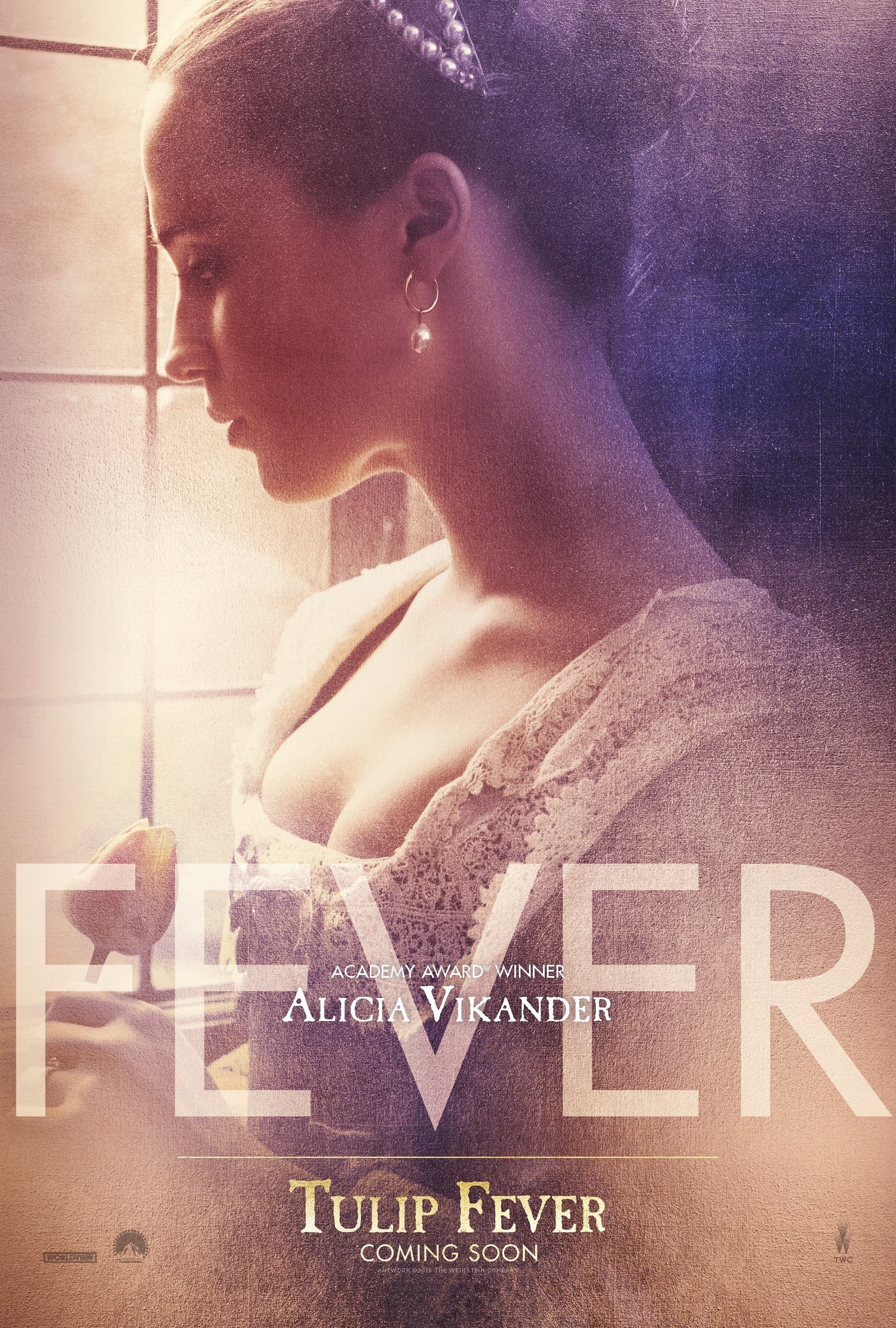
In 17th-century Amsterdam, a young woman married to a wealthy spice merchant begins an affair with the artist commissioned to paint her portrait, and the lovers stake their future on the speculative frenzy of the Dutch tulip bulb market. Adapted from Deborah Moggach's novel and shot at Pinewood and on location in Amsterdam, the film stars Alicia Vikander, Dane DeHaan, and Christoph Waltz.
What Is the Budget of Tulip Fever (2017)?
Tulip Fever (2017), directed by Justin Chadwick from a screenplay by Tom Stoppard and Deborah Moggach, was produced on a reported budget of approximately $25,000,000. The Weinstein Company financed and distributed the film alongside Worldview Entertainment and Ruby Films, with Paramount Pictures handling international distribution. The picture had been in development at Working Title Pictures and DreamWorks for more than a decade before Harvey Weinstein acquired the project and pushed it through production with a revised cast in 2014.
The $25,000,000 investment supported a fully realized 17th-century Amsterdam built on the Pinewood Studios backlot, extensive period costumes, a substantial ensemble cast led by Alicia Vikander, Dane DeHaan, and Christoph Waltz, and a script that survived multiple rewrites over twelve years. Repeated release date shifts (originally July 2016, then February 2017, then August 2017) and a troubled marketing campaign meant the picture entered theaters with limited momentum, and the worldwide gross of approximately $9,400,000 did not cover the production spend before P&A.
Key Budget Allocation Categories
Tulip Fever's $25,000,000 budget was distributed across several major production areas:
- Above-the-Line Cast Alicia Vikander led the cast fresh off Ex Machina (2014) and just before her Oscar-winning turn in The Danish Girl (2015). Christoph Waltz, a two-time Academy Award winner, played the merchant husband Cornelis. Dane DeHaan, Judi Dench, Holliday Grainger, Jack O'Connell, Zach Galifianakis, Cara Delevingne, Matthew Morrison, Tom Hollander, and David Harewood rounded out a dense ensemble whose collective quotes accounted for a sizable portion of the budget.
- Pinewood Backlot Build Production designer Simon Elliott constructed a full 17th-century Amsterdam street, canal-side facades, and a tulip auction hall on the Pinewood Studios backlot in Buckinghamshire. The standing set allowed for repeated shooting days without weather risk and provided controllable lighting for the Vermeer-inspired interior compositions.
- Costumes Costume designer Michael O'Connor (an Oscar winner for The Duchess) built more than 300 period costumes, including hand-stitched lace collars, brocade dresses, and merchant-class waistcoats designed to match the source paintings of Vermeer, Hals, and Pieter de Hooch that the production used as visual references.
- Cinematography and Lighting Cinematographer Eigil Bryld lit interiors to reference Dutch Golden Age painting, with extensive use of single-source candle and window light. The technical demands of the painterly aesthetic required substantial gaffer support, dimmable practicals, and HMI day-balance through tracing for window light.
- Visual Effects Limited but specific visual effects work included period Amsterdam canal extensions, ship masts and rigging on the harbor, and digital tulip-field augmentation. Cinesite handled the bulk of the period VFX integration.
- Score and Music Composer Danny Elfman delivered an unusually restrained chamber score that referenced 17th-century instrumentation. The music budget included orchestra hire and licensed period pieces.
- Long Development Costs The script had been in development since 2004 across multiple studios. Script fees paid to Tom Stoppard for his rewrite and to other previous writers represented a meaningful sunk cost rolled into the production budget.
How Does Tulip Fever's Budget Compare to Similar Films?
At $25,000,000, Tulip Fever sits in the mid-budget range for period romantic dramas. The comparison set illustrates how its commercial outcome compared with peer productions:
- Girl with a Pearl Earring (2003): Budget $12,000,000 | Worldwide $31,500,000. Peter Webber's similarly Vermeer-inspired period film cost roughly half and earned more than three times Tulip Fever's worldwide total, demonstrating the genre's narrow commercial corridor when audience interest aligns.
- The Duchess (2008): Budget $13,500,000 | Worldwide $43,300,000. Saul Dibb's Keira Knightley period piece cost roughly half and earned over four times Tulip Fever's gross, with a comparable awards-season positioning.
- The Other Boleyn Girl (2008): Budget $35,000,000 | Worldwide $78,300,000. Justin Chadwick's previous Tudor romance for Columbia cost more than Tulip Fever and earned over eight times the worldwide gross, providing the studio template that Weinstein attempted to replicate.
- Effie Gray (2014): Budget $8,000,000 | Worldwide $5,700,000. Richard Laxton's Emma Thompson-scripted Victorian drama cost a third of Tulip Fever and also failed theatrically, illustrating that period-romance failures are not unusual at this budget tier.
- Anonymous (2011): Budget $30,000,000 | Worldwide $15,400,000. Roland Emmerich's Shakespeare-authorship drama cost slightly more than Tulip Fever and also underperformed, with comparable awards-season targeting and a similar narrow theatrical window.
Tulip Fever Box Office Performance
Tulip Fever opened in North America on September 1, 2017 to $1,160,000 from 765 theaters, an opening per-screen average of approximately $1,500 that signaled minimal audience interest. The Labor Day weekend release date was the film's fourth scheduled opening after three Weinstein Company delays, and the picture had been screened to mostly negative critic and industry reactions in the lead-up.
Against a $25,000,000 production budget, the film needed approximately $60,000,000 worldwide to clear theatrical marketing and distribution costs. Here is the financial breakdown:
Box Office Breakdown
Tulip Fever (2017)

Tulip Fever returned roughly $0.22 in theatrical revenue for every $1 invested when measured against estimated production and marketing spend, putting it firmly in the failed-release category. The domestic gross of $2,400,000 trailed the international gross of $7,000,000, with the international take primarily coming from the UK, France, and the Netherlands where period-piece audiences traditionally support the genre.
Home video and streaming did not materially close the gap. The Weinstein Company collapsed in the autumn of 2017 following sexual misconduct allegations against Harvey Weinstein, and Tulip Fever became one of the final theatrical releases under the TWC banner. The picture has since circulated primarily on premium cable and SVOD as a catalog title.
Tulip Fever Production History
Deborah Moggach's novel Tulip Fever was published in 1999 and optioned by Steven Spielberg's DreamWorks shortly thereafter, with John Madden initially attached to direct and Jude Law and Keira Knightley discussed as leads. A 2004 production setback (the loss of UK Section 48 tax credits when government rules changed mid-prep) caused DreamWorks to abandon the project days before cameras were due to roll, with set construction already underway at Shepperton Studios.
The project remained dormant for nearly a decade before Harvey Weinstein acquired the rights through The Weinstein Company in 2013. Justin Chadwick was hired to direct on the strength of The Other Boleyn Girl (2008) and Mandela: Long Walk to Freedom (2013). Tom Stoppard provided a substantial rewrite of Moggach's earlier adapted screenplay, sharpening the dialogue and reframing the auction-house climax.
Principal photography took place in summer 2014 at Pinewood Studios in Buckinghamshire, with location work in Amsterdam, Norwich, and the Norfolk countryside. Production designer Simon Elliott built a substantial 17th-century Amsterdam street on the Pinewood backlot. Shooting wrapped in autumn 2014.
Post-production stretched across 2015 and 2016 as The Weinstein Company recut the picture multiple times in pursuit of a workable theatrical version. Release dates of July 2016, February 2017, and August 2017 came and went before the Labor Day 2017 opening. The marketing campaign was widely criticized as confused, with the tone wavering between bodice-ripper romance and prestige drama.
The film was ultimately released into a hostile environment as the first sexual misconduct allegations against Harvey Weinstein began circulating in industry trades. The Weinstein Company filed for bankruptcy in March 2018 and Lantern Entertainment subsequently acquired the catalog including Tulip Fever.
Awards and Recognition
Tulip Fever received no major awards recognition. Costume designer Michael O'Connor's work was discussed early as a possible craft contender given his previous Academy Award for The Duchess (2008), but the film's commercial and critical failure prevented any meaningful campaign. The picture was not nominated at the Academy Awards, BAFTAs, or Golden Globes.
Production designer Simon Elliott's Pinewood Amsterdam build was praised in trade craft coverage but did not translate into guild nominations. The picture's most durable legacy in the awards ecosystem may be the trivia that it represented one of Alicia Vikander's earliest post-Oscar leading roles, sandwiched between her win for The Danish Girl (2015) and Tomb Raider (2018).
Critical Reception
Tulip Fever received broadly negative reviews. The film holds a 9% approval rating on Rotten Tomatoes based on 150 critic reviews, with a critical consensus that called it a tonally confused costume drama whose talented cast was undermined by an incoherent script and overlong development. On Metacritic, the film scored 37 out of 100, indicating generally unfavorable reviews. Audiences surveyed by CinemaScore gave the film a B-, marginally better than critics but well below the studio's hopes.
The Hollywood Reporter's Todd McCarthy called the film "a costume drama in serious need of corseting," noting the picture's structural problems despite its visual craft. Variety's Owen Gleiberman wrote that the film "looks beautiful and feels narratively becalmed." The Guardian gave it two stars out of five, praising O'Connor's costumes and Bryld's photography but criticizing the romantic plot as airless.
Retrospective coverage has been minimal, with the film primarily remembered as a Weinstein Company late-period failure and a case study in how a project can be diminished by extended development and editorial intervention. The picture occasionally surfaces in academic film-economics discussions of the Dutch tulip mania, where the historical setting receives more positive engagement than the dramatic execution.
Frequently Asked Questions
How much did Tulip Fever (2017) cost to make?
The reported production budget was $25,000,000. The Weinstein Company financed the picture alongside Worldview Entertainment and Ruby Films, with Paramount handling international distribution. The project had been in development since 2004, originally at DreamWorks, before The Weinstein Company acquired the rights and produced the film in 2014.
How much did Tulip Fever earn at the box office?
The film grossed approximately $2,400,000 domestically and $7,000,000 internationally, for a worldwide total of $9,398,738. It opened to $1,160,000 from 765 North American theaters on the Labor Day weekend of September 1, 2017.
Was Tulip Fever a box office bomb?
Yes. Against a $25,000,000 budget and roughly $15,000,000 to $20,000,000 in marketing, the worldwide gross of approximately $9,400,000 resulted in a theatrical loss of approximately $30,000,000 to $35,000,000 before home video. It was one of the lowest-performing releases of the Weinstein Company before the studio collapsed in 2017 to 2018.
Who directed Tulip Fever?
Justin Chadwick directed the film. Chadwick had previously directed The Other Boleyn Girl (2008) and Mandela: Long Walk to Freedom (2013), and was hired specifically for his experience with period romance and prestige biopic material.
Where was Tulip Fever filmed?
Principal photography took place at Pinewood Studios in Buckinghamshire, England, where production designer Simon Elliott built a full 17th-century Amsterdam street on the backlot. Additional location work took place in Amsterdam, Norwich, and the Norfolk countryside.
Who stars in Tulip Fever?
Alicia Vikander stars as Sophia, with Dane DeHaan as the artist Jan Van Loos and Christoph Waltz as the merchant husband Cornelis Sandvoort. The supporting cast includes Judi Dench, Holliday Grainger, Jack O'Connell, Zach Galifianakis, Cara Delevingne, Tom Hollander, and Matthew Morrison.
Is Tulip Fever based on a book?
Yes. The film adapts Deborah Moggach's 1999 novel Tulip Fever, with a screenplay credited to Moggach and Tom Stoppard. Stoppard came aboard during The Weinstein Company's 2013 development restart and rewrote the earlier adapted screenplay that had circulated at DreamWorks.
What is the tulip mania in Tulip Fever?
Tulip mania was a speculative bubble in the Dutch Republic during the 1630s in which rare tulip bulb futures traded for the price of houses before the market crashed in February 1637. The film dramatizes the bubble through the lovers' decision to stake their elopement plans on a single rare Semper Augustus bulb.
Why was Tulip Fever delayed so many times?
The Weinstein Company delayed the film from July 2016 to February 2017 to August 2017 before finally releasing it on September 1, 2017. The delays reflected unsuccessful re-edits, uncertain marketing positioning, and the studio's broader release-calendar chaos in 2016 and 2017 ahead of the company's collapse.
What did critics think of Tulip Fever?
The film received broadly negative reviews. It holds a 9% approval rating on Rotten Tomatoes from 150 critics and a 37 out of 100 score on Metacritic. Audiences gave it a B- CinemaScore. Reviews praised the costumes and cinematography but called the script tonally confused and the romance airless.
Filmmakers
Tulip Fever (2017)

Build budgets like this one in Saturation
Start from an industry-standard feature film template, import the schedule and rates you already have, and let the cost report keep itself current as you spend. Real-time collaboration, no spreadsheets.