The World's Fastest Indian Budget
 Drama
DramaUpdated
Synopsis
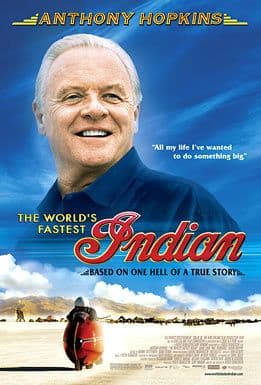
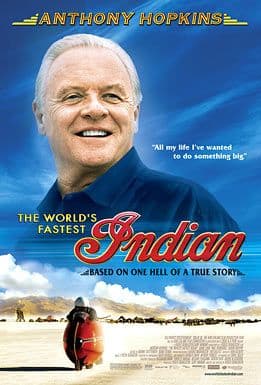
Burt Munro, an aging New Zealand motorcycle enthusiast from Invercargill, spends decades modifying his beloved 1920 Indian Scout in his backyard workshop before traveling to the Bonneville Salt Flats in 1967 to attempt a world land-speed record. Anthony Hopkins plays Munro across the journey from Invercargill to Utah, encountering an unlikely cast of American characters who help him pursue his lifelong dream.
What Is the Budget of The World's Fastest Indian (2005)?
The World's Fastest Indian (2005), directed by Roger Donaldson and distributed by Magnolia Pictures (North America) and 3L Filmverleih (international), was produced on a reported budget of $25,000,000. The biographical drama, based on the true story of New Zealand motorcycle enthusiast Burt Munro and his 1967 land-speed record attempt on the Bonneville Salt Flats, was financed by New Zealand Film Production Fund, OLC Rights Entertainment Limited, and an international co-production network. The investment positioned the film as a passion project that director Roger Donaldson had pursued for more than two decades following his 1971 documentary about Munro, Offerings to the God of Speed.
The math required the film to earn roughly $55,000,000 worldwide to clear breakeven after marketing, a target it exceeded comfortably thanks to Anthony Hopkins' draw and word-of-mouth driven theatrical holds. The World's Fastest Indian became one of the more successful art-house theatrical releases of 2005 and remains the highest-grossing New Zealand film at the New Zealand box office.
Key Budget Allocation Categories
The World's Fastest Indian's $25,000,000 budget was distributed across several core production areas:
- Above-the-Line Talent: Anthony Hopkins took the lead role of Burt Munro at a reduced rate compared with his post-Hannibal market rate, reflecting his personal interest in the story and the project's passion-project status. Director Roger Donaldson, the New Zealand-born veteran of No Way Out (1987), Cocktail (1988), and Thirteen Days (2000), worked at established director rates. Supporting cast members Diane Ladd, Annie Whittle, and Christopher Lawford took character-actor compensation appropriate to the modest budget.
- New Zealand and Utah Location Shoot: Principal photography ran from February to June 2004 across New Zealand and Utah locations. The New Zealand segments anchored at Invercargill, where Burt Munro actually lived, and the Bluff coast, while the American segments filmed at the actual Bonneville Salt Flats in Utah, in Los Angeles, and in selected highway locations along the original 1962 to 1967 travel route. The dual-country production took advantage of the New Zealand Film Production Fund and the Utah Film Commission incentives.
- Period Vehicles and Practical Effects: The film required the construction or restoration of multiple period-accurate motorcycles, including the modified 1920 Indian Scout that Munro raced at Bonneville. Three working replicas of the Munro motorcycle were built for principal photography, with each requiring extensive mechanical engineering to handle the salt-flat speed sequences. The period vehicle work, including 1960s American cars and trucks, drove a meaningful share of the production budget.
- Stunts and Speed Photography: Stunt coordinator Tom Eirikson supervised the salt-flat speed sequences, with multiple camera passes at the actual Bonneville Salt Flats under the same surface conditions Munro had raced. The production worked with Speed Week officials to film during periods that did not conflict with active competition events. High-speed camera rigs captured the racing footage that the screenplay required.
- Visual Effects: Visual effects work was deliberately limited to maintain the film's grounded aesthetic, with most effects work involving plate enhancements, selective wire removal during stunt sequences, and modest digital augmentation of the Bonneville speed sequences. Vendors including Weta Workshop handled the modest shot count, with the entire effects budget representing less than 5% of the total production budget.
- Score and Music: Composer J. Peter Robinson scored the film with an orchestral palette that integrated period-appropriate Americana and New Zealand folk influences. The soundtrack featured both original composition and licensed 1960s tracks that anchored the film's period setting. Music production was a meaningful budget line item for a film of this scale.
How Does The World's Fastest Indian's Budget Compare to Similar Films?
At $25,000,000, The World's Fastest Indian sat at the mid-range of mid-2000s biographical and inspirational drama bracket:
- Seabiscuit (2003): Budget $87,000,000 | Worldwide $148,336,445. Universal's contemporary horse-racing biographical drama cost 3.5x The World's Fastest Indian and earned 8.5x its worldwide gross while collecting seven Oscar nominations.
- Cinderella Man (2005): Budget $88,000,000 | Worldwide $108,539,911. Ron Howard's contemporary boxing biographical drama cost 3.5x The World's Fastest Indian and earned 6.2x its worldwide gross.
- Whale Rider (2002): Budget $3,500,000 | Worldwide $41,432,944. Niki Caro's contemporary New Zealand drama cost 14% of The World's Fastest Indian and earned 2.4x its worldwide gross, an exceptional ROI that demonstrated the international audience potential for New Zealand storytelling.
- In Pursuit of Honor (1995): Budget $12,000,000 | Worldwide $5,000,000. The contemporary period drama cost less than half of The World's Fastest Indian and earned just 30% of its worldwide gross.
- Walk the Line (2005): Budget $28,000,000 | Worldwide $186,438,883. Fox's contemporaneous Johnny Cash biographical drama cost 12% more than The World's Fastest Indian and earned 10.9x its worldwide gross while collecting five Oscar nominations including Best Actor for Joaquin Phoenix.
The World's Fastest Indian Box Office Performance
The World's Fastest Indian opened in New Zealand on October 12, 2005 and quickly became the highest-grossing film at the New Zealand box office that year. The North American limited release on December 7, 2005 was followed by an expansion through early 2006, with the film opening wide on February 24, 2006. The North American theatrical performance built steadily through positive word-of-mouth, eventually closing with a domestic total of $5,121,952.
Against a $25,000,000 production budget the film needed approximately $55,000,000 worldwide to reach breakeven after marketing. Here is the financial breakdown:
Box Office Breakdown
The World's Fastest Indian (2005)

The World's Fastest Indian returned approximately $0.51 in theatrical revenue for every $1 invested when measured against total estimated production and marketing spend, an outcome that placed the theatrical run at a meaningful loss. The domestic share was $5,121,952 against an international share of $13,167,079, a 28/72 split heavily weighted toward overseas markets including strong performance in New Zealand, Australia, and the United Kingdom.
Home video and television revenue eventually delivered substantial additional return, with the film becoming a perennial DVD bestseller in motorcycle-enthusiast and biographical-drama categories. The film has been credited with sustained tourism interest in Invercargill, where multiple Burt Munro memorial sites and museums have been established or expanded since the film's release. The annual Burt Munro Challenge motorcycle event in Invercargill has cited the film as a driver of international participant interest.
The World's Fastest Indian Production History
Development on The World's Fastest Indian began in the late 1970s when director Roger Donaldson, then a New Zealand documentary filmmaker, made the 1971 documentary Offerings to the God of Speed about Burt Munro. Donaldson lived in Invercargill for several months in the early 1970s and developed a personal relationship with Munro, who died in 1978 at age 78. Donaldson carried the feature film treatment for more than two decades, with multiple cast and financing iterations falling through before the project finally moved into pre-production in 2003.
Anthony Hopkins committed to the lead role in 2003 after reading Donaldson's screenplay, agreeing to a meaningfully reduced rate compared with his post-Hannibal market rate. Hopkins had grown up in Wales watching motorcycle racing and personally connected with the Burt Munro story. The casting was the unlock that allowed Donaldson to secure the New Zealand Film Production Fund and OLC Rights Entertainment financing.
Principal photography ran from February to June 2004 across New Zealand and the United States. The New Zealand segments anchored at Invercargill, where Burt Munro actually lived, with location work at the Bluff coast, Munro's actual workshop site, and surrounding South Island locations. The American segments filmed at the actual Bonneville Salt Flats in Utah, in Los Angeles, and in selected highway locations along the original 1962 to 1967 travel route. Three working replicas of the Munro motorcycle were built for principal photography.
Post-production extended into mid-2005, with composer J. Peter Robinson delivering the score in summer 2005 ahead of the October 12, 2005 New Zealand theatrical premiere. Magnolia Pictures acquired North American distribution rights and managed a platform release that began in limited theaters on December 7, 2005 and expanded through early 2006. The international rollout reached most overseas territories during the first quarter of 2006, with particularly strong holds in the United Kingdom and Australia.
Awards and Recognition
The World's Fastest Indian received the New Zealand Film and TV Award for Best Film at the 2006 ceremony, along with awards for Best Director (Roger Donaldson), Best Actor (Anthony Hopkins), and Best Original Screenplay. The film also won the Audience Award at the 2006 Mannheim-Heidelberg International Filmfest.
Internationally, the film received Golden Globe Award attention for Anthony Hopkins' performance, with multiple critics groups including the National Board of Review citing the lead turn. Anthony Hopkins received a Satellite Award nomination for Best Actor in a Drama. The Bonneville Salt Flats sequences were recognized by the Visual Effects Society for their integration of practical and digital effects work. While the film did not receive Academy Award nominations, its commercial and critical recognition cemented Donaldson's standing in the New Zealand cinema canon.
Critical Reception
The World's Fastest Indian received largely positive reviews. The film holds an 83% approval rating on Rotten Tomatoes based on 121 critic reviews, with a critical consensus that called it "a sweet-natured film that benefits enormously from Hopkins' performance." On Metacritic, the film scored 68 out of 100, indicating generally favorable reviews. Audiences surveyed by CinemaScore gave the film an A-, a strong response that drove the steady word-of-mouth theatrical holds.
Critics praised Anthony Hopkins' lead performance, the New Zealand cinematography, the period-accurate motorcycle work, and Donaldson's deliberate refusal to manipulate the audience through manufactured drama. Roger Ebert awarded the film 4 stars and wrote that Hopkins' performance was "completely without vanity, a treasure of restraint." The Hollywood Reporter's Kirk Honeycutt called the film "a small miracle of a movie."
Motorcycle and motorsport press received the film with notable enthusiasm. Cycle World praised the period-accurate motorcycle work and the Bonneville sequences, and multiple British and American motorcycle publications named it among the best motorcycle films ever made. The combination of mainstream critical respect, motorcycle-enthusiast endorsement, and Anthony Hopkins' personal commitment to the story established the film as a cult favorite that has continued to grow in stature over the two decades since release.
Frequently Asked Questions
How much did it cost to make The World's Fastest Indian (2005)?
The reported production budget was $25,000,000. The film was financed by the New Zealand Film Production Fund, OLC Rights Entertainment Limited, and an international co-production network, with Magnolia Pictures handling North American distribution. The investment positioned the film as a passion project that director Roger Donaldson had pursued for more than two decades.
How much did The World's Fastest Indian earn at the box office?
The film grossed $5,121,952 domestically and $13,167,079 internationally, for a worldwide total of $18,289,031. The 28/72 domestic-international split was heavily weighted toward overseas markets, with strong performance in New Zealand (where the film became the highest-grossing release at the box office that year), Australia, and the United Kingdom.
Is The World's Fastest Indian based on a true story?
Yes. The film is based on the real life of Burt Munro (1899 to 1978), a New Zealand motorcycle enthusiast from Invercargill who modified his 1920 Indian Scout over decades and set multiple world land-speed records at the Bonneville Salt Flats in Utah between 1962 and 1967. His 1967 under-1000cc record set on a modified 1920 Indian still stood as of 2026.
Who directed The World's Fastest Indian?
Roger Donaldson directed the film, working from his own screenplay. Donaldson, a New Zealand-born veteran of No Way Out (1987), Cocktail (1988), Dante's Peak (1997), and Thirteen Days (2000), made the 1971 documentary Offerings to the God of Speed about Burt Munro before pursuing the feature adaptation for more than 20 years.
Where was The World's Fastest Indian filmed?
Principal photography ran from February to June 2004 across New Zealand and the United States. The New Zealand segments anchored at Invercargill, where Burt Munro actually lived, with location work at the Bluff coast, Munro's actual workshop site, and surrounding South Island locations. The American segments filmed at the actual Bonneville Salt Flats in Utah, in Los Angeles, and selected highway locations along the original travel route.
Who plays Burt Munro in The World's Fastest Indian?
Anthony Hopkins plays Burt Munro. Hopkins committed to the role in 2003 at a meaningfully reduced rate compared with his post-Hannibal market rate, reflecting his personal interest in the story. Hopkins had grown up in Wales watching motorcycle racing and personally connected with the Burt Munro story. The casting was the unlock that allowed Donaldson to secure the financing.
Was The World's Fastest Indian a box office success?
Theatrically it underperformed. Against a $25,000,000 production budget and an estimated $10,000,000 to $15,000,000 in marketing spend, the film returned approximately $0.51 in worldwide gross for every $1 invested. Home video and television revenue eventually delivered substantial additional return, and the film became a perennial DVD bestseller in motorcycle-enthusiast and biographical-drama categories.
How does The World's Fastest Indian compare to other New Zealand films?
Whale Rider (2002) cost $3.5M and earned $41M worldwide, an exceptional ROI for a New Zealand drama. The World's Fastest Indian cost $25M and earned $18M worldwide, a higher absolute budget but inferior ROI. Among New Zealand-financed dramas, Indian remains one of the most ambitious in budget terms and the highest-grossing at the New Zealand box office in 2005.
What did critics think of The World's Fastest Indian?
The film received largely positive reviews, with an 83% approval rating on Rotten Tomatoes (based on 121 critics) and a 68 out of 100 score on Metacritic. Audiences gave it an A- CinemaScore. Critics praised Anthony Hopkins' lead performance, the New Zealand cinematography, and Donaldson's deliberate refusal to manipulate the audience. Roger Ebert awarded the film 4 stars.
Did The World's Fastest Indian win any awards?
Yes, particularly at the New Zealand Film and TV Awards in 2006, where it won Best Film, Best Director (Roger Donaldson), Best Actor (Anthony Hopkins), and Best Original Screenplay. The film also won the Audience Award at the Mannheim-Heidelberg International Filmfest in 2006 and received Satellite Award and Golden Globe attention for Hopkins' performance.
Filmmakers
The World's Fastest Indian (2005)

Build budgets like this one in Saturation
Start from an industry-standard feature film template, import the schedule and rates you already have, and let the cost report keep itself current as you spend. Real-time collaboration, no spreadsheets.