The World is Not Enough Budget
 AdventureActionThriller2h 8m
Updated
Synopsis
When oil tycoon Sir Robert King is assassinated inside MI6 headquarters, James Bond is assigned to protect his daughter Elektra, who is overseeing the construction of a Caucasus oil pipeline that has drawn the attention of nerve-damaged terrorist Renard. As Bond pursues Renard from the French Alps to Istanbul, he uncovers a plot to detonate a stolen Russian nuclear warhead inside a submarine in the Bosphorus, and discovers that the truth about Elektra is far more dangerous than the threat she appears to face.
What Is the Budget of The World Is Not Enough (1999)?
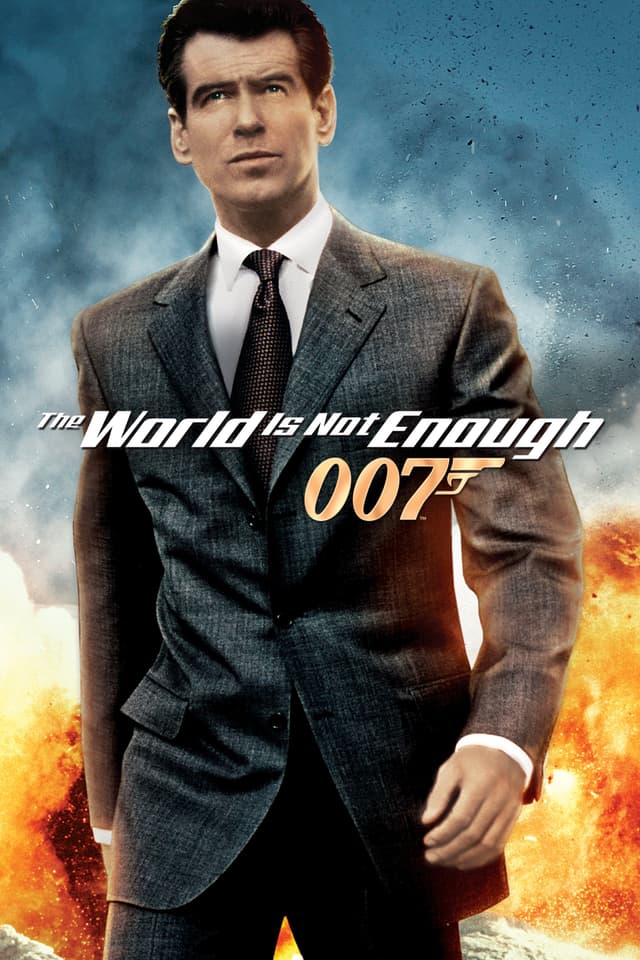
The World Is Not Enough (1999), directed by Michael Apted and distributed by Metro-Goldwyn-Mayer through United Artists, was produced on a reported budget of $135,000,000. The nineteenth official James Bond film and the third entry to star Pierce Brosnan as 007, it was financed and produced by Eon Productions, the Broccoli family company that has shepherded the franchise since Dr. No in 1962. Michael G. Wilson and Barbara Broccoli produced, the first time Broccoli was credited as a full producer alongside Wilson rather than as an associate, marking the generational transition from Albert R. Broccoli to his daughter and stepson.
The budget represented a meaningful escalation over the previous two Brosnan entries, GoldenEye (1995) at roughly $60,000,000 and Tomorrow Never Dies (1997) at roughly $110,000,000. The increase reflected longer stunt-unit shoots in the Caucasus and Turkey, an expanded second-unit programme for a pre-titles speedboat chase down the River Thames, and rising above-the-line costs tied to Brosnan and a deep international supporting cast that included Sophie Marceau, Robert Carlyle, Denise Richards, Judi Dench, and Robbie Coltrane reprising Valentin Zukovsky from GoldenEye. Eon and MGM expected the film to clear roughly $250,000,000 worldwide to reach profitability after marketing and distribution costs.
Key Budget Allocation Categories
The World Is Not Enough's reported $135,000,000 budget was distributed across several core production areas:
- Above-the-Line Talent: Pierce Brosnan, on his third Bond contract, commanded a salary in the high seven-figure range as the established face of the franchise. Sophie Marceau, fresh off Braveheart and a string of European hits, took the lead Bond-woman role of Elektra King, while Robert Carlyle (Trainspotting, The Full Monty) played the nerve-damaged terrorist Renard. Denise Richards as nuclear physicist Christmas Jones, Judi Dench returning as M in an expanded role, John Cleese debuting as R, and Desmond Llewelyn making his seventeenth and final appearance as Q rounded out a costly ensemble. Director Michael Apted, an Oscar nominee for Coal Miner's Daughter, commanded a tentpole-director fee.
- Pinewood Studios Stage Work: The entire production was anchored at Pinewood Studios outside London, including the 007 Stage built for The Spy Who Loved Me, used here for the climactic submarine and Caspian Sea oil pipeline sequences. Stage rental, set construction by production designer Peter Lamont, and the British crew base accounted for the largest single line item in the United Kingdom-heavy shoot.
- Location Shooting Across Three Continents: Principal photography ranged from Bilbao, Spain (the pre-titles bank assault) to the Caucasus Mountains in Azerbaijan, Chamonix and the French Alps (ski chase), Istanbul and the Bosphorus (the Maiden's Tower finale), and the River Thames in London for the speedboat sequence. International unit costs covered local crews, customs and shipping for equipment, permits, and security.
- Stunts and Second Unit: Stunt coordinator Vic Armstrong and second-unit director Vic Armstrong oversaw a fourteen-minute pre-titles speedboat chase on the Thames that ended at the Millennium Dome, the longest pre-credits sequence in series history at that point. The Q-built jet-boat was a custom build, and the unit shot for several weeks on the working river under restrictive Port of London Authority permits. The Chamonix paragliding-avalanche set piece added further stunt-aviation costs.
- Visual Effects: Visual effects supervisor Mara Bryan and houses including Cinesite handled the avalanche sequence, the submarine interior compositing, oil pipeline destruction work, and the Renard bullet-in-the-brain X-ray visualisations. The film sat at the transition point between practical model work and full CGI, with the climactic submarine relying heavily on physical miniatures shot at Pinewood.
- Score and Theme Song: Composer David Arnold, on his second Bond score after Tomorrow Never Dies, recorded with a full orchestra at Air Lyndhurst Studios in London. The title song, also called "The World Is Not Enough," was performed by Garbage and written by Arnold with lyricist Don Black, requiring band fees, recording costs, and a high-profile music video budget tied to MGM's marketing campaign.
- Marketing and Promotional Tie-ins: BMW, Smirnoff, Heineken, Visa, and Omega ran major global tie-in campaigns, partly offsetting MGM's prints-and-advertising spend through co-op promotion. The BMW Z8 placement was negotiated as a multi-million dollar product-integration deal that helped contain net P&A for the studio.
How Does The World Is Not Enough's Budget Compare to Similar Films?
At a reported $135,000,000, The World Is Not Enough sits at the higher end of late-1990s tentpole budgets and roughly in the middle of the Pierce Brosnan-era Bond run. The comparison set illustrates how 007 budgets escalated across the Brosnan tenure and how the franchise was repositioned under Daniel Craig:
- GoldenEye (1995): Budget $60,000,000 | Worldwide $352,194,034. Brosnan's debut cost less than half of The World Is Not Enough and out-grossed it, an early sign that the franchise's post-Cold War reset had real commercial pull at a lower production cost.
- Tomorrow Never Dies (1997): Budget $110,000,000 | Worldwide $333,011,068. The second Brosnan entry spent $25,000,000 less and earned a near-identical worldwide haul, suggesting diminishing returns on the budget escalation that followed.
- Die Another Day (2002): Budget $142,000,000 | Worldwide $431,971,116. Brosnan's final Bond film inched up the budget further and posted the highest gross of his run, but the CGI-heavy invisible-car climax drew critical backlash that forced Eon's reset.
- Casino Royale (2006): Budget $150,000,000 | Worldwide $599,045,960. The Daniel Craig reboot demonstrated what a stripped-back, character-driven 007 could deliver at roughly the same price point as Brosnan-era entries.
- The Mummy (1999): Budget $80,000,000 | Worldwide $415,933,406. Stephen Sommers' contemporary tentpole cost roughly 60% of The World Is Not Enough and out-grossed it worldwide, evidence that 1999 audiences were responsive to action-adventure spectacle from outside the Bond franchise.
- Mission: Impossible 2 (2000): Budget $125,000,000 | Worldwide $546,388,105. Released six months later, John Woo's direct competitor in the spy-action space cost less and earned $190,000,000 more, intensifying competitive pressure on the 007 franchise heading into the 2000s.
The World Is Not Enough Box Office Performance
The World Is Not Enough opened on November 19, 1999 in the United States, debuting at number one with $35,519,007 across 3,150 theatres, the strongest Bond opening to that point in the series. The film held well through the Thanksgiving holiday corridor and the December lead-in to its international rollout, where it played strongly in the United Kingdom, France, Germany, Italy, and Japan into early 2000.
Against a reported production budget of $135,000,000, the film needed approximately $250,000,000 in worldwide gross to reach profitability when accounting for marketing and distribution costs. Here is the financial breakdown:
Box Office Breakdown
The World is Not Enough

The World Is Not Enough returned approximately $1.68 to $1.86 in theatrical revenue for every $1 invested when measured against total estimated production and marketing spend, a solid franchise outcome that comfortably cleared the break-even line without matching GoldenEye's leaner profit margin. The domestic share of the gross was $126,943,684 against an international share of $234,888,716, a 35/65 split typical of the Bond franchise's historically strong overseas performance.
The result confirmed Brosnan's commercial standing as the lead and locked in his contract for a fourth and final entry, Die Another Day, three years later. It also reinforced Eon's willingness to keep escalating the production budget, a trajectory that ultimately ended in the 2002 invisible-car climax that pushed the franchise to a creative reset under Casino Royale (2006).
The World Is Not Enough Production History
Development began in late 1997 immediately after Tomorrow Never Dies, with Eon Productions retaining the writing team of Neal Purvis and Robert Wade on the strength of their work on Plunkett & Macleane. Purvis and Wade delivered an outline built around an oil-pipeline plot in the Caspian basin and a femme-fatale antagonist, with Bruce Feirstein, returning from GoldenEye and Tomorrow Never Dies, hired for the shooting-draft polish. Michael G. Wilson contributed story work as he had on every entry since 1981. Michael Apted, an unconventional choice given his documentary background on the Up series and dramatic work on Nell and Coal Miner's Daughter, was hired to direct in mid-1998 with a mandate to deepen the emotional through-line.
Casting Sophie Marceau as Elektra King was central to the script's shift toward a Bond film with a genuine antagonist relationship at its core. Robert Carlyle, riding high on Trainspotting and The Full Monty, was cast as Renard, a former KGB agent with a bullet lodged in his brain that has rendered him incapable of feeling pain. Denise Richards joined as Christmas Jones, the nuclear physicist who partners with Bond in the third act, in a casting decision that drew immediate scrutiny and ultimately some of the film's sharpest critical pushback. Robbie Coltrane reprised Valentin Zukovsky from GoldenEye, expanding the role into a substantial supporting part as a former Russian mob figure now running a caviar operation and casino in Baku.
Principal photography ran from January to June 1999, anchored at Pinewood Studios outside London, United Kingdom. The 007 Stage at Pinewood, originally built for The Spy Who Loved Me, hosted the climactic Maiden's Tower interiors and the submarine set, while location work covered Bilbao (the pre-titles bank scene), Azerbaijan (Caspian pipeline doubles), Chamonix and the French Alps (paragliding and avalanche sequences), Istanbul and the Bosphorus (the third-act submarine pursuit and Maiden's Tower finale), and the River Thames in London for the fourteen-minute speedboat chase that ends at the Millennium Dome. The Thames sequence, supervised by second-unit director Vic Armstrong, required custom jet-boat builds and shut down sections of the working river under strict Port of London Authority permits.
Post-production proceeded at Pinewood and at Air Lyndhurst Studios in London, where David Arnold recorded the score with a full orchestra. The title song, written by Arnold and Don Black and performed by Garbage, was recorded in Los Angeles and London and supported by a high-profile music video that received heavy MTV rotation in the lead-in to release. Desmond Llewelyn shot his Q scenes in the spring of 1999, handing over to John Cleese's R, and died in a car accident on December 19, 1999, weeks after the film's UK premiere, making The World Is Not Enough his seventeenth and final Bond appearance after a run that began with From Russia With Love in 1963.
Awards and Recognition
The World Is Not Enough received limited mainstream awards recognition, in keeping with the Academy's historical reluctance to nominate Bond films outside technical categories. The film was nominated for one Golden Raspberry Award (Razzie) for Denise Richards as Worst Supporting Actress, with Richards taking home the prize at the 2000 ceremony, a notable low point in the public reception of the casting.
At the Saturn Awards, hosted by the Academy of Science Fiction, Fantasy and Horror Films, the film received two nominations: Best Action/Adventure/Thriller Film and Best Supporting Actress for Sophie Marceau. It also received a BMI Film Music Award for David Arnold's score. Robert Carlyle's performance as Renard was widely cited by critics as a standout element of the film, although it did not translate into nominations at the BAFTAs, the Golden Globes, or the SAG Awards.
The Garbage theme song received an MTV Europe Music Award nomination in 1999 and continues to be regarded as one of the strongest Bond themes of the Brosnan era, frequently appearing on franchise-spanning critical rankings of the series' title songs.
Critical Reception
The World Is Not Enough received mixed reviews. The film holds a 51% approval rating on Rotten Tomatoes based on 154 critic reviews, with a critical consensus that the film offers polished action and a strong villain in Robert Carlyle but is undermined by a convoluted plot and miscast supporting roles. On Metacritic, the film scored 59 out of 100, indicating mixed or average reviews. Audiences surveyed by CinemaScore gave the film a B+, a slight downgrade from the A- received by Tomorrow Never Dies two years earlier.
Critics broadly praised Sophie Marceau's Elektra King as one of the most fully developed female antagonists in the franchise's history, with Roger Ebert writing in the Chicago Sun-Times that Marceau "manages to combine fragility and menace in a way the series has rarely attempted." Robert Carlyle's Renard drew similar praise for the actor's commitment to the bullet-in-the-brain physicality, although several reviewers, including The New York Times' Janet Maslin, felt the character was underused in the final act. The pre-titles Thames boat chase was singled out as a high point, with Variety's Todd McCarthy calling it "the most sustained action sequence in the Bond canon to date."
The most consistent critical complaint targeted Denise Richards' performance as nuclear physicist Christmas Jones, with reviewers from The Washington Post, The Guardian, and Entertainment Weekly all flagging the casting as a credibility problem for the film's third act. James Berardinelli wrote that Richards "is asked to carry scenes she is not equipped to handle," and the perception of the role has hardened over time into a frequent reference point in retrospective Bond rankings, where The World Is Not Enough typically sits in the middle of the Brosnan-era four-film run, ahead of Die Another Day but behind GoldenEye.
Frequently Asked Questions
How much did it cost to make The World Is Not Enough (1999)?
The reported production budget was $135,000,000. Eon Productions co-financed the film with Metro-Goldwyn-Mayer through United Artists, with Michael G. Wilson and Barbara Broccoli producing for the franchise's nineteenth official entry.
How much did The World Is Not Enough earn at the box office?
The film grossed $126,943,684 domestically and $234,888,716 internationally for a worldwide total of $361,832,400. It opened to $35,519,007 in the United States on November 19, 1999, the strongest James Bond opening weekend up to that point in the series.
Was The World Is Not Enough profitable?
Yes. Against a $135,000,000 production budget and an estimated $60,000,000 to $80,000,000 in marketing spend, the film returned approximately $1.68 to $1.86 in worldwide gross for every $1 invested. It comfortably cleared the break-even line, though its profit margin was narrower than GoldenEye's in 1995.
Who directed The World Is Not Enough?
Michael Apted directed the film, working from a screenplay by Neal Purvis, Robert Wade, and Bruce Feirstein. Apted, an Oscar nominee for Coal Miner's Daughter, was an unconventional choice for the franchise given his documentary background on the Up series, hired with a mandate to deepen the film's emotional through-line.
Where was The World Is Not Enough filmed?
Principal photography ran from January to June 1999, anchored at Pinewood Studios outside London. Location shooting covered Bilbao in Spain (the pre-titles bank scene), Azerbaijan (Caspian pipeline doubles), Chamonix and the French Alps (the avalanche sequence), Istanbul and the Bosphorus (the Maiden's Tower and submarine finale), and the River Thames in London for the opening speedboat chase.
How does The World Is Not Enough compare to other Brosnan-era Bond films?
It is the third of four Pierce Brosnan Bond films. GoldenEye (1995) cost $60,000,000 and grossed $352,194,034 worldwide. Tomorrow Never Dies (1997) cost $110,000,000 and grossed $333,011,068. The World Is Not Enough cost $135,000,000 and grossed $361,832,400. Die Another Day (2002) cost $142,000,000 and grossed $431,971,116, the highest of the Brosnan run.
Who sang the theme song to The World Is Not Enough?
The title song, written by composer David Arnold and lyricist Don Black, was performed by the American alternative rock band Garbage. It was recorded in Los Angeles and London and supported by a music video that received heavy MTV rotation in the lead-in to the film's November 1999 release. It is widely regarded as one of the strongest Bond themes of the Brosnan era.
Was The World Is Not Enough Desmond Llewelyn's final Bond film?
Yes. The World Is Not Enough was the seventeenth and final appearance of Desmond Llewelyn as Q, a role he had played since From Russia With Love in 1963. John Cleese debuted as his assistant R, set up as the successor character. Llewelyn died in a car accident on December 19, 1999, weeks after the film's United Kingdom premiere.
What did critics think of The World Is Not Enough?
The film received mixed reviews, with a 51% approval rating on Rotten Tomatoes (based on 154 critics) and a 59 out of 100 score on Metacritic. Audiences gave it a B+ CinemaScore. Critics praised Sophie Marceau as Elektra King and Robert Carlyle as Renard, the Thames boat chase, and David Arnold's score, but criticised the convoluted plot and the casting of Denise Richards as nuclear physicist Christmas Jones.
Did The World Is Not Enough win any awards?
The film won one Golden Raspberry Award for Denise Richards as Worst Supporting Actress and received two Saturn Award nominations for Best Action/Adventure/Thriller Film and Best Supporting Actress (Sophie Marceau). David Arnold won a BMI Film Music Award for his score. The Garbage theme song received an MTV Europe Music Award nomination in 1999.
Filmmakers
The World is Not Enough

Official Trailer
Build budgets like this one in Saturation
Start from an industry-standard feature film template, import the schedule and rates you already have, and let the cost report keep itself current as you spend. Real-time collaboration, no spreadsheets.