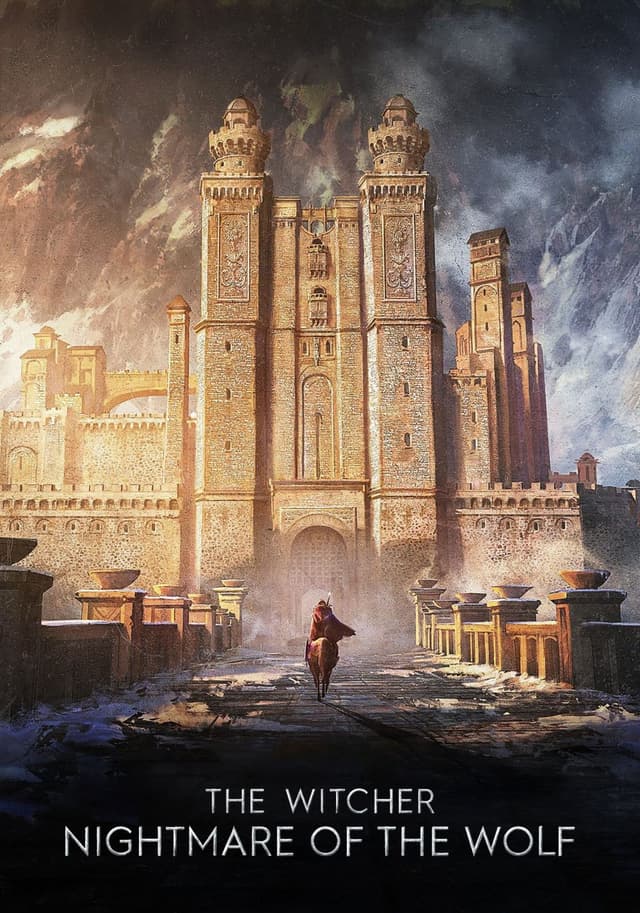
The Witcher Nightmare of the Wolf Budget
 AnimationActionFantasy1h 23m
Updated
Synopsis
Long before mentoring Geralt, the young witcher Vesemir trains as a monster hunter in service of coin and glory. When a new menace threatens the Continent and a relentless mage hunts those like him, Vesemir is forced to confront the cost of the witcher order and his own past.
What Is the Budget of The Witcher: Nightmare of the Wolf (2021)?
The Witcher: Nightmare of the Wolf (2021), directed by Kwang Il Han and distributed by Netflix, was produced as a feature-length animated prequel to the streamer's live-action The Witcher series. Netflix has never published a production budget for the film, in line with its standard policy of treating per-title costs on its animation slate as proprietary information. Industry estimates from animation trade press place the production cost in the range of $10,000,000 to $20,000,000, a typical band for a Studio Mir television-style feature of roughly 81 minutes running time.
The film was animated by South Korean studio Studio Mir, the same outfit behind The Legend of Korra, Voltron: Legendary Defender, and DOTA: Dragon's Blood. Lauren Schmidt Hissrich, the showrunner of the live-action Witcher series, produced through her Hivemind banner alongside Beau DeMayo, who wrote the screenplay. The investment served two purposes for Netflix: it expanded the Witcher universe between live-action seasons and gave the platform an animated original positioned to draw both anime viewers and existing Witcher fans.
Key Budget Allocation Categories
Animation budgets for streaming features cluster around a handful of cost centers. For Nightmare of the Wolf, those included:
- Studio Mir Animation Production: The bulk of the budget went to Studio Mir's in-house team in Seoul, South Korea, covering character animation, key frames, in-betweens, backgrounds, and compositing across roughly 81 minutes of finished footage. Studio Mir's pipeline relies on a blend of traditional 2D animation with selective 3D camera work, a labor-intensive approach that drove the bulk of below-the-line costs.
- Voice Cast: Lead Theo James voiced Vesemir, with Lara Pulver as Tetra Gilcrest, Graham McTavish as Deglan, Mary McDonnell as Lady Zerbst, Tom Canton reprising Filavandrel, and Matt Yang King in multiple roles. Voice casting for a streaming animated original involves session fees and residual structures negotiated through SAG-AFTRA, with featured performers typically working in two-day to one-week recording blocks.
- Writing and Showrunner Fees: Beau DeMayo, who later joined the live-action Witcher writers room and X-Men '97, wrote the screenplay. Lauren Schmidt Hissrich produced and Hivemind partners Mike Larocca and Sean Daniel oversaw development, with fees structured around feature-rate WGA scale plus negotiated overage.
- Score and Music: Composer Brian D'Oliveira provided the original score, blending orchestral textures with the Slavic folk instrumentation that defines the live-action series' sonic identity. The music budget covered original composition, orchestra and ensemble sessions, and final mix.
- Action Choreography and Storyboarding: The film features extended sword combat sequences animated to live-action choreography standards. Storyboarding, animatic, and key animation passes on these sequences absorbed a disproportionate share of the production schedule compared with dialogue scenes.
- Localization and Dub Tracks: Netflix funded multi-language dubbing across at least 30 territories at launch, plus closed captioning and subtitles. Localization typically runs 5 to 8% of total production cost for a Netflix original animation release.
- Marketing: Netflix mounted a substantial in-platform campaign positioning the film as essential viewing ahead of The Witcher Season 2. The marketing spend is not part of the production budget but is the dominant variable in whether streaming originals earn back their cost in subscriber retention.
How Does The Witcher: Nightmare of the Wolf's Budget Compare to Similar Films?
Streaming animated features rarely disclose budgets, but a few reference points give a sense of where Nightmare of the Wolf likely sits:
- Klaus (2019): Budget approximately $40,000,000 | Worldwide gross not theatrically released. Netflix's flagship Spanish-produced animated holiday film cost roughly two to four times what Nightmare of the Wolf is estimated to have cost, reflecting its higher-end 2D pipeline at SPA Studios in Madrid.
- The Mitchells vs. The Machines (2021): Budget approximately $80,000,000 | Worldwide gross not theatrically released. The Sony Pictures Animation feature that Netflix acquired during the pandemic represented a fully theatrical-grade CG production at four to eight times the estimated Nightmare of the Wolf budget.
- Justice Society: World War II (2021): Budget undisclosed, estimated $3,000,000 to $5,000,000 | Released direct-to-video. The Warner Bros. Animation DC feature offers the closest DTV-tier animation reference point, though at a lower estimated cost than the Studio Mir production.
- DOTA: Dragon's Blood Book 1 (2021): Budget undisclosed | Netflix series. Studio Mir's other 2021 Netflix project, also animated in Seoul, gives a sense of the studio's capacity and the platform's comfort with mid-budget animation commissions in this band.
- Castlevania Season 4 (2021): Per-episode budget estimated $2,500,000 to $3,500,000 | Netflix series. The fantasy-horror animated series that established Netflix's adult-animation lane offers the closest tonal and audience comparison and informed the platform's confidence in commissioning Nightmare of the Wolf.
The Witcher: Nightmare of the Wolf Box Office Performance
Nightmare of the Wolf was a Netflix exclusive and never received a theatrical release, so there is no traditional box office gross to report. The film premiered globally on Netflix on August 23, 2021, two and a half months before the launch of The Witcher Season 2 on December 17, 2021.
Because Netflix does not report viewership in dollar terms or break out subscriber-retention attribution by title, financial performance for the film is measured in platform engagement metrics. The estimated investment math, using mid-range industry assumptions, breaks down as follows:
Box Office Breakdown
The Witcher Nightmare of the Wolf

Netflix reported in its August 2021 Top 10 disclosures that Nightmare of the Wolf reached the global Top 10 in 71 countries during its launch week and accumulated 31,070,000 hours viewed in its first 28 days, equivalent to roughly 23 million completed views. That figure placed it well inside the streamer's most-watched animated debuts of 2021 and validated the franchise expansion strategy.
The film's commercial success drove Netflix to commission additional Witcher spin-offs in animation and live-action, including The Witcher: Blood Origin live-action prequel that aired in December 2022. The animated format was effective at expanding the universe at a fraction of the live-action production cost, a model Netflix would reuse for other franchises.
The Witcher: Nightmare of the Wolf Production History
Development on Nightmare of the Wolf was announced by Netflix in January 2020, less than a month after the December 2019 launch of the live-action Witcher Season 1. Lauren Schmidt Hissrich pitched the project as a way to fill the gap between live-action seasons and to explore Vesemir's backstory, a character who would not appear in live-action until Kim Bodnia took the role in Season 2. Beau DeMayo, who had joined the live-action writers room for Season 2, was tapped to write the screenplay.
Netflix engaged Studio Mir in Seoul, South Korea, for animation services. Studio Mir founder and CEO Yong-ki Jang assigned Kwang Il Han, who had previously directed episodes of The Legend of Korra and Voltron, to helm the feature. Production proceeded through 2020 and into 2021, overlapping with the COVID-19 pandemic, with remote voice recording sessions allowing the cast to record from home studios in the United Kingdom and the United States while animation continued in Seoul.
The film was originally scheduled for an unspecified summer 2021 launch, then locked to August 23, 2021. Netflix positioned the release as a four-month lead-in to The Witcher Season 2, with cross-promotional materials and a making-of featurette tying the two projects together.
Awards and Recognition
Nightmare of the Wolf received recognition in the animation and genre awards circuits. The film was nominated at the 49th Annie Awards in 2022 in the category of Best Animated Special Production, recognizing the technical and artistic achievement of Studio Mir's work. It also received a nomination at the 2022 Saturn Awards for Best Animated Film, alongside theatrical releases including Encanto and The Mitchells vs. The Machines, an unusual placement for a direct-to-streaming title.
Studio Mir received industry trade press recognition for the film's combat choreography, with Variety, IndieWire, and Cartoon Brew all citing the climactic sequences as among the year's most ambitious 2D action animation. The film did not register at the Academy Awards, which has historically excluded streaming-first animated features that did not meet theatrical eligibility windows.
Critical Reception
Nightmare of the Wolf received generally favorable reviews. The film holds a 87% approval rating on Rotten Tomatoes based on 47 critic reviews, with a critical consensus describing it as a stylish, brutal, and emotionally engaged prequel that expands the live-action series' world without requiring familiarity with it. On Metacritic, the film scored 73 out of 100, indicating generally favorable reviews. The film was not surveyed by CinemaScore, which does not cover streaming-exclusive releases.
Critics praised the action choreography, the voice performance from Theo James as a younger Vesemir, and the world-building that filled in backstory only hinted at in the live-action series. Variety's Caroline Framke called it "a fluid, fierce origin story that justifies its own existence," while The Hollywood Reporter's Daniel Fienberg wrote that the film "delivers the kind of self-contained satisfaction that the live-action show often lacks."
Some critics flagged the dense exposition required to introduce viewers to the Witcher mythology, the relentless tonal grimness, and pacing issues in the middle act. Genre press including IGN and Polygon highlighted the film as a high point of Netflix's 2021 animation output and a more confident entry in the Witcher universe than the live-action Season 2 that followed it.
Frequently Asked Questions
How much did it cost to make The Witcher: Nightmare of the Wolf (2021)?
Netflix has not disclosed an official production budget. Industry estimates from animation trade press place the production cost in the range of $10,000,000 to $20,000,000, a typical band for a Studio Mir television-style feature of roughly 81 minutes running time.
Where can you watch The Witcher: Nightmare of the Wolf?
The film is a Netflix exclusive and streams worldwide on Netflix. It premiered on August 23, 2021 and is not available on physical media or other streaming services.
Who directed The Witcher: Nightmare of the Wolf?
Kwang Il Han directed the film for Studio Mir, the South Korean animation house behind The Legend of Korra and Voltron: Legendary Defender. The screenplay was written by Beau DeMayo, a writer on the live-action Witcher series.
Who voices Vesemir in The Witcher: Nightmare of the Wolf?
Theo James, known for the Divergent series and the HBO series The White Lotus, voices the young Vesemir. The character is played by Kim Bodnia in the live-action Witcher series Seasons 2 and 3.
Is The Witcher: Nightmare of the Wolf canon to the live-action series?
Yes. The film is officially canon within the Netflix Witcher universe and was produced by live-action showrunner Lauren Schmidt Hissrich. Events in Nightmare of the Wolf, including the fall of Kaer Morhen, inform character backstory in Witcher Season 2.
How was The Witcher: Nightmare of the Wolf received by critics?
The film received generally favorable reviews, with an 87% approval rating on Rotten Tomatoes based on 47 critic reviews and a Metacritic score of 73 out of 100. Critics praised the action choreography, Theo James's voice performance, and the world-building.
How many people watched The Witcher: Nightmare of the Wolf?
Netflix reported that the film accumulated 31,070,000 hours viewed in its first 28 days, equivalent to roughly 23 million completed views. It reached the global Top 10 in 71 countries during launch week.
Did The Witcher: Nightmare of the Wolf win any awards?
The film was nominated at the 49th Annie Awards in 2022 for Best Animated Special Production and at the 2022 Saturn Awards for Best Animated Film. It did not win in either category but its nominations marked recognition of Studio Mir's technical achievement.
Which studio animated The Witcher: Nightmare of the Wolf?
South Korean studio Studio Mir animated the film in Seoul. Founded in 2010 by Yong-ki Jang, Studio Mir has also produced The Legend of Korra, Voltron: Legendary Defender, DOTA: Dragon's Blood, and X-Men '97.
How long is The Witcher: Nightmare of the Wolf?
The film has a running time of 81 minutes, in line with most streaming-exclusive animated features that target a feature-length single sitting without theatrical-pacing requirements.
Filmmakers
The Witcher Nightmare of the Wolf

Official Trailer
Build budgets like this one in Saturation
Start from an industry-standard feature film template, import the schedule and rates you already have, and let the cost report keep itself current as you spend. Real-time collaboration, no spreadsheets.