The Whole Nine Yards Budget
 Comedy
Updated
Synopsis
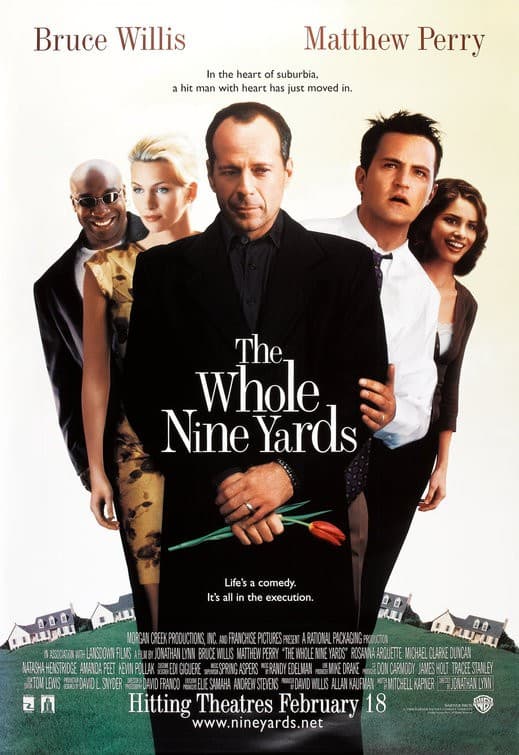
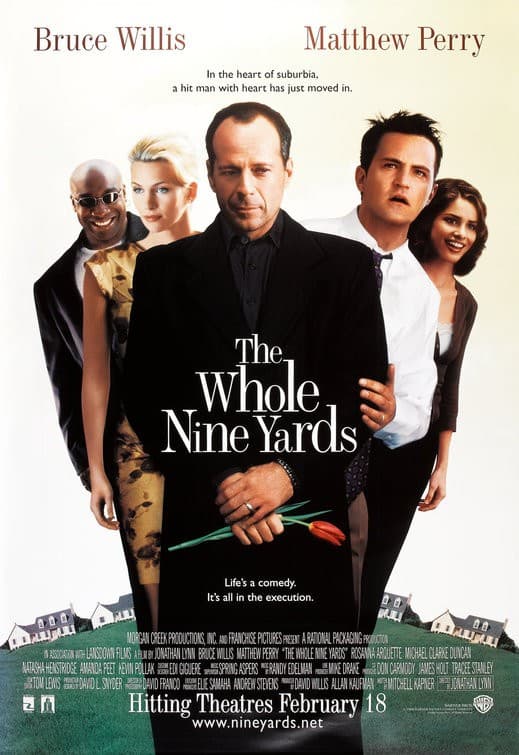
Mild-mannered Montreal dentist Nicholas "Oz" Oseransky learns that his new neighbor is Jimmy "The Tulip" Tudeski, a notorious Chicago hitman in witness protection. As Oz's wife schemes for the bounty on Jimmy's head, Oz finds himself navigating a tangled comedic web of double-crosses involving multiple mob families.
What Is the Budget of The Whole Nine Yards (2000)?
The Whole Nine Yards (2000), directed by Jonathan Lynn and distributed by Warner Bros. Pictures, was produced on a reported budget of $41,300,000. The mob comedy was co-financed by Morgan Creek Productions, Franchise Pictures, and Lansdown Films, with Warner Bros. handling worldwide theatrical release. Mitchell Kapner wrote the screenplay as an original spec script, which sold competitively in the late 1990s.
Bruce Willis and Matthew Perry headlined the cast, with Perry taking time off from Friends to film the project during his summer 1999 hiatus. The supporting cast included Natasha Henstridge, Amanda Peet, Rosanna Arquette, Michael Clarke Duncan, and Kevin Pollak. The mid-range budget reflected the project's positioning as a star-driven adult-audience comedy, capitalizing on the post-Pulp Fiction wave of darkly comic crime films.
Key Budget Allocation Categories
The $41,300,000 budget was distributed across these core production areas:
- Above-the-Line Talent: Bruce Willis, at the height of his post-Sixth Sense box-office leverage, commanded a substantial fee. Matthew Perry, anchoring the comic-lead role during his Friends prime, also commanded star-tier compensation. The combined lead cost anchored the largest single line item.
- Montreal Location Shoot: Principal photography took place primarily in Montreal, Quebec, with the production using Canadian tax incentives to anchor an extended studio and location shoot. The Canadian dollar exchange rate at the time provided additional cost efficiency.
- Director and Production Team: Jonathan Lynn, known for My Cousin Vinny (1992) and The Distinguished Gentleman (1992), commanded a feature-director rate. DP David Franco and composer Randy Edelman (with additional music by Gary Gold) headed the technical departments.
- Stunts and Action Sequences: The film features multiple action-comedy set pieces, including a yard-altering home invasion sequence and several gun-play moments. Stunt coordinator Daniel Bernhardt oversaw the physical comedy and action choreography.
- Score and Music Licensing: Randy Edelman composed the score with additional music by Gary Gold. The soundtrack budget included licensing of contemporary popular music selections.
- Marketing and Distribution: Warner Bros.' P&A spend was estimated at approximately $30,000,000 to $40,000,000, with a marketing campaign positioning the film around the Bruce Willis-Matthew Perry pairing and the dark mob-comedy premise.
How Does The Whole Nine Yards' Budget Compare to Similar Films?
At $41,300,000, The Whole Nine Yards sat in the standard range for late-1990s and early-2000s mob comedy productions:
- Analyze This (1999): Budget $30,000,000 | Worldwide $176,900,000. Warner's previous-year Robert De Niro and Billy Crystal mob comedy cost 27% less than The Whole Nine Yards and earned $70,000,000 more worldwide, providing the studio template the new film hoped to extend.
- Mickey Blue Eyes (1999): Budget $20,000,000 | Worldwide $54,300,000. Castle Rock's Hugh Grant mob comedy cost less than half and earned roughly half, illustrating the financial floor for the sub-genre.
- The Whole Ten Yards (2004): Budget $40,000,000 | Worldwide $26,200,000. Warner's sequel to The Whole Nine Yards cost roughly the same and flopped, providing a cautionary contrast to the original's commercial success.
- Get Shorty (1995): Budget $30,000,000 | Worldwide $115,100,000. MGM's previous Elmore Leonard mob comedy cost 27% less and earned slightly more worldwide, offering a thematically adjacent commercial twin.
The Whole Nine Yards Box Office Performance
The Whole Nine Yards opened on February 18, 2000, debuting at number one with $13,716,070 over its opening weekend. The film held strongly through its theatrical run. The financial breakdown:
Box Office Breakdown
The Whole Nine Yards (2000)

The Whole Nine Yards returned approximately $1.31 to $1.49 in worldwide theatrical revenue for every $1 invested. The domestic share of the gross was $57,262,492 against an international share of $49,109,159, a balanced 54/46 split that reflected the property's broad appeal across English-speaking and European markets. Warner Bros. recouped further through home video, cable, and television syndication. The commercial success led directly to the 2004 sequel The Whole Ten Yards, which failed to replicate the original's performance.
The Whole Nine Yards Production History
Mitchell Kapner wrote The Whole Nine Yards as an original spec screenplay, which sold competitively during the late-1990s spec-script market. Morgan Creek Productions and Franchise Pictures secured the rights and packaged the project with Jonathan Lynn directing. Bruce Willis attached to the project early in development, providing the marquee anchor that drove the financing and distribution deal with Warner Bros.
Principal photography took place in summer 1999 primarily in Montreal, Quebec, timed to accommodate Matthew Perry's Friends production schedule (the show was on summer hiatus during the shoot). The Canadian production tax credit and the favorable Canadian dollar exchange rate of the period anchored the financing structure.
The film's February 2000 release positioned it for the post-Super Bowl adult-comedy slot historically successful for star-driven dark comedies. Warner Bros. opened the film at number one against modest competition, and strong word of mouth carried the picture through several profitable weeks. The success prompted Warner's greenlight of The Whole Ten Yards sequel, released four years later.
Awards and Recognition
The Whole Nine Yards received no major awards recognition. The film was not nominated at the Golden Globes or the Academy Awards. It received nominations at the Teen Choice Awards in popular-vote categories tied to the Matthew Perry pairing.
Amanda Peet, in a breakout supporting role as a homicidal dentist, drew significant industry attention and was nominated for the Online Film Critics Society Award for Best Breakthrough Performance. Her performance accelerated her transition from television (Jack & Jill) to leading-actress feature work in the years that followed.
Critical Reception
The Whole Nine Yards received mixed reviews. The film holds a 47% approval rating on Rotten Tomatoes based on 121 critic reviews, with a critical consensus that praised the ensemble chemistry but found the film's comedic and dramatic registers uneven. On Metacritic, the film scored 47 out of 100, indicating mixed or average reviews.
Roger Ebert awarded the film three stars out of four, writing that "Perry has a comic gift for nervous frustration that the film exploits with affection," and praising the supporting work of Amanda Peet. The New York Times called the film "an amiable, light entertainment that benefits from a strong ensemble," while Variety found it "pleasantly diverting if structurally awkward." Bruce Willis and Matthew Perry's chemistry drew the strongest individual notices, with Amanda Peet's breakout supporting performance receiving particular attention. The combined critical and commercial response framed the film as a successful adult-comedy programmer rather than a prestige effort.
Frequently Asked Questions
How much did it cost to make The Whole Nine Yards (2000)?
The reported production budget was $41,300,000. The film was co-financed by Morgan Creek Productions, Franchise Pictures, and Lansdown Films, with Warner Bros. Pictures handling worldwide theatrical distribution.
How much did The Whole Nine Yards earn at the box office?
The film grossed $57,262,492 domestically and $49,109,159 internationally, for a worldwide total of $106,371,651. It opened to $13,716,070 in the United States, debuting at number one on the weekend of February 18, 2000.
Was The Whole Nine Yards profitable?
Yes. Against a $41,300,000 production budget and an estimated $30,000,000 to $40,000,000 in marketing spend, the film returned approximately $1.31 to $1.49 in worldwide gross for every $1 invested. Warner Bros. recouped further through home video, cable, and television syndication, and the commercial success led directly to the 2004 sequel.
Who directed The Whole Nine Yards?
Jonathan Lynn directed the film, working from Mitchell Kapner's original screenplay. Lynn was previously known for My Cousin Vinny (1992) and The Distinguished Gentleman (1992).
Who is in the cast of The Whole Nine Yards?
Bruce Willis plays Jimmy "The Tulip" Tudeski and Matthew Perry plays Nicholas "Oz" Oseransky. The supporting cast includes Natasha Henstridge, Amanda Peet (in a breakout role), Rosanna Arquette, Michael Clarke Duncan, Kevin Pollak, and Harland Williams.
Where was The Whole Nine Yards filmed?
Principal photography took place in summer 1999 primarily in Montreal, Quebec, timed to accommodate Matthew Perry's Friends production schedule (the show was on summer hiatus during the shoot). The Canadian production tax credit and the favorable Canadian dollar exchange rate of the period anchored the financing structure.
Is The Whole Nine Yards based on a true story?
No. The film is based on an original spec screenplay by Mitchell Kapner, which sold competitively during the late-1990s spec-script market. The dark mob-comedy premise was an original creation rather than an adaptation.
Was there a sequel to The Whole Nine Yards?
Yes. Warner Bros. released The Whole Ten Yards in 2004 with the original cast returning. The sequel cost approximately $40,000,000 and earned only $26,200,000 worldwide, failing to replicate the original's commercial success.
How did The Whole Nine Yards compare to Analyze This?
Warner's previous-year Robert De Niro and Billy Crystal mob comedy Analyze This (1999) cost $30,000,000 and earned $176,900,000 worldwide. The Whole Nine Yards cost 38% more and earned approximately $70,000,000 less worldwide, but still posted strong theatrical profitability and led to a sequel.
What did critics think of The Whole Nine Yards?
The film received mixed reviews, with a 47% approval rating on Rotten Tomatoes and a 47 out of 100 Metacritic score. Roger Ebert awarded the film three stars out of four. Bruce Willis and Matthew Perry's chemistry drew the strongest individual notices, with Amanda Peet's breakout supporting performance receiving particular attention.
Filmmakers
The Whole Nine Yards (2000)

Build budgets like this one in Saturation
Start from an industry-standard feature film template, import the schedule and rates you already have, and let the cost report keep itself current as you spend. Real-time collaboration, no spreadsheets.